Milton Keynes is definitely an electric vehicle hub, probably the leading EV city in the UK. It has lots of charge points and they are usually at least half full.
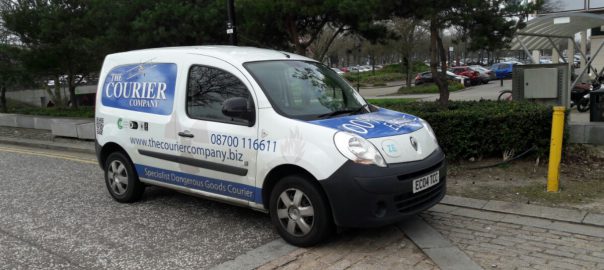
However, although you see tons of electric cars around the place, electric vans are still unusual. It was a treat, therefore, to see a Renault Kangoo ZE van delivering to the shopping centre.
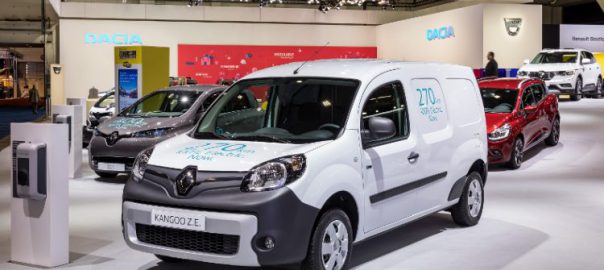
As promised, Renault has introduced a new larger battery equipped Kangoo Z.E. with up to 50% more range.
And while we are happy to see the upgraded “ZE 33” model, and its 33 kWh pack (instead of 22 kWh), the vans battery stills looks tiny as compared to the recently updated ZOE with a 41 kWh pack.
Renault Kangoo Z.E. 33 (33 kWh)
Renault pegs the new Kangoo ZE 33 at a range of 270 km/167 miles under the NEDC rating system, which translates to about 200 km/125 miles in ‘real world’ driving conditions.
The Z.E. 33 is shared with new Master Z.E. heavy commercial van.
Renault lineup – from left Twizy, ZOE, Kangoo Z.E., Master Z.E.
Renault has also utilized a new electric motor found originally on the ZOE R75/90, rated at 60 hp (44 kW), and has replaced the original (and fairly weak) charging system. The new Kangoo ZE can charge at near twice the rate of the previous version – up to 7 kW.
As you can see, the 7 kW charging capability still isn’t near on par with the 22 kW charging found in ZOE.
Anyway, the new Kangoo Z.E. is still far better then the previous version, so perhaps we should not be too critical. Renault promises the “ZE 33” will be available on the European market from mid-2017.
Britain’s low carbon energy revolution is actually saving money for households, a report says.
Blades Being Installed on a Wind Turbine at Yelvertoft Wind Farm (Image: T. Larkum)
Households make a net saving of £11 a month, according to analysis from the Committee on Climate Change.
It calculates that subsidies to wind and solar are adding £9 a month to the average bill, but that rules promoting energy efficiency save £20 a month.
Savings
The trend is being driven by government and EU standards for gas boilers and household appliances like fridges and light bulbs. These bring down carbon emissions and bills at the same time.
It means households don’t need to try specially hard to reduce energy usage – it just happens when they replace their old freezer.
The report says bills are about £115 lower in real terms since the Climate Change Act in 2008, having risen around £370 from 2004 to 2008 as international gas prices rose.
Gas and electricity use have been cut by 23% and 17% respectively, saving the average household £290 a year.
Many of the easy savings on highly inefficient devices have already been made, but the committee says it has been assured by manufacturers that more can be done.
The authors predict an annual bill reduction of £150 by 2030, driven by a mass switch to LED lights, and full take-up of more efficient condensing gas boilers.
This, they say, would more than compensate for another £100 a year rise from increased renewables deployment.
“What’s interesting, is that people aren’t having to strive to make these savings. They could save much more energy if they consciously set about it.”