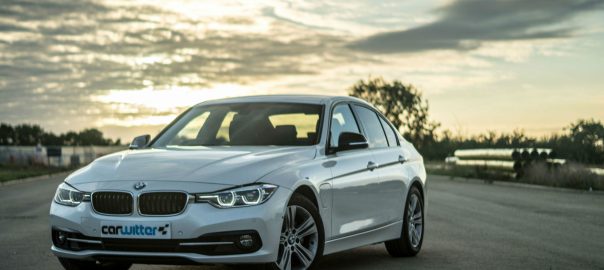
When I first received the 330e to test for a week I was pondering the purpose of a plug in hybrid. Why would you plug your car into the mains when it has a perfectly good 2 litre turbo charged petrol engine up front?!
BMW 330e (Image: CarWitter)
I had thought to myself that I wouldn’t bother plugging it in at all. But the novelty factor won me over.
Plugging the fossil fuelled beemer into the mains felt strange, but after 3 hours the thing was pretty much charged.
The next day I drove to and from work using no fuel at all. I was sold.
Blink and you missed the announcement. But last Friday, the UK’s much criticised energy supply grid system entered what is being seen as a “new era” with the announcement that eight large battery systems are being built to cope with the growing influx of wind and solar power.
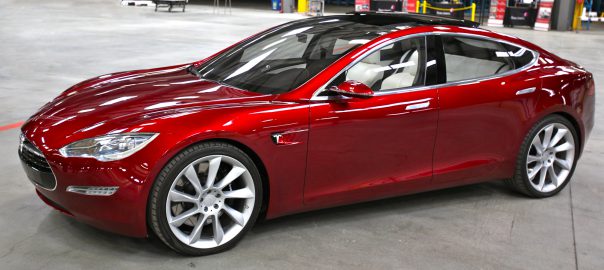
Tesla Model S
The deal – the largest of its kind in Europe – will see seven companies, including Sweden’s Vattenfall and UK-based Renewable Energy Systems, install eight lithium-ion battery systems around Britain.
“This is the single largest contract in Europe we’ve ever seen for storage and the largest of its kind globally since August last year,”
said Logan Goldie-Scot, head of energy storage at the Bloomberg New Energy Finance research group told the Financial Times.
Storing electricity in batteries has long seen as the “holy grail” for renewables as battery storage of electricity helps to supply power on the days that the wind is not blowing or the sun is not shining.
And the move is aimed at helping the UK cope with the growing prevalence of renewables, which now account for a quarter of UK electricity generation, up from 9 per cent in just five years.
If renewables can provide electricity to the grid which can be stored when demand is needed it will help the electric car revolution that is taking place. Just as the electricity supply network needs storage in batteries so do electric cars, and it is a shortage of batteries which is threatening to keep the price of electric vehicles high for the time being.
But Tesla is changing the game on electric vehicles, a subject explored in today’s Financial Times, which asks what it calls a profound question: “Could electric cars ever cut the world’s thirst for oil enough to depress crude prices significantly?”
Many things have gotten harder as the world settles into a protracted spell of low oil prices and sluggish growth — from avoiding deflation to creating jobs. One thing has gotten easier, as well as more urgent: eliminating fossil-fuel subsidies.
At these prices, who can refuse? (Image: G. Osodi/Bloomberg)
Governments have long paid lip service to this idea. The G-20 has been promising to phase out fuel subsidies since 2009, but the measures remain widespread and resilient.
Nations from the U.S. to the U.K. to Russia continue to spend billions on tax breaks and other subsidies for the production of oil, gas and coal. Japan, South Korea and China support massive fossil-fuel projects outside their borders. For years, many countries — including some of the world’s biggest energy producers — have also used subsidies to lower gasoline and diesel prices, supposedly to help the poor.
The sums involved are huge. The International Energy Agency estimates that countries spent $493 billion on consumption subsidies for fossil fuels in 2014. The U.K.’s Overseas Development Institute suggests G-20 countries alone devoted an additional $450 billion to producer supports that year.
These ridiculous outlays would be economically wasteful even if they didn’t also harm the environment. They fuel corruption, discourage efficient use of energy and promote needlessly capital-intensive industries. They sustain unviable fossil-fuel producers, hold back innovation, and encourage countries to build uneconomic pipelines and coal-fired power plants. Last and most important, if governments are to have any hope of meeting their ambitious climate targets, they need to stop paying people to use and produce fossil fuels.
Elon Musk inadvertently spawned a subculture that’s hacking the Model S into a 21st century tent.
Camping in a Tesla Model S (Image: T. Randall)
As the sun set beyond the long-needle pines and emerald waters of Lake Tahoe, I looked across the campfire and laughed out loud. I was about to go “camping” in the back of a $145,000 electric car because, well, it’s become a thing.
Tesla “Camper Mode,” as it’s often called, may not be sanctioned by the company, but a community of drivers is devoted to the practice. There are forums and YouTube videos that praise the virtues of Tesla camping and explore the hacks you’ll need to make it work. There’s even a third-party Tesla car app, with a “Camp Mode” function that will optimize the car’s systems for a good night’s sleep. This is a quirky, little Tesla subculture, and of course I had to try it myself.
I know what you’re thinking (because it was my first thought, too): Why would someone who can afford a Tesla need to bed down inside one? The last time I slept in a car was on a college road trip from Iowa to Florida, and it was a night of eternal torment, with cramped seats, suffocating heat, and mosquitoes that swarmed when we cracked the windows. Who would choose that again?
But Tesla camping promised something different. The sapphire blue Model S I was driving for the week has a 90 kilowatt hour battery—the largest you can find in a car on the road today. In theory, it should be able to handle a night of climate control and HEPA-level air filtration without much limiting of the vehicle’s range. Also, electric cars are virtually silent and release no tailpipe emissions (they don’t have tailpipes) so they won’t suffocate the camper or disturb the local fauna. As for the Model S’s panoramic glass roof, well, no tent can compete with that.
Warning: preg_match(): Compilation failed: invalid range in character class at offset 4 in C:\inetpub\vhosts\fuelincluded.com\httpdocs\wp-content\plugins\maxbuttons\assets\libraries\simplehtmldom\simple_html_dom.php on line 1389
Warning: preg_match_all(): Compilation failed: invalid range in character class at offset 4 in C:\inetpub\vhosts\fuelincluded.com\httpdocs\wp-content\plugins\maxbuttons\assets\libraries\simplehtmldom\simple_html_dom.php on line 694
Warning: foreach() argument must be of type array|object, null given in C:\inetpub\vhosts\fuelincluded.com\httpdocs\wp-content\plugins\maxbuttons\assets\libraries\simplehtmldom\simple_html_dom.php on line 701
Warning: preg_match_all(): Compilation failed: invalid range in character class at offset 4 in C:\inetpub\vhosts\fuelincluded.com\httpdocs\wp-content\plugins\maxbuttons\assets\libraries\simplehtmldom\simple_html_dom.php on line 694
Warning: foreach() argument must be of type array|object, null given in C:\inetpub\vhosts\fuelincluded.com\httpdocs\wp-content\plugins\maxbuttons\assets\libraries\simplehtmldom\simple_html_dom.php on line 701