The electric vehicle market is set to grow quickly, but so far there has been no consensus on the ‘second-life’ of the used EV batteries.
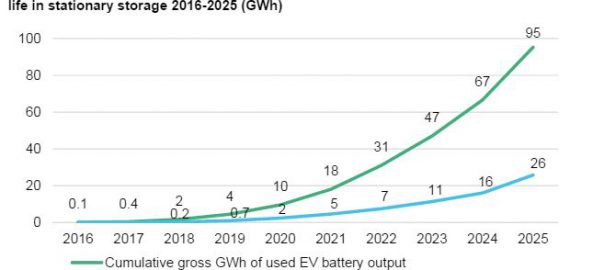
In this report, senior analyst Claire Curry has compiled the first data and shows that low-cost energy storage could be here sooner than previously thought.
She projects:
There will be 29 GWh of used EV batteries coming out of cars in 2025. This far exceeds the size of the current stationary storage market.
Of this, almost a third will get a second life as stationary storage. (10GWh)
Today, a new stationary storage system can cost up to $1000/kWh. In contrast, repurposing used EV batteries could cost as little as $49/kWh in 2018, with an additional $400/kWh cost to convert to stationary.
The auto industry is divided on the issue. While Tesla won’t be involved in second life, BMW, Nissan and Mercedes Benz have second-life stationary storage projects in place.
Recently, BMW announced its second quarter and half year sales results with record number of deliveries and revenues.
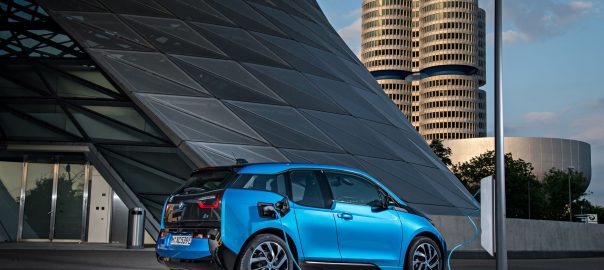
BMW i3 94Ah
One of the strong points of that report was the high demand of plug-in electric cars, which are rapidly taking over production volumes at the company.
The German manufacturer expanded its lineup to seven electrified models in Q2, which resulted in total first half sales that were 87% higher than year ago.
In total BMW delivered 23,675 all-electric and plug-in hybrid cars in the first 6 months of 2016. BMW added that by the end of July, customers had placed more than 7,000 orders for new version of the BMW i3 with its upgraded 33 kWh battery.
The pre-order demand is three times higher as compared to the launch of the i3 in 2014, and suggests that we should pretty excellent results for BMW plug-ins going forward.
“The BMW Group currently offers seven electrified models including plug-in hybrids, such as the new BMW 740e or the recently launched BMW 330e and BMW 225xe Active Tourer, and the fully electric BMW i3.
Thanks to the expanded range of electrified models, sales of this type of vehicle in the first six months of the year were just under 87% higher than the same period last year: a total of 23,675 have been delivered to customers worldwide. Furthermore, to the end of July 2016, over 7,000 orders had been received for the additional BMW i3 model with significantly extended battery range, which only celebrated its market launch in July. This is more than three times the figure of orders received for the first generation BMW i3 at the equivalent launch period.”
Nuclear energy’s cost, and a focus on alternative technology, including research on a new generation of hi-tech battery storage, is leading observers outside the green lobby to question the project’s value
Should Theresa May take the axe to the troubled Hinkley Point nuclear project, it will propel wind and solar power further into the limelight. And for renewable technologies to become really effective, Britain and the rest of the world need breakthroughs in electricity storage to allow intermittent power to be on tap 24/7, on a large scale and for the right price.
Cheap, light and long-life batteries are the holy grail, and achieving this requires the expertise of people like Cambridge professor Clare Grey. The award winning Royal Society fellow is working on the basic science behind lithium-air batteries, which can store five times the energy in the same space as the current rechargeable lithium-ion batteries that are widely used today.
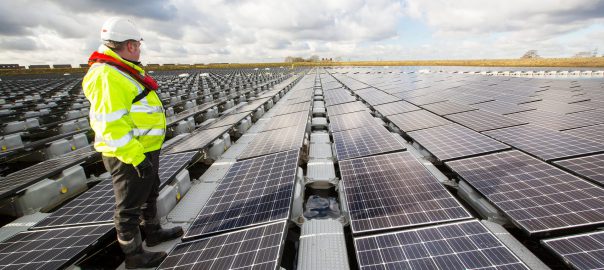
The floating solar farm on Godley Reservoir near Manchester (Image: A. Cooper/Guardian)
She is also focusing on sodium-ion and redox flow batteries; the latter store power in a liquid form, contained in vats or tanks that in theory can easily be scaled up to power-grid sizes.
“There has been an amazing transformation in this field. There is an explosion of interest and I am extremely lucky to have decided early on to concentrate on this area,”
she says, although she is keen to play down the idea that a eureka moment is just around the corner.
She is also thankful for Hinkley – if only because of the government’s long-term funding deal with EDF Energy that it gave rise to.
“It has put a price on [future] electricity in the market which is high, and this has potentially opened up further commercial space for new technologies such as batteries. But independent of Hinkley we do need better batteries and my chemistry will hopefully help find them,” she says.
The wisdom of bringing in the Chinese to help EDF, the French state-owned utility company, construct the proposed new Somerset reactors has been highlighted as a key factor behind the government’s reluctance to push the go button.
But ministers are also aware that, in the last 18 months, many experts in the field have concluded that the biggest argument against the plant is not that it is too expensive, at £18.5bn, but that the kind of “on-all-the-time” power it delivers is no longer what is required.
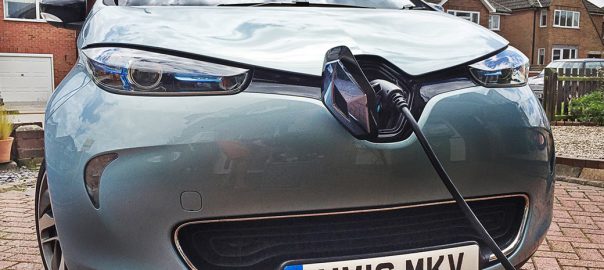
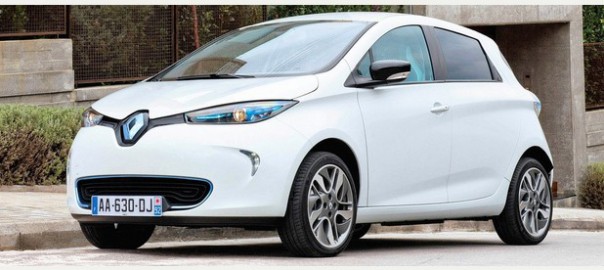
Month 3 running a Renault Zoe: the cure for range anxiety
It’s funny how your perceptions of things change through necessity. In a car burning dead dinosaurs I get a bit nervy when the fuel gauge reports that there’s less than 50 miles in the tank.
Now that I’m motoring like the Jetsons, if the Zoe’s range is anywhere above 20 I’m cruising along with barely a care in the world. Range anxiety? Not a chance. It shows that when you only have about 80 or so miles to play with, you soon recalibrate your idea of what is acceptable, not least because mileage in an electric car seems a much more precise figure. If there’s six miles left, you’ve got six miles and it seems to click down at a regular rate, whereas in a dinosaur car you might have six, or three suddenly, or 56.
Some of this certainty is down to Renault’s excellent range predictor, which learns the more you drive. So when I started it didn’t reckon much above 70 miles was possible, but the more time I spend in Eco mode, which limits the power of the air-con (which I switch off a lot anyway), slows the throttle response and doesn’t let you go above 60mph, the more optimistic it has become. My range is now up to 87 miles with a full charge.
Warning: preg_match(): Compilation failed: invalid range in character class at offset 4 in C:\inetpub\vhosts\fuelincluded.com\httpdocs\wp-content\plugins\maxbuttons\assets\libraries\simplehtmldom\simple_html_dom.php on line 1389
Warning: preg_match_all(): Compilation failed: invalid range in character class at offset 4 in C:\inetpub\vhosts\fuelincluded.com\httpdocs\wp-content\plugins\maxbuttons\assets\libraries\simplehtmldom\simple_html_dom.php on line 694
Warning: foreach() argument must be of type array|object, null given in C:\inetpub\vhosts\fuelincluded.com\httpdocs\wp-content\plugins\maxbuttons\assets\libraries\simplehtmldom\simple_html_dom.php on line 701
Warning: preg_match_all(): Compilation failed: invalid range in character class at offset 4 in C:\inetpub\vhosts\fuelincluded.com\httpdocs\wp-content\plugins\maxbuttons\assets\libraries\simplehtmldom\simple_html_dom.php on line 694
Warning: foreach() argument must be of type array|object, null given in C:\inetpub\vhosts\fuelincluded.com\httpdocs\wp-content\plugins\maxbuttons\assets\libraries\simplehtmldom\simple_html_dom.php on line 701