In April 2016, Jess Shanahan drove 2,500 miles across England, Wales, Scotland and Ireland in an electric car – through cities, villages, national parks and more. Here, Jess shares her experiences and encounters of driving Route 57, the Great British & Irish Road Trip.
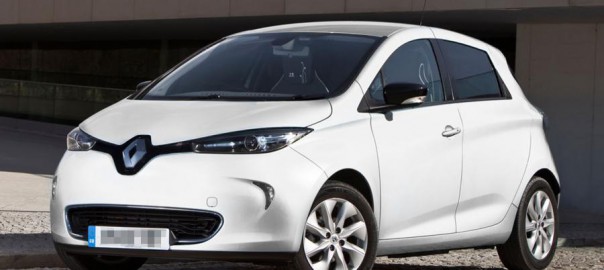
There has been a rumour circulating for a while that the ZOE will go up in price soon. It seemed credible as the current prices have held since the start of July, and the final sales quarter of the year is approaching.
Anyway, we were informed officially today that it’s true, and prices will go up from 1st October.
While we don’t know the full details of the change we know that it will impact the most popular model, the Dynamique Nav (but not the Expression) and that it will add about £350 onto the price of the car. We expect that to equate to about £15 per month on a 2 year PCP.
Renault has made it clear that it will honour the current lower prices on all orders received by 30th September. So, if you’re considering getting a ZOE, do give us a call (07920-790600) or drop us an email (sales@fuelincluded.com). Otherwise you could be kicking yourself in a few weeks’ time.
Annual Mileage
Monthly Cost (£990 Deposit)
Monthly Cost (£500 Deposit)
Fuel Included Miles
3,000
£175
£196
All
5,000
£199.60
£221
All
6,000
£203
£223
10,000
7,500
£207
£227
10,000
9,000
£218
£239
10,000
10,500
£230
£251
10,000
12,000
£243
£263
10,000
15,000
£266
£287
10,000
The other benefits of the deal remain the same, including the free installation of a charge point. As ever the car comes with 10,000 miles of fuel included, plus support, free tax, and in many places free parking.
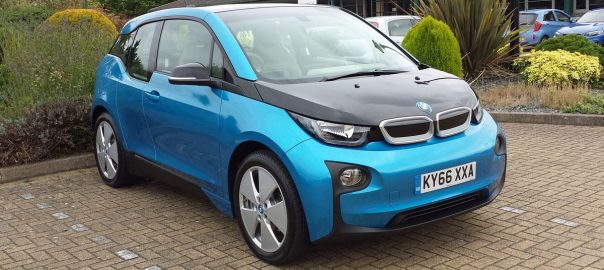
Following our family’s successful test drive of an i3 we decided to order one, and I looked around for a good deal. I contacted the dealer closest to my work in Milton Keynes but the only deal they could offer us was very expensive (ca. £600 per month).
Online there was a mix of offers available, most at very high prices but a couple at a good price. I researched these further and settled on a particularly attractive Personal Contract Hire (PCH) lease deal. I eventually took one, for a base i3 but with Loft interior and optional wood dash.
My first glimpse of our new i3 (Image: T. Larkum)
All of this took place about the time of, and was prompted by, the launch by BMW of the i3 version known as a ‘94Ah’ (because its new battery cells have a higher capacity than the old 60Ah ones). We are therefore receiving one of the first examples of this longer-range i3 to be produced, and the i3 was on the shortlist to follow our ZOE precisely because of the increase in range it would provide.
Our new i3 in the showroom (Image: T. Larkum)
I was surprised but pleased to learn that although the car would be on lease, it could be supplied through our local dealer (closest to home), Wollaston BMW in Northampton. That was particularly appropriate as that was where we had our test drive.
Nearly time to go… (Image: T. Larkum)
After waiting was seemed like ages (but was actually only a couple of months) I went and collected the car last Friday. There was a minimum of paperwork but a long and detailed handover in the showroom covering all the main points of operating the car (my thanks go to Ben at Wollaston for his patience and attention to detail).
Sitting outside the office (Image: T. Larkum)
I then drove it out of the showroom and straight to the office in Milton Keynes. There I didn’t even get to sit down before I was asked to do test rides, and eventually took out a dozen people. It was no hardship, though, as it’s such a pleasure to drive.
I’m loving the new i3 and haven’t stopped smiling since I picked it up!
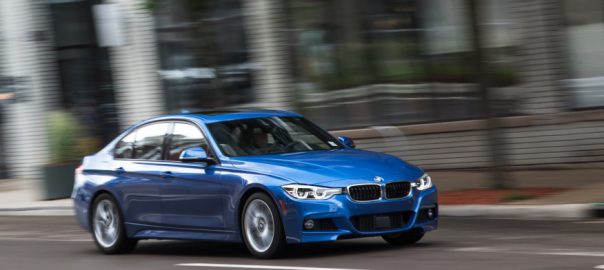
A dip in the Toyota Prius pool might elevate your state of environmentally responsible bliss, but surely you’d miss the driving joy that hybrids sacrifice to trim their CO2 footprints. Good news: Salvation has arrived in the form of a plug-in-hybrid sedan that’s actually fun to drive. The 2016 BMW 330e sedan tested here exploits lessons learned from BMW’s i3 and i8 models (now part of the iPerformance sub-brand, along with plug-in-hybrid versions of the standard cars) to resolve the classic rub between low consumption and high performance.
This green edition of the world’s bestselling luxury sedan is expensive, with a starting price of $44,695, but it’s sure to be a hit with those interested in saving the planet without resorting to public transit.
The powertrain components are a 180-horsepower 2.0-liter turbocharged inline-four in the usual underhood location, teamed with an eight-speed automatic transmission and an 87-hp electric motor/generator. The AC power provider replaces the torque converter inside the ZF 8HP gearbox. Computer-controlled servos and clutches provide manual and automatic command over gear ratios and three different propulsion modes. A 7.6-kWh air-cooled lithium-ion battery lives unobtrusively under the trunk floor, while the 10.8-gallon gas tank rests beneath the rear seat.
To experience the joys of combustion-free driving, simply punch the eDrive button on the console to engage the Max eDrive mode. After an initial driveline shudder, there’s barely a whisper as the car motors toward the future. As more city centers around the globe ban vehicles that produce tailpipe emissions, this mode will be an excellent means of maintaining personal mobility. With gentle accelerator pressure, the iPerformance will motor up to a top speed of 75 mph for a maximum of 14 miles, according to BMW, assuming the battery was fully charged at the start. When the driver inevitably grows weary of turtle mode, pressing deeper on the accelerator pedal—say, to execute a safe pass—automatically fires up the turbo four-cylinder. This occurs so smoothly that the transformation is revealed more by the swing of the tach needle than by any engine rumble.
Mode two, called Auto eDrive, is the default setting. The only difference from the Max setting is that the baton passes from electric propulsion to engine power at 50 mph.
Sales of electric cars continue to break records with the announcement by Go Ultra Low that more plug-in vehicles have been sold in the first half of 2016 than at any other half-way point. Electric car registrations are up almost a third compared to January – June last year at 31.8 per cent.
Electric cars can be a very effective way to save you money on motoring (Image: Go Ultra Low)
In 2015, it took another three months to reach this year’s 19,252 registrations, 4,640 units ahead of the same point in 2015, with that figure not reached until September last year. Also Q2 2016 is the 22nd consecutive quarterly rise for new plug-in car sales.
Records begin in 2011 when the UK Government introduced the Plug-in Car Grant (PiCG), offering electric car buyers an incentive to go green. Sales have continued to rise despite a change to the grant system that came into place in March 2016, which saw the original £5,000 subsidy for eligible vehicles – both pure electric (EV) and plug-in hybrid (PHEV) – halved for PHEVs and dropped by £500 for EVs.
The strong start to 2016 sees sales of PiCG eligible cars sit around the 70,000 mark. Transport Minister John Hayes said:
“I am delighted to see record numbers of motorists coming round to the benefits of cleaner, greener vehicles, which are also cheaper to run. The low-emission sector supports over 18,000 UK jobs and is a key pillar in our ambition for a low carbon, high tech and high skills economy.
“We want to make the UK a world leader in electric vehicle uptake and manufacture, to ensure that by 2050 every car and van on our roads is a zero emission vehicle. We are backing this with one of the most comprehensive support packages in the world, with more than £600m of government investment to help grow the UK market.”
Poppy Welch, Head of Go Ultra Low – the campaign backed by government and vehicle manufacturers to promote ultra low emission vehicles (ULEVs) – said:
“The continued growth in uptake of electric cars speaks for itself as registration records continue to be broken by motorists encouraged by the benefits electric motoring can bring.
“As awareness grows and motorists see the wide variety of vehicles already on UK roads coupled with benefits such as running costs from as little as 2p per mile, more drivers than ever are becoming motivated to go green. Since the introduction of the Plug-In Car Grant was introduced in 2011 the variety of electric models has expanded significantly, notably so in the past two years, giving motorists more choice than ever before.”
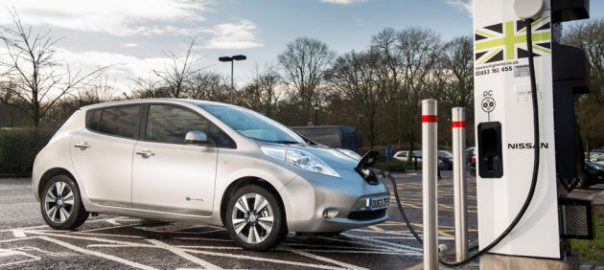
There will be more public EV charging locations than petrol stations by August 2020 according to market analysis by leading electric vehicle manufacturer Nissan.
Predictions see the UK at a tipping point for EV drivers
Using information from Zap-Map and the Energy Institute – for charging locations and fuel stations respectively – expectations are that in four year’s time EV’s will have an easier time than petrol or diesel cars in finding a refuelling point. Nissan’s workings are based on the fact that petrol stations continue to close, with less than 25 per cent open compared to four decades ago, while charging points continue to be installed across the country.
At the end of 2015, there were 8,472 fuel stations open in the UK – down from 37,539 in 1970. Nissan has assumed a steady rate of decline, which will see that number fall to less than 7,870 by August 2020. Considering that there were 3,646 charging points at the same point – with more than 4,100 today – when compared to 913 at the end of 2012, the upwards trajectory for charge points and decline of the petrol station are set to meet in 2020.
Edward Jones, EV Manager, Nissan Motor (GB) Ltd, said:
“As electric vehicle sales take off, the charging infrastructure is keeping pace and paving the way for convenient all-electric driving. Combine that with constant improvements in our battery performance and we believe the tipping point for mass EV uptake is upon us.
“As with similar breakthrough technologies, the adoption of electric vehicles should follow an ‘S-curve’ of demand. A gradual uptake from early adopters accelerates to a groundswell of consumers buying electric vehicles just as they would any other powertrain.”
While the majority of charging is down at the home and work, public charging points are crucial to everyday EV use too. Around 98 per cent of the UK motorway network is covered with charge points as service stations, and new units are being installed all the time.
London’s Mayor Sadiq Khan has announced that London’s new Ultra Low Emission Zone (ULEZ) could be introduced as early as 2019 in the latest attempt to reduce air pollution across the capital.
Fully electric vehicles will be exempt from paying the future ULEZ charge
This will be a year earlier than previously anticipated, with the roll-out initially focused on inner London, before expanding to both the North and South Circular starting from 2020.
Mr Khan stated:
“Just as in the 1950s, air pollution in London today is literally killing Londoners. But unlike the smoky pollution of the past, today’s pollution is a hidden killer.
“The scale of the failure to tackle the problem is demonstrated by the failure of the Government and the previous Mayor to meet legal pollution limits. Urgent action is now needed to ensure Londoners no longer have to fear the very air we breathe.”
Dr Ben Lane, Director of Next Green Car added:
“If we are to significantly improve air quality in our country’s cities and towns, we need just this type of bold and visionary measure. It is for this reason that we fully back the new London Mayor’s announcement to both widen the area of the planned Ultra Low Emission Zone and also to implement it well before 2020.
“We do, however, raise on note of caution as the proposed ULEZ standards are highly complex and may lead to confusion as to which vehicles are exempt from paying the charge. In addition, it is not immediately clear on TfL’s information website that all fully electric vehicles will be exempt from paying the ULEZ charge as they are for the existing Congestion Charge.”
Personal automobiles have given hundreds of millions of people the great luxury of a convenient and comfortable mode of transportation.
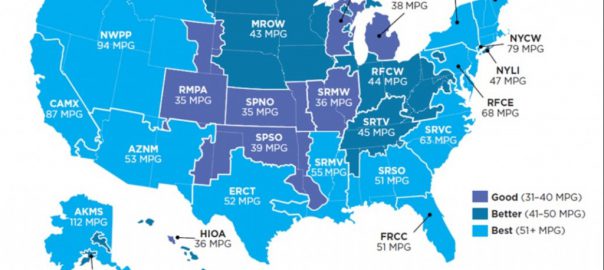
Electric-car wells-to-wheels emission equivalencies in MPG, Sep 2015 (Image: Union of Concerned Scientists)
But there’s no escaping that manufacturing these vehicles, driving them for 10 years or more, and then disposing of them creates pollution that has a wide range of negative impacts.
As advocates and some governments push for more plug-in electric cars, that poses a valid question: what’s the total emission impact of driving a vehicle that plugs into the grid for its energy?
Over the last five years, electric vehicles have become a target for some who are not convinced that they will lead to less pollution.
Two different types of emission need to be considered. First, there is carbon dioxide (CO2), a climate-change gas.
Second are what the EPA calls criteria pollutants: other toxic substances that come out of the tailpipes of vehicles with combustion engines—and out of the smokestacks of any electric powerplant that burns any hydrocarbon fuel.
The CO2 question is more easily answered. Studies by numerous groups indicate that electric vehicles recharged on most North American grids are, at minimum, cleaner than almost any gasoline or diesel vehicle.
The Government must disincentivise diesel vehicles with a view to phasing them out altogether if air quality is to meet guidelines, a new report finds.
The report finds that even if London returned to the lowest recorded level of diesel car ownership in the UK, it would still not comply with World Health Organisation guidelines and UK law by 2025
The ‘Lethal and Illegal’ research, published by Greenpeace, in partnership with the Institute for Public Policy Research (IPPR), uses new modelling based on transport emissions and air pollution data undertaken by King’s College which reveals that, even if London were to return to the lowest recorded level of diesel car ownership in the UK (around 10% of the car fleet in 1995), it would still not reach compliance with World Health Organisation guidelines and UK law by 2025.
In response, the authors say that to tackle pollutants such as NO2 and PM2.5 the UK government would need to progressively reform Vehicle Excise Duty (VED) to disincentive diesel vehicles. Also, a scrappage scheme should be put in place for older diesel cars across the UK or in areas of non-compliance with air pollution laws.
Alan Andrews, lawyer for ClientEarth, which is taking the government to court over air pollution, said:
“This report should send a clear message to the UK government that an ambitious and bold Clean Air Act is needed for the whole country. It should phase out diesel across the country and accelerate the shift to zero emission transport. This would help our cities clean up their air and achieve legal limits as soon as possible. The new government must now step up and deal with this public health crisis so that the whole country can breathe cleaner air.”