Category Archives: Golf GTE

News and reviews on the Volkswagen Golf GTE plug-in car.

This car uses green technology, not just to reduce emissions, but to go faster

VW Golf GTE is perfect for polar bear-loving speed freaks

The author doesn’t seem to get the difference between a hybrid and a plug-in hybrid, but otherwise it’s not a bad review

This car uses green technology, not just to reduce emissions, but to go faster

Until recently, hybrid cars were pretty sedate affairs. They were either for celebrities to be seen in, or they were the car your Uber driver arrived in. Now that’s changing, with the latest hybrids ranging from McLaren’s £866,000 P1 supercar to a string of saloons and hatchbacks from a range of mainstream car makers.

Enter Volkswagen and the new Golf GTE. Since the 1970s, the Golf has been the goose that laid the golden egg for VW, and the latest generation, the Mk VII, is an all-round brilliant machine. The GTE is its latest incarnation.

The idea is that if the all-electric VW Golf, which has a range of around 90 miles, leaves you worrying about broken charging stations and range anxiety, this new plug-in hybrid Golf GTE will tempt you. This, then, is a fast hybrid, a kind of Greenpeace-friendly hot hatch for polar bear-loving speed freaks.

The power comes from a combination of a 148bhp turbo-charged petrol engine and a 101bhp electric motor, which when combined can push out a maximum of 201bhp. The electric motor will charge in less than four hours from a domestic socket, or in just over two hours at a rapid-charging station of the type increasingly found at motorway service stations. This combination makes the GTE quicker to 60mph than the diesel-powered Golf GTD, while at the same time offering economy and emission figures to make a Toyota Prius blush, and leaving owners with a zero road-tax bill. If your daily commute is less than 31 miles (the electric-only range) this car offers incredibly low ownership costs and you could (theoretically) never fill up the tank.

However, this will depend on which of the five different drive modes you select, ranging from pure electric “E-mode” to “GTE”, which uses the petrol and electric powers to make this green Golf very quick indeed. If you indulge in this burst of power, though, electric range will drop to nearer 20 miles and the promised economy will be impossible to attain. Critics will say that it doesn’t live-up to the true heritage of the Golf GTI and doesn’t deserve the first two letters of its name. But this car uses green technology, not just to reduce emissions, but to go faster, to make driving fun. And that’s something to be celebrated.

Source: Independent

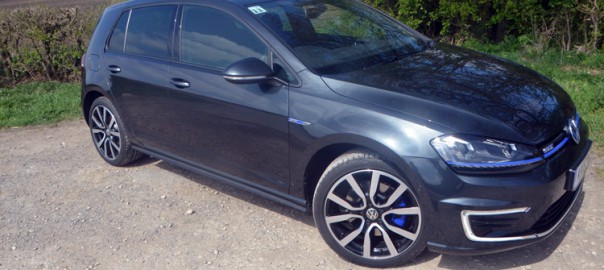
Volkswagen Golf GTE (Image: T. Larkum)

Volkswagen Golf GTE first drive: Hotting up the hybrid

You’ve heard of the Golf GTi. Now say hello to the Golf GTE. That’s E for electric, in case you were curious.

To readers of a certain age, GTE in the context of a performance car might be associated with another brand. When Pocket-lint was still in baby grows, it was Vauxhall that owned the GTE moniker, as seen stuck on the back of cars like its hot Astras.

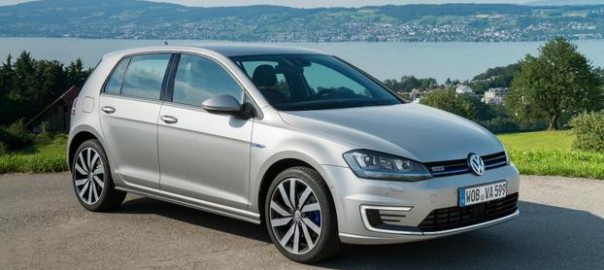
Volkswagen Golf GTE (Image: T. Larkum)

But Vauxhall’s loss is clearly Volkswagen’s gain, as it gives the German maker a neat and easy-to-understand badge strategy for its range of performance cars. So in Golf world, it’s GTi for (injection) petrol, GTD for diesel, and GTE for plug-in hybrid electric – although this isn’t a purely battery powered Golf (you’ll need an e-Golf for that).

The Golf GTE mates together a chunky battery pack that you can plug in and recharge (unlike a regular hybrid like, say, a Toyota Prius) with a 1.4 TSi petrol engine. This engine sometimes keeps itself quiet and lets the battery do all the work, sometimes works together with the battery and (if the battery’s drained) can propel the car on its own. It depends on what mode you put the car in, state of charge and so on.

The benefit to you of all this? Well, 31 miles of range on the battery alone – which VW figure is enough to get most of us to work and back each day. But then the sort of performance you get from the regular GTi when the battery and petrol motor are working together and producing their combined total power output of 204hp. In between times – and depending how often you charge the battery up, the GTE promises much greater economy than its petrol equivalent – officially, 166mpg and 39g/km of CO2.

We could bore you at length about the GTE’s numerous modes (pure electric, GTE, charge battery etc) and various degrees of super cleverness. Instead we’ll simply talk about how it drives.

Set off with e-mode pressed, and the Golf travels under the power of just its battery, so long as you keep the speed below 81mph. It’s quiet, serene and nippy without feeling outright fast in a way that so many electric cars do. Both the electric motor and engine drive through the standard 6-speed DSG automatic gearbox, but in electric mode it’s very difficult to discern any real kind of stepping, gear-changing feel. And that’s all part of the appeal. It’s a fuss-free experience.

Read more: Pocket Lint

VW Golf GTE Driven: Is It Really The GTI’s Hybrid Brother?

Imagine the lovechild of a Golf GTI with the all-electric e-Golf and you would be right on the money. The VW Golf GTE is exactly that car, offering a plug-in hybrid powertrain and the thrills of a GTI combined, at least on theory.

What’s what

As a true lovechild of its parents, the Golf GTE combines the C-shaped LED daytime running lights from the e-Golf with the GTI’s horizontal fins at the front with every detail painted blue instead of the GTI’s red, even on the iconic tartan pattern of the seats. A standard set of 18-inch wheels dressed with 225/40 tyres complete the sporty appearance of this tech-infested Golf.
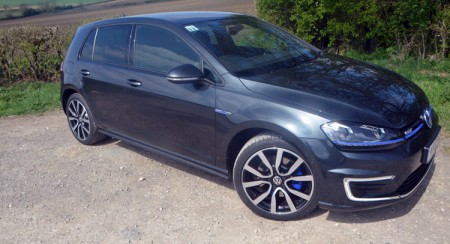
1625_2015-VW_GolfGTE_Carscoops

Under the bonnet we find a turbocharged 1.4-litre 148hp (150PS) TSI engine paired to a 101hp (102PS) electric motor integrated into the specially developed for hybrids six-speed DSG transmission. The combined output reaches 201hp (204PS) and 258lb-ft (350Nm) of torque which propel the VW Golf GTE to 62mph in 7.6 seconds and on to 138mph. But the most impressive figures claimed are about the efficiency of it: 166mpg UK (with the use of the battery, naturally) on the combined cycle and CO2 emissions of just 39g/km.

Plugged-In Details

The 8,7kWh lithium-ion battery is mounted underneath the rear seat and needs three hours and 45 minutes to be fully charged from a domestic mains outlet or two hours and 15 minutes from an optional fast charge wallbox. Depending on conditions, the all-electric range can reach up to 31 miles with the top speed limited to a more than sufficient 81mph.

The driver can choose from five different modes: E-mode, Hybrid Auto, Battery Hold, Battery Charge and GTE. As you might have guessed, the latter is the most aggressive of them all, tuning the powertrain for the best possible performance, while the Hybrid Auto mode proves to be the golden ratio between efficiency and performance.

Just Like A Tesla (Sort of)

When in E-mode, the Golf GTE feels brisk enough to tackle the usual city driving; put your right foot down and the 101hp electric motor pulls strongly the GTE in total silence, thanks to its instant torque reserves which are rated at a maximum 243lb-ft (330Nm) from a standstill with a continuous 125lb-ft (170Nm) on offer. Combine this with the direct steering and you have a fun zero-emissions car around the city. The real-world electric range is closer between 20 to 25 miles with the petrol engine stepping in when the battery levels are running low.

It’s when you take it outside the city limits that you start to really notice how smooth the driveline and how refined the collaboration between the two motors is, that makes the Golf GTE feel almost conventional, despite the crazy tech that goes under the skin. And that’s a compliment.

During our short drive on a mix of country roads and city driving we managed an average of 74mpg UK (equal to 61.6 mpg US and 3.8l/100km), which is a long way from the 166mpg UK (138mpg US or 1.7l/100km) official figure, but still remains an impressive result.

Does It Drive Like a GTI?

Not quite. Although it gives you the same, great confidence Golfs are known for, the GTE is unfortunately not the hybrid alternative of the GTI, but that’s not necessarily a bad thing. You can drive it fast and have a good time behind its wheel, especially with the GTE-mode engaged, enjoying the most balanced Golf chassis of the range due to the rear-mounted battery pack but the handling never comes close to that of the GTI’s. And there is one good reason for it: weight.

There is no escape from the inertia created by the GTE’s 1599kg kerb weight (including a 75kg driver). The battery pack alone adds 120kg to the sum, albeit it sits low in the chassis. But for the nature of it, the Golf GTE is a fun car to drive, certainly the most entertaining of the hybrids, with direct steering, solid performance and a nice ride too. You even get a miniature rev-counter for the petrol engine inside that always weird tachometer which shows whether you are draining or charging the batteries, going up and down like crazy during spirited driving.

To Sum Up

If you are looking for the same driving thrills of the Golf GTI, you’d be disappointed, but that’s more the marketing’s fault than the model itself. Because the VW Golf GTE offers one of the most capable hybrid powertrains in this price bracket, coupled with top levels of refinement and solid performance. It makes a great choice for those who want to try an electric vehicle but don’t want to suffer from the inevitable range anxiety and the usual bluntness. The main negative point is the price, with the VW Golf GTE starting at £33,085 in the UK which goes down to £28,035 after the £5,000 UK Government’s grant for plug-in vehicles and comes packed with kit, including adaptive cruise control, a 5.8-inch multimedia system and LED headlights.
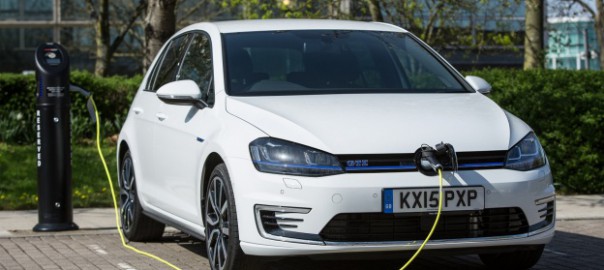
This car uses green technology, not just to reduce emissions, but to go faster

Driving the hybrid Volkswagen Golf GTE

Volkswagen finally makes a hybrid, but will it electrify you?

The Pitch

The Golf GTE is Volkswagen’s first – ha-ha! – charge into hybrid driving, a short 18 years after Toyota’s Prius first apologised onto our streets. They’re late to the party, certainly, but with a compelling sell.

The GTE pairs an 8.8kWh lithium-ion battery powering a 102PS electric motor (bolted cleverly inside the gearbox housing) with a 1.4-litre, 150PS TSI direct-injection petrol engine. Together this somehow adds up to a combined power of 204PS – hmmm – and a theoretical range of 580 miles.

The Battery

Giving a relatively titchy range of 31miles, the battery is charged via a nubbin under the front badge and should take around 3.75 hours from a domestic mains outlet, or 2.25 hours from a bespoke wall box. And here’s the big ticket number: 166. Volkswagen claims a combined cycle figure of 166mpg, while CO2 emissions should be zero in all-electric mode and 39g/km all round, so it’s expected to be exempt from VED and the Congestion Charge.

VW is desperate to position this in the same bracket as its GTi hot hatch. Hence the G and T up front. Indeed, they’re so serious about its GTi credentials they’ve even tailored the seat cloth with the brand’s iconic tartan bum-fondlers. Only in blue. Because blue’s “electric”, right?

This really is the best of all worlds: an electric runabout that’ll whizz you silently and cheaply to work – if you work reasonably nearby – while also an immensely fun hot hatch a spit off GTi performance when you marry the two engines. Wrapped in VW comfort, design skills and build quality. If the complicated engineering combination boasts VW’s legendary reliability, this is an enormously compelling vehicle.

Plus, with a £5k government electric vehicle rebate it’s £4,435 cheaper than a GTi. We know which one we’d rather have.

Read more: T3

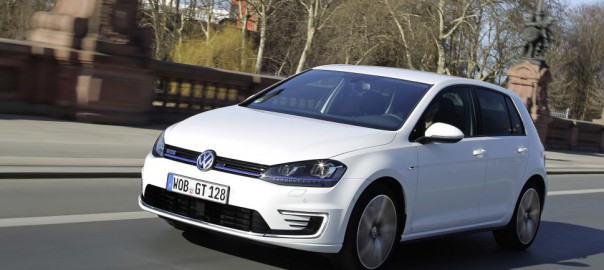
Volkswagen Golf GTE (Image: VW)

Volkswagen Leads Plug-In Electric Car Sales In Europe

Europe, with over 9,500 plug-in electric car sales in January 2015, far exceeded the US’ result of 5,924.

This year began especially strong for Volkswagen, which seems to now be most popular brand among plug-in electric car buyers.

We are not sure if VW will be able hold onto the #1 spot, but in January the automaker delivered over 2,300 cars (Golf GTE, e-Golf and e-up!) and some 2,800 if we include the whole VW Group (Audi and Porsche).

In second place is Nissan Tesla Renault Mitsubishi! Outlander PHEV had almost 2,000 sales, and with i-MiEV added in the result stood at nearly 2,100.

Nissan, combined with Renault (below 2,000), is at similar level, but only if we include Twizy.

Both BMW and Tesla are down in the hundreds range.

Well, Volkswagen might’ve come to the party late, but as a Group it’s moving forward to quickly become the sales leader in Europe.

Source: EV Sales Blog via Inside EVs

2015 VW Golf 7 GTE (204hp)

Automann-TV

Fast Autobahn acceleration test of the 2014/2015 Volkswagen Golf 7 GTE with the twin engine concept delivering 204 hp and up to 350 Nm of torque. While the 1.4 TSI with 150 hp is already not really slow, they added the 102 hp electric motor out of the e-Golf to make this a proper GT(E). As you can see, this car really pulls once you put it in “B” (Boost?) and GTE-mode. I don’t really know why it is significantly faster than what VW claims but it also feels like more than 200 hp! Especially as I tested the Golf 7 GTD and GTI (220hp) I can tell that this hybrid is very close to the GTI! Besides that you get an “E-Mode” that let’s you accelerate pretty decent up to 130 km/h and drive totally quiet in cities….I personally like it! On top of that you get the quick shifting DSG (6-speed) that also shifts in E-Mode…very cool!

See also: Gas2.org: Is The Volkswagen Golf GTE As Fast As The GTI?

Volkswagen Golf GTE (Image: Evo)

Volkswagen Golf GTE Plug-in Hybrid

Volkswagen’s versatile 2015 Golf GTE plug-in hybrid has officially gone on sale in the UK.

Designed on the same Volkswagen MQB platform as the rest of the seventh-generation Volkswagen Golf family, the 2015 Golf GTE combines a 75 kilowatt electric motor mounted inside the gearbox and 8.8 kilowatt-hour lithium-ion battery pack with a 1.4-litre, TSI direct-injection gasoline engine capable of producing 148 horsepower.

Complete with a six-speed DSG gearbox designed specifically for use with hybrid drivetrains, Volkswagen says the Golf GTE is capable of producing a total power output of 201 horsepower (150 kilowatts) and a maximum available torque of 350 Nm (258 lbs ft) when both engine and motor work in concert.

In all-electric mode, Volkswagen claims a range of up to 31 miles per charge are possible, although based on previous brief drives with the Golf GTE we’d suggest a real-world range of between 20 and 25 miles per charge is more realistic.

Unlike some plug-in hybrids however, the Volkswagen Golf GTE operates in all-electric mode at speeds of up to 81 mph, with the gasoline engine only kicking in under extremly heavy acceleration. Due to its small size, the battery pack can be recharged from empty too full in just under four hours with a domestic power socket, or two and a quarter hours from an appropriate 16-amp charging station.

On power up, the Golf GTE’s default is to enter into all-electric mode, using up the energy in its battery pack first before switching on its gasoline engine. It can also be entered at any point during the trip after engaging anther mode by pressing the mode switch.

Like most other plug-in hybrids on the market today however, it’s possible to enter into ‘Battery Hold’ mode, which allows the driver to reserve their car’s battery charge for later use in the trip.

There’s also a ‘Battery Charge’ mode, which makes it possible for the Golf GTE to use excess energy from its internal combustion engine to recharge the battery pack as it is driving along. While this will result in temporarily dropping fuel efficiency, it does make it possible to drive in all-electric mode more than once in a trip although any driving made in electric mode using power generated by the engine has obvious emissions implications from an environmental standpoint.

Read more: Transport Evolved

Volkswagen Golf GTE (Image: VW)

Golf GTE order books open

The Volkswagen Golf GTE is available to order from today [published 14 January], costing £28,035* RRP.

And unlike Volkswagen’s other electric vehicles (the e-up! and e-Golf) which are sold through a network of 25 e-Retailers, the GTE will be available through all of the company’s franchised sales outlets.

The name of Golf GTE reflects its standing in the line-up alongside the petrol-powered GTI and diesel GTD, while its pricing also reinforces this position. The new car is driven by two engines: a 1.4-litre 150 PS TSI direct-injection petrol engine and a 102 PS electric motor. Together, they produce a maximum power of 204 PS and a theoretical range of 580 miles, while maximum torque is 350 Nm (258 lbs ft). A six-speed DSG gearbox developed for hybrid vehicles is standard.

The electric motor is integrated into the gearbox housing, while further hybrid components include power electronics and a charger. An electro-mechanical brake servo and an electric air conditioning compressor make for energy-efficient braking and air conditioning. There are five operating modes: ‘E-mode’, ‘GTE mode’, ‘Battery Hold’, ‘Battery charge’ and ‘Hybrid Auto’. In pure electric mode (activated at the press of a button), the Golf GTE can travel up to 31 miles. Electric power can also be saved – for example when driving to a zero-emissions zone – and in electric mode, the GTE is capable of speeds of up to 81 mph.

With the TSI engine engaged as well, the Golf GTE can sprint from zero to 62 mph in 7.6 seconds and on to 138 mph, yet returns a combined cycle figure of 166 mpg and CO2 emissions of 39 g/km. As such it is expected to be exempt from VED and the Congestion Charge.

The Golf GTE’s 8.8 kWh lithium-ion battery can be charged in 3.75 hours from a domestic mains outlet, or 2.25 hours from a domestic wallbox.

The Golf GTE is available in five-door bodystyle only and in one highly-specified trim level. Visually, it combines elements of the e-Golf and Golf GTI, with C-shaped LED daytime running lights (e-Golf) and aerodynamic horizontal ‘fins’ (GTI). Where the GTI features red, the GTE has blue accents, including across the radiator grille and into the headlights (which as on the e-Golf are LED), while 18-inch ‘Serron’ alloy wheels are fitted as standard.

Inside too, the GTI’s red highlights are turned to blue – including the stitching on the steering wheel, gear lever gaiter and seats, and a blue stripe in the tartan pattern on the sports seats. Touchscreen infotainment system with DAB radio and Bluetooth is standard, while optional navigation includes bespoke EV features such as the ability to identify potential destinations on electric range, and charging points.

The GTE also has an e-manager which allows the driver to preset vehicle charging, as well as interior cooling or heating and these functions can be operated remotely using the Car-Net app on a smartphone; a three-year subscription is standard in the UK. The speedometer and tachometer are familiar, and the latter is supplemented by a power meter in the central display, which shows the status of the battery, whether or not power is being used and the intensity of any regeneration.

(*RRP OTR after £5,000 Government plug-in car grant has been deducted)

Source: Diesel Car Magazine

Volkswagen Golf GTE (Image: VW)

VW says Golf GTE plug-in hybrid offers the ‘best of both worlds’

Volkswagen says its Golf GTE plug-in hybrid offers eco-friendly buyers the “best of both worlds” — a compact hatchback that can be driven up to 50km in cities using electric power or up to 940km on highways with additional power from its gasoline engine.

The Golf GTE is VW’s second plug-hybrid after the low-volume XL1. Others will follow, including a Passat plug-in hybrid. VW is touting the Golf GTE’s sportiness. The plug-in has the same performance as a Golf GTI and is “both eco-friendly and sporty,” said Hans-Jacob Neusser, VW brand’s r&d head.

VW says the Golf GTE will complement the all-electric e-Golf, which went on sale in February. The e-Golf has a maximum range of 190km so it is more suited to urban driving than long distances, VW says. The Golf GTE costs 2,000 euros more than the 34,900 euro e-Golf in Germany. VW is not disclosing any production or sales forecasts for the Golf GTE.

Neusser said the car can be built on the same production lines as other Golfs so the company can react very flexibly to demand. IHS Automotive forecasts that VW will sell 24,233 Golf GTEs next year, with volume reaching a peak of 52,356 in 2021. VW says the Golf compact family now has the widest choice of powertrains in the segment with the GTE adding to the gasoline, diesel, CNG and EV versions.

Read more: AutoNews

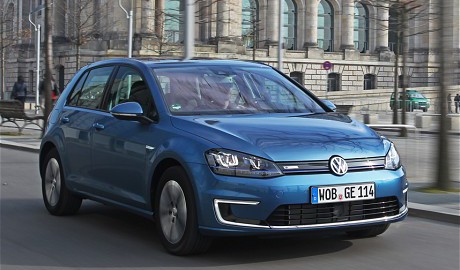
VW e-Golf (Image: Telegraph)

Volkswagen e-Golf versus Golf GTE

Volkwagen’s attempt to take on electric car rivals comes in the form of the e-Golf and Golf GTE

Electric cars remain a hot topic, so the chance to drive VW’s battery-electric e-Golf and its plug-in petrol/electric hybrid, the Golf GTE hot hatch, was interesting on several fronts.

There’s a crushing logic behind both of these eco cars, which is that the Volkswagen Golf has been Europe’s best selling car for the last two years. In 2013 the Golf’s 470,229 sales beat the second-placed Ford Fiesta by more than 60 per cent. So why fiddle with a winning formula for an electric future, when you can just pop in an alternative hybrid or battery electric driveline?

So the e-Golf and Golf GTE look like a standard Golf and mostly drive like one too. In the e-Golf you climb into a remarkably standard-looking cabin, engage Drive on a familiar looking gearstick, and stare at a standard-looking instrument binnacle, with a circular battery-usage meter in place of a rev counter. There’s a bit of creep built into the drivetrain to help when parking, but VW claims creep reduces overall range by between 1.2–3.1 miles, so it cuts out for prolonged brake stops or at speeds over 6.2mph.

Regenerative braking is not handled by the steering-column paddles as it was on the prototype we drove last year, but instead on the gearlever, which is neither as responsive nor as “special” as those paddles, which were dropped for cost reasons. So regen braking is shifted in four stages, with the ultimate, “B”, making the car drive like BMW’s i3 with full brake regeneration when you lift off the throttle – the brake lights go on in all but the mildest regen setting.

There are three main modes of travel: standard Drive, Eco and Eco+, which progressively limit the engine’s power, dull the throttle response and limit the air-conditioning. In standard mode and in the city, the e-Golf feels brisk enough (although the GTE is a lot faster). The ride on Berlin’s streets is mostly supple although the low rolling resistance tyres smash through potholes and there’s a bounding eagerness about the chassis over bumps. The steering is light and inert and the air-con is perfectly adequate although it eats into the range.

The GTE rides a little more harshly, but that fits its sporting credentials since this petrol/electric plug-in hybrid makes a combined 201bhp/258lb ft, which makes for a pretty quick car – 0-62mph in 7.6sec and a top speed of 138mph. Fuel consumption is quoted at 188mpg, but think 150mpg in urban use where the braking energy is saved in the battery; less on a long run.

The six-speed DSG transmission feels responsive, the steering is better weighted and the ride is more consistent than the e-Golf, but you do feel the 1.5 tons kerb weight of both cars as you turn into corners.

The interior is pretty much as the standard Golf GTI with blue instead of red flashes. Electric-only operation has a range of just 31 miles, the standard petrol/electric mode has a quoted range of 580 miles and there’s also a GTE setting on the dash, which sharpens throttle response and gives a more fruity exhaust note.

As well as its electric motor, the Golf GTE uses a petrol engine

It’s a pretty straight forward choice if you only have one car in the household: go for the hybrid GTE. It has good real-world performance and economy and a quoted range of 580 miles. It takes just 3.5 hours to recharge and your fleet manager and benefit-in-kind tax bill will enjoy its 35g/km CO2 emissions. And, since this driveline is already used by Audi and will be by Seat and Skoda, it should be reasonably reliable and economical to maintain.

Where the battery e-Golf scores is if you need a second or third car for mainly urban use and have access to charge facilities at home and at work. Recharge times are long off a household supply and the range is limited, but as an urban runaround it’s convincing, if not overwhelming.

Source: Telegraph (April 2014)