Category Archives: e-Golf

Fuel Included BMW i3 on static display (Image: T. Larkum)

Renault Zoe Climbs To #1 In Germany

The German plug-in electric car (PEV) market grew 23% in June, to 5,709 registrations, with plug-in hybrids (+25%) and fully electric cars (+21%) growing at a similar pace. In 2018, all-electrics are reaching 1% share, while plug-in hybrids have also grown their share to 1%, resulting in a total PEV share of 2%.

But the most interesting story on the fuels mix is the Titanic-like drop of diesel vehicles sales. In June, their sales sank 16%, to the benefit of all other kinds of fuels. Diesel now represents only 31% of the market. At this pace, diesel sales could be tot in this market by 2021. Inconceivable? Well, in 12 months, diesel lost 9% share, going from 40% to 31%.

Fuel Included BMW i3 on static display (Image: T. Larkum)

Looking at June best sellers, BMW had a 1–2 win, with the i3 scoring 509 units, a new year best, while the 225xe Active Tourer registered 500 units, a new record for the German MPV.

The Renault Zoe was 3rd, while the surprise of the month was the #5 Mini Countryman PHEV. With 300 deliveries, it had its best result ever in Germany.

Just outside the top 5, the VW e-Golf registered only 290 deliveries, its worst performance in 11 months. Is the German brand already starting the sunset mode of its BEV hatchback?

Read more: Clean Technica

Battle of the electric family cars: 2017 BMW i3 REX vs Volkswagen e-Golf

BY 2040, if the government gets its way, drivers looking for a new car will have a simple choice: buy an electric car or a hybrid car.
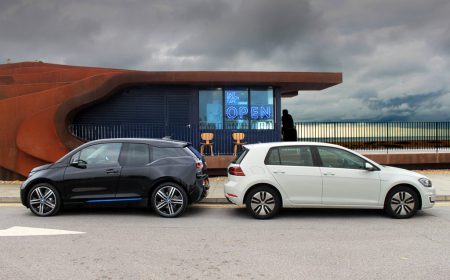
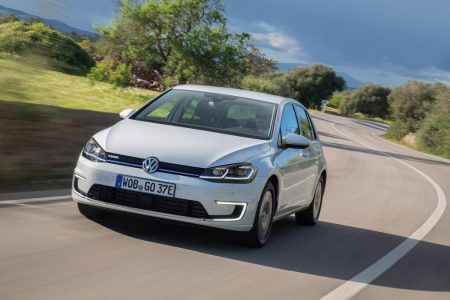
The Volkswagen e-Golf and BMW i3 REX give a taste of things to come. The former is Britain’s best-known family hatchback first, and a pure-electric car second. It should mean it’s user-friendly and doesn’t require as big a leap of faith as a high diver jumping from a cliff top.

The i3 REX is an electric car for pragmatists. In addition to having an electric motor and a battery pack, it has a two-cylinder petrol engine, packaged beneath the boot floor, in the same space as the car’s electric motor. This acts as a generator, to maintain battery charge when it gets low.

The e-Golf, which is propelled under battery power alone, has been revised for 2017 as part of the updated Golf range, and can officially travel 186 miles on a single charge. The i3 REX has a battery range of around 140 miles, but the REX motor allows it to travel a total of 200 miles before you need a top-up of electricity or petrol.
The e-Golf, which is propelled under battery power alone, has been revised for 2017 as part of the updated Golf range, and can officially travel 186 miles on a single charge. The i3 REX has a

We put the pair to the test, on a trip to the seaside. Needless to say, it rained; could the electric cars keep our spirits high?

2017 Volkswagen e-Golf review

Words: Will Dron
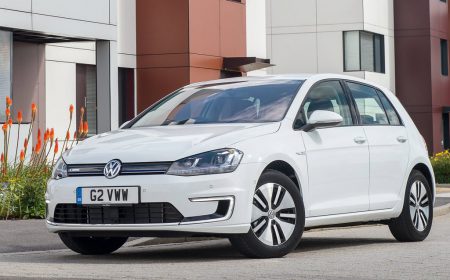
Well, it’s a Golf, isn’t it? VW sold 5,236 of its ever-popular hatchback in July alone, just 15 short of the best-selling Ford Focus. In order to create its electric car, all VW had to do was strip out the petrol or (whisper it) diesel engine, along with its transmission, and bolt in a few Duracell batteries and an electric motor. Oh, and change the alloys and tweak the styling of the lights slightly.

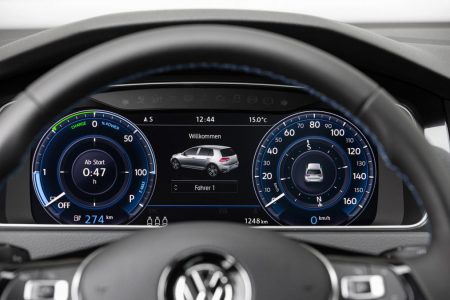
When you climb inside, it looks like a Golf, too. The instruments are the same, the switchgear is the same, the seats are the same, the infotainment system is the same (albeit with updated software to show electric energy flow and driving efficiency).

The i3, on the other hand… now that’s an incredible achievement. Designed from the ground up as an electric car, with a carbon fibre tub to save weight and carefully considered packaging, for optimal weight distribution. And the interior of the i3 — totally original and full of reclaimed wood and other dolphin-friendly materials. BMW put a huge amount of research and development into coming up with that car.

But then you remember… being a Golf is no bad thing.

The moment the penny really dropped was when James Mills, having parked his totally original, very clever little i3 REX next to the e-Golf, was having a little root around the back of my car. He quickly pointed out that the i3 has only four seats, whereas the VW has five, just like a normal Golf. Yes, the transmission tunnel houses the battery pack, so it doesn’t have a flat floor in the rear, but other than that, it’s a Golf.

Read more: Driving.co.uk

Volkswagen Golf GTE (Image: T. Larkum)

The Germans are Coming!

Volkswagen e-Up charging outside the Experience Centre (Image: T. Larkum)

The biggest manufacturers of all-electric cars sold in Europe are Nissan with their Leaf in 1st place in terms of sales (and e-NV200 van in 5th), Tesla with their Model S in 2nd place, and Renault with their ZOE in 3rd place. These manufacturers are, of course, Japanese, American and French respectively. What is interesting is that there is only one German entrant in the top 5, BMW with their i3 at 4th place, despite the fact that German manufacturers dominate the European market for fossil-fuelled cars.

Volkswagen Passat GTE (Image: T. Larkum)

The Germans do make electric cars – Mercedes has the B Class Electric and Volkswagen has the e-Golf and e-Up – but they appear to make no effort to market them. Historically they have also had lacklustre range and high prices. The bottom line is that they haven’t sold in significant numbers.

Volkswagen Passat GTE (Image: T. Larkum)

German Plugin Hybrids (PHEVs)

Instead it seems that German manufacturers have decided that the plugin hybrid (PHEV) combining an electric drivetrain with a conventional petrol engine is what people want. Or at least they see it as an intermediate step towards full electrification. Considering PHEVs, the top 10 sales now include Mercedes with the C350e in 2nd place (after the Mitsubishi Outlander), the BMW 330e in 4th place and the Volkswagen Golf GTE at 6th place.

Volkswagen Passat GTE (Image: T. Larkum)

In fact, Volkswagen has arguably embraced PHEVs more than any other manufacture. They currently offer both of their two biggest selling cars, the Passat and the Golf, in PHEV form as the ‘GTE’. Both of them offer the ability to commute (up to about 20 miles) on electricity with the option of using petrol for longer distances – they also have pretty good 0-60 times too.

Volkswagen Golf GTE (Image: T. Larkum)

VW on the Rise

With these cars in the vanguard, and with the e-Up and newly improved e-Golf to come, Volkswagen may soon make significant inroads into plugin sales in the UK.

Volkswagen Golf GTE (Image: T. Larkum)

These were some of the thoughts that came to me looking at the row of EVs charging outside the Milton Keynes Electric Vehicle Experience Centre (EVEC). Of the eight cars, three were from Volkswagen (so nearly 40%). We ourselves are looking to start offering VW plugins soon, and I’m sure we’ll see VW as an EV brand on the rise from here on.

Volkswagen Golf GTE (Image: T. Larkum)

As ever, if you want to test drive any of the cars mentioned here just get in touch.

f

2017 Volkswagen e-Golf: first drive of updated 125-mile electric car

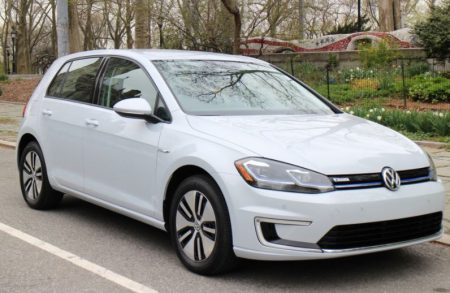
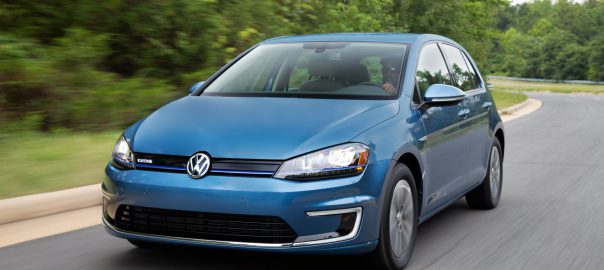
The 2017 Volkswagen e-Golf, the only battery-electric car sold by VW in the U.S., got a large range boost for its third year on the market.

2017 Volkswagen e-Golf

While the current model year is winding to a close, 2017 e-Golfs are just now reaching dealers in the handful of states where the compact electric car is offered for sale.

But with an EPA-rated range of 125 miles combined, the 2017 VW e-Golf now offers more range than any all-electric car that’s not a Tesla or a Chevy Bolt EV.

That’s a 50-percent increase over the previous model’s 83 miles, and significantly increases the practicality of the e-Golf for drivers with longer commutes—or those who live in areas with winter weather.

Two weeks ago, we spent a brief time behind the wheel of a 2017 e-Golf, though New York City traffic prevented any meaningful test of the car’s expanded range.

For that we’ll wait to get the electric Golf for a longer test.

2017 Volkswagen e-golf

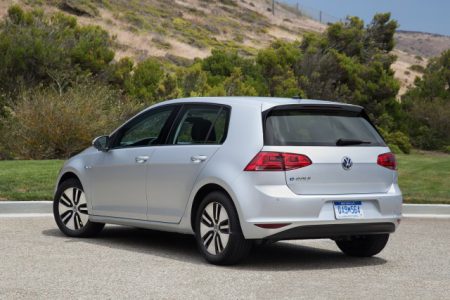
Meanwhile, what we can tell you is that the latest e-Golf is exactly what it was before: a Volkswagen Golf that happens to run on battery power.

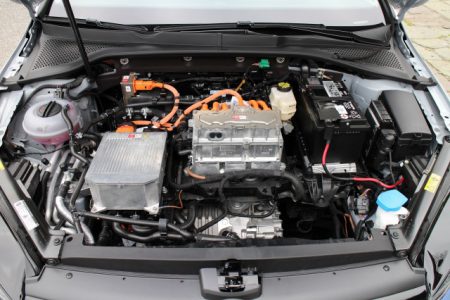
What’s under the hood (and under the floor, rear seat, and cargo bay) may differ completely, but you’d never know it.

It’s so similar to conventional gasoline-powered Golfs that uninformed passengers might never catch on that it wasn’t simply the latest version of the 40-year-old hatchback classic.

As a result, our impressions of the longer-range VW e-Golf are essentially the same as those we had three years ago in testing its earlier iteration.

The 2017 e-Golf received a boost in its motor output, from 86 kilowatts (115 horsepower) to 100 kw (134 hp). Torque increased as well, from 199 to 214 lb-ft.

VW claims the acceleration from 0 to 60 mph is faster, at 9.6 seconds, which is a reduction of more than 1 second. To be honest, we couldn’t sense any difference, but it’s been three years.

2017 Volkswagen e-Golf

Reversing the car into parking spaces was as smooth as forward acceleration.

We noted no whine from either motor or power electronics under any circumstances, an impressive feat.

We smiled at the translation from German in the digital gauge clusters; in an e-Golf, it’s not “regeneration” but “recuperation.”

Otherwise, at the risk of disappointing those seeking decisive first-drive impressions … yep, it’s an electric Golf. Just as we expected, frankly.

Read more: Green Car Reports

VW e-Golf 2017 First Drive

The e-Golf has long been a very good EV in terms of driving experience, but it has significantly lacked the range to truly compete with the big players in the electric car market.

It started out with a below average electric range, and almost all of its rivals have upped their game since the e-Golf’s launch. Now though it’s Volkswagen’s turn to bring out an improved model. NGC went to the car’s launch in Majorca to try out the new VW e-Golf.

What’s new

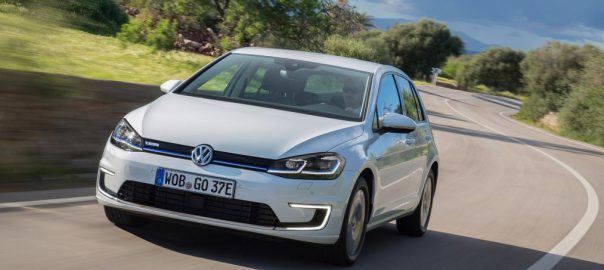
Volkswagen has given its entire Golf line-up a refresh, with sharper styling front and rear, and improved equipment levels inside. The e-Golf is no different and benefits from these changes, though more importantly, the all-electric model has also had more done to it than any other Golf.

On top of the Golf line-up’s updates, the e-Golf also now benefits from a more powerful electric motor and significantly larger battery capacity. The upshot is a slightly more stylish car, with more tech and improved value for money; and an EV with around 50% more range and a little extra performance to go with it. That means an increase in battery capacity from 24.2 kWh to 35.8 kWh, and power jumps from 85 kW (115 hp) to 100 kW (136 hp). It all sounds great on paper, but how does it come together on the road?

What’s it like to drive

Something that was a positive with the first-generation e-Golf for some was that it was similar to a ‘normal Golf’. Unlike rivals such as the Nissan Leaf and BMW i3, VW didn’t create a new and edgier car, but used it’s tried, tested, and very popular Golf as a foundation. Climbing from a conventional petrol or diesel Golf and into an e-Golf sees very few changes presented to the driver, instantly putting many at ease behind the wheel.

From there, the driving experience does change but actually becomes easier in many respects. The instant torque from the electric motor, the single gear transmission, and regenerative braking create a very digital driving experience, and one that is both enjoyable and convenient. An EV’s most natural habitat is in built up areas, with the low speeds and stop-start traffic minimising the restrictions of the relatively limited range of an EV compared to a conventionally powered car. Here the e-Golf excels, helped by the low centre of gravity created by the battery pack being placed in the car’s floor. It’s nimble, very nippy in short bursts of acceleration, and fun to drive.

Read more: Next Green Car


New Volkswagen e-Golf 2017

All-electric Volkswagen Golf receives new tech, more power and big range boost for 2017 – can it compete with the best EVs as a result?

Of the near-half a million Golfs sold in Europe last year, only a tiny fraction featured an electric powertrain. Most of those were the plug-in hybrid GTE, too, so the e-Golf – first launched three years ago – still has plenty of ground to cover to take battery power to the mainstream market. Sales projections are much more positive for 2017 and beyond, however.

Volkswagen e-Golf 2017

The biggest change will be the extension in predicted range. VW has managed to fit a more energy dense lithium-ion battery, allowing greater capacity without increasing the physical size of the pack.

As a result, the claimed range has risen from 119 miles to 186 miles, while you can now charge it to 80 per cent from a fast charging point in just 45 minutes. It still takes four hours to charge fully on a home charger, or 13 hours from a domestic three-pin plug socket, and we’d expect around 130 miles to be achievable in the real world.

Volkswagen e-Golf 2017Like many top-spec Golfs you’ll find new tech in the form of VW’s 12.3-inch Active Info Display, which replaces lesser cars’ analogue dials. This is particularly useful in the EV, allowing you to prioritise things like remaining range, as well as accessing real-time info on the required length of your next charging stop.

Elsewhere, all e-Golfs get the glossy new 9.2-inch Discover Pro infotainment system as standard, which is feature-packed and largely slick to operate – save, that is, for the rather useless hand-swipe gesture control.

Volkswagen e-Golf 2017

Aside from that, it’s the same sober but impressively solid Golf interior that we’ve grown to appreciate over the years. From the inside, the only clues that you’re driving an EV are the subtle badges and the blue stitching. Sticking the electric motor where the engine usually is means that there’s no dent to the VW’s ample rear passenger space, either, although the 341 litre boot is 39 litres down on the standard car due to the batteries under the floor.

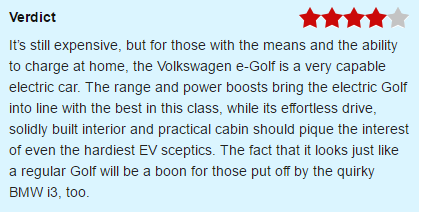
Auto Express Verdict

Read more: Auto Express

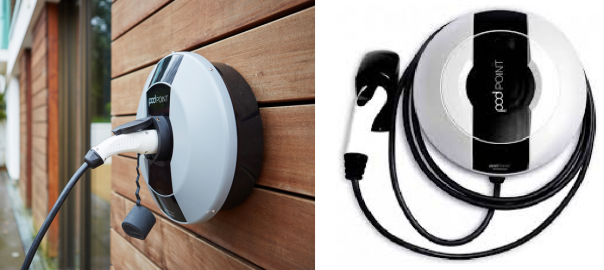
Untethered and Tethered Charge Points (Image: POD Point)

Choosing a Charge Point

When buying an electric car it is nearly always worthwhile to get a dedicated charge point installed at home.

It’s more convenient than an ‘occasional use’ or ‘granny’ (13 Amp) charge cable because you don’t need to reel it up and put it away each time.

Home Charging a Renault ZOE with a Dedicated Charge Point (Image: Charging Solutions)
Charging a Renault ZOE with a Home Charge Point (Image: Charging Solutions)

It will also be significantly faster because a dedicated charge point can provide more power without the risk of overheating. Also some electric cars, such as the Renault ZOE, don’t come with such a cable and buying one yourself can be very expensive (£500+).

The good news is that the installation of domestic charge points is subsidised by the UK government.

There are 3 decisions to be made when selecting the type of charge point for your car:

  • Tethered or Untethered
  • Connector Types
  • Power Level


Tethered or Untethered

There is usually the choice of a ‘tethered’ cable (it is fixed to the charge point) or an ‘untethered’ cable (it plugs into and can be removed from the charge point).

Untethered and tethered charge points (Image: Chargemaster)
Untethered and Tethered Charge Points (Image: Chargemaster)

Untethered has the advantage of allowing different cables to be connected (for example you can use the same charge point for a Nissan Leaf and a Renault ZOE). However, most people choose tethered because it avoids the inconvenience of connecting a cable whenever you need to charge (usually daily). It also reduces the risk of the cable being stolen.

A charge point with a tethered cable will usually cost more than an untethered one (typically about £50 more) because of the cost of its cable.

Untethered and Tethered Charge Points (Image: POD Point)
Untethered and Tethered Charge Points (Images: POD Point)

If you choose untethered you will need to use your own cable to connect to the car; it is the same cable that would be used to connect to a public charging point. It may come free with the car, for example the Renault ZOE or the Nissan Leaf with the 6.6kW charge option come with one. Otherwise you will need to buy one (we can advise you on suppliers).


Connector Types

All untethered domestic charge points supplied in the UK come with a Type 2 socket on the charge point, just as all public charge points now have (or at least officially should have) Type 2 sockets. Similarly all charge cables have a Type 2 plug at the charge point end.

Type 1 (5 pin) and Type 2 (7 pin) connectors

If the cable is tethered then you need to tell the installer the type of plug you want at the car end. This will depend on the car:

  • Type 1 socket: Nissan Leaf, Mitsubishi Outlander PHEV, Kia Soul EV
  • Type 2 socket: Renault ZOE, BMW i3, Tesla, VW e-Golf and Hyundai IONIQ

The Type 2 or ‘Mennekes’ connector is the official standard in Europe and should eventually replace the Type 1.


Power Level

A dedicated charge point can provide higher powers than a typical occasional use charging cable which will run at 10 Amps, equivalent at 230 Volts to 2.3 kilowatts. The charge will take place at the highest power that both the charge point can provide and the car can use.

There are two common power levels:

  • 16A = 3.5kW: This is the maximum charge level of the Nissan Leaf 3.3kW, the Mitsubishi Outlander and the VW e-Golf.
  • 30A/32A = 7kW: This is the maximum charge level of the Nissan Leaf 6.6kW, BMW i3, Kia Soul EV and Hyundai IONIQ. The standard Renault ZOE can use this level, in fact anything up to 22kW.

The higher power reduces the charge time so a typical EV battery will charge in about 8 hours at 16A but in about 4 hours at 32A.

It may be best to install the highest power charge point you can afford; even if your current car can’t use all the power, the next one almost certainly will be able to.

Electric Cars (Image: Autocar)

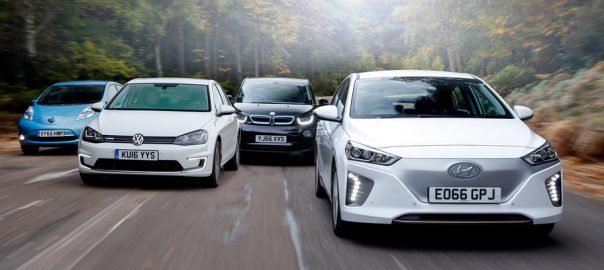
Hyundai Ioniq, Volkswagen E-Golf, BMW i3 vs Nissan Leaf

The Hyundai Ioniq Electric is the latest addition to a growing class of city-friendly battery-powered hatchbacks. We pit it against its rivals

The electric vehicle market is growing, so we’ve collected the Hyundai Ioniq, Volkswagen E-Golf, BMW i3 and Nissan Leaf together to see which comes out on top.

Hyundai Ioniq, Volkswagen E-Golf, BMW i3 vs Nissan Leaf - electric vehicle group test (Image: Autocar)
Hyundai Ioniq, Volkswagen E-Golf, BMW i3 vs Nissan Leaf – electric vehicle group test (Image: Autocar)

A watched EV never boils. More to the point, it doesn’t bleep, flash, pop, ping or do anything else that you might imagine an all-electric hatchback ought to do to indicate a completed charge. Shame. I like the idea of a Nissan Leaf gradually browning, wafting warm toast smells in every direction, before spontaneously hopping three feet into the air like a slice of Warburton’s ready for the butter knife.

It would at least make an interesting spectacle in the motorway services car park in which we’re now waiting. We’ve got four brand-new battery cars lined up in front of Ecotricity’s fast chargers, each suckling almost noiselessly in turn from the national grid, before setting off on an exercise we’ve been waiting a long time to carry out.

It was six years ago that the Nissan Leaf and Mitsubishi i-MiEV first tested the appetite of drivers all over the developed world for a compact, affordable electric hatchback. It’s an appetite that’s needed plenty of encouragement, but it’s finally growing at something close to the rate those evangelical early market entrants had hoped for. Viewed globally, the market for pure EVs and plug-in hybrids will total more than 600,000 cars this year, up about 50% year on year. Just over half of all those ‘plug-in’ cars sold this year will be wholly electric-powered.

More important, as concerns today’s agenda, the all-electric hatchback market now provides the UK motorist with enough choice to populate a full Autocar group test. Welcome, then, the new Hyundai Ioniq Electric to UK showrooms. And allow us to introduce it to the similarly priced, all-electric rivals against which its stature must be measured: the Nissan Leaf, Volkswagen e-Golf and BMW i3.

Having followed the early-stage development of these zero-emissions pioneers, we’ve become used to the strengths and limitations of electric propulsion at the affordable end of the ownership spectrum. An £80,000 Tesla may already offer the sort of cruising range it takes to replace internal combustion in a car for almost any occasion or journey, but a £25,000 Leaf doesn’t – and probably won’t for a few years yet.

Where affordable EVs have already shown strength is when performing as responsive, relaxing, cost-efficient short-range transport, in the role typically served by the second car in a family. And that’s how we’re going to test today’s field. We’ve plotted a route across north London, taking in some of its most congested streets and winding up at Queen Elizabeth Olympic Park in Newham. We simply want to know which of these cars would serve you best with predominantly urban use in mind.

Before we set off, time for a quick poke around our newbie: the Hyundai Ioniq. The Leaf, i3 and e-Golf are well known to us, all having been the subject of Autocar road tests over the past few years and all serving customers looking for slightly different things from their first EV. And rather than competing for exactly the same customers as any of its new-found rivals, the Ioniq definitely adds to the breadth of choice in the market.

Read more: Autocar

Making of: Gran Prix

Go Ultra Low enlists a Top Gear legend for the ‘Gran Prix’ challenge and reveals Britain’s most passionate female car fan aged over 60.

In this video we go behind the scenes as our winner, Helen Mary Jones, stars in her very own car review video at the iconic Brands Hatch racing circuit – with a little help from motoring TV presenter Quentin Willson.

Helen swapped her own Aston Martin DB9 sports car for a pure-electric Volkswagen e-Golf for the day, but can electric cars be just as fun to drive – and which was quicker off the line?

https://www.youtube.com/watch?v=jl1ngWwDGOE