Ask a North American driver to name companies that make electric cars, and you’ll probably hear Tesla, maybe Nissan, and perhaps Chevy or BMW or Toyota.
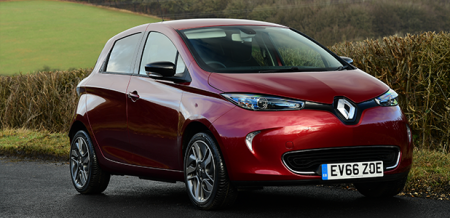
Longer-range Renault Zoe electric car, introduced at 2016 Paris Motor Show
Chinese drivers may be more likely to say BYD (and perhaps Tesla), but Europeans will likely name Renault. (And Tesla.)
The Renault Zoe, now in its fifth year but entirely unknown to U.S. and Canadian buyers, continues to be the best-selling battery-electric car in Europe.
Its maker is part of the longstanding Renault Nissan Alliance, which recently added Mitsubishi to become the fourth largest automaker in the world collectively.
The French maker just released its first-half global sales figures, and the Zoe continues to dominate the sales charts within Europe.
In Europe, as Renault notes, overall the carmaker had 26.8 percent of the market for battery-electric and plug-in hybrid cars.
Longer-range Renault Zoe electric car, introduced at 2016 Paris Motor Show
Its first-half sales volumes grew 34 percent, and registrations of the subcompact hatchback Zoe rose 44 percent.
That meant the Zoe remains Europe’s top-selling electric vehicle.
One factor that may keep the Zoe, which went on sale in late 2012, at the top of the charts is this year’s substantial upgrade in battery capacity.
There weren’t cars only on display inside the Electric Vehicle Experience Centre (EVEC) at the launch. There were also a large number charging up outside, presumably getting ready for test drives for the public for the opening the next day.
Electric cars ready for free test drives in Milton Keynes (Image: T. Larkum)
The large numbers and broad range of EVs available was impressive.
How about a quick quiz: can you identify them all? The answers are given below.
Electric cars ready for free test drives in Milton Keynes (Image: T. Larkum)
Of course, whether you own an EV or are considering your first, you’re welcome to test drive any of the vehicles on show for free. Just get in touch and we’ll help arrange it.
Answers to the Quiz: these are the electric cars waiting to give test drives (from nearest the camera to furthest away):
Slough Borough Council has purchased three Renault Zoe EV vehicles as staff pool cars.
The purchase follows Slough Borough Council’s ‘journey to clean air’ initiative, as part of its low emissions strategy.
The pool car scheme is part of Slough’s wider fleet challenge programme, providing ‘environmentally friendly’ solutions for staff travel to meetings, site inspections and client visits. This all helps towards Slough’s aim to decarbonise its fleet.
Leader of Slough Borough Council Cllr Sohail Munawar said:
“The fleet challenge is just one of the ways we are making a difference to our communities and our environment. By introducing a pool of both ultra-low emissions electric cars and e-bikes, we are moving towards that goal.
“Forty staff tried the Renault Zoe and the feedback was excellent. They found it easy to drive and the controls clear and simple to understand. The charging lead is easy to connect and the range the car offers makes it ideal as a pool car.
The three Zoe Dynamique iNav R90 Z.E.40 models were sourced through Renault Croydon and have been fitted with the optional rear-view parking camera.”
Groupe Renault UK’s national fleet manager Mark Potter said:
“We’re delighted that Slough Borough Council has chosen the Renault Zoe as its first electric pool car. The Zoe creates no emissions at the tailpipe, and with the 250-mile range (NEDC) available from its Z.E.40 battery, it will be able to complete return journeys across the borough without needing to stop and charge up again. We are sure staff will also enjoy its smooth, quiet performance and fun character.”
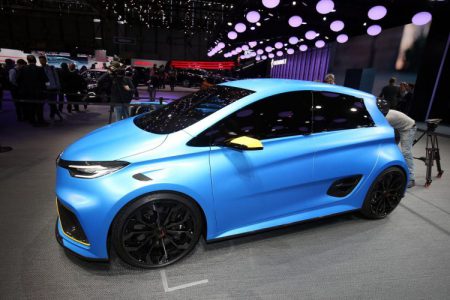
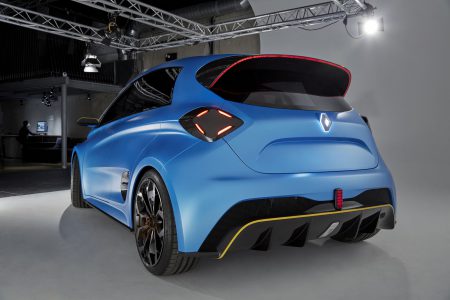
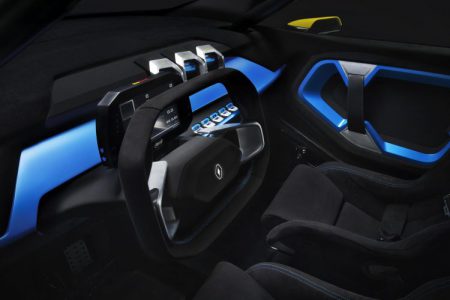
The pint-sized Zoe is far from being the most exciting electric car out there, but it’s a whole different story with the bonkers E-Sport concept. Unveiled earlier this year in Geneva, the zero-emissions city car had a pair of electric motors good for a combined output of close to 460 horsepower (343 kilowatts) and a torquetastic 472 pound-feet (640 Newton-meters).
As it turns out, Renault Sport is actually analyzing the prospects of coming out with a high-performance Zoe that would carry the “RS” suffix. In an interview with Autocar, the go-faster division’s boss, Patrice Ratti, admitted
“we are thinking about doing a Zoe RS but it is a big study that will take time.”
He went on to specify the hot e-hatch is being considered thanks primarily to the developments made in battery technology, thus making the Zoe RS a feasible project worthy of being evaluated for a potential production model.
Renault ZOE E-Sport
If green-lighted, the Zoe RS (see render here) will go through some significant changes compared to the concept. Besides being subjected to steering and chassis modifications, the batteries would also have to be tweaked in order to boost range over the E-Sport, which had enough juice for a mere 15 minutes while being driven at full throttle. For the sake of comparison, the regular Zoe ZE 40 you can actually buy can cover up to 250 miles (400 kilometers) between charges as per the New European Driving Cycle (NEDC).
Should the road-going model get even close to the concept’s performances, it’s going to be a little electric beast. Renault Sport said the show car would do 0 to 62 mph (100 kph) in just 3.2 seconds. Top speed was electronically capped at 130 mph (210 kph), a process which took less than 10 seconds from a standstill.
Renault ZOE E-Sport
But Renault Sport has bigger fish to fry right now as it’s gearing up to introduce the all-new Megane RS. Slated to debut on September 12, the newest performance model carrying the diamond logo will premiere at the Frankfurt Motor Show.
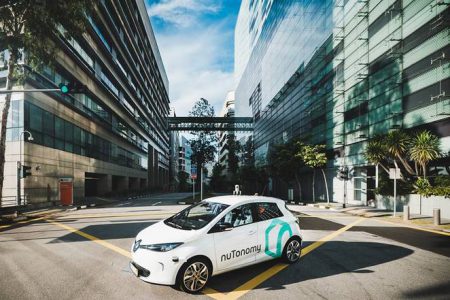
One of the leading on-demand ridesharing companies has committed to charging its forthcoming autonomous electric vehicle fleet with electricity from renewable sources.
Renault ZOE / nuTonomy
One of the promises of services such as Lyft and Uber (which are called ridesharing platforms but are more like dispatchers for freelance taxis) is that they will reduce the need for car ownership, and that they will bring down the total number of cars driving in cities, thereby also decreasing vehicular emissions.
The logical next step in that clean transport play is to move to greener cars, such as hybrids, plug-in hybrids, and full electric vehicles, and the one beyond that is using autonomous cars, while the third move looks to be a combination of electric mobility and self-driving cars. But although those steps, in conjunction with things like walkable neighborhoods and clean last-mile vehicles, can help move us forward in terms of a more sustainable transportation model, one of the many environmental elephants in the room is the origin of the energy powering this EV evolution, which in many places is still predominantly fossil fuels.
According to a blog post from Lyft co-founders, the company is committed to using 100% renewable electricity to charge its forthcoming fleet of autonomous electric vehicles, right from the get-go, beginning with the nuTonomy self-driving vehicle pilot program launching in Boston this year.
Milton Keynes is the best place for EV spotting. It has so many electric cars that you get to see all sorts.
Here’s an odd mix charging up at lunchtime today. At the left is a Vauxhall Ampera, essentially a rebadged GM Volt, and no longer made. In the middle is the ubiquitous Renault ZOE.
On the right is a Mercedes C350e, the first electric Mercedes I’ve seen in the flesh.
Renault received commendations in two categories at last night’s Auto Express Awards with ZOE in the Electric Award category and All-New Grand Scénic in the Best MPV category.
The Renault ZOE, fitted with the new 250-mile range (NEDC) Z.E.40 battery, was commended in the Electric Award category. The Renault ZOE’s new Z.E. 40 battery delivers almost double the range of the previous battery, providing motorists with an electric vehicle option that is better suited to many lifestyles with the average daily commuting distance being well within the ZOE’s capabilities.
The All-New Grand Scénic, recently launched in the UK, was commended in the Best MPV category.
Commenting on the commendations, Graham Hope, Editor at Auto Express said: “The ZOE is doing a great job of making electric motoring a realistic option for more and more buyers. With its increased range, it makes running an EV viable for many, it doesn’t cost the earth to own and it’s an enjoyable car to drive, too.
Vincent Tourette, Managing Director, Groupe Renault UK, said of the results:
“The 2017 ZOE with the Z.E.40 battery, as well as interior and exterior upgrades, builds on its previous success and now delivers the longest range of any mainstream electric vehicle. We’re delighted that Auto Express have commended these as vehicles in their respective segments.”
The global market for electric vehicles has not grown as fast as Renault expected when CEO Carlos Ghosn announced a bold investment of 4 billion euros ($4.5 billion) six years ago to develop the technology, said Gilles Normand, the automaker’s senior vice president for electric vehicles.
Although most EV buyers are in cities or suburbs, increasing numbers of people in rural areas are choosing battery powered cars, Normand says.
However, electric vehicles are “clearly” the future of the automotive industry, Normand told attendees of the 2017 Automotive News Europe Congress here on Wednesday.
In 2011, Ghosn had predicted that the Renault-Nissan alliance would have the ability to produce half a million electric vehicles by 2013. Last year, total sales of electrified vehicles including pure electric and plug-in hybrids from all automakers were about 465,000.
While overall sales figures have not hit Ghosn’s early target, the alliance is the global leader with its Renault Zoe and Nissan Leaf electric cars.
Normand pointed to a number of technological and regulatory trends, including stricter clean air and emissions regulations. In China, Normand said, the “airpocalypse” is a real fact and is driving government regulations that aim to have 5 million zero emissions vehicles on the road by 2015. In India the government has announced “massive” investments and wants to see 100 percent electric vehicle use by 2030.
“Electric vehicles are a good short term answer for particulate emissions, and a long term solution for climate and CO2 emissions, together with cleaner energy generation,”
he said.
The spread of fuel economy standards around the world — 83 percent of the global automarket is bound by such standards, Norman said — is forcing automakers rethink their product offerings, he said.
If you’re looking for a true game-changing company in the automotive arena, it’s the Renault-Nissan Alliance, not Tesla, that has a firm grasp on the future.
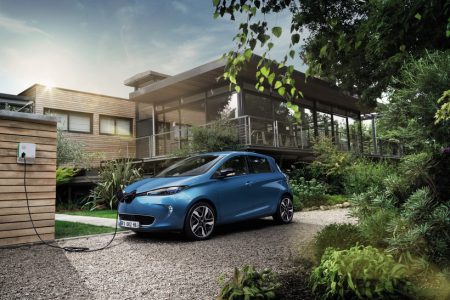
Renault ZOE
With all the talk of climate change and the Paris Agreement, ask yourself if you’ve ever heard of the Renault Zoe. Probably not. It’s an electric vehicle (EV) sold by French automaker Renault. It’s also the most popular EV in Europe and is mechanically similar to the Nissan Leaf we have here in the U.S. So why should you care about this French EV? One simple reason: Automakers are serving a global market whether they like it or not and Renault-Nissan will soon be setting the agenda for EVs around the world. Partly thanks to partnerships between Nissan, Renault and now Mitsubishi, the Zoe is the perfect barometer for global EV success or failure.
According to CleanTechnica, an EV website, of the top-selling EVs and plug-in hybrid electric vehicles (PHEV) in Europe, Renault, Nissan and Mitsubishi have the top three spots for in 2016 and that trend continues into 2017. In total, Renault, Nissan and Mitsubishi vehicles make up 6 of the top 30 spots, including some oddballs like the Outlander PHEV, Renault Kangoo ZE and Nissan e-NV200. Only VW Group has more total vehicles in the top 30.
EVs Replace Diesel?
Eventually, EVs will replace diesel as the budget and eco-friendly option. Last year, I spoke to a Renault-Nissan executive, and he said that affordable diesel-powered small cars are likely the first to gradually disappear given the stricter emissions regulations coming to the E.U. The main reason is that the cost of compliance is getting to be a serious obstacle. In short, as emissions requirements become increasingly stringent, the cost of building compliant cars will go up. The U.S. pulling out of the Paris Agreement won’t change automakers’ global strategy, but China deferring compliance until 2030 may remove some of the urgency of the agreement.
The first area to feel this will be small, typically inexpensive cars where the buyers are very price-conscious. Renault-Nissan Alliance Chairman and CEO Carlos Ghosn echoed those sentiments at a press conference at the Paris Auto Show in 2016. And judging by his comments and how he essentially spun every emissions question into a talking point about EVs and the Zoe/Leaf, the next version of that car will likely put the Renault-Nissan Alliance in the catbird seat when it comes to global EV sales.
Maybe they’re already there: If budget friendly, diesel-sipping small cars go away, the next best option for budget-strapped motorists is an EV like the Zoe. According to Forbes, Renault-Nissan is on track to sell nearly 10.5 million vehicles in 2017, second only to Toyota. Therefore, Alliance decisions and innovations are bound to have a ripple effect on the global automotive marketplace.
The new five-seater SUV is currently offered with two diesel engines, but there is scope for this to change in future
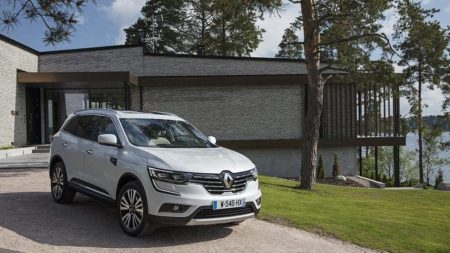
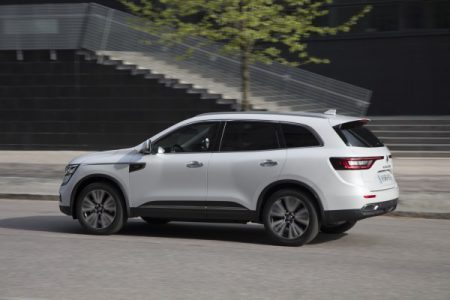
Renault Koleos SUV
A Renault director has not ruled out the possibility of a plug-in hybrid or pure electric version of its new Koleos SUV making its way into production.
The Koleos will go on sale in the UK in July, and will only be offered with a choice of two diesel engines – a 1.6-litre, 128bhp unit and a larger 2.0-litre 173bhp unit.
When quizzed on whether the recent bad press diesel has received in the UK could see an electric or PHEV version of the Koleos introduced to the market, Renault UK’s managing director Vincent Tourette said it was a possibility.
“It’s technically possible because we’re part of the alliance with Nissan and Mitsubishi now, so that’s something we have in the bank between us,”
he explained.
Renault Koleos SUV
“But at the moment, we are monitoring closely the way the market is going and if at some point we consider it’s a strong customer requirement, we will go for it. But today, it’s not in the plans.
“Today we have made the choice to offer our vehicles with petrol engines, with diesel engines and as pure EVs, which by the way, most manufacturers have decided to invest in too.
“So that’s our positioning and that’s the way our product plans have been formulated. But then we do have within the Renault-Nissan Alliance other possibilities, and if at some point we consider that [an electric/PHEV Koleos] something Renault also needs to bring to the market, we will have the possibility to do it.”