Category Archives: Electric Cars

News and reviews of the latest electric cars (full electrics and plug-in hybrids).

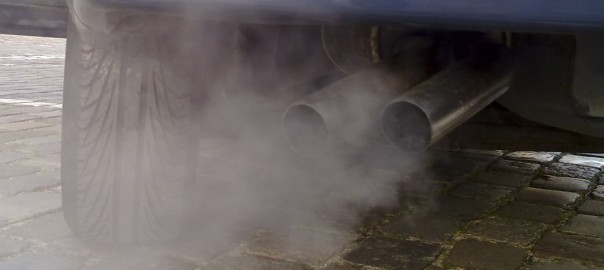
Car exhaust pollution (Image: Wikipedia)

Electric Cars: The Next Health Kick?

A 2013 MIT study concluded that in the United Kingdom more people suffer premature deaths from breathing in auto emissions than from auto accidents

Back in the 1980s, I interned at the EPA. An older employee told a story of a public hearing to illustrate how Americans are confused in their thinking about risk. The EPA was proposing a cleanup solution for a toxic waste dump which would reduce risk of premature death down to one in one million residents.
A local resident stood up and passionately argued that any risk was unacceptable, no matter the cost. “EPA has to reduce risk to zero,” she exclaimed to rousing applause.

Following the hearing, she went outside and lit up a cigarette – increasing her risk of premature death much greater than living next to this superfund site.

Americans are great at hating some risks and ignoring others.

One risk that we have collectively ignored is the health impact of automobile emissions.

Where there is combustion, there are bi-products which severely impact the human respiratory system. These emissions can cause coughing, lung irritation, lung cancer and cardiovascular disease. They can cause or contribute to premature death in the young, the elderly and individuals with respiratory issues, such as asthma, as well as cause pulmonary problems in developing fetuses.

Cars are a significant source of these pollutants. In a number of states, including my home state of New Jersey, car and truck emissions are the largest source of air pollution – greater than the power sector or industry. And in all states, pollution is elevated close to roads. The US EPA, asserts that the concentration of Nitrogen Oxide is 30 to 100 percent greater closer to highways.

So how dangerous are these emissions? Probably greater than you think.

A 2013 MIT study concluded that in the United Kingdom more people suffer premature deaths from breathing in auto emissions than from auto accidents. Closer to home, the California Air Resource Board estimates that more than 9000 California deaths a year are caused by air pollution from cars and trucks. And the American Lung Association and Environmental Defense Fund released a study in May that argues that a transition to electric cars in California would prevent 600 heart attacks and 38,000 asthma attacks annually in that state alone.

Read more: Energy Biz
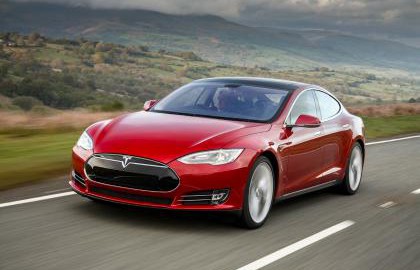
Tesla Model S (Image: AutoExpress)

Tesla announces new finance deals for Model S

Manufacturer promises to buy back Tesla Model S electric car for 50 per cent of original value

Tesla has revealed the new finance packages available to private buyers of the Model S. The company claims that the deals have been created from the ground up rather than as copies of plans offered by other manufacturers.

The financing will be offered through Tesla’s partner, Alphera Financial Services. The main news is that Tesla promises that the resale value guarantee, the price given to customers when their three-year agreement comes to an end, will be 50 per cent of the base purchase price of the 60 kWh Model S electric car.

Tesla claims that the new programme has no gimmicks, and offers customers the option to sell the car back to the company once the three years is over, or extend the hire purchase agreement for longer.

Buyers will have to put down a 15 per cent deposit initially, with the choice of a 48-, 60- or 72-month contract. With an interest of 5.9 per cent APR, monthly costs will be around £820 month. The agreement limits mileage to 15,000 miles per year, with owners charged 17p per mile if they go past this.

Georg Ell, Tesla’s UK Country Director, said:

“We understand that many customers enjoy the simplicity of a Hire Purchase but also may seek some assurance of the future value of Model S. We want to do the right thing for customers, so we’re delighted to be able to offer this transparent and fair financing programme.”

Source: Auto Express

UK electric car sales surge in 2014

Industry figures show sales growth outpacing diesel and petrol equivalents, although volumes remain small

Electric cars, hybrids and other alternatively-fuelled vehicles (AFVs) are increasingly grabbing market share from traditional petrol and diesel models, new industry figures reveal.

The latest statistics from the Society of Motor Manufacturers and Traders (SMMT) show 9,955 AFVs were registered in September, a 56% rise on the same time last year.

This accounted for 2.3% of the total market – a 44% year on year rise – in a month that saw a 5.6% rise in overall registrations compared to September 2013. Diesel and petrol vehicles saw registrations grow just under 6% and 4% respectively, but diesel’s market share remained static, while petrol fell one percentage point as a result of the growth in registrations.

According to the SMMT, 37,842 AFVs have been sold during 2014, a more than 50% increase on the same point a year ago, while market share has also grown from 1.4% in 2013 to 1.9% this year.

UK October 2014 Electric Car Sales (Image: SMMT/BusinessGreen)

An SMMT spokesman told BusinessGreen the AFV market is seeing the benefit of more models coming onto the market – there are now more than 20 plug-in vehicles available compared to six in 2011 ranging from hatchbacks and saloons to SUVs and sports cars – while consumers are increasingly aware of the advantages of zero emissions driving. He added:

“We do expect this trend to continue in the future as a number of models increases. Infrastructure is being well-supported by government at the moment, and as long as that continues there’s no reason why the market for plug-in vehicles shouldn’t grow even more in the coming months and years.”

Read more: Guardian

Tesla Model S taxi in Amsterdam (Image: Taxi Electric)

Tesla’s Model S gets new taxi role in Amsterdam

At around £50,000, a Tesla Model S is a desireable car, but hardly the sort of vehicle to bring electric driving to the masses.

As a result there are probably hundreds if not thousands of wannabe Telsa owners in the country.

But one company is giving commuters to get a chance to experience the Model S by running it as a taxi.

The Netherland’s Taxi Electric firm offers the Model S as part of its Amsterdam fleet of electric vehicles, which until now has consisted just of Nissan LEAF cars.

One of Europe’s leading markets for electric vehicles, the Model S will be right at home in Amsterdam with its new Nissan brothers; even if it is rather an unusual mini-cab.

Hiring the Model S should be easy as Taxi Electric has also just signed a deal with Cabforce – a European-wide advanced-booking service for taxis and minibuses, which helps makes it easy to book and pay for cabs while abroad.

As part of an environmentally-friendly initiative, all of the Cabforce / Taxi Electric green transport options are now flagged up under the new Cabforce Green branding.

Tommi Holmgren, co-founder of Cabforce, says:

“Our transport solutions might be green, but we’re certainly not ‘green’! We’ve got a lot of experience in this industry and we know what business travellers want – efficient, professional service with a touch of class to ensure their pre-booked journeys are always hassle free”.

Read more: Green Car Website, InsideEVs

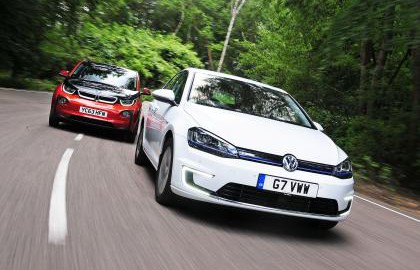
BMW i3 Goes Head-to-Head with VW e-Golf (Image: AutoExpress)

Volkswagen e-Golf vs BMW i3

Can the new VW e-Golf put battery-powered cars on the road to mainstream success? We find out as it meets the brilliant BMW i3

Electric cars have yet to spark a wholesale switch away from the combustion engine, but sales are rising and the launch of an electric version of Europe’s biggest-selling car is another example of the growing surge towards the mainstream.

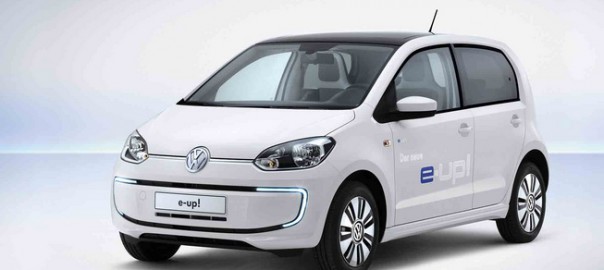
The new VW e-Golf is available to order now and follows hot on the heels of the e-up! city car. Plus, once you factor in the Government Plug-in Car Grant, the newcomer costs £25,845 – which places it squarely in the path of BMW’s new i3.

The £25,680 i3 has already impressed us with its head-turning image, cleverly packaged interior and advanced composite structure. So if you’re ready to make the switch to electric motoring, is the cutting-edge, futuristic BMW or the electrified Golf the better choice?

Read more: AutoExpress

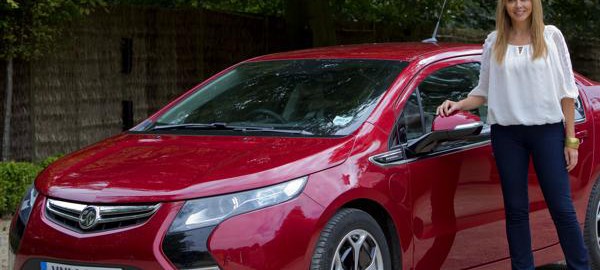
Carol Vorderman trials Vauxhall Ampera (Image: Vauxhall)

Carol Vorderman trials Vauxhall Ampera

Carol Vorderman has become the latest ambassador to test the Vauxhall Ampera extended-range electric car in support of the Go Ultra Low campaign.

Carol Vorderman trials Vauxhall Ampera (Image: Vauxhall)

Go Ultra Low, a partnership between the UK automotive industry and Government, is designed to encourage more drivers to consider ultra low emission vehicles (ULEVs). Vorderman was keen to get involved with the project, commenting:

“I’m obsessed with engines, cars and aeroplanes, and with a degree in Engineering, I’ve always been fascinated by how things work.”

As a busy working mum, the TV star was initially wary that driving a ULEV would just add to her to do list. However, after a couple of months trialling the Vauxhall Ampera she said:

“Actually quite the opposite is true, it’s easy. You come home, plug it in, you go away and come back in the morning and it’s fully charged. It gets me through the day and I don’t have to go to the petrol station which long-term, saves me a considerable amount of money.”

Read more: New Car Net

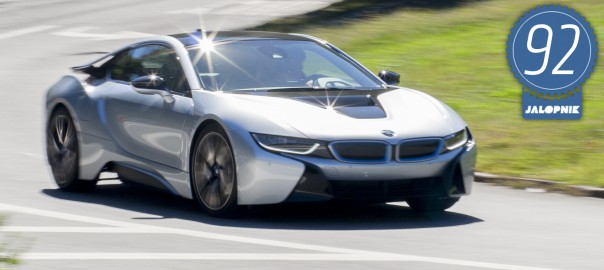
2015 BMW i8: Jalopnik Review (Imaged: Jalopnik)

2015 BMW i8: The Jalopnik Review

The BMW i8 is the most significant and forward thinking car on the road today. This is BMW’s vision of the future, and, for once, the future is no longer doom and gloom. The future is a positive, thrilling place. A place that we want to be. Don’t be scared, gearheads, we’re going to be ok.

(Full Disclosure: BMW loaned us the i8 for five days. Five days where we couldn’t go anywhere without having someone’s jaw drop with a look like the future just drove by them. And that’s because it did.)

BMW’s i division is a huge gamble by the automaker. A company that has always been known for making “The Ultimate Driving Machine” was making a move into what are called “personal mobility products.”

Sounds sexy, right?

The i3 and i8 are meant to represent the future of motoring as BMW sees it. And thankfully that doesn’t mean soul sucking boredom. In the case of the i8, we have the 1.5 liter three cylinder from the Mini — which has been turboed to hell to make 228 horsepower and 236 pound feet of torque — sitting behind the driver. That charges the battery but also powers the rear wheels. Up front there is an electric motor producing 129 horsepower and 184 pound feet of torque.

Under normal conditions, the electric motor powers the i8. It can get up to 75 MPH under electricity alone and can go for about 20 miles on a full charge with no interaction from the engine.

But that’s not all. The electric and gas can work together to change efficiency to performance. Put the i8 in sport mode or slam the pedal down, and you get pure torque from the electric motor and revvy turbo goodness from the engine. Like the McLaren P1, LaFerrari, and Porsche 918, the i8 uses its electric motor to increase performance.

Read more: Jalopnik

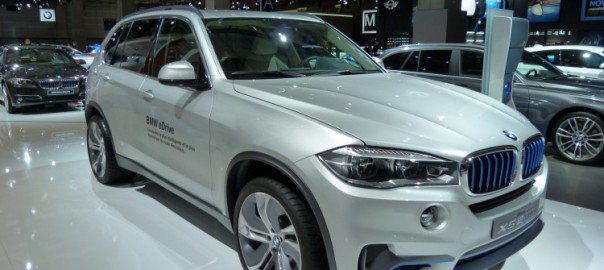
BMW X5 eDrive at Paris Motor Show (Image: BimmerToday)

2014 Paris Motor Show: BMW X5 eDrive Hybrid

BMW’s “green fleet” was represented at the 2014 Paris Motor Show not only by the BMW i3 and i8, but also by the BMW X5 eDrive Hybrid. With just a few months before its market debut, the plug-in hybrid X5 continues its auto show circuit and lands in Paris.

The X5 xDrive40e is the first hybrid X5 to be offered and it was previewed last year at the Frankfurt Auto Show.

The plugin hybrid will featured a four-cylinder petrol engine with turbocharging technology which generates, along with an electric motor, an output of 200 kW (272 hp). The standard sprint to 100 km/h is achieved by the BMW X5 xDrive40e in less than 7.0 seconds. Up to 120 km/h of pure electric drive is possible thanks to the 70 kW electric motor.

The seamless transition between electric, combined electric-petrol and pure petrol is remarkably smooth.

Visually, the plugin hybrid differs from the “regular X5″ mainly through an additional opening at the front left fender where the engineers placed a power connector for charging the high-voltage battery, which is housed in the rear of the vehicle.

To manage battery capacity BMW has created three drive modes for the X5 eDrive, Intelligent Hybrid, Pure Electric, and Save Battery. It is the Save Battery mode that highlights how BMW expects the vehicle to be used. Going into Save Battery mode restricts the use of battery capacity – allowing for a reserve to complete a journey in pure electric mode inside a city core for example.

Source: BMW Blog