Category Archives: Electric Cars

News and reviews of the latest electric cars (full electrics and plug-in hybrids).

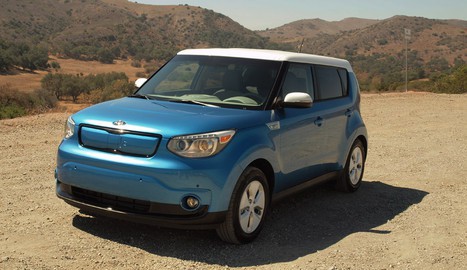
2015 Kia Soul EV Plus (Image: John Matras Media LLC)

2015 Kia Soul EV Plus review: Little feet

Hamsters, in case you haven’t noticed, have very small feet. So does the 2015 Soul EV. It’s a battery-electric vehicle, not only is it, well, sorta small, it’s carbon footprint—for those who believe—is downright tiny.

Not only does it have no “point of use” emissions—where the electricity come from is beyond its control—it’s also into eco materials and other “earth-friendly” bits and procedures.

Take the drivetrain. Under the hood of the is a liquid-cooled AC synchronous permanent magnet motor has multi-layer magnets, improving efficiency. The motor produces only 109 horsepower but it’s rated at 210 lb.-ft. of torque, and since that comes at zero rpm, the Soul EV fairly leaps off the line.

Drive is via the front wheels through a single-speed constant-ratio gear reduction unit. The faster it goes, the faster the motor spins. Period. The electric motor requires no shifting, as usual with electric cars.

Kia places the batteries for the Soul EV are under the floor. Only several inches thick, the batteries are stacked to fit under the front seats without raising their h-point, the distance of the occupants’ hips from the floor of the vehicle. The floor behind the front seat, however, is raised to allow the batteries to fit. There’s minimal reduction in rear seat leg room, however, because the seats are moved rearward, Instead of legs hanging down, the rear passengers’ feet ride further forward. The seat is still high enough—the Soul has a high seating position to begin with—and because the boxy Soul has generous head room, that doesn’t change because the rear h-point doesn’t change.

The Soul EV also puts more battery packs in the space otherwise used for the gas-powered Soul’s fuel tank, and all batteries cooled via a fan in the erstwhile spare tire well. A lot of electric conversions lose trunk space because the batteries, but because the Soul EV are under the floor and where the fuel tank would go, the rear cargo space of 18.8 cu.-ft. (with rear seats up) doesn’t change. The 120v charger also fits in the trunk in a special place under the floor.

Charging ports are behind a swing-out panel in the middle of the Soul EV’s grille. Two charging ports are standard, including a SAE J1772 port for Level 1 and Level 2 AC, and a CHAdeMo DC fast-charging port (480v).

A fully depleted battery will take 24 hours to recharge using a standard 120v outlet, but plug it into a 240v outlet and the time drops to less than five. A similarly no-charge battery can be brought up to 80-percent charge in as little as 33 minutes with a 50 kW-output DC fast charger.

Of course, no one runs a battery completely to the bottom of the electric pail, so real life charging times will be less, especially if the electric Soul driver takes advantage of opportunistic charging in mid-trip. For home charging Kia has partnered with Bosch, Leviton and AeroVironment so Soul EV owners can get the best unit for their applications…and so Kia doesn’t have to worry about stocking its own branded charger.

The 2015 Kia Soul EV can be spotted by the closed-off “tiger” grille of the standard Soul, though the outline of the grille is kept both for identity and to point out, hey, that thing ain’t got no radiator grille. Cooling air—even running batteries and the electric motor creates heat—is brought in under the front bumper.

Other cues to the 2015 Kia Soul EV are the color accent trim in the front and rear fascias, projector headlights, LED “positioning lamps”, and LED tail lights, which look like “E 3” when viewed from behind. The Soul EV gets 16-inch alloy wheels unique to the model, with super low rolling resistance (SLRR) tires that have 10 percent less drag than regular tires for better range.

The Soul EV also has “EcoElectric” badges on the front fenders for those who don’t get it otherwise. At first, the Soul EV will come in four color schemes, Caribbean Blue lower body with Clear White roof, Shadow Black lower body with Inferno Red roof, Titanium Gray, and Clear White.

The Soul EV will be offered in two trim levels, the base Soul EV and the upgrade Soul EV +, priced at $33,700 and $35,700 respectively. The EV+ will most easily identified by its standard fog lights.

2015 Kia Soul EV Plus (Image: John Matras Media LLC)

Changes in the interior go beyond the change in the rear seat. The instrument panel replaces the tachometer of the gas models with a charge/power/recharge dial. The dial also includes “fuel gauge” and a large digital number for the range in miles remaining.

Between that dial and the speedometer, the Soul EV has a 3.5-inch OLED screen that displays data on the vehicle’s energy flow, charging time, ECO driving level and energy economy, which measures how efficiently the battery is operating. It’s also where the Soul EV tells you it’s running out of battery charge, as our test vehicle did when it reached 20 percent remaining.

An eight-inch capacitive-touch navigation screen is standard on the Soul EV. The navigation system, in addition to the usual nav duties, tracks the closest recharging stations. Introduced for the first time on the Soul EV, UVO EV Services includes downloadable apps that allow EV owners to download Yelp 6, the online urban city guide, along with iHeartRadio digital radio service, and Sound Hound, which listens to what’s playing and displays all related information such as lyrics, the artist, title and album cover art.

Interested in reducing your “carbon footprint”? The 2015 Kia Soul EV helps with what it’s made of. Instead of petroleum based fabrics, the headliner uses stuff made from corn and sugar.

The Kia Soul EV with a heat pump instead of conventional (for electric vehicles) electric resistance heating. Air conditioning and heating are a big drain on battery life, Kia runs the usual a/c compressor “run backwards” to operate as a heat pump. The Soul EV also has a setting for just the driver, directing heated/cooled air at the driver only, for solo driving or when the driver is feeling particularly selfish.

The HVAC system can also be scheduled to pre-heat or cool the passenger compartment while the Soul EV is still plugged into the charger, so you can drive off fully charged, and not have to consume battery charge on heat up/cool down. Air intake control regulates inner and outer air flow to reduce HVAC usage, regulating interior temperature by carefully managing recirculated cabin air. Still, range will be affected by ambient outdoor air temperature.

According to Kia, the 2015 Kia Soul EV has a range of about 93 miles. That’s conservative, per the distance we drove. Unfortunately, we didn’t take note of exactly how far we travelled, but we were approaching that distance when the Soul EV gave us the 20 percent warning.

Otherwise, the 2015 Kia Soul EV impressed us with its transparent operation. Other than being quieter, there was little reason to think that the Soul EV was anything but a regular everyday automobile. Well, the silence and that the Soul was, in a word, slow. Kia says zero-to-sixty takes about 12 seconds. It sucks up battery charge, of course, to do that, so most people won’t. But merging into fast traffic will require planning, even if it’s easy to accidentally cruise at hyper-legal speeds, thanks to the Soul EV being so quiet.

Drivers can extend range with a mode selection, however. The standard drive “D” mode imitates what drivers are used to, with an easy coast-down. ActiveEco, set via pushbutton, increases regenerative braking over standard drive, and slows accelerator tip in. Placing the shift lever in “B,” however, greatly increases regenerative braking, which allows “one-pedal” driving. Lift the pedal and the car slows as if the regular service brakes were used.

That’s probably the way hamsters would drive. Or maybe not. You never know with hamsters. Except that when they drive a Kia Soul EV, they have a very small carbon footprint.

Source: Examiner
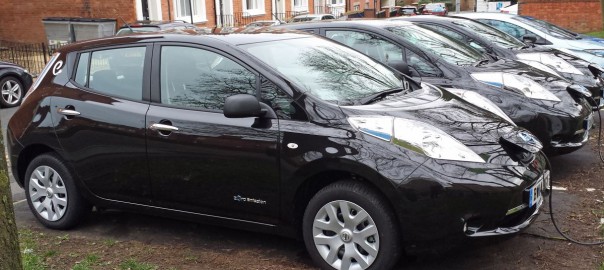
e-Car Club Nissan Leafs outside Northampton Derngate (Image: T. Larkum)

Hybrid sales down, but EVs rise despite lower gas prices

Somewhat surprisingly, hybrids that still use gas, but don’t need recharging, took the biggest hit.

Cheap gas will kill sales of hybrids and electrical vehicles conventional wisdom holds, but a closer look at the numbers through November shows a more complex picture.

Somewhat surprisingly, hybrids that still use gas, but don’t need recharging, took the biggest hit. Through 2014’s first 11 months, gas-electric hybrid sales fell 9% to 418,850, according to hybridcars.com, slipping to 2.8% of the total U.S. light-vehicle market from 3.2% a year earlier.

Plug-in hybrids and pure battery-driven models actually had a strong year. Sales of plug-in hybrids jumped 17% to 51,490 and sales of battery electrics rose 31% to 55,906, of which the Nissan Leaf accounted for nearly half (27,098). Leaf sales were not only up 35% for the first 11 months, they were up 34% in November when gas prices were well into their decline.

e-Car Club Nissan Leafs outside Northampton Derngate (Image: T. Larkum)
Nissan Leaf (Image: T. Larkum)

But alternative propulsion represents a sliver of our automotive landscape. The internal combustion engine, even if the current glut of crude oil vanishes by March, will be the dominant powertrain for years to come.

The Obama administration’s goal of 1 million battery-only and plug-in electric vehicles on U.S. roads by 2015 will not be achieved.

So this may not be the best time to buy your first shares of Tesla Motors, although they have fallen about 25% from an early September peak of $286.

General Motors is to unveil an upgraded Chevrolet Volt at the North American International Auto Show this month into a headwind of the lowest gas prices since the bad old days of late 2008.

But there are still folks out there for whom saving a few hundred dollars a year is not enough. They’re looking to kick the fossil fuel habit altogether and there are more choices for them.

While Volt sales have tumbled 16% from 2013, Ford more than doubled sales of its Fusion Energi plug-in to 10,761. Toyota sold 14% more of its Prius plug-in (12,772 through November).

The less consumers pay at the pump the more likely they are to opt for size and power over fuel economy. Sales of pickups, SUVs and vans outnumbered passenger cars again by 52% to 48% through November. December sales, which automakers will release Monday, likely will show that trend will grow stronger.

Most every new model, regardless of its size, offers significantly better mileage than the one it replaces because of a combination of reduced weight and more-efficient engines.

Even so, the average fuel economy of vehicles sold in the U.S., which had risen 26% over the past seven years, fell to 25.3 m.p.g. for November from 25.8 in August, according to data compiled by the University of Michigan’s Transportation Research Institute.

So the longer gas prices stay low the more difficult it could be for automakers to meet the federal government’s fuel economy standards.

The Obama administration, under a law enacted under the Bush administration in 2007, requires the average fuel economy of cars and light trucks sold in the U.S. to rise annually and hit 34.1 m.p.g. by 2016. The target rises to 54.5 m.p.g. in 2025.

But the law called for a “midterm review” before the 2017 model year to determine whether to ease the standards based on consumer habits, gasoline prices and other factors.

Don’t be surprised if automakers start suggesting soon that such a review be in the direction of a less-ambitious standard.

Source: Detroit Free Press

Tesla Opens 20th Supercharger Station in the UK

Tesla Opens Its 20th Supercharger Station In The UK

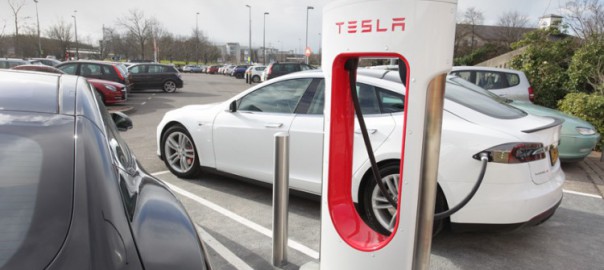
Tesla announced that it energized its 20th Supercharger station in the UK and is on schedule to reach full coverage by the end of 2015.

“Today, Supercharger stations are available at Sainsbury’s supermarkets in Winchester, Exeter and Bristol. Tesla also recently opened stations at Junction 15 of the M1 near Northampton and Brent Cross shopping centre in North London.”

The total numbers for the world already exceed 300 stations and 1,600 Supercharging points.

Tesla Opens 20th Supercharger Station in the UK

More than 40% are installed in Europe – 129 stations with over 670 Supercharging points.

Source: Inside EVs

2015 VW Golf 7 GTE (204hp)

Automann-TV

Fast Autobahn acceleration test of the 2014/2015 Volkswagen Golf 7 GTE with the twin engine concept delivering 204 hp and up to 350 Nm of torque. While the 1.4 TSI with 150 hp is already not really slow, they added the 102 hp electric motor out of the e-Golf to make this a proper GT(E). As you can see, this car really pulls once you put it in “B” (Boost?) and GTE-mode. I don’t really know why it is significantly faster than what VW claims but it also feels like more than 200 hp! Especially as I tested the Golf 7 GTD and GTI (220hp) I can tell that this hybrid is very close to the GTI! Besides that you get an “E-Mode” that let’s you accelerate pretty decent up to 130 km/h and drive totally quiet in cities….I personally like it! On top of that you get the quick shifting DSG (6-speed) that also shifts in E-Mode…very cool!

See also: Gas2.org: Is The Volkswagen Golf GTE As Fast As The GTI?

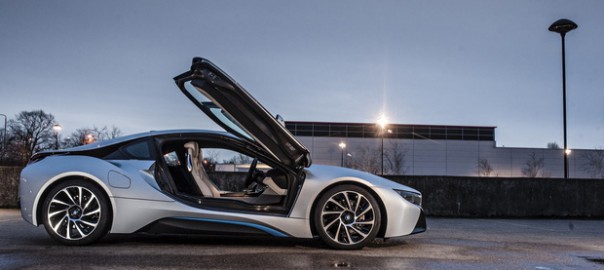
On the road: BMW i8 (Image: The Guardian)

BMW i8: Reviewing The Car Of Tomorrow

We were promised flying cars, teleportation and hover boards. We don’t have any of that. But now we have this: The BMW i8 and it’s a future that cannot get here soon enough.

My body hurt. My mind was numb. I had just spent a week in Las Vegas for the Consumer Electronics Show and was ready to fly home. But first I had to drive a brand-new 2015 BMW i8 to L.A. It’s a rough job, but someone has to do it.

The i8 is BMW’s latest supercar, able to go 0 to 60 in about 4.4 seconds with its hybrid electric/gas powertrain. The i8 looks like a Hot Wheels car, handles like a supercar and is as expensive as a high-end Porsche. With a starting price of $135,000, this isn’t the car for everyone. It’s actually a gateway into BMW’s other hybrid, the cute and cheap BMW i3, a shorter, sporty runaround that BMW is touting as their answer to crunchy hybrids from Honda, Nissan, and Chevy.

I set out, gassed up and fully charged. My time with the i8 was short. I had already spent several days cruising around Vegas where the i8 got more attention than the volcano in front of the Mirage. The car stopped traffic. People gawked from sidewalks and leaned out of cabs to snap pictures.

Stopping at a gas station was an exercise in patience. Everyone had to take a picture and tell me a story about a car they once loved but totaled. It got the most attention parked at a hotel across from CES where most thought it was part of BMW’s trade-show exhibit.

Nope, she was all mine for the next couple of days.

Since the i8 lacks a proper trunk, I jammed my luggage in the back seat and took off to LA down I-15. The sun was shining and the traffic was light. I didn’t plan on taking the quick route all the way to my airport hotel some hundred miles away. Nope, I had all day to get there and was going to make the most of my time with the i8. I turned off the expressway at the first sign of the Mojave National Preserve and found what I was looking for: empty desert roads. I smiled and I assume the i8 did as well.

It’s astounding BMW made the i8 at all. It’s a concept car turned production car. BMW released the stunning concept in 2009 at the height of the recession. Now, some five years later, I’m sitting on the side of an empty road with the i8’s scissor doors open and admiring the desolate beauty outside Las Vegas. All I can hear is a slight whine from the hybrid electric powerplant ready to be abused.

Nestled somewhere within the i8’s frame is an electric motor and tiny 3 cylinder, 1.5L turbocharged engine. They work in tandem to power the i8. The results will make treehuggers and gearheads equally happy.

When driven in hybrid mode, the i8 is quick and plentiful. It can go about 15 miles on effectively just electric power. When the gear shift lever is kicked over to sport mode, the i8 becomes exhilarating.

In either mode it’s quick off the line and at speed. Stomp the right pedal to the floor and the i8 flies to 60 mph in 4.4 seconds. Even more impressive, though, is when passing is required. As I understand it, the powertrain uses the electric motor to give the moving car an instant boost and then seconds later the 3 cylinder engine takes over. The car leaps forward with supercar might and plants occupants into the seats.

The car simply thunders when driven in sport mode and hugs the roads like a modern supercar should. BMW piped some of the engine noise back into the cabin through the audio system. Sure, that might be cheating a bit, but the notes are genuine and raw. I found the sound to be the most surprising thing about the i8. I simply wasn’t expecting the hybrid to sound so mean.

Read more: Tech Crunch

2015 Volkswagen e-Golf First Test: A Wintry Week Spent e-Golfing

Temperatures in the teens and 20s don’t make for ideal electric-vehicle driving conditions, but that was the weather presented during my week in Motor Trend’s electric Car of the Year. How’d it work? Way better than expected in every way except range, which plunged about as much as we were told to expect.

VW rates the e-Golf’s real-world range at 70-90 miles, the EPA says 83, and the range-remaining display generally started out saying 65 miles on these cold mornings, when started in the Normal driving mode. This mode automatically dials up a cozy 72 degrees on the climate control system, which is warmer than I would usually set it, but it refuses to remember my 69-degree setting upon restart. (Eco reduces the climate control power, and Eco+ switches it off, increasing the remaining range.) When I hit the buttons for electric windshield, rear-window, and side-view mirror defrosting, as well as both front-seat heaters, one morning, that range estimate dropped to as low as 48 miles briefly, but minutes later, as I toggled off the high-power glass heaters, the range rebounded to well into the 50s.

Read more: Motor Trend

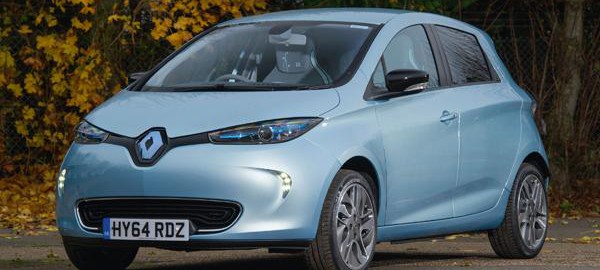
Renault ZOE EV

Next-Generation Renault ZOE With Real-World Range Of 186 Miles

Interesting and potentially huge news is coming out of France in regards to the new, next generation Renault ZOE and next-gen Nissan LEAF.

According to Les Echos, the new versions of both models will be ready in 2017 with double the range of today’s Renault-Nissan electric cars.

In the case of the next-gen ZOE, Beatrice Foucher, Director of Renault’s electric program, stated that the aim is 300 km (186 miles) of real-world range (and 400 km stated on NEDC).

The current generation of ZOE can go 210 km (130 miles) in NEDC testing.

Nissan apparently could equip the new LEAF with a 48-kWh battery pack, according to the report out of France.

Les Echos sees progress in battery technology, as well as in falling prices per kWh – from $1,000 in 2010 to $400 in 2014 and $180 in 2025 (forecast).

Source: Inside EVs

The Electric Vehicle: Celebrating Five Years of Progress

Towards the end of 2009, zero-emission electric cars were little more than concept cars. At that year’s Frankfurt motor show Renault displayed four electric prototypes – the Fluence, Z.E sedan, the Kangoo Z.E van, the Twizy tandem two-seater and the ZOE subcompact… but that’s all they were: ideas. Electric cars were an utopian dream, something for the sci-fi magazines.

What a difference five years makes. Today electric cars are a reality. Manufacturers, led by Alliance partners Renault and Nissan, have a growing number of pure electric vehicles on sale – indeed, the trail-blazing Nissan LEAF is the world’s bestselling EV.

Major cities across the globe all have extensive recharging posts in place, and extended fast charging networks now link countries. Electric bikes and scooters are readily available and Renault is behind a global single-seat motor racing championship purely for electric vehicles – Formula E.

Cities and towns in France – 18 in all, including Paris, Lyon and Bordeaux – have car-sharing programmes, called Autolib, based around electric vehicles. EVs have caught on in London, too, where the electric Nissan e-NV200 has been developed into an iconic black cab and is due to start taking fares next year.

So what’s going to happen between now and 2020? There can be no doubt that charging networks will continue to expand and sales of EVs will rise and rise. And, who knows, electric vehicles might no longer need humans behind the wheels. Autonomous cars might be at the concept stage at the moment… but as we have seen, a great deal can happen in five years.

Source: Renault-Nissan Blog

UK electric fleet passes 24,500 mark

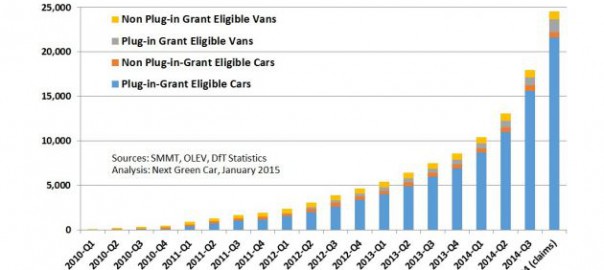
With the recent announcement from Office for Low Emission Vehicles (OLEV) that 23,083 claims have been made through the Plug-in Car Grant scheme, the total number of electric cars and vans in the UK is about to exceed 24,500 vehicles for the first time.

uk-registered_ulevs_2010-2014-3_NGC

These figures are supported by the Society of Motor Manufacturers and Traders (SMMT) which reports that 19,972 plug-in cars were registered in the UK by the end of 2014.

Taken together with the fact that at least 1,467 electric cars and vans which are not eligible for the Plug-in Grant scheme have also been registered, the total UK light-duty electric fleet will number at least 24,550 in the coming weeks as vehicles are delivered and formally registered for use on UK roads.

Given that the figure for the number of non-OLEV eligible registered EVs takes longer to become publicly known, it is highly likely that the total number of registered ULEVs in the UK now surpasses 25,000 vehicles in total (cars and vans).

Another indicator that the electric market is growing in strength is the number of fully electric and plug-in hybrid models available in the UK. While only 9 EVs were available for the major manufacturers in 2011, this increased to 18 models in 2013, and now stands at 29 high-quality, fully crash tested cars and vans with more models due for launch in 2015.

Dr Ben Lane, Director of Next Green Car said:

“The number of EVs registered in the UK continues to grow exponentially demonstrating that UK car buyers are continuing to embrace the EV revolution.

“Reports from new EV owners suggest that, rather than economic or environmental arguments, it is the dramatic improvement in driving experience that it really starting to change perceptions about electric power-trains.

“Recent research from Nissan also shows that driving range is much less of an issue than previously thought with European owners of Nissan LEAFs travelling more than 50% further per year (10,307 miles) than the European average for a petrol/diesel vehicle (6,721 miles).”

The latest EV model entrants include the Tesla Model S and Mitsubishi Outlander PHEV which have already made their mark in the UK market. Other high-quality models now available include the Kia Soul EV (which NGC range-tested in December 2014) and the Nissan e-NV200, the latter bringing all the benefits of electric to the small van market.

Source: Next Green Car