Category Archives: Electric Cars

News and reviews of the latest electric cars (full electrics and plug-in hybrids).

Renault unveils a unique documentary: The Electric People

[Note that although the video is in French, you can switch on Captions and through the YouTube Settings button you can set it to auto-translate to English]

electric_people_doc_renault

From 8 to 28 July 2015, Sandra Reinflet (writer, singer and photographer) and Mathilde Terrier (journalist) took ZOE out on a most unusual Tour de France. The challenge would be to find electricity for charging the car every 150 kilometres along the way, with the help of the growing community of ZOEnautes and other electric car buffs. The three-week adventure gave rise to a documentary portraying this pioneering movement, along with its values and its commitment to progress and the environment.

For COP21, an event on which it is an official partner, Renault is proud to unveil this unique film, which will also be shown at the major climate conference.

Summer 2015, Sandra and Mathilde set out into uncharted territory with their Renault ZOE, roaming the roads throughout the country and knocking on the doors of total strangers, members of the electric vehicle movement. A strong community spirit would ensure there was always a power outlet available for recharging their batteries.

It was an original way to show that you can go far with an electric car, and meet a lot of interesting people along the way.

You can view the whole film on this remarkable journey at www.LePeupleElectrique.fr.

See these videos for more on Renault France YouTube channel:
– trailer: https://youtu.be/9GFz9jmqMl4
– teasers: https://youtu.be/dapVywKyAGQ and https://youtu.be/vp4NGU0ByN8
– film : https://youtu.be/4G-oWvguLig

It paints portraits of these electric vehicle pioneers. They’re all very different, but what they have in common is that they’ve stopped being mere bystanders and decided to take an active part in the shift toward environmental responsibility.

For some behind-the-scenes insights into this unique experience, don’t miss Sandra Reinflet’s talk at the COP21 Solutions exhibition in the Grand Palais, from 11:30 to 12:00 on Saturday 5 December.

Source: Renault Media
Second-life batteries used in electric van

Carwatt presents a unique automotive application for second-life batteries from electric vehicles

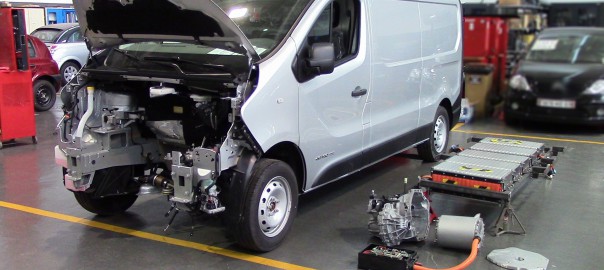
On the sidelines of the COP21 summit, in the Solutions Gallery running from 2 to 9 December 2015 in Le Bourget near Paris, Carwatt and its partners —Renault, Paris City Council, BPI France, the Alès École des Mines Engineering School, and the Bobigny Business Campus — are showing a very special electric Renault Trafic. This prototype vehicle, the only one of kind in the world, is powered by second-life lithium-ion batteries recycled from Renault electric cars.

73952_global_eTrafic_Renault

Circular economy at work with electric vehicles

When, over time, the batteries of a Renault electric vehicle fall the performance threshold specified for their initial automotive power duty (around 75% of initial capacity), they can still provide valuable service in “second-life” applications before end-of-life disposal at a recycling centre. Experiments are already under way on power storage applications, for example.
Carwatt develops innovative applications for using these batteries to convert used urban commercial vehicles into electric vehicles. In giving a second automotive life to these batteries, Carwatt provides a good illustration of the founding principles of the circular economy, in that the whole-lifecycle battery value is optimized through successive usages.

Lower pollution and less expense

Electric conversion of urban commercial vehicles reduces investment levels as well as makes a concrete and immediate contribution to reducing urban pollution levels, since 94% of commercial vehicles are diesel-fuelled. In 2016, Carwatt and Paris City Council will be experimenting with other Renault commercial vehicles converted to run on electricity.

Source: Renault Media

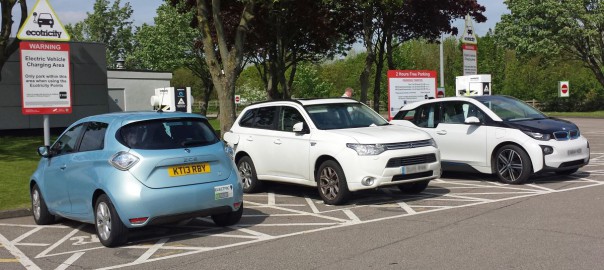
My ZOE plus an Outlander PHEV and i3 charging at London Gateway (Image: T. Larkum)

EV Spotting

I see more electric cars on the road every day now, they are no longer the novelty they used to be. In my area I see many Nissan Leafs and a few ZOEs. And, of course, it seems like the Mitsubish Outlander PHEV is everywhere!

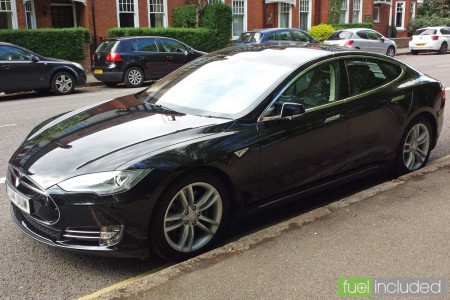
I saw my first Tesla Model S in my hometown of Northampton a few months back – that seems like a milestone of sorts.

Tesla Model S in Northampton (Image: T. Larkum)

A week later I was travelling down to London and called in to the London Gateway services for a charge. By the time I had finished and was packing up to leave I had been joined by an Outlander and a BMW i3, all 3 cars lined up in a row at the chargepoints. Hopefully such a tableau will be commonplace in the future.

My ZOE plus an Outlander PHEV and i3 charging at London Gateway (Image: T. Larkum)

Of course, it did highlight that only the ZOE has its charging socket at the right end!

Government Autumn Statement on Transport

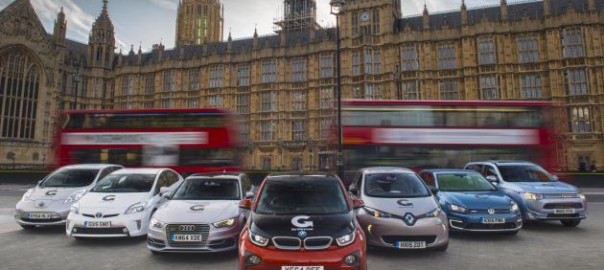
The government will spend more than £600 million between 2015-16 and 2020-21 to support uptake and manufacturing of ultra-low emission vehicles (ULEVs) in the UK, maintaining the global leadership that has seen 1 in 4 of all European electric vehicles built here and keep the UK on track for all new cars to be effectively zero emission by 2040.

goultralow2015_EVs_parliament_GUL

This investment will save 65 million tonnes of carbon and help deliver the Long Term answer on urban air quality.

Source: Gov.uk

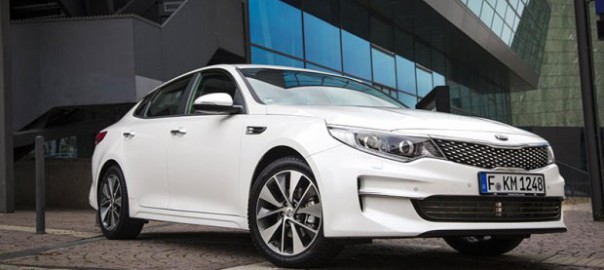
2016 Kia Optima (Image: Kia)

New Kia Optima to feature plug-in PHEV

Fleet and business users will be the target for Kia dealers as they open order books for the all-new D-segment Optima saloon. The diesel-engined version of the all-new Optima goes on sale at prices from £21,495-£28,895 in January and will joined later in the year by the brand’s first plug-in petrol-electric hybrid (PHEV) to be sold in Europe.

2016 Kia Optima (Image: Kia)

The latest Optima offers sharper styling, higher quality, new technology and significantly better economics, with fuel efficiency improved by up to 25% along with substantial reductions in CO2 emissions.

All launch versions of the car use the 1.7-litre CRDi turbodiesel engine which has had its power increased by five horsepower to 141PS. Torque gains are higher, a 15Nm increase to 340Nm and available at a lower 1750rpm.

The Optima PHEV will feature a 9.8 kWh lithium-polymer battery back, paired with a 50 kW electric motor and 2.0-litre GDI petrol engine. Kia is claiming a 27 mile range on electric charge alone.

Kia said the PHEV would deliver a combined fuel figure of 119mpg with engineers targeting 48mpg combined in charge-sustaining mode. Charging times range from less than three hours at a 240V Level 2 charging station or nine hours from a standard 120V power outlet.

Read more: MotorTrader

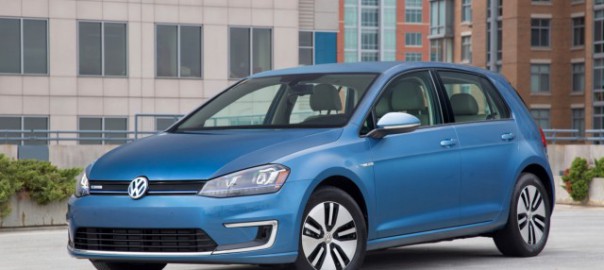
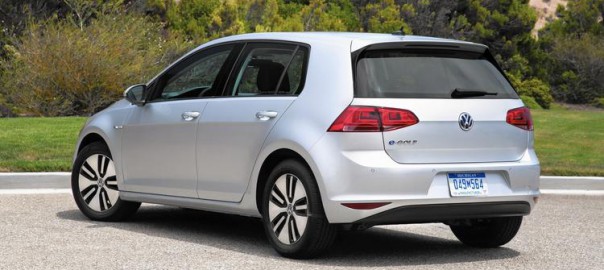
2016 Volkswagen e-Golf

Volkswagen To Increase Electric Drive Spending By €100 Million

Volkswagen’s strict financial position after Diesel Gate carries with it serious consequences.

2016 Volkswagen e-Golf

CEO Matthias Müller recently announced a reduced level of spending for 2016 of €1 billion.

Some investments are on hold, delayed, reviewed or switched to other areas.

“The Volkswagen Group is aligning investment activity in its Automotive Division with the current situation. The aim is for planned investments in property, plant and equipment, investment property and intangible assets, excluding capitalized development costs (capex), to be capped at approximately EUR 12 billion next year. The average figure for the previous planning period was about EUR 13 billion per year.”

Matthias Müller, Chairman of the Board of Management of Volkswagen said:

“We are operating in uncertain and volatile times and are responding to this. We will strictly prioritize all planned investments and expenditures. As announced, anything that is not absolutely necessary will be cancelled or postponed.”

Alternative drive technologies seem to be among the “absolutely necessary” group because those technologies will get an additional €100 million in 2016. Volkswagen, Audi and Porsche will have green lights to introduce more plug-ins, but not all EVs will be able to go ahead at full speed as the electric Phaeton project announced earlier will be delayed.

Read more: Inside EVs

You can charge a Renault Zoe faster in Germany

Renault Germany entered into a partnership with a company specialized in electric transport solutions to test a system that would reduce the charging time for electric cars.

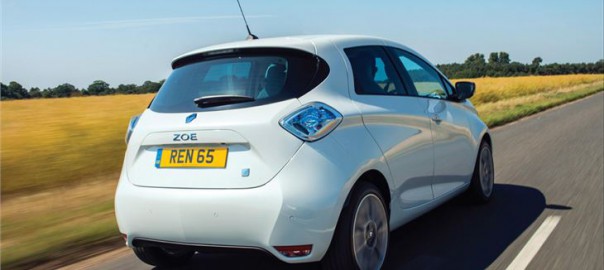
Renault ZOE
Renault ZOE

Electric cars’ charging times are the main drawback of such vehicles. You have to be really patient when you plug in your car, and when you are in a hurry, such patient does not last for long. Electric car owners appreciate reduced charging times for their vehicles, and even more so reduced charging cost. To test such a system, Renault Germany teamed up with The Mobility House (based in Zurich and Munich), which specializes in electric transport solutions such as smart charge terminals and energy storage systems. The Mobility House (TMH) has developed a technology that substantially reduces the charging cost for the customer, as well as shortening the charge time by an hour. Eleven ZOE owners, working at Renault in Germany, were selected to test the system developed by TMH under real-life conditions.

Once plugged into a special charge station at the ZOE owner’s home, the car communicates its electricity needs via a Renault Global Data Center to TMH, which schedules vehicle charging on the basis of energy cost data. Electricity from the grid costs more during high demand periods and less when demand is low, so the system detects consumption peaks and stops charging until the cost falls. Fast charging then proceeds, at lower cost, until the car batteries are fully charged.

This technology enables electric car owners to optimize their electricity expenses without the trouble of having to calculate peak and trough demand periods themselves. It marks the first stage in forthcoming development of “smart grids”. Renault and TMH are also working together on other solutions for reducing charging costs, and offering electric vehicle owners ways to earn money by generating electricity to be fed into the grid.

Source: IN Auto News

The 2016 VW e-Golf is a spirited runabout that makes almost no compromises in terms of performance, comfort or cargo space (Image: Volkswagen of America Inc.)

Car review: VW’s all-electric e-Golf is zippy and roomy

In light of the still-widening diesel emissions scandal, it’s no surprise that Volkswagen came to the Los Angeles Auto Show promoting an electric car.

The 2016 VW e-Golf is a spirited runabout that makes almost no compromises in terms of performance, comfort or cargo space (Image: Volkswagen of America Inc.)

The German car company brought a fleet of the sporty e-Golf battery electric vehicles to the show, eagerly throwing the keys to anyone willing to take a test drive.

The car is worth promoting. The VW e-Golf is a spirited runabout that deserves its place in the popular Golf family. In going electric, it makes almost no compromises in terms of performance, comfort or cargo space. It looks like a Golf, and it runs like a Golf.

And like most battery electric vehicles, it costs too much, takes too long to recharge, and has too little range.

Volkswagen, though seemingly late to the battery electric game, has been testing fully electric prototypes since the 1980s. Introducing the e-Golf as a model year 2015 car, it’s now entering a crowded field. I count more than a dozen contenders, among them league leaders Tesla Model S and Nissan Leaf.

Other than the Tesla — which can drive three times farther than any other BEV but also costs at least three times more — electric cars on the market include the Fiat 500e, BMW i3, Chevy Spark, Ford Focus, Kia Soul, Mitsubishi i-MiEV, Smart EV and Mercedes B-Class.

The e-Golf lands near the top in terms of range, a promised 83 miles between charges — not far behind 93 for the Kia, 87 for the Fiat, 85 for the Mercedes and 84 for the Leaf — and in the middle in terms of price, less than the BMW or Mercedes, about the same as the Fiat and the Kia, and well above the Ford or Chevy.

Read more: LA Times

Car exhaust (Image: BBC)

Diesel cars hit by Chancellor’s Spending Review

In a surprise move, Chancellor George Osbourne has announced that the three per cent diesel supplement in company car tax will remain in place until 2021, cancelling plans to drop it next year.

Car exhaust (Image: BBC)

The announcement was made in today’s (Tuesday 25th November) government Spending Review, which also confirmed that the Office for Low Emission Vehicles (OLEV) will not see cuts to its budget which provides subsidies for electric vehicles (EVs) and charging infrastructure.

The current company car tax system sees diesel cars subject to a three per cent supplement over petrol models, and there were plans to remove this in April 2016. This would bring BIK tax levels for petrol and diesel cars, with emissions in the same tax band, to the same level.

However, potentially in response to the recent VW emissions scandal, George Osbourne has decided to scrap the cut and the three per cent supplement will remain until spring 2021 – earning the Treasury an additional £1.36 billion over the course of five years.

The emissions scandal might have had a significant role to play in the change in decision, along with the need by the Chancellor to find extra resources after expected cuts in a number of sectors were not as bad as first thought. One factor that definitely helped change Osbourne’s mind though was the uncertainty as to when the new, more rigorous EU Real Driving Emissions (RDE) test comes into effect, and how strict it will be.

Osbourne said:

“The development and sale of Ultra Low Emission Vehicles will continue to be supported, but in light of the slower-than-expected introduction of more rigorous EU emissions testing, we will delay the removal of the diesel supplement from company cars until 2021.”

Read more: Next Green Car