Earlier this month, wee flew out out to Germany to test the new 530e iPerformance in the German Alps and on the Autobahn to demonstrate its impressive capabilities.
The BMW 530e sets a best in class pure electric range at 50 km or about 30 miles, and Bavarian engineers say this longer pure electric range should allow most owners to commute to work without using any petrol.
As for its power source, trailblazing BMW eDrive technology teams up an eDrive electric motor with a 4-cylinder 2.0-liter TwinPower Turbo combustion engine to create an exceptionally efficient and powerful plug-in hybrid drive system.
OPINION: The 2006 documentary film “Who Killed the Electric Car?” presented a fairly depressing account of why electric vehicles are rarely seen on our roads.
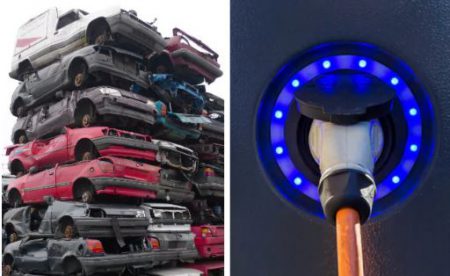
The message was that we could have them, but big business didn’t want us to have them. General Motors had developed an electric vehicle, the EV-1, which customers drove on a lease agreement, and absolutely loved, until GM took them all back and unceremoniously crushed them.
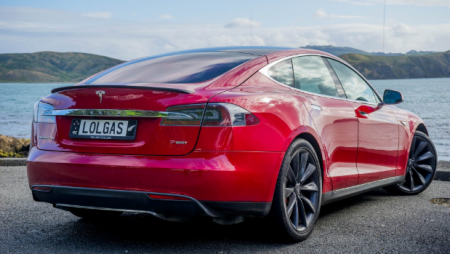
An electric Tesla 3 with a licence plate that cocks a snoot at the internal combustion engine.
Something has changed since that documentary was produced. Now it seems like big business does want us to have electric vehicles. GM would love to sell you one today, if you were in the United States, and there is no shortage of options for those of us in New Zealand. BMW have a very BMW-like electric car, with Nissan and others looking after more budget conscious drivers.
However, the reason for the change falls short of a fascinating tale of intrigue involving globalist powers living high on oil riches. There is money involved, but at the root of it all are, rather anticlimactically, science nerds developing battery chemistry, and engineering nerds building factories to produce what the scientists come up with.
The fact is that there has only ever been one problem with electric vehicles: the batteries. It turns out, thanks to nature, that storing lots of electrical energy in a small volume that doesn’t weigh a huge amount, is very difficult. On the flip side of this we have oil which, thanks to nature, it turns out is really very easy to do the same with. Early on we sensibly went all in for the oil option, because it was there, big companies could sell product and make money, and consumers were happy.
The rate of battery development was no doubt hurt by our love of oil, but it didn’t stop. In fact, there was an unexpected saviour of the electric car, which began its heroic march in the 1990s, in the form of an army of laptops and mobile phones.
SINGAPORE/KUALA LUMPUR: Demand for petrol in Asia may peak much earlier than expected as millions of people in China and India buy electric vehicles over the next decade, threatening wrenching change for the oil industry, oil and auto company executives warned.
They said refiners should prepare for a future in which petrol, their biggest source of revenue, will be much less of a cash cow.
Change is being prompted by policy moves in India and China, where governments are trying to rein in rampant pollution, cut oil imports, and compete for a slice of the fast-growing green car market.
Refiners should prepare for a future in which petrol, their biggest source of revenue, will be much less of a cash cow as electric vehicles gain traction. — Reuters
In its “road map”, released in April, China said it wants alternative fuel vehicles to account for at least one-fifth of the 35 million annual vehicle sales projected by 2025.
India is considering even more radical action, with an influential government think-tank drafting plans in support of electrifying all vehicles in the country by 2032, according to government and industry sources interviewed by Reuters late last week.
“We will see a clear shift to electric cars. It’s driven by legislation so electric cars are coming, it’s not a niche anymore,”
Wilco Stark, vice president for strategy and product planning at German car maker Daimler, told Reuters.
Stark and other executives were interviewed during the Asia Oil & Gas Conference in Kuala Lumpur this week.
Daimler sees electric vehicles contributing 15% to 20% of its overall sales by 2025 and at least an additional 10% of sales coming from hybrids, he said.
Electric cars currently make up less than 2% of the global car fleet, and any faster-than-expected growth in that percentage will materially impact oil demand and the refining business.
No more petrol or diesel cars, buses, or trucks will be sold anywhere in the world within eight years.
The entire market for land transport will switch to electrification, leading to a collapse of oil prices and the demise of the petroleum industry as we have known it for a century.
Are fossil fuelled cars set to become extinct?
This is the futuristic forecast by Stanford University economist Tony Seba, founder of technology consultants RethinkX . His report, with the deceptively bland title Rethinking Transportation 2020-2030, has gone viral in green circles and is causing spasms of anxiety in the established industries.
Prof Seba’s premise is that people will stop driving altogether. They will switch en masse to self-drive electric vehicles (EVs) that are ten times cheaper to run than fossil-based cars, with a near-zero marginal cost of fuel and an expected lifespan of 1m miles.
One by one, EVs are decimating records set by internal combustion engine vehicles. NIO/NextEV’s $1.48 million electric supercar, the NIO EP9, has set a new lap record around one of the world’s most famous and grueling racetracks, the Nurburgring Nordschleife.
The car managed a time of 6:45.90, which is the fastest lap ever set by an electric vehicle around the track – and in fact is faster than any production vehicle, electric or otherwise, beating the Lamborghini Huracan Performante by just over 6 seconds.
This would be the fastest lap ever done by any production vehicle – assuming we count the EP9 as a production vehicle. Currently, NIO has built seven EP9s, and plans another production run of ten more cars. While this is certainly a small number of units, other cars with smaller production runs (and similarly-high prices, like the McLaren F1 XP5 prototype, of which 5 were built) have qualified as “production” vehicles for these purposes, so the EP9 probably deserves the title.
We haven’t seen the new lap yet, but NIO plans to release a video sometime within the week. For now, have a look at their edited video of the previous EV-record-setting lap here:
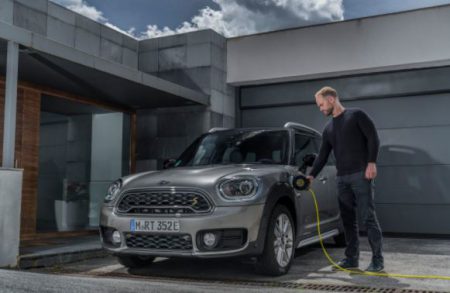
MINI has released full specs, further details, and an extensive photo gallery ahead of the launch of its first production plug-in hybrid – the MINI Cooper S E Countryman ALL4 plug-in hybrid.
The MINI Countryman PHEV (which is the name we are going with from here on out), begins sales in Europe and the US and in June.
In UK prices (without plug-in car grant) start at £31,585 OTR (‘On-the-road’).
MINI Cooper S E Countryman ALL4
MINI Countryman PHEV quick specs:
all-wheel drive with 1.5L 3-cylinder TwinPower Turbo Technology petrol engine (100 kW/136 hp), 6-speed Steptronic automatic transmission and 65 kW (87 hp) electric motor. System output of 165 kW/224 hp and 385 Nm.
up to 42 km (26 miles) of all-electric range NEDC – one can mostly likely expect around 28 km/17 miles EPA
Combined power consumption: 2.3 – 2.1 l/100 km (average fuel consumption of 134.5 mpg); combined CO2 emissions: 52 – 49 g/km
7.6 kWh battery
0-60 mph in 6.8 seconds
top speed in all-electric mode of 78 mph (125 km/h)
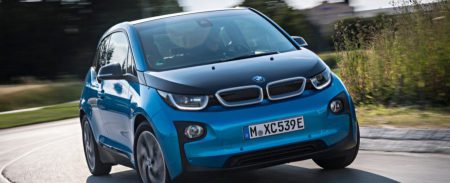
It’s just been crowned the inaugural 2017 World Urban Car Award winner at the New York International Show, but does the BMW i3 94 Ah (yes, that’s the model’s proper name, thank you very much) deserve recognition? Without doubt, the answer is a resounding yes. The attention is well-deserved.
BMW i3
Some car companies have taken charge (pun intended) and faced the future head on with the acceptance that either we like it or not, electric mobility is here to stay, while other car manufacturers are still in denial. BMW is among the leading manufacturers of this movement towards e-mobility.
The 2017 BMW i3 is amazing to drive, clean, elegant, subcompact (allowing you to park and maneuver easily), and widely available.
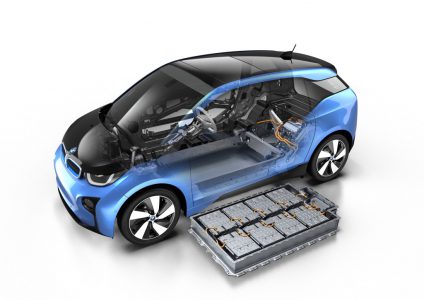
Compared with the original i3 (which has a battery capacity of 60 Ah), the 2017 BMW i3 has a larger battery in terms of capacity (94 Ah/33kwh), meaning increased driving range, but its physical size stays the same.
BMW i3, 94Ah Battery
Another thing car enthusiasts are buzzing about the 2017 BMW i3 is the immediate response you get from the electric engine. It offers 150kW and 250Nm of torque, with both available anytime you want to use it.
One of the model’s biggest advantages lies in the way it is constructed. Underneath the 2017 BMW i3 is a carbon fibre reinforced plastic (CFRP) passenger cell. This feature helps the car maintain its high torsional rigidity but at the same time without putting too much weight.
The 2017 BMW i3 offers satellite navigation, automatic lights and wipers, and a rear-view camera among its standard features. Other features include a multimedia system that boasts of four speakers plus a digital radio, as well as an interior trim mostly made of recycled material, sticking to its eco-friendly routes.
The 2017 BMW i3 BMW i3 comes with the standard complement of safety features. These include six airbags specifically designed for a model that has slim as well as lightweight seat frames.
With the General Election fast approaching, Next Green Car compares the key motoring elements of each of the main parties’ manifestos.
In [this] policy comparison, we focus on green vehicle issues and advances in autonomous and connected technologies; subjects we cover day-to-day on the website. Ultra low emission vehicles, air quality, electric vehicle issues and autonomous driving plans are all covered.
Promoting electric vehicles is a key policy for all the main political parties
In the interest of neutrality, parties are listed alphabetically and cover both previously announced promises and those new elements revealed in the latest manifestos. The three main parties which have published their manifestos are included – other parties will be added when their manifestos are released.
Conservatives
Aim to lead the world in electric vehicle and autonomous vehicles
Almost every car and van to be zero-emission by 2050
Invest in smart grids for more efficient EV charging
Modest roll-out of Clean Air Zones as part of air quality plans
Although the Conservative manifesto is rather light on motoring-related announcements, as the party in power they have already implemented a number of clear policies relating to low and ultra low emission vehicles.
The headline policy is the ambition
“for Britain to lead the world in electric vehicle technology and use….” and for “almost every car and van to be zero-emission by 2050”.
To achieve this, the Conservative Party has already earmarked funding of £600 million by 2020, which will take the total investment since 2011 to £900 million, extending a policy that was initiated under the previous Conservative-Lib Dem coalition. Investment is also planned for ‘smart grids’ designed to make the most efficient use of electricity infrastructure through the use of Vehicle to Grid (V2G) technology….. Read more, Next Greencar
Labour
Return the railways back into public ownership
Work towards zero road deaths in UK
Maintain UK at forefront of the manufacture and use of ultra low emission vehicles
Retrofit diesel buses to Euro 6 standards
Labour’s key message is that the party
“will invest in a modern, integrated, accessible and sustainable transport system that is reliable and affordable.”
Road safety is an important element of the party’s transport agenda, with aims to work towards zero deaths on the UK transport network. The manifesto lays out a number of policies to
“encourage and enable people to get out of their cars, for better health and a cleaner environment.”
To achieve these aims, Labour’s main focus is to improve public transport and reduce fares. One central element of this policy is the aim to return the railways back into public ownership, a policy that has already gained much coverage since the manifesto launch. While there is less focus (and detail) on road vehicle technology in the document, the party is committed to maintaining the UK at the forefront of the development, manufacture and use of ultra low emission vehicles, and supporting the creation of clean modes of transport through investment in low emission vehicles…. Read more, Next Greencar
Liberal Democrats
Creation of a new Green Transport Act
Ban on sale of diesel cars and vans by 2025
Encourage manufacture and uptake of electric vehicles
Introduce ultra-low-emission zones and Clean Air Zones to ten towns and cities
In the Lib Dems’ manifesto, the party sets out a detailed set of measures to reduce environmental impact of transport, which would be implemented through the creation of a Green Transport Act. This would include an air quality plan to tackle air pollution, and support for manufacturers of low-emission and electric vehicles.
The plans include a diesel scrappage scheme, and a ban on the sale of diesel cars and small vans in the UK by 2025. All private hire vehicles and diesel buses licensed to operate in urban areas would have to to run on ultra-low-emission or zero-emission fuels within five years. The party would also reform vehicle taxation to encourage sales of electric and low emission vehicles….Read more, Next Greencar
During my recent trip to the Veneto region of Italy (Venice/Padua/Verona) I stayed in a hotel near Venice, in Mestre on the mainland. Most of Venice, of course, has no cars – just a lot of polluting boats.
Renault ZOE Car Sharing poster in Padua (Image: T. Larkum)
The mainland, however, is packed with cars like any European region. It was very disappointing, therefore, not to see a single electric car in the time we were there.
There was a single bright spot, during a day trip to Padua (Padova). I have previously reported on the Car Sharing Padova organisation there and its use of Renault ZOE electric cars.
I’m pleased to say that it’s still up and running. I saw an encouraging poster in Padua for Car Sharing Padova at an upcoming trade fair.
It did seem, however, like a small oasis in an electric car desert.