[Test drive of] 2017 BMW i3 94 Ah REx. The last bit of that name seems like a jumbled mess of letters and numbers so, for those who aren’t well versed in EV-speak, it means that [this] particular i3 had the newer 94 Amp-Hour battery and a gasoline Range Extender.
The end of the Oil Age is within sight. Everyone who follows the news should be able to see this by now, although people have vastly different ideas about the timeline.
Above: Internal Combustion Engine vs. Battery Electric Vehicle (Instagram: cars217mph / gunthersahagun)
Consultancies, investment analysts and think tanks around the world produce a constant stream of predictions about the future impact of new technologies on the auto and oil industries. Despite the pundits’ painstaking perusal of primary sources, including economic data and interviews with industry insiders, their conclusions do not agree, to say the least.
The oil industry itself, along with mainstream investment banks, tends to foresee a gradual, decades-long transition. BP’s 2017 Energy Outlook predicts that electric vehicle (EV) sales will grow to a mere 6% of the global auto market by 2035 (from around 1% today). A recent report by Goldman Sachs is a bit more adventurous, predicting that pure EVs will capture 5% of the market by 2025. The US Department of Energy’s Energy Information Administration (EIA) has doubled its forecast from last year, but still predicts that EVs will account for only 8% of the US market in 2025.
Sign of the times: Emirates National Oil Company just opened the first solar-powered gas station in Dubai (Source: CleanTechnica)
Organizations of a more greenish hue are more sanguine: Greentech Media Research expects EVs to score 12% of the US market in 2025, and Bloomberg New Energy Finance predicts 35% globally by 2040. A study from the Carbon Tracker Initiative argues that EVs could capture 33% of the global market by 2035, and that reductions in battery costs
“could halt growth in global demand for oil from 2020.”
To those who follow the EV industry, none of this is really news. Lately, however, there have been signs that at least some in the oil industry are reassessing the threat to their empire, and preparing for a “peak oil” scenario that may come much sooner than they have been predicting.
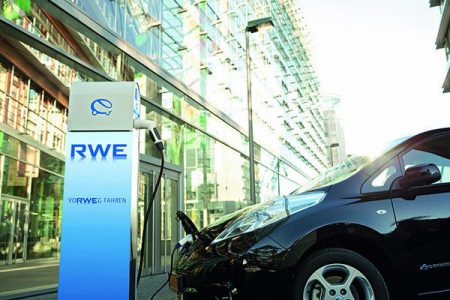
Another sign of the times: RWE, Germany’s biggest gas and energy provider, just launched hundreds of electric vehicle charging stations (Source: Trustnodes)
People who have never owned an electric car don’t understand how different charging one is compared to fuelling a petrol or diesel car. Therefore I’m going to explain what charging an electric car is like so that potential owners can understand it better.
Home charging a Nissan Leaf (Image: Nissan)
The point I want to get across is that charging an electric car is much easier and more convenient than filling a fossil-fuelled car. That’s an idea that can be difficult to grasp. Now that I’ve upgraded to electric (I’m on my second all-electric car) I could never go back, any more than I’d give up my smartphone and make do with a landline.
Here I’ll concentrate on the ins and outs of home refuelling, and cover charging away from home another time.
Charging System
Most electric cars come with a charging cable (fitted with a 13 Amp plug) that can be used to charge the car; such cables can be bought separately where they are not supplied with the car. One name given to these items is ‘granny cable’ as they can also be used to charge up while visiting relatives.
BMW i3 ‘occasional use’ charging cable (Image: BMW)
Another name they are given is ‘occasional use cable’ as they are not intended to be used frequently. They will also be slow to charge the car (12 hours or more) as a standard home socket is not capable of providing as much power as the car can potentially take.
Instead most car owners will have a special charge point installed at home to charge their car. This often comes free with a new car. It is typically wired straight into the main house consumer unit. It will be capable of passing higher power than a standard socket – usually either 16 or 32 Amps – and will be designed for frequent use.
Using a third-party ZOE granny cable while visiting my brother (Image: T. Larkum)
These charge points can be installed either inside a garage, or on a garage or other outside wall. Sometimes they’re just put on a post beside the driveway. They are all waterproofed and can be used in all weathers (including heavy rain). They usually come fitted with a tethered cable to match the car but sometimes just have a socket to which the owner can connect different cables, for example if the unit has to charge electric cars with different types of connector. The pros and cons of having a tethered versus untethered charge point are covered elsewhere.
Charging an Electric Car: Frequency
How often does an electric car need to be charged? This is an important question, and is key to why charging is more convenient than conventional refuelling.
The obvious answer, at least to someone used to a conventional car, would be “when it’s empty”. That’s because most people let their cars run low on fuel before refilling. There is no good reason for this; it simply reflects the fact that conventional refuelling is so inconvenient that it is to be avoided whenever possible. It takes time, and usually also involves a diversion from where you actually want to go.
With an electric car you could choose to do the same thing, relying on public charge points, and that can work if you can’t do home charging. However for the majority of electric car owners with a home charge point the easiest thing is simply to charge at home overnight every night.
Charging a Renault ZOE on the drive (Image: Fraunhofer ISE)
Electric cars use Lithium-Ion batteries, similar to those found in mobile phones (though they have significantly more sophisticated charge management systems than phones and so last longer). Lithium-Ion likes to be kept charged unlike previous technologies (e.g. Nickel-Cadmium batteries) that you were supposed to run down before recharging. Therefore it does no harm to plug in every night and so have the car battery fully charged every morning ready to go.
Using a dedicated high power charge point allows a typical electric car to be charged in about 4 hours. It’s also fine to only partly refill it. Therefore it can be perfectly practical to drive, say 100 miles during the day for work, then go home and – those evenings when it’s useful – top it up for an hour or two and go out again for, say, another 50 miles.
Charging an Electric Car: Process
It’s very easy to charge an electric car once you have a dedicated charge point. If you are lazy, like me, then you have a tethered one with its cable permanently attached so you don’t have to unpack a cable each time. Similarly, I choose to leave mine switched on permanently for convenience.
In this case, charging is as simple as the following:
Open the charge point door on the car
Uncurl just enough of the charge cable to insert its connector into the car’s charge socket
The car will automatically start to charge when it sees the electrical connection made. It will control the charge and finish it automatically.
On my original Renault ZOE the charge point door was unlocked using a button on the key fob or a switch inside the car. The charge socket was in the nose and so required walking around to it to insert the connector. The total time taken was about 15 seconds; this would also be typical for the Nissan Leaf.
Charging a Nissan Leaf in the garage (Image: Chargemasterplc.com)
On my current BMW i3 the charge point door is always unlocked if the car is unlocked, and the charge socket is on the driver’s side. Therefore I can insert the connector after I have parked the car and as I walk out of the garage; there is literally no additional time taken to set the car for charging. The Hyundai IONIQ Electric also has the socket on the rear quarter, though on the passenger side.
Charging a BMW i3 on the drive (Image: BMW)
People sometimes ask me how long it takes to charge my car. They probably expect to hear me say ‘4 hours’ or whatever, but actually it takes me personally no time at all, not a single minute. That’s because I don’t care how long it takes for the battery to fill up while I’m in the house (and probably asleep).
Charging a Hyundai IONIQ Electric on the drive (Image: T. Heale)
With my i3 having a range of about 120 miles, and my commute being 45 miles, it’s not even a problem if I forget to charge for a day or two. However, like with your smartphone, making charging it a daily routine is generally the best option.
Summary
One of the great things I love about a car that’s electric is no longer having to spend time fuelling it. It’s just 100% full every morning when I get in, as if by magic. I certainly don’t miss having to travel to petrol stations, often standing in the dark and rain, to hand over large amounts of money.
Now instead I fuel the car myself using renewable energy. During the week I charge it from wind (courtesy of our renewable electricity supplier) and a fill-up costs about £2.50. At the weekend I can charge it from our solar panels for free.
Simple calculation[s] as to the impact on electricity demand as we progressively switch over to electric cars.
National Grid estimates up to 7% increase in electricity demand by 2040 for EVs
There are around 30 million cars on the road today [1]. National Grid’s Future Energy Scenarios 2016 presents 4 scenarios – in the most ambitious ‘Gone Green’ scenario there are 9.7 million electric vehicles (EV) on the roads in 2040 using an extra 24 TWh/year. Relative to current electricity demand that is an increase of 7%[2].
But the impact on peak demand will be minor, if drivers respond to time of use pricing.
However, this demand is highly unlikely to be spread evenly through the day and year. Firstly, people tend to drive more in the summer, presumably because it is considerably more pleasant than driving in the winter [3]. Fortunately our peak electricity demand is in the winter so this helps to even out the load.
Secondly, assuming time of use pricing is widely adopted drivers will try quite hard to charge their vehicles at times of the day when the electricity is cheap. Most people will have quite a lot of flexibility and during the peak time a lot of drivers are on the road anyway.
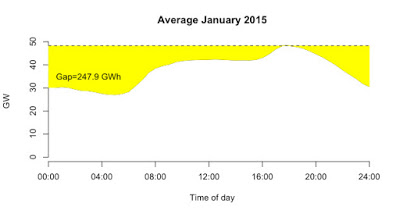
This means electric car charging will increase non-peak demand much more than peak. The chart below shows a typical January day. If electric car charging is spread over non-peak times it will start to fill in the yellow area but not impact on the peak demand. 24 TWh/year is 66 GWh/day so it could fill in just over a quarter of the yellow area.
A typical day’s UK electricity demand in January
If all cars were electric there would be more impact on peak demand
However, 66 TWh/day is from only 9.7 million electric vehicles. If we replaced all 30 million cars, it would be nearer 200 GWh/day. This does still fit into the yellow area – just – but it would be quite a challenge to ensure that there was no ‘leakage’ and it did not impact on the winter peak at all.
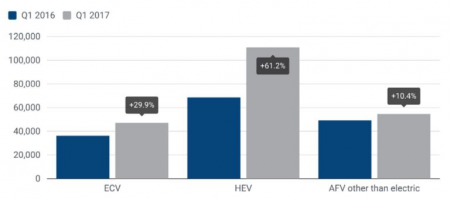
According to the European Automobile Manufacturers Association, alternative fuel vehicles (AFV’s) in the Europe Union are off to a very strong start in the first quarter of this year, increasing their numbers sold by 37.6% to 212,945 vehicles.
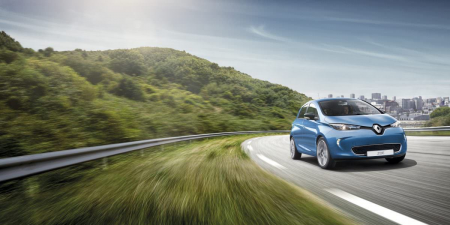
Renault ZOE ZE40
Hybrid vehicles (HEV) showed the biggest growth with 61.2% versus the same period last year, now counting 111,006 units. Electrically chargeable vehicles (ECV = BEV and plug-in hybrids) grew with 29.9% from 36,322 units sold in Q1, 2016 to 47,196 units in Q1, 2017. This includes 49% growth for “battery-only” (BEV’s) to 24,592 units sold and 13% growth for the plug-in hybrids (21,644 units). The U.S. market showed a similar growth of 49% for electric car sales to 40,700 units sold in the first quarter according to Bloomberg New Energy Finance. The American car market is about 16% larger.
All the major markets in the EU added many new AFV registrations over the first three months. Spain showed the largest increase (+87.4%) over the first quarter of 2017 followed by Germany (+67.5%), the UK (+29.9%), France (+24.8%) and Italy (17.2$). The growth in Italy is due in large part to the recovery in LPG-fuelled (natural gas) cars, but for the other markets, the growth is mostly the result of strong sales in electrically chargeable vehicles (ECV’s or BEV’s) and hybrid-electric (plug-in hybrids).
New passenger car registrations by alternative fuel type in the European Union during the first quarter of 2017.
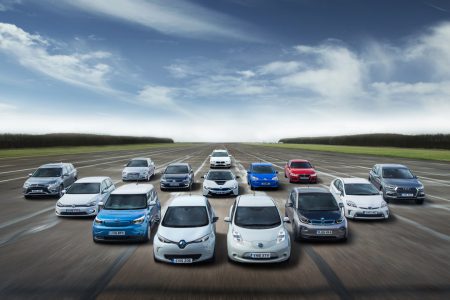
Looking at electric- or battery-only car sales in Europe reported by the European Alternative Fuels Observatory, we see that the improved Renault Zoe is the number one seller by far, followed by the Nissan Leaf, BMW i3, Tesla Model S and X and the others.
In a “green” effort, the Metropolitan Police Department will start by transitioning 250 of them to hydrogen and electric cars. The new vehicles will be put in place over the course of the next 12 months.
“The response from police drivers to the BMW i3 has been very positive. It’s actually a very quick car.”
Included in the initial plan is hydrogen fuel cell cars, specifically for emergency response vehicles, 30 plug-in hybrids for responding to “999” calls, additional larger vehicles (vans) for crime scenes, and 1o vehicles for Royalty protection officers.
The hope is that at least half of the police force is driving electric cars by next year. This is all part of a multi-million program which includes replacing about 700 vehicles. Monies are also allocated for infrastructure, and the capital area will get five hydrogen chargers.
The organization has looked into the BMW i3 and the Toyota Mirai as viable options. Hydrogen scooters are a possibility for specific patrol routes. At this point, officials aren’t ruling out any automakers or vehicles, as long as they are “clean.” Talks have included vehicles from Ford, Nissan, Mercedes, Renault, and Volkswagen, among others. All vehicle types are also being considered, from mopeds, to cars, and vans. The chief of police, Bernard Hogan-Howe, reportedly spoke personally with Elon Musk about the concept of using Tesla vehicles for “front line” operations.
Trials are already underway and more are planned. The BMW i3 REX has been successful in testing, specifically due to its acceleration. Hydrogen scooters manufactured by Suzuki are also being tested. Jiggs Bharij, the head of the Metropolitan Police fleet services, said:
“The response from police drivers to the BMW i3 has been very positive. It’s actually a very quick car.”
This is all comforting to residents due to the poor air quality in London. Many people have threatened to leave the area if changes aren’t initiated. Sian Berry, a member of the London Assembly Green Party concluded:
“A lot of new and positive ideas are being trailed and considered by the Met here … But what we need from them is a firm deadline for getting all diesel police vehicles off the road. Every organisation with a fleet in London needs to be making plans for this to happen as soon as possible, and this needs to start with the Mayor’s own bodies, including TfL and the Met.”
Research from Frost & Sullivan finds that the global PHEV market is estimated to reach about 3.7 million units by 2025 with 4.8 million light vehicles in an optimistic scenario and 2.9 million light vehicles in a conservative scenario.
Mitsubishi Outlander PHEV Concept-s
The reasons behind such growth include the imminent launch of 100 new models, favourable incentives, emission target compliance, and long battery ranges.
However, factors that may impede PHEV adoption include the phasing out of electric vehicle incentives, long-range battery electric vehicles, emergence of 48V mild hybrids, and the complexity of having two powertrains in a single vehicle.
“The stringent emission norms of 95 g CO2/km can only be met by PHEV technology, while EV battery technology evolves to overcome limitations. PHEVs have a better market than BEVs due to uncertainty in charging infrastructure,”
said Frost & Sullivan Intelligent Mobility Research Analyst Pooja Bethi.
“Owing to their ability to provide internal combustion engines and EV advantages, the PHEV market is set for high demand and growth.”
Dedicated EV platforms like the Volkswagen (VW) MQB, Mercedes-Benz EVA, and BMW FSAR are major drivers, pushing PHEV growth.
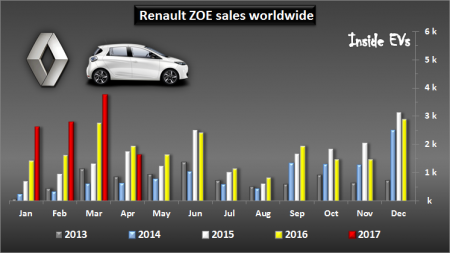
The introduction of a new longer-range Renault ZOE 40 Z.E. with 41 kWh battery and 300 km (186 miles) of real world range has translated into “higher highs” being set for sale…until this month.
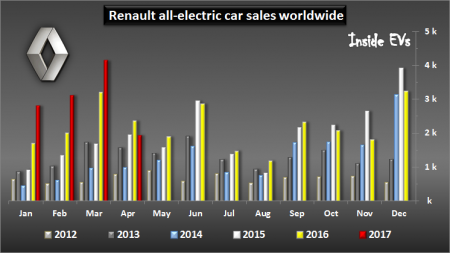
April disappointed with just around 1,690 ZOE deliveries (a drop of 14.5% year-over-year).
In general, overall Renault electric car – mostly relied on ZOE – also decreased to 1,931 (down 18%).
Thankfully, sources indicate that April’s hiccup was not demand-related, but rather build-related.
And while we don’t ever wish for production flaws, or recalls, deliveries during the month where muted thanks to a defective part installed on cars produced before April 19th.
The repair (to do with locking the vehicle in parking mode using the handbrake) apparently isn’t the most simple fix, reportedly taking from 6-8 hours to rectify, and the company says it will likely take until the end of June to work all the issues out of the system.
New vehicles now coming of Renault’s Flins assembly line are not effected, but it may take another month to see sales rebound and return to previous trajectories.
With that said, and after four months, Renault has still sold nearly 12,000 electric cars (excluding Twizy), which is 29% more than year ago.
As part of the UK’s ambitions to become a leading hub for the development of electric vehicles (EVs), Britain’s biggest carmaker Jaguar Land Rover (JLR) and the UK government have announced plans for the establishment of the core UK hub for EV battery production and development.
Joined by academics and business leaders for the announcement on Tuesday, the central UK players aim to create the National Battery Prototyping Centre (NBPC) in Coventry, which will become the home for EV development and testing in the UK.
UK automotive aims for the national test centre acting as a catapult for large-scale battery production at the historic centre of the UK auto industry. The city of Coventry is already home to the main London Taxi Company EV factory and major JLR research facilities at Warwick University. It also forms part of the key connected and autonomous vehicle (CAV) cluster in the country, which stretches from Birmingham and Oxford to London.
JLR CEO Ralf Speth said the founding of the national battery centre would help JLR to commit to building electric vehicles in the UK, as is wishes to do. Its all-electric I-PACE SUV, which is set to beat rivals to market launching in 2018, will be made in Austria, and JLR has also gone overseas to Slovakia for a new production plant for its conventional vehicles. Speth says that in order for it to springboard major production in the UK, it requires considerable improvements to UK-based capabilities, including in pilot testing, support from science (often through universities) and in the UK’s energy supply (with UK energy being some of the most expensive in the world). At least in the first two areas, the UK government now looks set to deliver.
The Kangoo Z.E. is the all-electric, zero emissions version of Renault’s smallest van
The Renault Kangoo ZE is the electric version of the Kangoo, Renault’s smallest van. Like the diesel version, it’s available in standard, Maxi and Maxi Crew body styles. In reality the only difference between the diesel and ZE (Zero Emissions) version is the fact there’s an electric motor under the bonnet instead of an engine, and a battery pack under the load area where the fuel tank would normally be.
Renault Kangoo ZE
The Kangoo ZE has a payload of 650kg, which is the same for the Maxi ZE, while the two versions have a load volume of 3.4 and 4 cubic metres respectively. This pair are two-seaters, while the Maxi Crew ZE has five seats.
Prices start from around £16,500, thanks to a Government Plug-In Car Grant of up to £8,000, while Renault offers two purchase options; you can either buy the Kangoo ZE outright, or buy the van and hire the batteries to help keep costs in check and eliminate any concerns about the batteries losing their longevity.
Power for the Kangoo ZE comes from a 44kW electric motor, which is the equivalent of 60bhp from a conventional engine. While that means the ZE has less power than any of the conventional Kangoo range (and 0-62mph takes a laborious 20.3 seconds), it doesn’t feel slow, thanks to a healthy 226Nm of torque (only the more powerful dCi 110 does better), and this torque is available as soon as you put your foot on the accelerator, so it really does nip away from the traffic lights.
Renault claims a range of 106 miles for the Kangoo ZE – it’s the same for the Kangoo Maxi, and is the same quoted for the Kangoo’s main rival, the Nissan e-NV200 – but in the real-world you can expect a range of around 75 miles on a full charge.