Renault’s Japanese ally has presented its first ever sustainability plan – and it’s rather ambitious. Over the next 4 years it wants to crank up its annual sales of electric or electrified cars to 1 million units per year, thereby reducing by 40 percent the CO2 emissions of its models compared to the year 2000. At the same time, it targets a 30-percent reduction in CO2 emissions coming from vehicle manufacturing and other corporate activities.
Nissan Leaf (Image: Qurren/Wikipedia)
Moreover, it wants to reduce the use of new materials by 70 percent through the promotion of circular economy of reused and recycled lithium-ion batteries used in electric vehicles. Finally, Nissan aims at reducing the water intake per unit in global production by 21 percent compared with 2010.
The autonomous driving experience has been, up until recently, an expensive technology reserved for luxury cars. Among others, Nissan is working to bring partial autonomous driving to lower-priced machines. Nissan’s ProPilot Assist is part of a technology package that cost just $650 on our long-term Leaf. That’s a ridiculously good deal. The Leaf’s tech package also includes automatic emergency braking with pedestrian detection, intelligent lane intervention, an electronic parking brake and high beam assist. ProPilot Assist is also available on the Nissan Rogue as well as Infiniti’s new QX50 crossover.
Nissan Leaf (Image: Qurren/Wikipedia)
Okay, so ProPilot is cheap and available (like me when I was single) but is it any good? To find out we decided to give the ProPilot a workout from Los Angeles to San Diego. Why San Diego? Aside from simply being a destination within reach the Leaf’s driving range, San Diego was the location Nissan chose to launch its new Kicks entry-level crossover, and we were on the schedule to test drive it. The event headquarters was a hotel in San Diego’s Gaslamp Quarter with a charging station in its parking garage, so I could plug the Leaf in overnight and have a full charge for my drive home. Perfect.
ProPilot aims to ease the monotony and frustration of a typical freeway commute, and no other freeway in the free world will redline your temper quicker than I-405 in Los Angeles. There’s always traffic. And the I-5 freeway, which links southern Orange County to San Diego is no slouch in that department either. The 130-mile drive from LA to San Diego can easily suck more than 3 hours from your life. So, if there ever was a time we’d like to let the car do some of the driving—this would be it.
It didn’t take long after the second-generation Nissan LEAF entered the European market in February for it to take the lead among all-electric cars in Europe.
It just knocked the Renault ZOE from its pedestal.
According to EagleAID, Nissan LEAF sales in Western Europe amounted to 11,441 in the first four months of 2018 (up 48% year-over-year) and that was enough for it to overtake the Renault ZOE.
5,790 delivered in March (Western Europe) and another 3,309 in April. The LEAF is of course the best-selling plug-in model in all of Europe as the Western part represents almost all sales.
Nissan is celebrating the 100,000th delivery of the LEAF car this month in Europe, in a move hailed as a victory for electric mobility. Globally, over 320,000 Nissan LEAF have been sold, making it the most sold EV in the world.
Susana de Mena, of Madrid, milestone buyer of the 100,000th LEAF said, “I’ve spent two years trying to find an electric car. I knew it would be a Nissan!
“When I saw there was a brand-new model of the LEAF, there were no doubts in my mind it would be the perfect fit. My husband and I agreed that the quality, price and specification made it second-to-none.
“We are very conscious that we must respect and protect the environment, so we knew we’d want to go 100% electric. On top of this, an electric car lets us get to the very centre of Madrid when ordinary vehicles can sometimes be restricted due to pollution issues.”
Nissan Leaf (Image: Qurren/Wikipedia)
Combining sales of the new Nissan LEAF and previous LEAF models, the 100,000 customers across Europe have helped propel the Nissan LEAF to the position of best-selling EV in the world.
With now more than 37,000 new LEAF ordered in Europe, one new Nissan LEAF is sold every 10 minutes in Europe to customers looking to switch to innovative and zero-emission technology.
It is nearly two years since I began my daily journeys in a clean, electrified vehicle — no particulates, zero emissions, human friendly, child friendly. I found myself driving in a light bubble that seemed to push the smell of gas to the periphery.
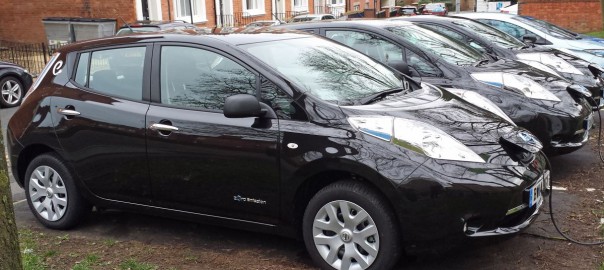
e-Car Club Nissan Leafs outside Northampton Derngate (Image: T. Larkum)
Becoming free dependence on oil/gas in my personal driving, it was initially easy to enjoy heightened optimism about air pollution and environmental concerns. I hoped that most drivers would to switch to electric vehicles — soon. If I could do it, many could.
Things have changed in an uncomfortable, challenging way within the history of those two years, though. EV range is the least of my worries.
I’m now accustomed to the ease and the smooth nature of the LEAF, and I sometimes take for granted what I fell in love with — the fluid ambiance and the sublime quietude that comes with a zero-emissions electric vehicle.
Remember the old saying,
“you don’t know what you have till it’s gone”?
I recently left the Nissan LEAF at the shop to get a tire changed. It was going to take a day, so Nissan offered me a nice new gasoline-powered loaner. Immediately, I felt the “rougher” feeling of an ICE car … just turning it on. No magical quiet jingles like the LEAF provides.
Taking off was fine, but not nearly as responsive as my LEAF, which moves like a silent airplane through time and space — without the smell of diesel or gasoline. I feel as if I am on a private plane in the LEAF. In the gas car, I was presented with a gravelly sound and feeling from under the car, a rumbling engine, and bad smells of gas. I felt I went backwards in time. It was similar to, but not nearly as deadly as, the day after the last election.
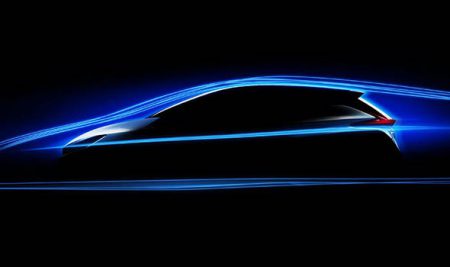
NISSAN has released yet more details of the forthcoming Leaf 2018 which will debut next month.
Image: Nissan
Nissan Leaf 2018 is just a few weeks away from being revealed.
Ahead of its September 6th debut there has been a lot of anticipation about the new EV.
Nissan has claimed that the new Leaf will be packed with their most advanced technologies and will ‘raise the bar’ for the electric vehicle market.
The zero-emissions vehicle has been the most popular EV in the UK for a number of years but with advancements in the market segment and more competition, the new car needs to deliver on more than style and technology.
Range anxiety is still the biggest problem for many would-be EV drivers as they don’t believe that an electric car can support their lifestyle.
Previous generation Leaf’s have not breached the 200 mile range and with the 24kW battery achieving a theoretical range of 124 miles of charge and the 30kW delivers 155 miles.
With the Model 3 producing around 220 miles with its standard battery and 310 miles with the long range battery pack then Nissan will need to produce a car with range closer to the 200 mark to compete.
In addition to this, with the lower price point they will be aiming to draw some potential customers away from Tesla.
From initial reports about the car’s specs and leaked pictures we know that the it sports a more conventional exterior design.
It looks heavily influenced by the new Nissan Micra which was unveiled earlier this year.
When you think of the electric cars, Tesla is perhaps the name that first comes to your mind. For all its technical achievements, the Elon Musk-backed company has also done a great job of marketing and made itself synonymous with the electric cars industry. But as industry observers know, if there’s one car that’s come close to matching – and at times exceeding – Tesla’s success, it’s the Nissan Leaf.
The Nissan Leaf was the world’s best selling electric car for a couple of years, and at other times was not too far behind Tesla’s offerings. While Tesla is the upstart that has shaken up multiple industries, Nissan, of course, is among the incumbents in one of the biggest industries in the world. The automaker invited Gadgets 360 to its headquarters in Yokohama, Japan earlier this year, and we got an opportunity to pick the brains of some of the company executives to understand the company’s vision for the future of mobility.
We touched upon a wide range of topics, from autonomous driving – and the role Nissan will play in its evolution – to clean energy, and the company’s beliefs that vehicle-to-grid might be a huge opportunity for automakers and consumers alike.
What is vehicle-to-grid?
If you’ve heard anything about electric cars, you’ve obviously realised that they need to be charged regularly, often at night, when the car is standing idle in the garage. With vehicle-to-grid, automakers want to make the relationship between the cars and the grid a lot more involved, starting with how the cars might want to give back to the grid.
Daniele Schillaci, EVP, Nissan explains.
“The EV [Electric Vehicle] technology is changing also the cost of ownership for the customer,” says Schillaci. “Because today, when you have normal technology – gasoline or diesel – your car in the night, is stuck on the garage, you cannot use it, it’s a fixed cost. The EV technology – thanks to the vehicle-to-home – means the car, even when you don’t use it, it becomes a variable cost. Because during the night, your house charges the car because the electricity fee is very low during the night. And during the day, your car can charge your house, when the electricity fee is higher.”
With the announcement of the 2040 ban on all new petrol and diesel cars, we get behind the wheel of three electric vehicles to see if the future really is green.
(L to R) Nissan LEAF, Hyundai IONIQ, Renault ZOE
WHAT’S NEW?
Since the announcement of the 2040 ban on new petrol and diesel cars, all you read in the news is about how we’re all going electric. So if that’s the case, which is the best electric car to buy? We chose three to test – a Renault Zoe, Hyundai Ioniq and Nissan Leaf.
The Hyundai Ioniq is by far the newest and in our opinion one of the best-equipped. The Nissan and the Renault have both been around for some years now, and the Leaf is actually due to be replaced by a new model next year.
The Ioniq is Hyndai’s first attempt at making an all-electric car, and it’s very good.
Inside, the cabin feels solidly built and very comfortable. It also has lots of kit including, on our car, heated and cooled electric seats.
Next is the Renault Zoe, a great-looking little car with bags of character on the exterior alone. Step inside and it’s also a funky place to be. It also features the best-claimed range of the three EVs, with 250 miles on the NEDC cycle thanks to its new ‘Z.E. 40’ battery.
Finally, we have the Nissan Leaf, the oldest of the three in terms of design and this shows in its rather ungainly styling and outdated technology. It also has the lowest theoretical range with just 155 miles.
LOOKS AND IMAGE
This is where the Nissan Leaf falls down – massively. It is not appealing at all on the outside with its bulbous rear-end and huge headlights. This continues inside where it can best be described as dull and old-fashioned.
The Hyundai is in a different league. It looks fresh, funky and modern. Add a touch of colour and you have a car that will be very enjoyable to own. This continues inside too where it feels light and airy with a very easy to use dashboard and centre console.
The Renault is the best looking of the bunch. Its chic Parisian styling blends well with modern life and makes it look more premium than it actually is. However, this doesn’t quite continue inside. Although the cabin looks chic, it feels cheap, with the plastics belonging in a cheap supermini.
SPACE AND PRACTICALITY
In terms of space, all three are roughly the same, offering ample leg, head and luggage space and a plethora of cubbyholes throughout the cabin.
The Hyundai feels a tad better than the other two, and has a fairly decent-sized boot at 350 litres – enough for some suitcases or a weekly shop. You can probably fit the family dog in there too.
The Zoe feels slightly smaller in comparison, but is more of a hatchback compared to the Ioniq’s saloon looks. It has a marginally smaller boot at 338 litres, but this would definitely be enough on a daily basis.
The Nissan Leaf boasts the largest boot at 370 litres. It also has a fairly large cabin, which can easily accommodate four adults.
Renault-Nissan Alliance, after the acquisition of Mitsubishi, is now approaching 500,000 cumulative all-electric car sales – more than any other automotive group.
The Renault-Nissan Alliance includes also Mitsubishi Motors Corporation
At the end of June 2017, the Alliance counter stands at 481,151 units (some 130,000 more than year ago).
The biggest impact on the number comes from the Nissan LEAF and Renault ZOE.
The number doesn’t include plug-in hybrids – of which, new Alliance partner Mitsubishi has sold over 130,000 copies of the Outlander PHEV.
Renault-Nissan Alliance CEO Carlos Ghosn with Renault ZOE and Nissan LEAF For COP21
“Cumulative sales of electric vehicles by the companies also rose significantly to 481,151 units, reaffirming the Alliance’s role as the leading electric car manufacturer for the mass-market segment.
The increase was driven primarily by demand for the Nissan LEAF and the Renault ZOE, which remains the #1 EV sold in Europe, and Mitsubishi’s i-Miev.”
Renault-Nissan Alliance is now aiming to become industry’s number-one automotive sales group for full year 2017.
Total Renault-Nissan Alliance increased in the first six months of 2017 by 7% to 5,268,079 million.
The newly updated Renault ZOE is the best selling EV for Europe so far in 2017
Here is list of Renault-Nissan Alliance brands (excluding joint ventures in China):
Renault (includes also Dacia, Alpine and Renault Samsung Motors)
Nissan (includes also Infiniti and Datsun)
Mitsubishi
And list of plug-in models:
Renault ZOE
Renault Kangoo Z.E.
SM3 Z.E.
Nissan LEAF
Nissan e-NV200
Mitsubishi i-MiEV and other MiEV family in Japan
Mitsubishi Outlander PHEV
There is also Renault Twizy – a heavy quadricycle.
THE Government has said it will ban all diesel and petrol powered cars from 2040 bringing the curtain down on the era of the internal combustion engine.
Ministers unveiled their court-mandated plans for meeting EU limits on harmful nitrogen dioxide pollution this morning.
They include a £255 million fund to help local authorities come up with ways to improve air quality, ranging from improving public transport and changing road layouts, to charging zones for polluting vehicles if other measures don’t work.
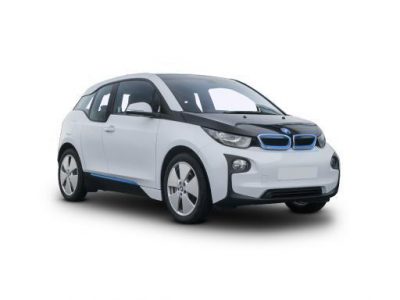
The BMW i3 – one of the UK’s most popular EVs
But much of the focus was on plans to end the sale of all conventional petrol and diesel cars by 2040, to help tackle air pollution and climate change emissions.
The impending shake-up is already having an impact on the electric car market.
Consumer interest in electric vehicles is soaring. The market for alternatively fuelled vehicles (AFVs) saw a record market share of 4.4 per cent in June with more than 10,700 hitting the roads, a rise of 29 per cent.
At the same time the overall used market for electric vehicles has seen values increasing by 7 per cent this year.
Motoring expert Chris Plumb from hpi said:
“Interestingly it appears to be the range extender models which is driving the recent strong performance as values of pure electric have struggled of late. The BMW i3 is a popular choice and is a great second hand buy. It brings a good level of specification and badge prestige.
“The optional range extender can increase the range of the BMW i3 in comfort mode from up to 125 miles to a total of 206 miles. The small, rear-mounted, quiet two-cylinder petrol engine powers a generator that maintains the charge of the battery at a constant level, so that the BMW i3 can continue to drive electrical.”
A used BMW i3 with 15,000 miles on the clock has a used value of £14,650 against a new price of £30,925.
The made-in-Sunderland Nissan Leaf with the 30KWh power train is attracting higher used values than the lower powered 24kWh battery pack as it has a larger range.
According to Nissan, the Leaf has an official range of up to 124 miles (4kWh) or up to 155 miles (30kWh).