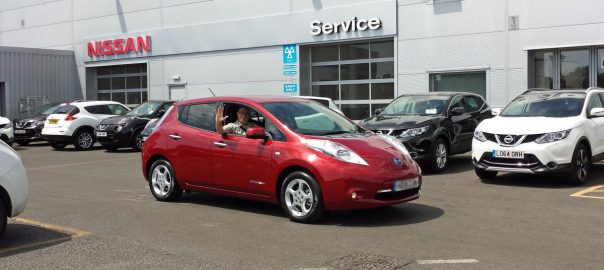
The original Nissan Leaf is a glorious bridge between the analogue and digital ages
In this brave new age of smartphone dependence we’ve probably all found ourselves having sunk several weeks of our lives into a time dump of a game that sucks your attention into it and gives nothing back. Like the most recent obsession, a strategy thing where you send trucks back and forth between places carrying stuff. No more sophisticated or interesting than that, but boy was it addictive.
Until it was updated, presumably by someone who never opened the app before, let alone played it. One eight-second download and suddenly the game was rendered unplayable and useless. Sure, it enjoyed a smart new look, some spiffy graphics and a bit of jaunty new in-game music, but the very basic functions had been changed in a blink and it was impossible to work out how to do them. So… deleted.
Charging with an Ohme smart charging cable
But what happens when they do that to your car? Manufacturers are cock-a-hoop about over-the-air updates and the boundless potential of what they can do. Polestar recently did an update that made its cars drive longer distances, Volkswagen did one that meant they could charge harder for longer.
If you would like to know more about Solar Panels and the PowerBanx range of home battery systems, and get a free instant quote, please complete our online form:
Andy Palmer thinks motorists need to learn more about electric cars with the 2030 petrol and diesel new car ban looming on the horizon
Over a decade ago, when I began developing what became the world’s first mass-market electric car, the Nissan Leaf, it was considered an oddity. EVs back then were treated with scepticism and intrigue in equal measure. Why? Largely because the understanding of what they were, how they were made and how they benefit motorists (and the planet) was non-existent. In fact, one rival auto exec said I was crazy for pioneering an electric vehicle and I may as well have taken the cash invested in it and chucked it into the Pacific. Thankfully, I didn’t take his advice.
Nissan Leaf 3.Zero e+ (Image: Nissan)
Today, we are a better-informed audience. But by how much? There are around 395,000 battery electric vehicles on UK roads right now. That’s certainly a lot more than when I first began work on the Leaf, but compared to the 32.7 million total passenger cars on the road, it still barely registers. I have no doubt that’ll change and that in the near future, there will be more EVs than combustion engine vehicles. It’s as inevitable as death and taxes. But to get to that point and for the market to truly mature, we need an informed audience of motorists.
If you would like to know more about Solar Panels and the PowerBanx range of home battery systems, and get a free instant quote, please complete our online form:
CAR BUYERS in the UK have purchased the second highest number of EVs in the world – second only to China.
The staggering rise in the number of electric vehicles (EVs) purchased by Britons was underlined by new figures showing the UK second only to China in the amount of battery-powered cars bought in the past ten years. The research by experts at PartCatalog showed there were more than 1.75million EVs sold in Britain since 2010.
It also showed that between 2015 and 2020, yearly sales of electric cars have increased a massive 444 percent globally, going from around 500,000 sales to just shy of three million per year over the five years.
Nissan Ariya EV SUV (Image: Nissan)
China leads the world in EV uptake with more than 4.5million cars sold over the past decade.
The country also manufactures more EVs than anyone else, with even US-based Tesla making more cars in Shanghai than they do in California.
But the UK is runner-up and way ahead of countries like Germany, the USA and France.
Even traditionally early technology adopters like Japan are way down the table.
Both China and the UK have seen their Governments hand large subsidies and grants to buyers to tempt them into buying electric vehicles, which is likely to be an influence on the amount sold.
However the Government here will shortly scrap the £350 grant for installing a home charger and last month lowered the grant for buying an EV from £2,500 to £1,500.
It was originally £5,000 when initially introduced but has been reduced every year since.
If you would like to know more about Solar Panels and the PowerBanx range of home battery systems, and get a free instant quote, please complete our online form:
Stop trying to re-create your gas engine car from electricity and the answer will become clear.
If you’re considering an electric vehicle, don’t make the mistake of buying one with too much range. Unlike combustion engine cars with virtually unlimited range, electric cars make the most sense when they have the right amount of range, not a surfeit of it.
There are several reasons to temper your instinct to get the most range possible.
Nissan Leaf – a Perfect Family Car
Cost
Range costs a lot of money. For example, a Nissan Leaf with 226 miles of range costs $6,600 more than the same trim level with 149 miles of range.
There is no real parallel with combustion cars as their cost of range is in the price and consumption rate of fuel, not the vehicle’s MSRP. You can argue that an EV earns back its overall cost premium in per-mile energy savings, but a long-range electric car will need many more of those low-cost miles — and probably years of covering them to do so.
The cost of EV range can make buyers recoil from one without knowing that their perception of sufficient range, not cost, is the real problem.
Weight
Longer range versions of a given electric car have larger, heavier batteries. Unlike a tank of gas that weighs about 100 pounds and gets lighter as it’s used, an EV battery can easily weigh 1,000 pounds and stays just as heavy as it is “emptied,” increasingly becoming dead weight the remaining amount of charge must lug around.
The long range Tesla Model 3 (358 miles of range) weighs 172 pounds more than the RWD version’s still-generous 272-mile range, a weight difference equal to the entire payload a car will most often carry: the driver. The difference is even more pronounced when comparing a long range Model 3 to a comparable conventional BMW 3 Series, which is about 475 pounds lighter.
If you would like to know more about Solar Panels and the PowerBanx range of home battery systems, and get a free instant quote, please complete our online form:
We purchased it secondhand just over five years ago. It’s a Nissan Leaf. All electric.
We purchased it in the days when people used to say ‘we haven’t got the infrastructure’ or ‘where are we going to get all the energy from?’ or ‘they don’t have the range’.
I let the wife conduct the research, just so she could build up her range anxiety until we saw an affordable great little car on sale from Stebbings on Hardwick Narrows.
Since we have had the car we have never used a public charge point, of which there are six times as many as there are petrol pumps in the UK and growing by around 200 a week on top of the hundreds of home chargers installed daily. No, we just use the ‘granny charger’ which is basically a three-pin plug charger, like your mobile phone. It uses about half the energy a kettle uses and stays on for an hour here and an hour there to keep us topped up.
A showroom tour of a Nissan Leaf (Image: T. Larkum)
Go out, come home, plug in. That’s all there is to it and for over five years, that’s my knowledge of electric cars.
Oh, you need to put washer fluid in for the windscreen and air in the tyres every now and then, but that’s it.
If you would like to know more about Solar Panels and the PowerBanx range of home battery systems, and get a free instant quote, please complete our online form:
Alliance will sell 35 pure-electric cars on five new platforms by 2030
The Renault–Nissan–Mitsubishi Alliance has confirmed a €23 billion (£19bn) investment in electrification over the next five years as it seeks to strengthen the partnership between the three brands.
The money will be spent on expanding the common electric platforms available to brands within the Alliance from four to five after the introduction of a small EV platform for use from 2024 for European models such as the forthcoming Renault R5 and newly announced replacement for the Nissan Micra. Both cars will be engineered by Renault and built in its ElectriCity network of plants in northern France.
Captur E-TECH Plug-in (Image: Renault)
The new CMF-BEV platform was described as a “game-changer” by Renault CEO Luca de Meo, who said it reduces costs by 33% compared with the platform currently used by the Renault Zoe. “It will be the key to democratise electric cars,” he said. “For the very first time, EVs will be able to compete with internal combustion engines in this segment.”
Renault said more than 60% of components will be carried over from the CMF-B platform, which underpins cars such as the Renault Clio and Nissan Juke.
The platform will underpin five cars from Nissan, Renault, Alpine and Dacia and volumes will reach 250,000 cars a year, de Meo said. The relatively low volumes suggest it will be a Europe-only platform.
If you would like to know more about Solar Panels and the PowerBanx range of home battery systems, and get a free instant quote, please complete our online form:
Planning for a long-distance drive in your electric car doesn’t have to be a headache. Here’s everything you should consider before you set off.
While petrol and diesel drivers have recently faced fuel anxiety, the range anxiety that comes with driving an electric car has been around much longer and is still a real concern for many, whether they own an electric car or are simply contemplating one. Range anxiety can be conquered though, so let’s break down what needs to be considered to keep your mind at ease if you’re planning a long-distance drive in a plug-in car.
How far can you travel on a full charge?
Nissan Leaf (Image: Qurren/Wikipedia)
The first thing to consider when planning a long-distance journey in an electric car is how long the battery will last on a full charge.
Of course, the ideal scenario would be to make the journey on a single full charge and recharge overnight while you catch some Zs but, if your range doesn’t quite cut it, you’ll be able to plan out where to make that tactical first stop to recharge and how many times you’ll need to stop along the way to your destination. Depending on the make and model, weather conditions, and your driving style, you can expect to have a range of anywhere between 100 and 300 miles from a fully charged electric car. The UK’s best-selling electric car this year is none other than the Tesla Model 3, having sold over 22,000 units by 1st December and topping the best-selling car list back in September. This sought-after beauty comes with a range of 360 miles, which could get you from Cambridge to Edinburgh on a full charge, so depending on where you’re heading, you wouldn’t have to make many stops, if any at all!
If you would like to know more about Solar Panels and the PowerBanx range of home battery systems, and get a free instant quote, please complete our online form:
The new electric Nissan Ariya goes on sale in the UK from £43k, as Nissan finally delivers a new EV to the market, 12 years after the Nissan LEAF arrived.
Nissan has become synonymous with EVs ever since the electric Nissan LEAF arrived back in 2009, but despite that early lead in electric cars it’s failed to deliver anything really new to the market since.
OVO Vehicle-to-Grid (V2G) charging (Image: T. Larkum/Fuel Included)
But that changed last year with the arrival of the Nissan Ariya, an all-new electric Nissan Crossover / SUV, which we’d expected to have gone on sale at the start of 2021.
But ‘Covid and Chips’ put paid to an early arrival for the Ariya, but now Nissan is ready to take orders for the Ariya in the UK – with first deliveries in summer 2022 – with prices starting from £41,845.
Offered with a choice of front or four-wheel drive, and two battery capacities, the Ariya sits on the new CMF-EV Platform, with the range kicking off with the FWD Ariya Advance with 215bhp and 65kWh battery, good for 0-62mph in 7.5 seconds and range of 233 miles.
If you would like to know more about Solar Panels and the PowerBanx range of home battery systems, and get a free instant quote, please complete our online form:
When asked if they would consider buying an electric vehicle as their next car, 70% of European drivers say they would. The most popular reason for drivers considering the change is the environmental benefits offered by a zero-emissions vehicle (49%)
When asked if they would consider buying an electric vehicle as their next car, 70%1 of European drivers say they would. The most popular reason for drivers considering the change is the environmental benefits offered by a zero-emissions vehicle (49%1).
The pan-European survey is Nissan’s most comprehensive investigation into the driving habits and charging experience of EV drivers to date. Dispelling many of the myths currently preventing drivers from making the switch, the research demonstrates there are good reasons to change to an EV.
In order to understand what motivates or prevents drivers to switch to electric mobility, Nissan surveyed 7,000 motorists across Europe, split evenly between EV and ICE (internal combustion engine) motorists. The pan-European survey1 is Nissan’s most comprehensive investigation into the driving habits of EV drivers to date.
Initial findings released today, uncovered that EV driver satisfaction is promisingly high, with 89%1 of EV drivers saying the switch to EV was the right decision. 74%1 feel more relaxed and 77%1 find it smoother to drive than an ICE vehicle.
With 97%1 of EV drivers finding the transition from ICE to EV “as expected” or “easier”, it portrays a promising prospect for those willing to embark on their electrification journey.
Furthermore, the majority (70%1) of motorists admit the range autonomy of their EV is better than expected before purchase. This counteracts the 58%1 of ICE owners who are not considering an EV because they believe they offer low driving range and demonstrates the reality that owning an electric vehicle is highly positive.
“With this new research, we’re seeing first-hand that European drivers are embracing electrification. Just as they are continuing to explore what electric vehicles have to offer, we are committed to showing them the vast benefits of electric mobility and how easy actually it is to make the switch,” said Arnaud Charpentier, Region Vice President, Product Strategy and Pricing, Nissan AMIEO.
“From low running costs to surprising performance, electric cars like the Nissan LEAF have transformed the everyday driving experience for the better”
Despite a contrast emerging among the EV motorists and ICE drivers, the importance of sustainability remains clear across the board – nearly 85%1 of all drivers surveyed place value on being environmentally friendly.
The power of switching
The survey portrays electric driving as enjoyable and desirable; 89%1 of European EV drivers are happy with their experience and 78%1 agree it is better than expected.
Nissan Ariya EV SUV (Image: Nissan)
In addition, over one third (34%1) of EV drivers made the decision to switch thanks to the advanced technology offering in electric cars, demonstrating the key role these features play in enhancing enjoyment behind the wheel.
Almost one third (31%1) of ICE drivers considering an EV also confirm the advanced technology is tempting them to convert, making its role in the electric revolution more prominent than ever.
Climate control
Research found nearly half (49%1) of ICE drivers are considering the switch as electric vehicles are environmentally friendly, with 40%1 of EV drivers having switched for the same reason. 33%1 of EV drivers made the decision due to the zero-emissions nature of electric vehicles, further highlighting the importance of eco-friendly mobility.
And with good results, as over the past decade Nissan LEAF owners have prevented more than 2.5 million tonnes of CO2 from being emitted into the atmosphere globally.
To further demonstrate Nissan’s commitment to address climate challenges, the company recently unveiled its path to become carbon neutral by 2050 across products and operations. For Europe, electrified vehicles will represent about half of the sales by the end of FY23 and expanding renewable energy generation at its Sunderland plant to account for 20% of its energy needs – enough to build every single zero-emission Nissan LEAF sold in Europe.
Read more: Automotive World
It’s Time to Go Green!
If you would like to know more about Solar Panels and the PowerBanx range of home battery systems, and get a free instant quote, please complete our online form:
A decade since its creation and into its second generation, the first mass-market electric car is established and here to stay. We drive an original and a new e+ and trace its development
Ten years ago, with then all-powerful Carlos Ghosn standing in the foreground to accept plaudits, Nissan revealed its revolutionary Leaf, a Ford Focus-sized hatchback and the world’s first modern mainstream EV.
Its design and development had cost about £4 billion, Nissan insiders boasted, which was around double what they would have had to spend on a similarly sized conventional car. But, they said, their view of the future made that outlay well and truly worthwhile – and so it has proved.
Reception of the Leaf was mixed. Futurists, early adopters and the eco-minded all admired the confidence of Ghosn and co in seeing where car engineering would need to go, but industry pragmatists were much less sure. Where were the customers for this car or the market forces that would make car buyers, always conservative, take it seriously? People rarely change their habits without powerful inducements, and there were none here.
It helped that the world’s motoring journalists were encouraging. Many hadn’t driven a decent electric car until their first go in a Leaf so had laboured under the delusion that an EV would be as sluggish and unresponsive as the proverbial milk float or golf buggy. (A delusion that took longer to shift among potential customers and still lingers today.)
Nissan Leaf (Image: Qurren/Wikipedia)
They loved the Leaf’s simplicity, refinement and responsiveness, thus it was voted both Europe’s Car of the Year and World Car of the Year in 2011 – better recognition than even Ghosn and his most optimistic colleagues could have expected.
To underscore the Leaf’s decade of achievements, crowned by the fact that global sales of this UK-made car have now passed 500,000 in 59 countries (and a third of them in Europe), we decided to borrow both an original and a current model from Nissan to view and drive them – and, above all, to compare them for steadiness of concept. After all, many of Nissan’s decisions back in the 2000s, when it was deciding what EV owners would want, were essentially shots in the dark.
The early Leaf we found was a 30kWh ‘station car’ in near-perfect order because of a low mileage and a fastidious owner; the current car was an example of the recently launched Leaf e+, packing more than twice the power and range of that original, and with 0-62mph acceleration that shaved more than 3.0sec off the 2011 model’s perfectly respectable 9.9sec.
Such progress in a decade paints an interesting picture of the speed and direction of all EV development: the latest Leaf may be dynamically more capable but it also, despite growing very little in its exterior dimensions, adds handily to the original’s cabin and boot space.
In early 2011, the Leaf created immediate headlines by playing an unexpected but vital role in Japan’s recovery from a disastrous earthquake and consequent tsunami. With regular supplies knocked out, power from Leaf batteries provided much-needed electricity and light to assist Japan’s doctors to continue treating patients in some of the worst-affected areas. A total of 4.8 million households lost power; and Nissan provided 66 Leafs, grabbed back from early distribution, to power clinics and operating theatres.
This unique-to-Leaf contribution has been repeated several times since in Japan, which suffers 10% of the world’s earthquakes and experiences frequent typhoons.
Nissan has since made its EVs’ ability to ‘give something back’ a powerful selling point: working through a suitcase-sized power converter, a fully charged Leaf can power an average house for between two and four days, and when the power is expended, it can travel to an EV charger and return to do it all again. Small wonder that Nissan is a leader in efforts to portray EVs as lifesaving power sources as well as mere cars. The day is fast coming, says Nissan, when EVs will play a full-time role in powering households.
If you would like to know more about Solar Panels and the PowerBanx range of home battery systems, and get a free instant quote, please complete our online form: