A brief video of the Kia Soul EV, walking around the exterior and also showing the front and rear interiors. It was taken when we had the car on loan for a test drive – see our blog post: http://fuelincluded.com/2016/01/kia-s…
Category Archives: Kia
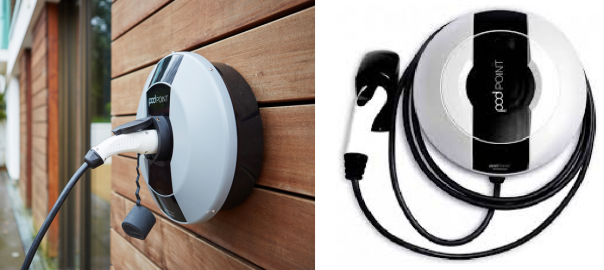
Choosing a Charge Point
When buying an electric car it is nearly always worthwhile to get a dedicated charge point installed at home.
It’s more convenient than an ‘occasional use’ or ‘granny’ (13 Amp) charge cable because you don’t need to reel it up and put it away each time.

It will also be significantly faster because a dedicated charge point can provide more power without the risk of overheating. Also some electric cars, such as the Renault ZOE, don’t come with such a cable and buying one yourself can be very expensive (£500+).
The good news is that the installation of domestic charge points is subsidised by the UK government.
There are 3 decisions to be made when selecting the type of charge point for your car:
- Tethered or Untethered
- Connector Types
- Power Level
Tethered or Untethered
There is usually the choice of a ‘tethered’ cable (it is fixed to the charge point) or an ‘untethered’ cable (it plugs into and can be removed from the charge point).

Untethered has the advantage of allowing different cables to be connected (for example you can use the same charge point for a Nissan Leaf and a Renault ZOE). However, most people choose tethered because it avoids the inconvenience of connecting a cable whenever you need to charge (usually daily). It also reduces the risk of the cable being stolen.
A charge point with a tethered cable will usually cost more than an untethered one (typically about £50 more) because of the cost of its cable.

If you choose untethered you will need to use your own cable to connect to the car; it is the same cable that would be used to connect to a public charging point. It may come free with the car, for example the Renault ZOE or the Nissan Leaf with the 6.6kW charge option come with one. Otherwise you will need to buy one (we can advise you on suppliers).
Connector Types
All untethered domestic charge points supplied in the UK come with a Type 2 socket on the charge point, just as all public charge points now have (or at least officially should have) Type 2 sockets. Similarly all charge cables have a Type 2 plug at the charge point end.

If the cable is tethered then you need to tell the installer the type of plug you want at the car end. This will depend on the car:
- Type 1 socket: Nissan Leaf, Mitsubishi Outlander PHEV, Kia Soul EV
- Type 2 socket: Renault ZOE, BMW i3, Tesla, VW e-Golf and Hyundai IONIQ
The Type 2 or ‘Mennekes’ connector is the official standard in Europe and should eventually replace the Type 1.
Power Level
A dedicated charge point can provide higher powers than a typical occasional use charging cable which will run at 10 Amps, equivalent at 230 Volts to 2.3 kilowatts. The charge will take place at the highest power that both the charge point can provide and the car can use.
There are two common power levels:
- 16A = 3.5kW: This is the maximum charge level of the Nissan Leaf 3.3kW, the Mitsubishi Outlander and the VW e-Golf.
- 30A/32A = 7kW: This is the maximum charge level of the Nissan Leaf 6.6kW, BMW i3, Kia Soul EV and Hyundai IONIQ. The standard Renault ZOE can use this level, in fact anything up to 22kW.
The higher power reduces the charge time so a typical EV battery will charge in about 8 hours at 16A but in about 4 hours at 32A.
It may be best to install the highest power charge point you can afford; even if your current car can’t use all the power, the next one almost certainly will be able to.
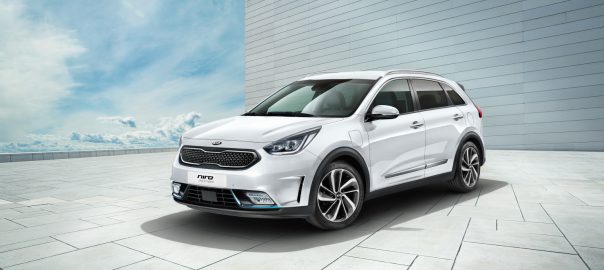
Crossover Practicality from New Kia Niro Plug-in Hybrid
- Niro Plug-in Hybrid model on sale across Europe during Q3 2017
- 8.9 kWh High-capacity lithium-polymer battery pack and 1.6-litre GDI engine
- Development engineers target pure-electric range over 55 kilometres
- CO2 emissions targeted to fall below 30 g/km
- Plug-in Hybrid crossover offers 324-litre cargo space and spacious cabin
- Advanced energy-saving measures and unique styling features
- Optional Towing Pack with 1,300 kg capacity
Kia Motors has today unveiled the Niro Plug-in Hybrid at the Geneva International Motor Show. The new derivative combines high versatility and crossover design appeal with maximum fuel efficiency from its advanced new plug-in hybrid powertrain.
The Niro Plug-in Hybrid will go on sale across Europe during Q3 2017, pairing an economical 1.6-litre GDI (gasoline direct injection) engine with a 8.9kWh high-capacity lithium-polymer battery pack. The latest addition to Kia’s hybrid crossover range substantially reduces emissions over the more conventional Niro hybrid – engineers are targeting CO2 emissions below 30 g/km (combined, New European Driving Cycle) and a zero-emissions pure-electric driving range of over 55 kilometres. Final electric range and CO2 emissions figures will be published closer to the car’s on-sale date.

Michael Cole, Chief Operating Officer, Kia Motors Europe, commented:
“Annual sales of plug-in hybrid models in Europe are expected to grow to more than 600,000 units by the end of 2023, while the crossover market is also forecast to expand in the coming years. There is a clear demand from customers for a vehicle which combines the practicality and ‘cool’ image of a compact crossover with the ultra-low emissions of an advanced plug-in powertrain. The Niro Plug-in Hybrid will be the only car on the market to offer this combination.”
“The Niro Plug-in Hybrid is one of the latest low-emissions cars from Kia which will help the company achieve its global target for 2020 – to improve fuel efficiency by 25% compared with 2014 levels.”
The Niro Plug-in Hybrid is one of two low-emissions vehicles unveiled by Kia at the Geneva International Motor Show, alongside the new Optima Sportswagon Plug-in Hybrid.
Read more: Kia Press Office

UK electric vehicle boom drives new car sales to 12-year high
The number of new cars registered in the UK hit a 12-year high in January, with electric vehicles taking a record share of the market, according to the Society of Motor Manufacturers and Traders (SMMT).

The industry body had warned of a slowdown in the motor trade in 2017 because of the impact of the weak pound, but there was no sign of deceleration in the first monthly numbers of the year.
Drivers registered 174,564 cars in January, up 2.9% on last year, to reach the highest monthly level since 2005, the trade body said.
Alternative fuel vehicles, mainly electric cars, such as the Nissan Leaf, increased by a fifth to reach a record 4.2% share of new vehicle registrations, beating a previous high of 3.6% in November last year.
Read more: The Guardian
Driving Route 57 – The UK & Ireland’s Route 66
In April 2016, Jess Shanahan drove 2,500 miles across England, Wales, Scotland and Ireland in an electric car – through cities, villages, national parks and more. Here, Jess shares her experiences and encounters of driving Route 57, the Great British & Irish Road Trip.
https://www.youtube.com/watch?v=mXn2BS2Ngow
Read more: Route 57

2016 Kia Optima PHEV review
Plug-in hybrid Optima is a practical, tax-efficient PHEV that undercuts rivals and fulfils its main remit well

What is it?
Kia’s first plug-in hybrid, complete with the credibility-stretching fuel economy and emissions figures we’ve come to expect from cars of this type. The Optima PHEV combines the efforts of a normally aspirated 2.0-litre petrol engine and a 50kW electric motor to deliver a peak system output of 202bhp.
There will be more interest among company car drivers in the Optima’s price and CO2 figure. At £31,495 after the UK government’s £2500 plug-in incentive, it undercuts both the Mitsubishi Outlander PHEV and Volkswagen Passat GTE, the VW by nearly £5000. The 9.8kW/h lithium ion polymer battery, which is located underneath the rear of the car, is powerful enough to deliver a claimed 33 miles of electric-only range, and because the official EUDC consumption test allows plug-ins to start with a full battery and finish with a depleted one, the Optima scores a 176.6mpg rating and 37g/km of CO2.
Getting anywhere close to those figures in the real world will mean lots of short journeys between charging stations, of course, and a little patience. Kia says the battery pack can be replenished from flat in three hours by a 240V domestic supply.
Although it is Kia’s first plug-in, the Optima PHEV is mechanically pretty much identical to the Hyundai Sonata PHEV already on sale in some markets. Like its sister, it uses a six-speed automatic gearbox rather than a CVT, with the electric motor effectively replacing the torque converter at low speeds. Thereafter it can either supplement the petrol engine or, in EV mode, power the car by itself at up to 75mph.
Read more: Autocar

2,500 mile Electric Car Road Trip through UK & Ireland
On 6th April 2016 Jess Shanahan set out from Plymouth on a 20 day journey across England, Wales, Scotland and Ireland – finishing in Galway on 26th April.

The road trip, named Route 57 for its 57 ‘must see’ destinations along the way, included stops in cities, villages, forests, and national parks – documenting the journey with photos and video.
The route was designed by Jurys Inn Hotels, and driven in a Kia Soul EV supplied by DriveElectric, using electric car charging points (mapped out by ZapMap). The electric car saw the capital cities of four countries, was welcomed by 17 town and city mayors, stopped at motor museums, iconic landmarks, and drove through scenic landscapes including Dartmoor, the Brecon Beacons, the Lake District, The Cairngorms, Wicklow Mountains and more.
Source: Agenda21 Digital
Kia Soul EV Now Available on PCP
Warning: preg_match(): Compilation failed: invalid range in character class at offset 4 in C:\inetpub\vhosts\fuelincluded.com\httpdocs\wp-content\plugins\maxbuttons\assets\libraries\simplehtmldom\simple_html_dom.php on line 1389
Warning: preg_match_all(): Compilation failed: invalid range in character class at offset 4 in C:\inetpub\vhosts\fuelincluded.com\httpdocs\wp-content\plugins\maxbuttons\assets\libraries\simplehtmldom\simple_html_dom.php on line 694
Warning: foreach() argument must be of type array|object, null given in C:\inetpub\vhosts\fuelincluded.com\httpdocs\wp-content\plugins\maxbuttons\assets\libraries\simplehtmldom\simple_html_dom.php on line 701
Warning: preg_match_all(): Compilation failed: invalid range in character class at offset 4 in C:\inetpub\vhosts\fuelincluded.com\httpdocs\wp-content\plugins\maxbuttons\assets\libraries\simplehtmldom\simple_html_dom.php on line 694
Warning: foreach() argument must be of type array|object, null given in C:\inetpub\vhosts\fuelincluded.com\httpdocs\wp-content\plugins\maxbuttons\assets\libraries\simplehtmldom\simple_html_dom.php on line 701
Fatal error: Uncaught Error: Attempt to assign property "href" on array in C:\inetpub\vhosts\fuelincluded.com\httpdocs\wp-content\plugins\maxbuttons\blocks\basic.php:171 Stack trace: #0 C:\inetpub\vhosts\fuelincluded.com\httpdocs\wp-content\plugins\maxbuttons\classes\button.php(382): MaxButtons\basicBlock->parse_button() #1 C:\inetpub\vhosts\fuelincluded.com\httpdocs\wp-content\plugins\maxbuttons\classes\button.php(476): MaxButtons\maxButton->parse_button() #2 C:\inetpub\vhosts\fuelincluded.com\httpdocs\wp-content\plugins\maxbuttons\classes\button.php(903): MaxButtons\maxButton->display() #3 C:\inetpub\vhosts\fuelincluded.com\httpdocs\wp-content\plugins\maxbuttons\classes\maxbuttons-class.php(525): MaxButtons\maxButton->shortcode() #4 C:\inetpub\vhosts\fuelincluded.com\httpdocs\wp-includes\shortcodes.php(434): MaxButtons\maxButtonsPlugin->shortcode() #5 [internal function]: do_shortcode_tag() #6 C:\inetpub\vhosts\fuelincluded.com\httpdocs\wp-includes\shortcodes.php(273): preg_replace_callback() #7 C:\inetpub\vhosts\fuelincluded.com\httpdocs\wp-includes\class-wp-hook.php(324): do_shortcode() #8 C:\inetpub\vhosts\fuelincluded.com\httpdocs\wp-includes\plugin.php(205): WP_Hook->apply_filters() #9 C:\inetpub\vhosts\fuelincluded.com\httpdocs\wp-includes\post-template.php(256): apply_filters() #10 C:\inetpub\vhosts\fuelincluded.com\httpdocs\wp-content\themes\twentythirteen\content.php(43): the_content() #11 C:\inetpub\vhosts\fuelincluded.com\httpdocs\wp-includes\template.php(812): require('...') #12 C:\inetpub\vhosts\fuelincluded.com\httpdocs\wp-includes\template.php(745): load_template() #13 C:\inetpub\vhosts\fuelincluded.com\httpdocs\wp-includes\general-template.php(206): locate_template() #14 C:\inetpub\vhosts\fuelincluded.com\httpdocs\wp-content\themes\twentythirteen\category.php(28): get_template_part() #15 C:\inetpub\vhosts\fuelincluded.com\httpdocs\wp-includes\template-loader.php(106): include('...') #16 C:\inetpub\vhosts\fuelincluded.com\httpdocs\wp-blog-header.php(19): require_once('...') #17 C:\inetpub\vhosts\fuelincluded.com\httpdocs\index.php(17): require('...') #18 {main} thrown in C:\inetpub\vhosts\fuelincluded.com\httpdocs\wp-content\plugins\maxbuttons\blocks\basic.php on line 171