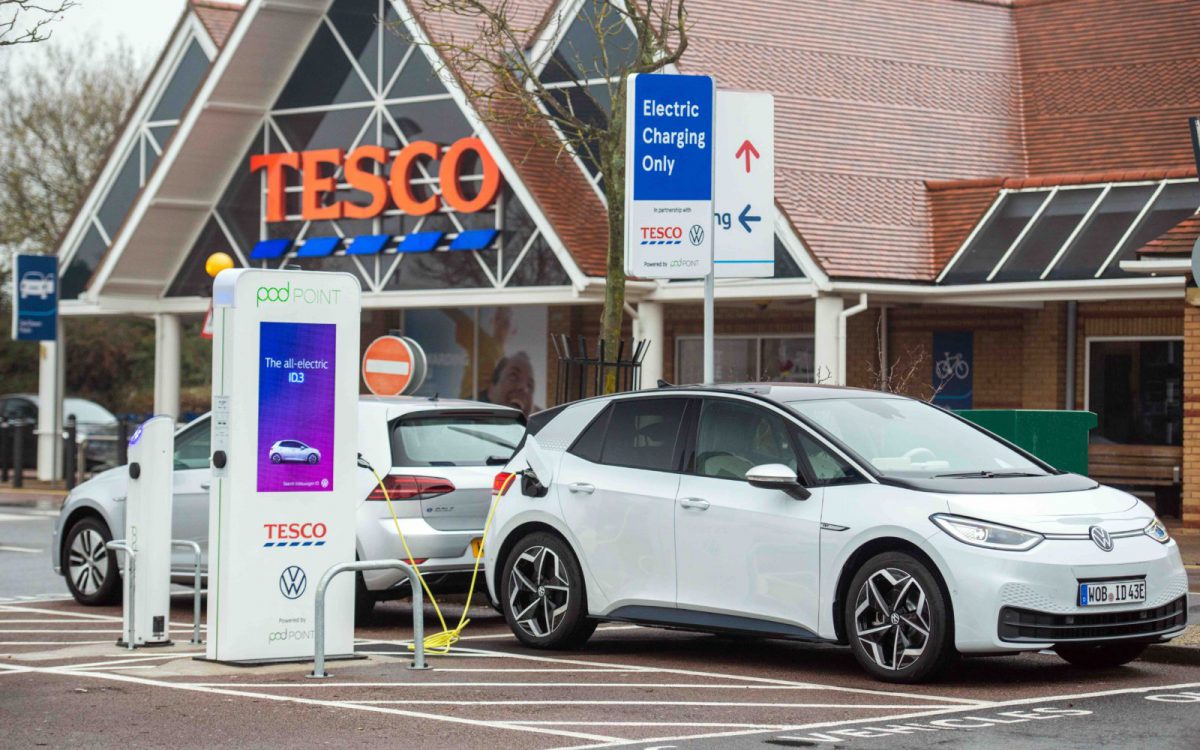
Electric vehicle (EV) charging company Pod Point has reached a new milestone in its rollout of chargers at Tesco stores.
Chargers have now been installed at 200 Tesco stores, with the latest – four 7kW charging bays – going in at the Chester Tesco Superstore. This takes the number of chargers installed as part of the rollout to 402, with at least two charging points installed at each location.
POD Point Rollout at Tesco Stores (Image: Tesco/POD Point)
The partnership is on track to install chargers at a further 200 stores by the end of the year, Pod Point said, with 12% of the total Tesco store footprint now having EV charging facilities.
This is set to rise to 36% following the rollout, which is being done as a partnership between Pod Point, Tesco and Volkswagen and was first announced in 2018.
It is aiming to install 2,400 charging points across 600 UK stores, with chargers first installed in 2019.
Since then, over 669MWh has been used to power customers’ vehicles, with the chargers – which are free to use – powered exclusively through renewables.
If you would like to know more about Solar Panels and the PowerBanx range of home battery systems, and get a free instant quote, please complete our online form:
Due to the Covid 19 pandemic, not only are the production lines in most electric car plants at a standstill but now first effects on charging infrastructure are becoming apparent.
This concerns both the production of charging points and the maintenance and distribution of the pillars.
Ubitricity and Pod Point, for example, are postponing charging point installations in the UK that are currently not necessary. The responsible Ubitricity manager announced that the installation of new lantern charging points in London would be suspended as the work was not considered “essential”. However, the existing charging points will continue to be maintained.
Pod Point Solar Charge Points charging electric cars (Image: T. Larkum)
The same applies to Pod Point, but in some “critical” cases the company announced exceptions in a statement. For example, home chargers ordered will continue to be installed at homes of people who were classified as “key workers” in the coronavirus crisis or if the household only has battery-electric cars and no more ICEs. Orders are still possible for all customers, but installation will take place at a later date.
The same applies to commercial installations; here too, companies that rely exclusively on electric cars and charging points installed at the workplace for “key workers” will continue to be served. Maintenance work at Homecharge customers and the public Pod Point network will continue. However, for the time being, maintenance work on charging points at the workplace will only be carried out for those working in the health or logistics sector.
If you would like to know more about Solar Panels and the PowerBanx range of home battery systems, and get a free instant quote, please complete our online form:
EDF has confirmed its long-rumored acquisition of electric vehicle (EV) charging company Pod Point, in a move that sees it cement its position in the UK EV space.
The energy supplier has purchased the charging company together with Legal and General, which is taking a c.23% stake in EDF’s newly-formed joint venture. This follows the finance giant purchasing a share in Pod Point last March.
EDF says that the acquisition will bring benefits including reduced costs to customers, through the combination of EDF’s energy solutions and Pod Point’s 62,000 chargers in the UK currently.
Pod Point Solar Charge Points charging electric cars (Image: T. Larkum)
The acquisition follows its purchase of battery storage and EV charging infrastructure firm Pivot Power last November as it seeks to grow in the EV space, both in the UK and Europe.
Simone Rossi, UK CEO of EDF said EVs will be “crucial” to reducing carbon emissions and fighting climate change.
“With the addition of charge points, we can help our customers to reduce their carbon footprints and benefit from lower fuel costs by going electric. The additional electricity demand from EVs will require urgent investment in low carbon generation from renewables and nuclear.”
Erik Fairbairn, Pod Point CEO & founder said that this was an “incredibly exciting next chapter” for the company.
“By joining up with EDF we can take things to the next level and accelerate our national roll out of charging points and make it even easier for drivers across the UK to go electric. I’m immensely proud of what the Pod Point team has already achieved but think it is only a fraction of what we will now be able to do with EDF.”
If you would like to know more about Solar Panels and the PowerBanx range of home battery systems, and get a free instant quote, please complete our online form:
Volkswagen, Tesco and Pod Point are determined to provide shoppers with free charging points as motorists increasingly turn to electric vehicles as they become more and more convenient to run
Electric car drivers can now charge their vehicles for free while doing their weekly shop at over 100 supermarkets across the UK.
Volkswagen has partnered with Tesco and Pod Point to provide shoppers with free charging points – with a further 2,000 units in the pipeline.
Volkswagen ID.3 electric car (Image: Volkswagen.com)
It is estimated a typical EV driver who spends 50 minutes shopping each week could get more than 1,000 miles of free electricity for their car over a 12 month period.
The free charging points are a response to the growth of electric cars in the UK, with sales up by 125 per cent this year according to the Society of Motor Manufacturers and Traders.
And demand is set to rise, with Volkswagen’s survey of 2,000 UK motorists revealing 41 per cent are considering leasing or owning an EV as their next vehicle. This figure increases to 61 per cent among the 25-34 age group.
If you would like to know more about Solar Panels and the PowerBanx range of home battery systems, and get a free instant quote, please complete our online form:
Free charging for electric cars will be available for customers at some Tesco stores from next year.
Tesco, in partnership with Volkswagen, plans to install almost 2,500 charging bays at up to 600 stores by 2020.
A standard 7kW charger will be available for free, but drivers will have to pay for a faster service.
Customers will be able to leave their cars to charge while doing their shopping, which should give time for a “substantial” free charge, VW said.
VW e-Golf (Image: Volkswagen.co.uk)
How long it will take to fully replenish the battery will depend on the type of car. A company called Podpoint will build the charging facilities for VW and Tesco.
Volkswagen has two electric vehicles on the market in the UK, the e-Golf and the e-Up. It has sold about 1,350 of the cars since they went on sale four years ago, but has plans for a massive expansion.
By 2020 it wants to offer an electric version of all its models.
We’re in Skegness for the aquarium, our youngest is diving with the sharks! While she waits to go in I’m off to get the car charged.
The i3 has plenty enough range to get back to the Peterborough services. In fact it’s suggesting we could get 160 miles out of this charge which theoretically could get us all the way back to Northampton.
However Zap-map.com says there’s a free POD Point charger in Skegness so I’m going to investigate.
It’s in the Aura Business Park and it turns out to be easy to find. I plug in and it’s charging immediately, nothing else required.
While in the Aquarium the car gets fully charged. The dive has just finished and we’ll be heading back to the car in a minute. There’s a Pizza Hut next to it so I suspect that’s what we’ll be having for dinner tonight!
Update: We did eat in Pizza Hut. We also got home all the way from Skegness to Northampton without needing to charge (in fact, with about 40 miles left on the clock) – and for free!
The Solar Charge Points at Devon Cliffs – and only 2/3 of the cars shouldn’t be parked there! (Image: T. Larkum)
On arrival we found a pleasant surprise – a solar powered charging bay in the main reception car park. I have since learned that it was installed about a year ago in a joint venture with Bourne Leisure (owners of the park), Solarplicity and POD Point.
Having last charged at Sedgemoor, about 60 miles back, we didn’t need to charge again for the first few days. Then I started looking into how to start a charge – doing some Googling, searching on the POD Point online map (which didn’t show the charge point), installing the POD Point app, etc.
However, it all turned out to be unnecessary – I called POD Point and they explained that it was a private charge point – hence not on the public map – and that it was free to use. In hindsight I should have just plugged in and tried it!
The POD Point charge points at Devon Cliffs (Image: T. Larkum)
We have since made good use of the charge point, leaving the car on charge overnight most days. It is marked as a 7kW point which should charge our i3 in about 4 hours. In fact I am seeing charge times significantly longer than that so I would guess it is actually running at about half that, 3.5kW. Perhaps that has something to do with being solar powered, e.g. a reduced charge outside sunny hours, I don’t know. Anyway, the car is fully charged every morning so it doesn’t really matter.
The charge point has been a real boon – allowing us to go on long trips out most days without needing to find anywhere else to charge.
I wrote last week of what is required to fill out the on-line application for the POD Point charge point. Once I had applied things moved pretty quickly.
Attaching the POD
The following day I got an email outlining the name and time of an installation appointment a week later. They also sent me a link to click should I need to reschedule. Two days before the install, I got a further email confirming I was still available and confirming that the engineer would arrive between 1pm and 3pm.
Come the day, a minor glitch. 3pm came and went and no engineer. I followed up with an email at 3.40pm, and 10 minutes later got a call from the engineer saying when he would arrive. So at 4.15, the installation began.
My installer turned out to be Mohamed Aly and was very knowledgeable and enthusiastic. He had the whole job done and dusted in an hour and a quarter.
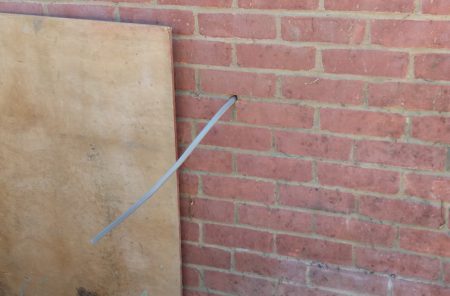
First he laid the cable and drilled through to the desired mounting point for the POD, and then attached the POD.
Lay the cable and drill through
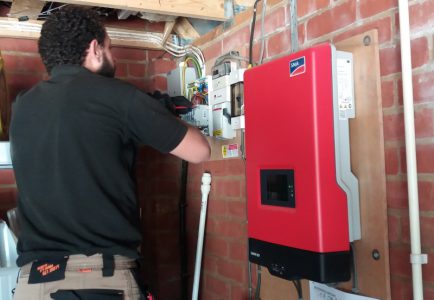
At the other end, he now connected to the mains. You can see my Photo-Voltaic Solar Array converter to the right. Mohammed commented that he used to install Photo-Voltaic systems, and that the SMA inverter I have was the most reliable he ever came across.
Connect to the mains
The final step was commissioning the system and connecting it to my WiFi router. A neat process in which he connected his tablet wifi to the POD, then selected the router from the list and ‘handed’ it over to the POD.
Connect to WiFi
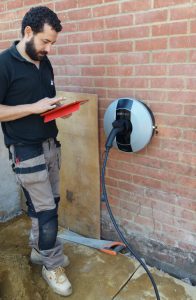
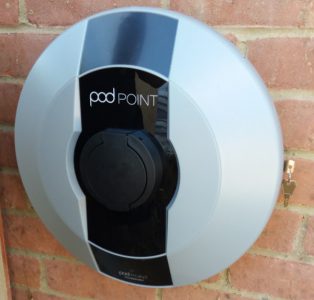
The finished POD. We did test it, and it all worked as expected. Many thanks to POD Point and to Mohamed.
I Have my New Car Ordered – Now I Need a Charge Point
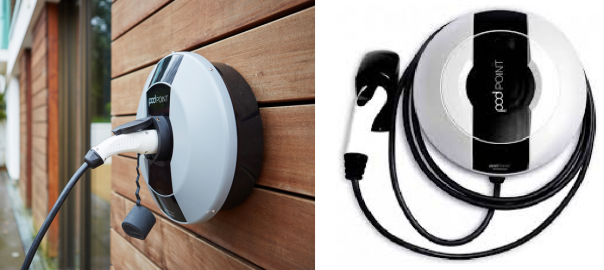
Untethered and Tethered Charge Points (Image: POD Point)
With my new Leaf, I get a new, FREE, POD Point charge point.
Thanks to a Nissan discount of £264 and the government OLEV scheme discount of £500, there is no charge for me at all for the entry level unit, although there are a couple of upgrade options you can choose.
Here is a quick guide to what to expect when you are ready to get your system installed. This blog covers the on-line application, with a separate blog that covers the installation.
Ordering my New Charge Point
The process starts with an email from POD Point to start the application. It was pretty straightforward and the pictures below step through the choices offered. The three choices I made of most significance to me were the following:
1) Upgrade to a 7kW charger. This cost £95. This seemed good value and future proofs me for longer range cars in the future.
2) Upgrade to a key so that I can lock the charger if necessary. This cost £30. I am not sure if electric thieving is likely.
3) I chose to have an un-tethered system with a type 2 socket so that it could work with any car. This was no charge. POD-Point tell me there is no difference in charge between a tethered and un-tethered system.
1 – The initial email from POD Point
2 – website starting point
3 – charge power choice
4 – tethered/untethered choice
5 – extras: key, cable, freestand
6 – Order summary showing total price less the nissan discount
7 – A statement that I have bought/leased a new car and have suitable off-street parking for a chargepoint to qualify for the OLEV grant
8 – 2nd Order summary including the OLEV grant
9 – payment for my extras
10 – payment summary
11 – address for installation
12 – installation specific questions
13 – statement of whether I do or don’t want the OLEV grant
14 – formal grant application. This needed a form downloaded, filled in and uploaded. Not particularly difficult and definitely worth it to save £500.
Ten years ago the notion that electric vehicles (EV) could significantly disrupt the conventional diesel-fuel monopoly of the car market seemed like a pipedream – but that dream is coming close to a reality. Erik Fairbairn, the Founder of UK electric vehicle (EV) charging company POD Point, which recently crowdfunded £9m on Crowd Cube, explains why EVs are about to become the new normal.
It’s Fairbairn’s belief that in the future EV drivers will no longer need to stop somewhere to charge their car, but instead this mundane task will happen when the car isn’t being used, which is 90% of the time.
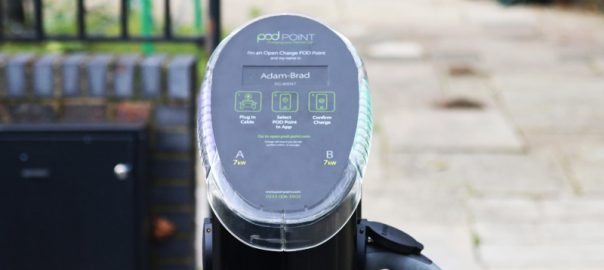
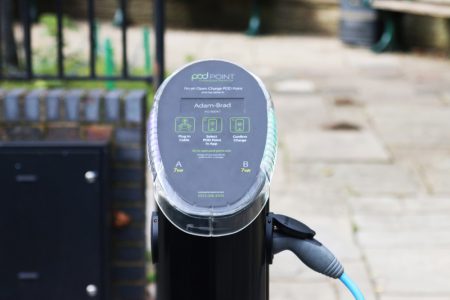
There are 2,000 public POD Point charge stations around the UK. Image courtesy of POD Point.
Starting a revolution
“My first thought was: how do you put energy into your car? With a petrol pump, so you probably need something similar for an EV,”
Fairbairn explains.
His POD Points look like conventional petrol pumps, but instead of a long, oily nozzle at the end of the handle there is a large plug.
Fairbairn quickly grasped that he couldn’t completely replicate the petrol station experience, as to take a battery from empty to full in two minutes simply doesn’t work.
“I realised I need to put a charge point everywhere your car is parked,”
he explains.
Grid watch
One of the main concerns linked to widespread EV roll-out is the energy demand and strain they will inevitably put on the national grid, which Fairbairn believes can be managed with demand-side response.
“In the future, when we get to a mass roll-out of EVs we can carefully manage how many cars are charging at any one minute,”
he says.
Who’s investing?
POD Point is one of the top ten most crowdfunded business in the UK. It previously raised £5m across three different rounds of crowdfunding and in December raised an additional £9m.
“Crowdfunding is great as there are many EV drivers that want to invest in the company – there is this affinity between the company and the drivers who like being part of the POD Point ecosystem,”
says Fairbairn.
Mass adoption
The immediate plan for POD Point is to scale-up the UK operation, but regardless of the outcomes of Brexit, there is huge potential for the company in neighbouring Europe.
“I think the UK is one of the more advanced places in Europe for EV charging, but the opportunity to export from UK to the rest of Europe and build networks across the whole of the continent is very exciting,”
says Fairbairn.
In the rankings of EV adoption, Norway is first, the Netherlands second at 5%-8%, and the UK third at 2%.
“The biggest barrier for EVs today is that they are more expensive,” Fairbairn says. “My rule of thumb is that mass adoption is going to happen when we get a 200-mile range car for £20,000 and I think that will happen in 2020.”