Electric cars may be the safest way to travel with ‘contact free’ trips guaranteed
Electric cars can be charged for over 300 miles from the comfort of your own driveway meaning road users do not need to visit packed petrol stations. The contact free trips mean road users can top up their car without any risk of picking up any germs from fuel pumps or other motorists.
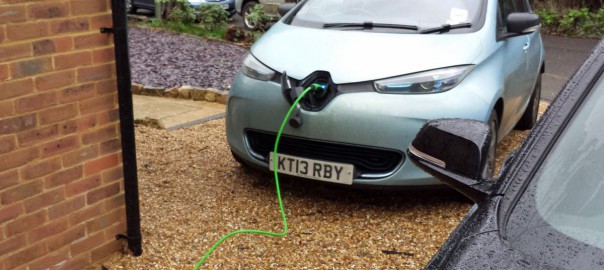
Charging at home (Image: T. Larkum)
Speaking to Express.co.uk, Fiona Howarth, CEO of Octopus Electric Vehicles said motorists would also be able to charge at numerous other areas away from traditional petrol stations.
She said the growing infrastructure has meant motorists can top up while staying in hotels and even at parks.
Ms Howarth told Express.co.uk:
“With the ability to safely charge at home and complete up to a 310 mile trip on one charge, electric vehicles make contact free trips possible this summer.
“If you do need to charge while you’re out, the growing UK charging infrastructure means you can charge at National Trust properties or even stay in numerous hotels and apartments where charging is available on site, avoiding more crowded traditional stops.”
If you would like to know more about Solar Panels and the PowerBanx range of home battery systems, and get a free instant quote, please complete our online form:
Climate change has raced up the list of priorities for the public during the last year or so.
MORI polls have shown that this is now at the top of the public’s concerns, sharing importance levels only achieved by Brexit, social care and the NHS
But there is much to do in order to meet the government’s legally binding targets of the UK being net-zero carbon by 2050. Of the key areas of electricity supply, heating and transport, progress in the latter is slower by some margin.
So, what are the answers?
Government policy is lagging behind where it should be and attracting criticism from the independent Committee on Climate Change. The automobile industry is moving ahead regardless, perhaps seeing the way the wind is blowing. Local authorities are declaring climate emergencies and introducing wide ranging local plans to achieve even more stringent targets.
More infrastructure is being delivered to facilitate EV charging but, more importantly, this is being linked to wider green agenda aims via vehicle to grid chargers. These fit EV ownership nicely into the thread of ‘homes / buildings as power stations’ in their own regard and the very definition of decentralisation. All of these will play a role in the future. Government policy looks forward to 2035 but perhaps by then the deep seated and intractable desire of the British individual to own a car at all might be starting to fade, with car clubs and shared transportation becoming the norm.
Climate Change
There is a whole international infrastructure which oversees climate change across the globe. The UNFCCC and IPCC have been saying for years that global warming is worsening and that urgent action needs to be taken. However, the IPCC report of October 2018 touched a particular nerve with the public.
This was the most hard-hitting report to date and effectively said that the world has 12 years to get a grip on global warming, or there will be irreparable damage to the world’s ecosystems and environment. From this report sprung a new vigour of climate action. Greta Thunberg and Extinction Rebellion were but two indicators of this.
If you would like to know more about Solar Panels and the PowerBanx range of home battery systems, and get a free instant quote, please complete our online form:
A new government fund is to help pay for connection costs to enable the installation of high-powered charging (HPC) at motorway sites across England.
The Rapid Charging Fund – which was first announced in the 2020 Budget – will be available to fund a portion of costs at strategic sites where upgrading connections to meet future demand for HPC is “prohibitively expensive and uncommercial”, supporting several governmental ambitions.
Milton Keynes ‘Mushrooms’ Charging Hub (Image: T. Larkum)
One such ambition is that by 2023, six HPC points between 150kW and 350kW will be available at motorway service areas in England, with some larger sites having up to 10-12 chargers.
Secondly, by 2030 this network is expected to be “extensive”, with the government planning for there to be 2,500 HPC points across England’s motorways and major A roads. This increases to 6,000 by 2035, the date the government is consulting on to ban sales of new petrol and diesel vehicles.
Timing and delivery of the funding is to be confirmed in due course, the government said. No details as to how much funding will be available has been disclosed.
It listed expectations it had for new chargepoints to make them easy to use and hassle-free, including that they are able to take credit and debit card payments and will be available 99% of the time.
If you would like to know more about Solar Panels and the PowerBanx range of home battery systems, and get a free instant quote, please complete our online form:
An AA survey suggests 85% of drivers think the signs would have ‘more impact’ if they were green.
More than four out of five drivers believe signs for electric vehicle (EV) charge points would be easier to spot if they were green, a new survey suggests.
Some 85% of 17,500 drivers polled by the AA said signs featuring a white “P” in a green box would have “more impact” in indicating the location of charge points.
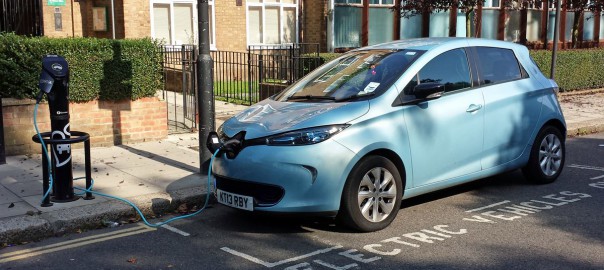
Slow Charging the ZOE at Highgate (Image: T. Larkum)
This would be instead of a blue box, which is the colour used on designs currently approved by the Department for Transport.
AA head of roads policy Jack Cousens said transforming charge point signage in this “simple” way could make a “big difference” to demand for electric cars by easing concerns over the extent of the charging infrastructure.
He went on:
“Drivers believe there are a lack of charging points, but the case is they are hidden in plain sight. While fuel forecourts have the benefit of large totem poles, charge points can blend into the background.
“Changing to a green parking sign will help them stand out and reassure drivers who are thinking about buying an EV that there are more charge points than they think.”
If you would like to know more about Solar Panels and the PowerBanx range of home battery systems, and get a free instant quote, please complete our online form:
Zap-Map in partnership with the REA has carried out a survey on EV use during the COVID-19 pandemic
83% EV users still reliant on their EV for essential travel and almost three in ten (29%) are still using the public charging network
Almost a quarter of these EV users (24%) identify as ‘key workers’
98% of the public charging infrastructure is operating as normal – although there is an increase on normal reporting rates of issues
A survey by Zap-Map in partnership with the REA has found that EVs and the public charging network are vital for essential travel and keeping ‘key workers’ on the move during the COVID-19 pandemic.
Charging Station in Sunderland (Image: Fastned)
The survey which took data from over 3,000 EV users found that, despite EV use falling significantly in line with the overall reduction in travel, 83% of users are still reliant on their EV for essential travel. Of these, just under a quarter (24%) identify as key workers with the majority of these (36%) working in healthcare with others working across a range of sectors including utilities, food delivery, transport, public safety and education.
Amongst those surveyed, 29% are still using the public and manufacturer-owned charging network. This number increases when looking at key workers, with just under half (47%) reliant on the public charging network. Although this is a reduction in the pre-COVID proportion of usage (which is more than 90%), it demonstrates how important the charging infrastructure continues to be for many EV drivers.
Whilst the vast majority of those surveyed were satisfied with the public and manufacturer-owned network, 21% of users reported experiencing some issues, an increase on normal reporting rates. This number increased to 28% amongst key workers, most likely due to this group utilising the infrastructure more frequently. The two key lockdown-related issues cited are either delays to chargers being repaired and inaccessibility of charge points where a site has been closed or is now behind a barrier.
Zap-Map has also been working closely with the network operators and incorporating direct feedback from EV drivers to identify and highlight the chargers clearly on the map. As it stands, 430 charging points, out of a total of over 18,000 across the UK (2%), have been identified as temporarily non-accessible due to lockdown measures.
In light of the issues identified in the survey, the REA has contacted the Government asking them to classify public and manufacturer-owned EV charging maintenance personnel as key workers. The REA and Zap-Map are also working with the Office for Low Emission Vehicles to fully understanding issues relating to site accessibility.
If you would like to know more about Solar Panels and the PowerBanx range of home battery systems, and get a free instant quote, please complete our online form:
Scottish and Southern Electricity Networks (SSEN) is looking at portable electric vehicle (EV) chargers in a new project.
The £320,000 Local Electric Vehicle Energy Loop (LEVEL) project, which has secured funding from Ofgem’s Network Innovation Allowance (NIA), is to scope out the design and capabilities of portable EV charging devices.
The project is to last 18 months, starting this month, with the aim of identifying ways to improve network and charging resilience to meet short term demand.
Rapid charge points (Image: Drive Energi)
Future applications of the technology include deployment in advance of bad weather, such as in remote locations across Scotland that experience power cuts as a result of adverse weather.
LEVEL will also investigate the feasibility of positioning charging devices in public car parks during the summer months, boosting local capacity.
The project will develop the standard and specification of the temporary chargers and will include a demonstration of a device in SSEN’s licence area in the north of Scotland.
It will consider the customer interface, such as the development of an app to display the charger locations, as well as what the best ownership model for the devices would be, which SSEN said may be public bodies.
The role of the chargers in vulnerable communities and the implications for metering and settlement from temporary connections will also be considered.
“A portable charging device could be a valuable tool to help us manage short-term and short-notice surges in demand, whilst avoiding costly network reinforcement,” said Kate Jones, project manager for LEVEL at SSEN.
If you would like to know more about Solar Panels and the PowerBanx range of home battery systems, and get a free instant quote, please complete our online form:
IONITY is continuing its rollout of high-power charging (HPC) with the completion of its latest site.
The station – the fourth to be open to the public in Great Britain – is located at Leeds Skelton Lake Services. It is the first UK station to have six of IONITY’s new 350kW chargers, which feature a new design and improved functionality.
IONITY rapid charge points at Leeds Skelton Lake Services (Image: IONITY)
The new chargers use halo lighting to provide customers with information about the charging status of the battery, with illumination to make use in darkness easier. They also have a new position and design of charging cable to make attaching to the car easier than the current units.
IONITY ordered 324 of the chargers from manufacturer ABB in January, with plans to roll them out across 24 countries by the end of 2020.
IONITY also plans to open a further seven HPC facilities with Extra MSA – which operates parts of the UK’s motorway network – during 2020, with the deal between the two announced last year. The other locations have already been selected, with two being the M40 J2 Beaconsfield and M25 J9-J10 Cobham Services.
If you would like to know more about Solar Panels and the PowerBanx range of home battery systems, and get a free instant quote, please complete our online form:
There have been plenty of good news stories coming from the automotive sector since the covid-19 outbreak, including car manufacturers switching their production lines to make ventilators.
But, of course, there are concerns about the industry’s economic stability, at the beginning of April 2020 car sales were down 44 per cent.
However, there are three powerful reasons why the electric vehicle market will be supercharged by this dreadful virus and lockdown when it’s over.
Clean refuelling
Firstly, drivers will want electric vehicles because diesel and petrol forecourts will be perceived as unclean. You have to hold the pump the previous person has used, touch the screen or enter the shop to pay. With electricity you can fuel up at your own home for consumers, or at a centralised depot for fleet owners.
Charging at home
We may all want to get back to normal but some things you can’t unknow, and one of those things is how infection is transmitted.
Preserving environmental gains
Secondly, people will want to do things differently and better. Those who can afford to buy cars will want to play a part in making the world a better, greener place. Already we are seeing how nature is recovery as a result of the lockdown: “This is the first time I have seen such a dramatic drop-off over such a wide area for a specific event,” said Fei Liu, an air quality researcher at NASA’s Goddard Space Flight Centre describing levels of nitrogen dioxide over China.
The nationwide shutdown has led to a big drop in air pollution across the UK’s major cities. For nitrogen dioxide pollution, new data shows that this has almost halved in London, Birmingham, Bristol and Cardiff. Transport contributes 23 per cent of global carbon emissions and driving is by far the largest element of that, contributing 72 per cent of transport carbon emissions.
If you would like to know more about Solar Panels and the PowerBanx range of home battery systems, and get a free instant quote, please complete our online form:
Installations of electric vehicle (EV) chargers are beginning to halt amidst new government guidelines regarding COVID-19.
Ubitricity Electric Avenue project lamppost charging (Image: Siemens)
Speaking to Current± yesterday, ubitricity’s managing director Daniel Bentham said they had received communication from Transport for London and the London boroughs that afternoon, and were told that the installation of EV chargers is not considered to be essential work.
“We’ll be pausing the installation of new charge points under the second phase of the Go Ultra Low City Scheme, but we will still be maintaining and conducting repairs and finishing any works which are currently underway,” Bentham said.
Ubitricity provides “all the hardware and services” for Siemens, which then does the installation works for a number of London boroughs under the Go Ultra Low City Scheme. The pair announced the completion of the UK’s first fully electrified residential avenue of lamppost chargers last week, which Bentham said now feels like “a different world almost”.
“We were on the street last Monday doing the photoshoots and the world changed the next day.”
If you would like to know more about Solar Panels and the PowerBanx range of home battery systems, and get a free instant quote, please complete our online form:
Due to the Covid 19 pandemic, not only are the production lines in most electric car plants at a standstill but now first effects on charging infrastructure are becoming apparent.
This concerns both the production of charging points and the maintenance and distribution of the pillars.
Ubitricity and Pod Point, for example, are postponing charging point installations in the UK that are currently not necessary. The responsible Ubitricity manager announced that the installation of new lantern charging points in London would be suspended as the work was not considered “essential”. However, the existing charging points will continue to be maintained.
Pod Point Solar Charge Points charging electric cars (Image: T. Larkum)
The same applies to Pod Point, but in some “critical” cases the company announced exceptions in a statement. For example, home chargers ordered will continue to be installed at homes of people who were classified as “key workers” in the coronavirus crisis or if the household only has battery-electric cars and no more ICEs. Orders are still possible for all customers, but installation will take place at a later date.
The same applies to commercial installations; here too, companies that rely exclusively on electric cars and charging points installed at the workplace for “key workers” will continue to be served. Maintenance work at Homecharge customers and the public Pod Point network will continue. However, for the time being, maintenance work on charging points at the workplace will only be carried out for those working in the health or logistics sector.
If you would like to know more about Solar Panels and the PowerBanx range of home battery systems, and get a free instant quote, please complete our online form: