Category Archives: Charging

VW Group to partner with BP to expand ultra-fast EV charging network

Volkswagen Group and BP will join forces to accelerate the roll-out of ultra-fast electric vehicle (EV) chargers across the UK and Europe.

The two companies will install new 150kW chargers at existing BP retail sites, as part of the partnership. They have signed a memorandum of understanding for their collaboration and intend to finalise agreements in the coming months.

The new partnership will make BP the car maker’s official charging partner, enabling the integration of BP’s charging network into VW Group vehicles to make finding and paying for charging simpler.

Thomas Schmall, member of the board of Volkswagen Group and CEO of Volkswagen Group Components, said: “Ultra-fast charging is the key enabler for e-mobility and therefore a main pillar for Volkswagen´s transformation.

“Together with strong partners like BP, we take this important matter into our hands and will build up to 18,000 new chargers in Europe. That is about a third of the estimated ultra-fast charging demand in 2025.”

The partnership is expected to provide EV drivers with greater confidence in being able to access nearby, reliable, quality charging options. BP estimates approximately 90% of people in the UK and Germany live within a 20-minute drive of one of its sites.

Emma Delaney, BP’s executive vice president, customers and products, said: “Enabling the rapid expansion of electric vehicles is core to Bp’s plans to grow our convenience and mobility business, and supports our net zero ambition.

“Partnering with Volkswagen Group we intend to address a key concern for people considering buying an EV: range anxiety.

“Together we can provide drivers in the UK and Europe with the fast, reliable and convenient charging solutions they need to feel more confident about making the switch.”

Read more: SMART TRANSPORT

It’s Time to Go Green!

If you would like to know more about Solar Panels and the PowerBanx range of home battery systems, and get a free instant quote, please complete our online form:

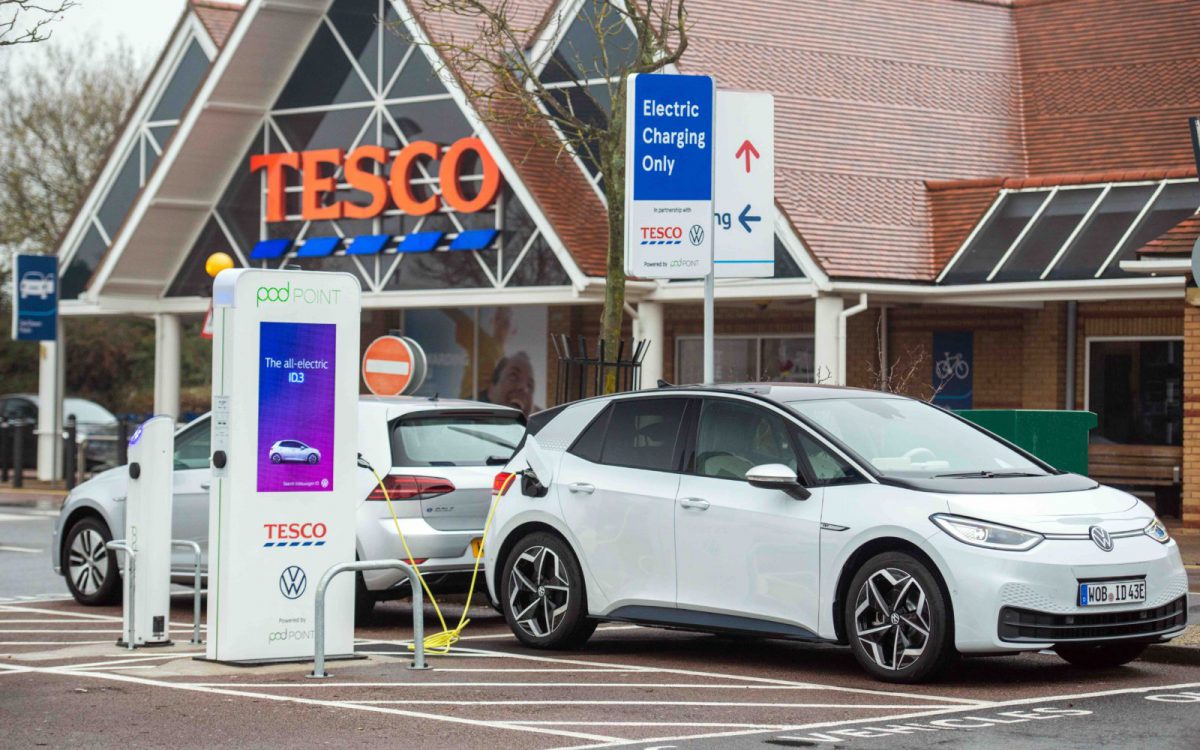
POD Point Rollout at Tesco Stores (Image: Tesco/POD Point)

IT’S ELECTRIFYING Driving an electric vehicle is cheaper than you think – costing just from 1p per mile!

We spoke to Go Ultra Low ambassador Ben Fogle all about it. In association with Go Ultra Low.

Having seen the positive impacts lockdown has had on the environment, we’re all keen to continue doing our bit – but the advice can be confusing.

From giving up meat to reducing your waste there’s so much you can do – but have you considered an electric vehicle (EV)?

Last year, we caught up with Ben Fogle, Go Ultra Low ambassador, to tell us all about his experiences with EVs.

Go Ultra Low is an industry and government campaign aiming to educate the UK about EVs.

When it comes to going green, Ben says it’s important to focus on what you can do and not what you can’t.

“I don’t think anyone is perfect and I’m the first one to put my hands up and say I’m not the perfect green citizen,” he told us. “The important thing is to realise the impact we have and work out what we CAN do.”

POD Point Rollout at Tesco Stores (Image: Tesco/POD Point)

For Ben and his family, switching to an EV seemed like a sensible and exciting decision and it wasn’t one they took lightly.

“As a family we looked at our mode of transport. We use public transport where we can – we use trains and we use buses but we also have a car and we need a car.”

“No one likes change, we’re all creatures of habit, but we’ve been an EV household for the best part of a year now – and we wouldn’t go back!”

Although switching to an EV seems like a big change, as they are at the forefront of technology, if you’re at the stage of life where you’re looking for a new car it can be an economically friendly decision as well as an ecologically friendly one.

There are now a lot of comparable price points available for EVs and plenty of leasing options, too. We’re also reaching the point where there are second hand EVs coming into circulation, so the price tag isn’t as large as you might think- and they can be cheaper to run.

When Ben used to live in London it used to cost £7 to fill the car at the chargepoint near his house, and he would combine the charge time with a dog walk. It would only take 30 minutes to fully charge and it would last them a week. Now Ben charges as home, so it’s even cheaper.

You can install a chargepoint at home or you can access one of the 38,000 public chargepoint connectors across the country. You can also get a government grant of up to £350 to help install a chargepoint in your home.

“I’d love to meet other people who get a full week’s driving from less than £7 petrol.”

Read more: The Sun

It’s Time to Go Green!

If you would like to know more about Solar Panels and the PowerBanx range of home battery systems, and get a free instant quote, please complete our online form:

BP Pulse unveils UK rollout of ultra-fast EV charging hubs

BP Pulse has unveiled new plans to rollout ultra-fast charging hubs across the UK, with these to be developed in partnership with the Electric Vehicle Network (EVN).

The first of these sites – which will have 24 ultra-fast charging points – is to open later this year, with “a significant number” of rapid and ultra-fast charging locations expected to be developed.

The rollout will include “state of the art” hubs of between six to twelve chargers as well as e-forecourts with up to 24 ultra-fast 300kW chargepoints alongside on-site solar PV and battery storage systems. The e-forecourts will have both retail and convenience facilities for the drivers while they wait for the cars to be charged.

BP Pulse has signed an agreement with energy efficiency investment firm Sustainable Development Capital LLP (SEEIT) – which made a £50 million investment commitment to EVN as its development partner in EV charging infrastructure in August – for the rollout.

The EV charging locations are to be developed and constructed by EVN, contracted through a 20-year, fixed price CPI inflated Energy Service Agreement. EVN is also to manage the operation and maintenance of all the sites.

Matteo de Renzi, CEO of BP Pulse, said the new hubs will complement the company’s existing plans to launch a number of ultra-fast chargers on BP’s forecourts, adding that “it’s exciting to be launching this new additional option for drivers”.

It follows BP Pulse announcing it has made £2 million available to deliver “radical improvement” in the reliability of older UK electric vehicle (EV) charging infrastructure.

Jonathan Maxwell, CEO of SEET, said that EV sales are at an “inflection point”, adding that “this investment, in partnership with the Electric Vehicle Network, is a significant commitment to EV charging infrastructure in the UK”.

EVN is currently planning to develop a further c.400 EV charging sites, with SEEIT having the right of first refusal to provide an additional c.£150 million in the next 24-36 months.

Read more: CURRENT

It’s Time to Go Green!

If you would like to know more about Solar Panels and the PowerBanx range of home battery systems, and get a free instant quote, please complete our online form:

SWARCO eVolt is supplying 45 charging units, including 11 of its Rapid Chargers capable of charging two vehicles simultaneously in 30 minutes, across 28 sites in East Lothian (Image: eVolt)

Motor Fuel Group unveils £400m investment into ultra-rapid EV charging

The Motor Fuel Group (MFG) is to install c.3,000 150kW and 350kW electric vehicle (EV) chargers at its forecourts by the end of 2030 in a new commitment to electrification.

This is to be enabled by a c.£400 million investment, with the rollout of the chargers to all suitable remaining locations to be fully completed by 2035.

To date, MFG – which operates refuelling forecourts under the BP, Shell, Esso, Texaco, JET and Murco fuel brands – has installed EV chargers at 108 of its sites through third parties. In October 2019, for example, IONITY installed two 350kW chargers at a Scottish forecourt owned by MFG, laying claim to the fastest charging station in the country.

Alongside this existing network, MFG will self-fund, build and operate its own EV charging hubs, with each hub to consist of between four and eight ultra-rapid 150kW EV chargers.

SWARCO eVolt is supplying 45 charging units, including 11 of its Rapid Chargers capable of charging two vehicles simultaneously in 30 minutes, across 28 sites in East Lothian (Image: eVolt)

These will be augmented with 350kW chargers as vehicle battery technology improves, the company said.

In 2021, it will build EV charging hubs at 40 sites, offering over 200 150kW chargers. The initial focus will be on major trunk roads and urban areas.

From 2022 onwards, MFG plans to build at least 50 additional EV charging hubs per year, with a significant number of these to be on the strategic road network.

William Bannister, CEO, MFG, said the new investment will “help keep UK motorists on the move”, adding that he is “looking forward to engaging with government to ensure this investment best meets the national EV infrastructure requirement to help us all make a contribution to ensuring Britain meets its net zero target by 2050”.

Read more: CURRENT

It’s Time to Go Green!

If you would like to know more about Solar Panels and the PowerBanx range of home battery systems, and get a free instant quote, please complete our online form:

Volkswagen Group and bp to join forces to expand ultra-fast electric vehicle charging across Europe

  • bp and Volkswagen Group agree to strategic collaboration on EV charging in Europe
  • Plan to develop ultra-fast EV charging network at bp retail sites
  • bp’s charging networks to be integrated into VW Group vehicles

Volkswagen and bp today announced they intend to work together on extending and speeding up the deployment of ultra-fast electric vehicle (EV) charging facilities at bp retail sites across the UK, Germany and elsewhere in Europe.

Extensive ultra-fast charging networks are seen by both companies as essential to accelerate the adoption of electric vehicles. The companies today signed a memorandum of understanding for their collaboration and intend to finalize agreements in coming months. This would bring together two leading global players in mobility to develop a network of ultra-fast chargers at convenient and high-quality locations – bp sites, and Aral sites in Germany.

The partnership should give EV drivers greater confidence in being able to access nearby, reliable, quality charging options. bp estimates approximately 90% of people in the UK and Germany live within a 20-minute drive of a bp or Aral site.

The agreement would also make bp the Volkswagen Group’s EV charging partner, with the integration of bp’s charging network into VW Group vehicles to make finding and paying for charging fast and simple. The network would also be available for other EV customers as part of the bp pulse network (Aral pulse in Germany), improving access to ultra-fast charging for EV drivers more widely.

Emma Delaney, bp’s executive vice president, customers and products, said: “Enabling the rapid expansion of electric vehicles is core to bp’s plans to grow our convenience and mobility business, and supports our net zero ambition. Partnering with Volkswagen Group – one of the world’s great automotive companies – we intend to address a key concern for people considering buying an EV: range anxiety. Together we can provide drivers in the UK and Europe with the fast, reliable and convenient charging solutions they need to feel more confident about making the switch. By deploying ultra-fast charging, rapidly and at large scale, we can establish a leading position and help accelerate the take-up of EVs.”

Thomas Schmall, Member of the Board of Volkswagen Group and CEO of Volkswagen Group Components, said: “Ultra-fast charging is the key enabler for e-mobility and therefore a main pillar for Volkswagen´s transformation. Together with strong partners like bp we take this important matter into our hands and will build up to 18,000 new chargers in Europe. That is about 1/3 of the estimated ultra-fast charging demand in 2025.”

Electrification is at the heart of bp’s convenience and mobility strategy and the company aims to grow its network of public EV charging points by 2030 to over 70,000 worldwide. bp pulse is already the most used EV charging network in the UK1 and plans to have around 250 ultrafast chargers operating at bp retail sites by the end of this year. In Germany, Aral pulse is also already rolling out ultrafast charging points across its retail sites – expecting to have 500 installed by year end.

Read more: bp

It’s Time to Go Green!

If you would like to know more about Solar Panels and the PowerBanx range of home battery systems, and get a free instant quote, please complete our online form:
Charging with an Ohme smart charging cable

EV drivers urged to choose right tariff for home charging

Company car drivers charging an electric vehicle (EV) at home could save up to £1,250 a year by choosing the right tariff, says Rightcharge.co.uk.

With energy prices rising in the UK from 01 April 2021, many households will be paying larger electricity utility bills, including those drivers who charge their company vehicles at home.

However, the vehicle home charger and energy comparison site says that this is the perfect opportunity for fleet drivers to find more generously priced EV-friendly energy tariffs that cover charging for fully-electric and plug-in hybrid vehicles – providing a combined home and vehicle charge saving on household energy costs.

For example, a fleet driver covering 20,000 miles annually would expect to pay £2,344 on a standard variable tariff from one of the big six energy suppliers, which would include both household energy use and £1,300 for the charging of the vehicle.

Charging with an Ohme smart charging cable

From April that total will increase to £2,599 a year, including £1,454 for charging the same car, representing an annual price increase faced by the driver of £154 for just the charging alone, potentially impacting any financial benefit-in-kind (BIK) taxation gains drivers may have gained from swapping from a conventional diesel car to an EV.

Yet users who switch to a lower-cost alternative EV energy tariff on or after April 1, could find themselves paying only £1,349 a year – with the charging element representing just £459 of that amount – says Rightcharge.

This represents a massive saving of £995 on charging a vehicle at home, with an additional £255 saved on household energy bills. That’s a total saving of £1,250 a year.

Charlie Cook, founder of Rightcharge, said: “EV-friendly energy tariffs are so incredibly cheap in comparison to a standard tariff, that a homeowner can actually start charging their car at home and reduce their total energy bill at the same time – effectively getting from A to B for free.

“A fleet driver doing 20,000 miles per year can save £1,250. That’s a huge saving EV fleet drivers could be making by simply switching.”

Rightcharge allows users to compare EV-friendly energy tariffs by taking their car into account as well as their home, helping customers to minimise costs for running EVs – plus special payment available for fleets. Rightcharge also helps users to select the correct charger for vehicle and home offering.

Cook said: “We want to help drivers minimise their EV costs – and we suspect many just don’t realise what they can save. Our price comparison website points them in the right direction.”

Read more: FleetNews

It’s Time to Go Green!

If you would like to know more about Solar Panels and the PowerBanx range of home battery systems, and get a free instant quote, please complete our online form:

SWARCO eVolt is supplying 45 charging units, including 11 of its Rapid Chargers capable of charging two vehicles simultaneously in 30 minutes, across 28 sites in East Lothian (Image: eVolt)

Motoring: How does charging electric vehicles at public charge points work?

Considering an EV, but not sure how charging on the road works? Here’s what you need to know, says Darren Cassey.

Interest in electric vehicles is rising rapidly, particularly since the government announced petrol and diesel cars will be banned from sale from 2030.

However, the idea of switching to an electric vehicle can be daunting, with all this talk of charging and ‘range anxiety’.

If you can charge your vehicle at home, ensuring you have a full ‘tank’ every time you leave the house, public charge points won’t be too much of a concern.

But if you do a lot of long journeys, or you can’t charge at home, using public charge points will be a vital – if currently alien – prospect.

With this in mind, we’ve put together a simple guide to show that while EV charging can seem like a minefield, once you’re all set up, it’s not much different to filling your car with petrol.

Here’s what you need to know…

What is a public charge point?

A public charge point is the petrol station of the EV world. It’s a place where EV owners can go to charge their vehicle, and they’re usually located in convenient locations, such as motorway service stations, hotel car parks and supermarkets. In some cases, they’re also available on residential streets, something that is becoming increasingly popular.

How do I find one?
The best way is to use a site like Zap-Map (zap-map.com), which provides a map of pretty much every connector in the UK.

However, if you have an account with a specific provider, it will almost certainly have an app that will show its own charge points.

How do they work?

The process is similar to using the ‘pay at pump’ feature of a petrol station, though it can vary slightly between providers.

SWARCO eVolt is supplying 45 charging units, including 11 of its Rapid Chargers capable of charging two vehicles simultaneously in 30 minutes, across 28 sites in East Lothian (Image: eVolt)

You simply drive up to the charge point and follow the instructions on the screen to set up payment, then plug your vehicle in using the cable on site or using your own.

It’s not always quite that simple, though.

There are numerous providers, each with their own app.

The vast majority should now allow for contactless payment, but it’s usually cheaper if you sign up for an account and pay through this. Some services require a monthly subscription fee too.

How much does it cost?
Here’s where it can get complicated.

Charging from home is the most cost-effective way of topping up your batteries, but when it comes to public charge points, it can vary depending on the provider and the speed of the charge – think of it like comparing the price of a litre of fuel at different forecourts, as well as the difference between premium and regular fuel.

As an example, BP Pulse charges 12p per kWh to subscription members, which some charge points costing nothing at all – membership costs £7.85 per month, with the first three months free.

However, if you ‘pay as you go’, there’s a minimum spend of £1.20 with prices starting at 18p per kWh.

Plus, using a contactless payment method sees prices start at 25p per kWh with a minimum spend of £1.50.

Are all chargers compatible with all cars?
No, so you’ll have to make sure your car is compatible with the charge point you’re heading to. In truth, you’ll be unlucky if you head to a location you can’t use, but it’s worth noting, just in case.

When searching on a site like Zap-Map, you can filter by connection type so it only shows places you can charge.

Which provider is best?

If you have a Tesla, great news, because the firm’s Supercharger network is consistently voted the best in the UK. However, drivers of non-Tesla models can’t use them.

Read more:

It’s Time to Go Green!

If you would like to know more about Solar Panels and the PowerBanx range of home battery systems, and get a free instant quote, please complete our online form:
Solihull Observer

Rapid Charging Step 1: Access the Rapid Charger (Image: T. Larkum)

Government to end Ecotricity’s service station charge point monopoly

Motoway service station charge points are set for an overhaul as the Government plans to intervene with new legislation to remove monopolies and ensure chargers are reliable and accessible by all.

Ecotricity currently holds an exclusive contract to provide charging provision along the motorway network, but this is set to change according to Transport Minister Rachel Maclean.

Speaking to electrifying.com, she said: “We do believe it will take government investment to ‘charge up’ this market. So we’ve got nearly £1 billion to upgrade those connections at motorway service stations. What we are going to have is at least six high power chargers in every motorway service area by 2023.”

Service level agreements will be put in place to ensure 24/7 customer care and there will be clear pricing information available. If these standards are not met the government says it will use legislation to enforce them.

Rapid Charging Step 1: Access the Rapid Charger (Image: T. Larkum)

The chargers will be available to anyone with a contactless payment card and will be in addition to Tesla units, which are already installed at most service stations. Larger sites will have up to 12 new points providing speeds of up to 350kW.

Maclean added: “We want the private sector to come in and we will take the best commercial offer. Now we have set out our strategy this is an attractive area for investment. This will drive an increase in performance.”

The move has been welcomed by industry experts. RAC spokesman Rod Dennis said: “This is great news as charging electric cars at motorway service areas needs to fast, reliable and easy to pay for so drivers can make longer journeys with the minimum of fuss.

“Nothing is more frustrating to an electric car driver than the sight of an out-of-order charge point, so the fact that there will be a commitment to having chargers ‘in service’ will make a big difference. The promise of clear pricing is also important as drivers are used to knowing what they’d be paying before filling up, thanks to petrol price ‘totems’ on forecourts.

“It should also go a long way towards showing would-be EV drivers that ‘range anxiety’ is a thing of the past, further speeding up the switch to electric.”

It’s not just the rapid charging network which will see investment, the Government has also doubled the funding available to councils to improve local charging infrastructure.

Read more: FleetNews

It’s Time to Go Green!

If you would like to know more about Solar Panels and the PowerBanx range of home battery systems, and get a free instant quote, please complete our online form:

Charging Hub with eVolt Rapid Chargers (Image: SWARCO eVolt)

Instavolt lauds opening of UK’s largest public rapid charger motorway hub

Instavolt has laid claim to the UK’s largest public rapid charger motorway hub as it opens a new electric vehicle (EV) charging site.

The eight-bay hub is located at Welcome Break’s service area on the northbound carriageway of the M6 at Corley in the Midlands. A further seven rapid chargers are to open on Welcome Break’s southbound carriageway at Corley by the end of the month.

The chargers form part of a £50 million investment by Instavolt to help meet its goal of installing 5,000 rapid EV chargers by 2025. It currently has 570 rapid chargers installed.

Charging Hub with eVolt Rapid Chargers (Image: SWARCO eVolt)

The EV charging firm has signed agreements for chargers with a number of companies, including fast food chains KFC and McDonalds. The KFC partnership covers the installation of rapid chargers at up to 450 KFC drive thru restaurants in the UK, while the McDonalds partnership – announced in July 2020 – is for the installation of 125kW chargers at new and existing drive thru restaurants “where they can be accommodated” across England, Wales, Scotland and Northern Ireland.

Instavolt’s chief executive officer, Adrian Keen, said the project at Welcome Break’s service areas marks “a significant step forward for EV drivers” as it allows them to take advantage of Instavolt’s contactless payment and “class leading reliability” on a motorway for the first time.

He added that the M6 has particular importance for the company due to it being “one of the busiest and longest continuous motorways in the UK”.

Read more: CURRENT

It’s Time to Go Green!

If you would like to know more about Solar Panels and the PowerBanx range of home battery systems, and get a free instant quote, please complete our online form:

Charging Station in Sunderland (Image: Fastned)

Analysis: How UK grid will cope with an EV revolution by 2030

Executives from National Grid and home battery firm Moixa discuss the challenges

It has been clear for a while now that electric vehicles are coming. If the sales charts and chatter on social media weren’t clues enough, the UK government’s announcement of a 2030 ban on the sale of new ICE cars is the future writ large in bold font. But as Brits start to buy more EVs, many people are worried about the infrastructure to charge them and whether it can cope.

Will the UK’s transport network give us the flexibility we currently enjoy from our cars? In the latest of our Autocar Business Live webinars, sponsored by NewMotion, some of the fog was cleared by our guests: Graeme Cooper, National Grid’s project director for transport decarbonisation, and Ben Fletcher, EV project lead at Moixa, a clean-tech software company working specifically with home batteries.

Some EVs, such as the Nissan Leaf, can serve as a storage medium. Will all cars act as storage devices in the future?

Fletcher said: “This is known as vehicle-to-grid [charging]. The car can take power from the grid or provide it back into the house. There are huge advantages to this, but there are a number of challenges around it. There are some hardware costs – it isn’t just a normal charge point, so that’s a bit more expensive – and there’s also a different way that the driver thinks of the vehicle. They need to be incentivised to be plugging in their car at all times, rather than just when they want it to be taking a charge.”

Cooper added: “There’s societal behaviour with this. I’m three years and 40,000 miles into EV ownership, and when I first had it, I plugged it in every night; now I only plug it about once a week. And if it’s not plugged in, it’s not visible and not controllable.

“We need behavioural scientists to look at this: when you ask people when they use their car, it’s 5.30 to 7.30 on a cold, wet winter’s commute. When does the grid most likely need power out of the battery? At 5.30 to 7.30 on a cold, wet winter’s day. Is this [vehicle-to-grid] going to be big or small? I think the jury is out on that. But one thing I would say is that flexibility is going to be critical. If we’ve got more variable generators like wind or solar, what you need is consumption that turns up or down when that is happening.

Charging Station in Sunderland (Image: Fastned)

Why won’t there be blackouts?

Cooper answered: “Because we [National Grid] are a monopoly, we work to a standard that’s administered by Ofgem, the regulator, and we live up to a 99.99987% reliability; that’s seven seconds a year. When we look forward to what’s coming – more EVs, more electrification of heat – yes, the grid and the energy market will change. But this is a managed transition that doesn’t happen overnight. So we plan for it, we watch for it, we even advise: The people in the National Grid Electricity System Operator do a forward forecast every year called the Future Energy Scenarios that says what we think is coming and how we manage it. The uptake we’re seeing in electric cars now isn’t a surprise.

Is there enough time before 2030 to get it all ready?

Fletcher said: “As somebody who has been involved with the EV market for quite a long time now, what’s interesting is that the ‘hockey stick’ we see with the vehicles [slow growth of sales morphing into rapid uptake] is actually following a similar trend that we see in the number of charge points that are out there. The more people buy EVs, the greater the market there is for people to be charging those cars.

Cooper added: “By 2030, we will have 40GW of off-shore [energy generation capacity] installed in the UK. That’s an additional 30GW on top of what we already have today. Now, that in itself means we need more smart consumption to match that, so the two things go lock-step together. There will be the right wires to do off-shore wind and the right wires to do EV charging. The energy market will grow because of electrifying more things.

“The government has a policy called Project Rapid, which is high-power, on-route charging. They also have £950 million funding in place, and that’s to make sure that at every motorway service area in England, there’s adequate futureproofed capacity for everybody to go clean transport. You will start to see futureproofed grid capacity going into these services.”

What speed does my home charger need to provide?

Cooper said: “If you’re thinking about fuelling an EV like you would a petrol car, then all of this is lost on you. Cars are stationary for 96% of the time, so what you actually want to do is charge the car while it’s parked – so overnight or while you’re in an office. Charging a car fast is actually the wrong thing to do. I come home and once a week, I plug the car in and it charges at 7kW. By the morning, the car is full.”

Fletcher agreed: “You should always be doing something else while your car is charging. So the opportunity gain you get between a 22kW charger and 7kW charger is pretty small, because most people sleep overnight and that’s the time it will take to charge. I’ve never found a [charging] point where 7kW wasn’t adequate for what I needed to do with the car.”

Read more: AUTOCAR

It’s Time to Go Green!

If you would like to know more about Solar Panels and the PowerBanx range of home battery systems, and get a free instant quote, please complete our online form: