Category Archives: Charging

Britain’s electric vehicle charging network to become bigger and faster thanks to £300m boost

The UK’s electric vehicle charging infrastructure network is about to get bigger and faster thanks to a £300m investment that will see 1,800 new ultra-rapid charge points, tripling the current network of 918 across the country.

Ofgem, the government regulator for gas and electricity markets in Great Britain, announced the funding boost with 39 motorway service areas and key trunk road locations across the country set to get the cabling they need to install the new ultra-rapid charge points.

A further 1,750 charge points will be supported in towns and cities. As drivers make the switch from petrol and diesel to electric, Britain’s cables, substations and other infrastructure need a massive upgrade to support this new demand for electricity.

The investment will be delivered in the next two years and is part of a much bigger plan to ensure Britain has the energy infrastructure it needs to support the move to low carbon transport and heating while maintaining secure supplies. The magnitude of this investment is expected to be in the order of over £40 billion through Ofgem’s regulation of energy networks.

Every region in Britain will benefit from today’s announcement, with 204 net zero projects worth £300.5 million across England, Scotland and Wales. These shovel-ready, low carbon projects start this year, supporting clean transport and heat, and opening up local electricity grids to take on more low carbon generation.

While electric car ownership is on the rise, Ofgem research has found that 36% of households that do not intend to get an electric vehicle are put off making the switch over a lack of charging points near their home. An extensive motorway charging network and more charging points in cities and train stations will help address this ‘range anxiety’, so Ofgem is accelerating investment to boost charge point installation.

Cities like Glasgow, Kirkwall, Warrington, Llandudno, York and Truro will benefit from increased network capacity to support more ultra-rapid charge points, increased renewable electricity generation and the move to more electric heating for homes and businesses. Investment also covers more rural areas with charging points for commuters at train stations in North and Mid Wales and the electrification of the Windermere ferry.

Jonathan Brearley, chief executive of Ofgem said:

“This £300 million down payment is just the start of building back a greener energy network which will see well over £40 billion of investment in Britain’s energy networks in the next seven years.

“The payment will support the rapid take up of electric vehicles which will be vital if Britain is to hit its climate change targets. Drivers need to be confident that they can charge their car quickly when they need to. We’re paving the way for the installation of 1,800 ultra-rapid charge points, tripling the number of these public charge points. Drivers will have more charging options for longer journeys.

“In the year that Glasgow hosts the COP26 climate summit, the energy networks are rising to the challenge and working with us and partners to accelerate projects that can start now, benefiting consumers, boosting the economy and creating jobs.”

Read more: electric & hybrid

It’s Time to Go Green!

If you would like to know more about Solar Panels and the PowerBanx range of home battery systems, and get a free instant quote, please complete our online form:

InstaVolt scoops up contract to rollout 200 chargers for Costa Coffee

InstaVolt has completed a food and drink chain hattrick as it announces a new partnership with Costa Coffee.

Over 200 rapid electric vehicle (EV) chargers are to be installed at Costa Coffee Drive-Thru locations across the UK, offering charging speeds of up to 120kW.

InstaVolt’s ‘open charger’ model enables any driver to use its charging points on a pay-as-you-go basis, upping visibility and ease of charging.

It builds on the existing 176 chargepoints already in operation across selected Costa Coffee locations in the UK, and follows InstaVolt signing partnerships with fast food giants KFC and McDonalds.

InstaVolt’s chief executive officer, Adrian Keen, made reference to what he described as “one of the biggest barriers” to EV uptake, with this being the perception that there is a lack of public chargers.

“EV charging needs to ‘slip in’ to customers everyday lives, and by partnering with Costa Coffee, we’re able to take additional steps towards combatting range anxiety in the UK,” he added.

The new partnership comes in a busy period for the EV charging firm, having achieved a record month in March for installations, coming in at 62 rapid chargers set live.

In the same month, InstaVolt laid claim to the UK’s largest public rapid charger motorway hub, with the eight-bay hub located at Welcome Break’s service area on the northbound carriageway of the M6 at Corley in the Midlands.

Current± caught up with Keen to discuss the hub as well as how the partnerships with big name brands are “fundamental to our business case”.

Last month, InstaVolt also become the latest charging network to be available to drivers through EV subscription service Onto, with access to all 2,000 chargers on Onto enabled through an RFID card.

Read more: CURRENT

It’s Time to Go Green!

If you would like to know more about Solar Panels and the PowerBanx range of home battery systems, and get a free instant quote, please complete our online form:

Charging Station in Sunderland (Image: Fastned)

Largest electric-car charging hub in the UK to be built at Brent Cross

Brent Cross shopping centre will soon feature the UK’s largest EV charging hub

A total of 236 electric-car charging points will be installed in London’s Brent Cross shopping centre’s car parks over the next five years, making it the largest charging hub in the UK.

The chargers will be operated by Franklin Energy as part of its LiFe Network. According to Franklin, 50 22kW DC fast chargers and two 350kW DC rapid chargers will be installed in the centre’s car parks by the end of this year, making up the initial phase.

The charging hub will not only serve the shopping centre’s customers, but also aims to provide those travelling on the M1, A41 and A406 via the North Circular Road with easy access to charging points.

Charging Station in Sunderland (Image: Fastned)

Louise Ellison, group head of sustainability at Hammerson, one of main investors in the project, said: “The installation of the UK’s largest EV charging facility will not only attract more visitors to our centres at a time when we’re expecting to see a significant increase in electric vehicles on the roads, but also shows our continued commitment to tackling climate change, as we continue our journey towards becoming net positive by 2030.

“Combined with our renewable electricity contracts, this service has the potential to significantly reduce the carbon footprint of visitors to Brent Cross by supporting the transition to electric vehicles.”

The 350kW DC rapid chargers will be important in future-proofing the Brent Cross hub, as more cars capable of charging at those speeds, like the Kia EV6 and Hyundai Ioniq 5, are starting to appear, so it’s no longer the exclusive preserve of high-end models like the Porsche Taycan or Audi e-tron GT.

Read more: driving electric

It’s Time to Go Green!

If you would like to know more about Solar Panels and the PowerBanx range of home battery systems, and get a free instant quote, please complete our online form:

Almost half of UK businesses are planning to install on-site EV charging this year

Nearly half of businesses are planning to install electric vehicle (EV) charging points on their premises over the next year according to a new survey.

Commissioned by Centrica Business Solutions, it found that companies are planning to invest £15.8 billion in EVs and on-site charging points over the twelve months to March 2022. This is a 50% increase year-on-year from the £10.5 billion invested by companies between April 2020 and March 2021.

Of those polled, 46% are planning to install charging points, although 37% have already installed the infrastructure. Additionally, 30% have already invested in on-site generation technologies to charge their EV fleets, such as solar panels. Almost half are planning to invest in such generation in the future.

This follows 40% of companies saying they had increased the number of EVs in their fleets during the last year. Of these, 58% said the biggest driver was an effort to meet corporate sustainability targets, while 51% said it was to reduce operational disruption caused by low and zero-emission zones and 37% were attracted by the lower maintenance and whole-life costs of EVs.

Greg McKenna, managing director of Centrica Business Solutions, said it was encouraging to see investment in EVs was still a priority “despite the disruption of the past year”.

“Now that 2030 is set in stone as the end of new petrol & diesel sales we need to ensure three things to help get us there, sufficient electric vehicles to meet demand, reliable charging infrastructure that’s available to all and a flexible energy system that can deliver green power where it’s needed.”

Barriers to the adoption of EVs remain, and 43% of businesses said they hadn’t increased their EV numbers at all while 10% actually decreased their EV fleet size. The biggest barrier remains range anxiety, with 34% of companies citing it as a chief concern, putting it just ahead of the need to prioritise spending elsewhere during the pandemic, which 32% of companies cited.

But 67% of companies said they were well prepared to operate fully electric by 2030, when the government’s ban on the sale of new petrol and diesel cars is set to come in.

“As we accelerate towards our net zero future, I’m delighted to see UK firms at the forefront of the electric vehicle revolution,” said Rachel Maclean, transport minister.

“With British businesses set to increase their investment in electric vehicles by 50%, the message is clear – the future is electric. With generous government grants and tax incentives which could save drivers over £2,000 a year, there has never been a better or more exciting time to make the switch.”

Centrica Business Solutions launched a Fleet Charging Management System in March to ease the transition to electric for fleets. The app acts as a virtual fuel card, meaning a driver is automatically reimbursed for charging costs, and also includes tariff optimisation.

The company’s UK supplier British Gas is using the app for its fleet. Centrica has committed to electrifying its 12,000-strong operational fleet by 2025, with British Gas ordering an additional 2,000 Vivaro-e vans from Vauxhall earlier this year, the largest EV order for a commercial fleet in the UK ever.

Read more: CURRENT

It’s Time to Go Green!

If you would like to know more about Solar Panels and the PowerBanx range of home battery systems, and get a free instant quote, please complete our online form:

Charging with an Ohme smart charging cable

E.On launches renewables-backed EV charging tariff

E.On Next is launching two new tariffs designed to be climate friendly, one focused on electric vehicles (EVs) and one offering the perk of tree planting.

Both new tariffs – Next Drive and Climate+ – offer 100% renewable energy through Renewable Energy Guarantee of Origin (REGO) certificates, a measure that has been often criticised for being a “shortcut”.

It comes as some suppliers increase their use of power purchase agreements (PPA), allowing them to use renewable electricity directly sourced from generators. This includes OVO signing a PPA with Ørsted’s Barrow Offshore Wind Farm and ScottishPower launching new domestic fixed price tariffs using 100% renewable energy sourced from its own wind farms, whilst suppliers such as Good Energy source 100% of their electricity through PPAs.

As well as using renewables, Next Drive also allows EV drivers to charge their cars at a fixed price of 4p/kWh between midnight and 4am, with the supplier claiming this can save customers up to £188 a year. Outside of these off-peak hours, Next Drive charges drivers 17.6p/kWh.

To be eligible for the tariff, drivers will need to use the free Next Drive app – developed in partnership with ev.energy – to automatically schedule charging during off-peak periods. This app can also be used to monitor the energy use, costs and savings of their at-home charging over time.

Charging with an Ohme smart charging cable

This follows a number of EV tariffs being launched by other suppliers, also offering free or discounted charging during off-peak hours. This includes Bulb’s rate of 4p/kWh between 2am and 6am, EDF’s 4.5p/KWh between 12am and 5am daily, Good Energy’s tariff that offers weekly free periods during excess renewable generation and OVO’s ‘type of use’ tariff, which offers a flat rate of 6p/kWh at any time of day.

The second new tariff to be launched by E.On Next, Climate+, offers carbon offset gas, which is achieved by investing in carbon neutral initiatives including the funding of clean energy projects around the world and through carbon emission reduction certificates. The tariff is priced at £1,075 for a typical dual fuel customer.

For every customer who signs up to Climate+, E.On Next will fund the planting of five new trees with charity One Tree Planted, supporting a project in the Peru Rainforest.

Michael Lewis, E.On UK CEO, said that through E.On Next, the supplier is offering “people simple ways to make their heating and hot water and their driving more sustainable”.

E.On Next was launched in March 2020, with the supplier forming a strategic partnership with Octopus’ tech arm Kraken Technologies as part of a restructure of the company’s online platform.

It came after E.On announced in January 2020 it would be supplying over 100,000 small business customers with 100% renewables-backed electricity, with this in turn following it switching all of its then 3.3 million residential customers to 100% renewables-backed supply in July 2019.

Read more: CURRENT

It’s Time to Go Green!

If you would like to know more about Solar Panels and the PowerBanx range of home battery systems, and get a free instant quote, please complete our online form:

IONITY rapid charge points at Leeds Skelton Lake Services (Image: IONITY)

How much does it cost to charge an electric car?

ELECTRIC cars are becoming increasingly popular around the world.

But how practical are they? Here’s everything you need to know if you’re thinking about getting one.

How much does it cost to charge an electric car at home?
According to EDF Energy, electricity costs 14p per kWh on average.

So, you’d pay £6 for a 13-hour charge on a 40kWh Nissan Leaf using a 3kW charger.

However, as electricity costs less off-peak (e.g. at night), the charge is more likely to be £4.

Home charging can be done using an existing plug socket or a wall-box home charging unit.

A typical wall-box home-charging unit can supply power between 3 and 22kW – and with a charge of 7KW, it can cut charge times in half.

You’ll need to pay to install one, but a government grant will fund up to 75 per cent of the cost of purchase, up to a maximum value of £350.

How much does it cost to charge an electric car at a charging station?
Running an electric car is less expensive than a petrol or diesel thanks to the cheap cost of charging up.

The cost depends on the type of vehicle you’re charging, what its battery capacity is, and where you’re topping it up – at home, work or via a public provider.

You’ll pay more at a public operator for a fast charger, for example, while slow 3kW chargers are the cheapest to use.

IONITY rapid charge points at Leeds Skelton Lake Services (Image: IONITY)

But it’s not simply a case of plugging in anywhere – you’ll need accounts with various operators like Chargemaster, Source London, Pod Point, and Ecotricity to make sure you can access different points.

Some of these come with a nominal yearly or monthly subscription fee and then a fixed usage rate depending on how long you charge for while others offer pay-as-you-go.

Most use an app to help you keep track of costs.

According to Pod Point, for a typical electric car with a 60kW battery, and up to 200 mile range:

Charging at home costs about £8.40 for a full charge
Work points should be free
Public location charging at supermarkets or car parks are often free for the duration of your visit
Rapid charging points, for example at motorway service stations, can cost about £6.50 for a half-hour charge

Where are the electric car charging stations in the UK?
Zap-Map is a useful app that shows you the location of charging points across the UK, and the type of charger available.

EVs currently account for around 3-4 per cent of the UK new car market, it says.

Although the charging infrastructure is expanding, there will be greater load on the grid than initially expected.

There are more than 7,000 locations with a public charging point installed, providing more than 20,000 connectors.

Many electric cars also have sat nav that recognises these locations and can direct you to those within range

Businesses can provide charging points, so check with your office.

And why not consider getting a home charger installed so you can plug it in overnight?

Petrol stations also have charging points.

Read more: THE Sun

It’s Time to Go Green!

If you would like to know more about Solar Panels and the PowerBanx range of home battery systems, and get a free instant quote, please complete our online form:
Lexus UX 300e (Image: blog.lexus.co.uk)

How many miles can an electric car go? Top 10 models compared, including Tesla and Hyundai

ELECTRIC cars are becoming more and more popular as the UK public aims to be more environmentally conscious and cut back on their pollution emissions. But how far can an electric car go before it needs charging? These are the top 10 electric cars compared, including models from Tesla, Hyundai and Renault.

The UK will be banning the sale of new petrol and diesel cars from 2030, in a bid to improve the nation’s carbon footprint. That means manufacturers and the public will be forced into looking at electric vehicles – and there are plenty already on the market.

Electric cars are very similar to the modern day petrol or diesel vehicle – with one very big difference.

The engines aren’t powered directly by fossil fuels, and instead use everyday electricity to get people from A to B.

All you need to do is plug your car into your domestic electrical points, saving you a trip to the petrol station.

But some people may have heard horror stories about electric cars only managing to go 50 miles before having to recharge for a few hours – that simply isn’t the case.

Lexus UX 300e (Image: blog.lexus.co.uk)

How many miles can an electric car go?
The average modern-day electric car can drive anywhere between 200 and 350 miles before needing to charge.

That’s relatively similar to most full tanks of petrol or diesel.

In the early years of electric cars, up to 2016, vehicles were only capable of going about 100 miles before running out of power.

If you have a hybrid vehicle, you’re likely to get between 10 and 50 miles out of it before switching to petrol.

The University of California, Davis’s Plug-In Hybdrid & Electric Vehicle Research Center said: “All electric vehicles come with a standard 120V charging cord (like your laptop or mobile phone) that you can plug-in in your garage or carport.

“Electric vehicles that are equipped for fast-charging can receive an 80 percent charge in about 20 minutes.

“Current electric vehicles travel about 250 miles on a charge, though there are some, such as Teslas, that can do about 350 miles on a charge.

“Many automakers have announced plans to bring to market electric vehicles that promise longer range and even faster charging.”

Estimate ranges for different electric cars:

Tesla Model 3 LR – 348 miles

Hyundai IONIQ – 193 miles

Renault All-New Zoe – 338 miles

Nissan Leaf e+ – 239 miles

Jaguar I-Pace – 292 miles

Honda e – 125 miles

Kia e Niro – 281 miles

Vauxhall Corsa e – 209 miles

Audi E-tron – 249 miles

BMW i3 – 182 miles

Tesla vehicles provide drivers with one of the greatest ranges in a single charge, according to the Society of Motor Manufacturers and Traders (SMMT).

The car could take you from Brighton to Newcastle in a single journey without stopping.

Read more: EXPRESS

It’s Time to Go Green!

If you would like to know more about Solar Panels and the PowerBanx range of home battery systems, and get a free instant quote, please complete our online form:

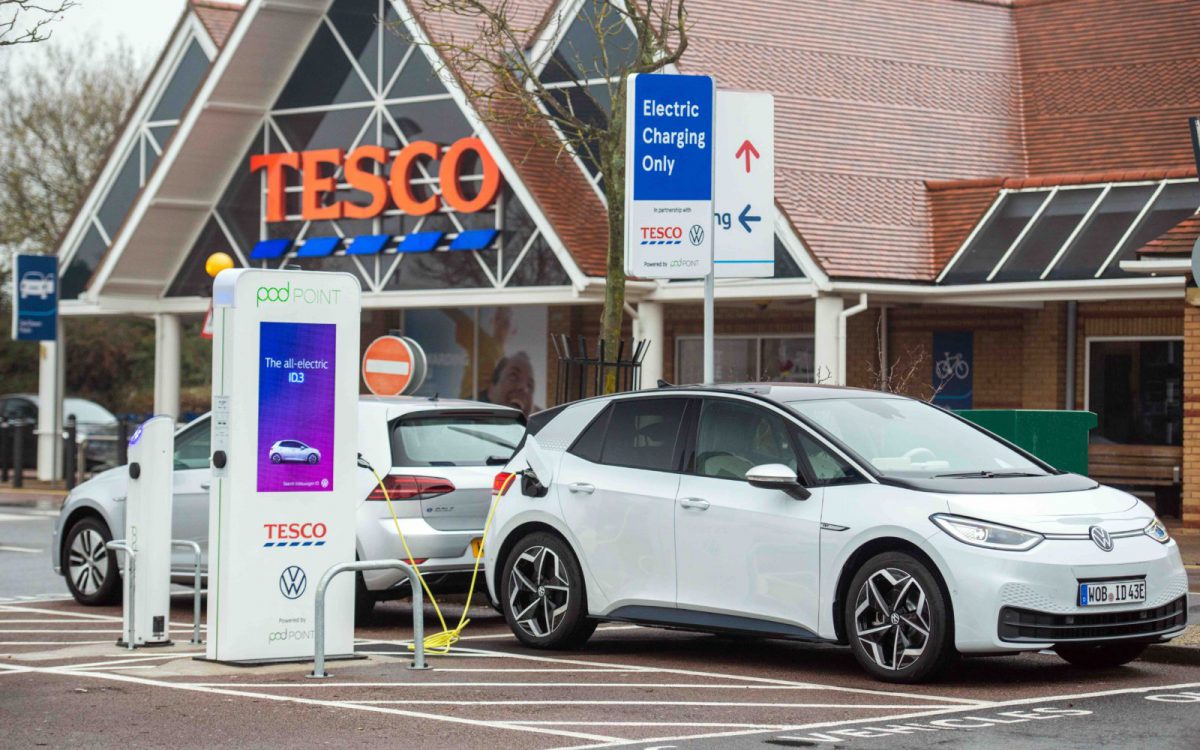
POD Point Rollout at Tesco Stores (Image: Tesco/POD Point)

Good Energy unveils EV tariff offering free periods of charging

Good Energy is launching a new tariff that allows electric vehicle (EV) drivers to charge for free during periods of excess wind and solar generation.

Developed in partnership with Zap-Map – a company Good Energy owns a 50.1% stake in – the Zap Flash tariff includes ‘flash’ windows based on periods where Britain is generating an abundance of solar and wind. Drivers will then be alerted to a four-hour window when charging their vehicle comes at no extra cost and is backed by Good Energy’s 100% renewable electricity supply.

The flash period will vary in day each week, although the times will remain the same in the summer and winter months, with customers to receive at least 24 hours notice ahead of the period. The Summer Flash period will run from April to September between 11am and 3pm, while the Winter Flash Period is to run from October to March between 11pm and 3am.

POD Point Rollout at Tesco Stores (Image: Tesco/POD Point)

The tariff will be enabled by smart metering, with Good Energy to rollout smart EV chargers and an updated app alongside the new product. It will initially be launched in beta phase, allowing for more sophisticated versions as the energy supplier learns from customers.

Good Energy’s CEO and founder, Juliet Davenport, said that with Britain generating “so much” renewable electricity, it only “makes sense for us to take advantage of this free resource”.

It was announced in February that Davenport is to step down as CEO, with Nigel Pocklington to takeover the role.

Read more: CURRENT

It’s Time to Go Green!

If you would like to know more about Solar Panels and the PowerBanx range of home battery systems, and get a free instant quote, please complete our online form:

Instavolt rapid charger at McDonalds (Image: Instavolt)

InstaVolt celebrates record-breaking month for charger installs

InstaVolt has achieved a record month for electric vehicle (EV) charging installations, with 62 rapid chargers set live in March.

These 62 chargers are spread across twenty different regions in the UK, with the highest proportions being in Warwickshire (15), Greater London (six) and Oxfordshire (four).

These new charger installations are to support InstaVolt’s ambitions of delivering 5,000 chargers by 2024/25, with CEO Adrian Keen stating the record couldn’t have been achieved without the effort put in by the installation team, praising for having worked “incredibly hard”.

Instavolt rapid charger at McDonalds (Image: Instavolt)

It comes after InstaVolt opened the UK’s largest public rapid charger motorway hub, located at Welcome Break’s service area on the northbound carriageway of the M6 at Corley in the Midlands.

The EV charging network has also previously signed deals with KFC and McDonalds to rollout chargers at their sites, with the KFC partnership targeting the installation of rapid chargers at up to 450 sites while the McDonalds partnership is for the installation of 125kW chargers at new and existing drive thru restaurants.

Read more: CURRENT

It’s Time to Go Green!

If you would like to know more about Solar Panels and the PowerBanx range of home battery systems, and get a free instant quote, please complete our online form:

Milton Keynes 'Mushrooms' Charging Hub (Image: T. Larkum)

Shell planning roll-out of rapid EV chargers

Oil and gas major Shell plans to install 5,000 rapid electric vehicle chargers in Britain by 2025 in a bid confirm a market-leading position in the transition to clean energy.

The Anglo-Dutch company is also proposing an investment in on-street public charging points, building on its relationship with Ubitricity which it acquired in February.

The plans form part of Shell’s low-carbon strategy unveiled in February which will see more than 30,000 Shell Recharge charge points by 2025. It is working with a network of 17 partners.

Shell currently has 100 “rapid” 50-kilowatt and “ultra-rapid” 150KW chargers on its forecourts in Britain.

Milton Keynes 'Mushrooms' Charging Hub (Image: T. Larkum)
A Charging Hub (Image: T. Larkum)

Shell Recharge locations are supplied by 100% certified renewable energy sources, that have been generated using wind, solar and biomass.

Meanwhile, Reuters reports that EU policy plans for plug-in hybrid vehicles (PHEVs), which contain an electric battery and a combustion engine, could mean the “transition” technology has a shorter lifespan than envisaged by some leading automakers.

Draft green finance regulations would ban manufacturers from labelling them as “sustainable investments” beyond 2025, potentially deterring investors. Meanwhile planned rules on emissions of pollutants like nitrogen oxides could increase the cost of producing these cars.

The aim of such reforms is to speed the transit to fully-electric vehicles and meet climate goals.

Read more: Daily Business

It’s Time to Go Green!

If you would like to know more about Solar Panels and the PowerBanx range of home battery systems, and get a free instant quote, please complete our online form: