Category Archives: BMW

News and reviews of BMW electric cars (including plug-in hybrids).

In Praise of the Ecotricity Charging Network

Last week I took a bunch of friends to a concert by the progressive rock band Haken. The round trip distance from Northampton to Nottingham was 150 miles. So, even in the new i3, I knew I would need a charge or be constrained to keep my speed low.

With a bit of Googling I settled on parking at the Victoria shopping centre as it had a charge point. On arriving we plugged in and I started a charge using an old Plugged in Midlands card.

The concert was great and Haken were in fine form. However afterwards we returned to the car to find the charge had failed. Unfortunately I hadn’t been able to monitor its progress on my smartphone as the location had no signal.

So we went to Plan B and stopped off on the way back at Donnington Services to top up on the Ecotricity rapid charger. Although we might have gotten away with just a ten minute charge, there were signs saying the M1 was closed further south so I gave it a  good 20 minutes instead.

After a coffee and a Danish we were on our way. It turned out that it wasn’t just the M1 that was shut but also the main alternative, the A5, so we had to divert a long way out via Rugby.

The i3’s range was more than up to it though and we got home with charge to spare. The trip took place after going to work earlier in the day so the i3 had done 200 miles in a day without trouble. And all for £8.70 in fuel costs (the daytime charging at work in Milton Keynes).

Charging at Sedgemoor Services on the M5 (Image: T. Larkum)

BMW set to launch biggest ever model offensive and second wave of electrification

BMW sold 2.25 million cars across all its brands – BMW, Mini and Rolls-Royce in 2016.  But for the first time in eleven years sales at the core BMW brand fell below rival Mercedes-Benz. It is looking to transform and revitalise the company by focusing on new launches, particularly electric vehicles (EVs).  At the annual press conference it announced plans to launch no less than 40 new and revised models.

Charging at Sedgemoor Services on the M5 (Image: T. Larkum)
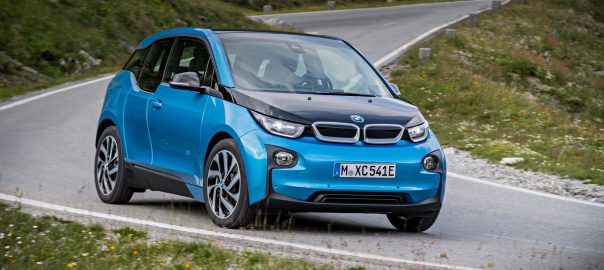
BMW i3 (Image: T. Larkum)

CEO Harald Krüger said:

‘We are launching the biggest model offensive ever… We have started a transformation unlike anything our company has seen before.’

By 2025, BMW aims for electric and plug-in hybrids to account for 15-25% of overall group sales.  In the short term it is targeting sales of 100,000 EVs by the end of the year.

BMW’s electrification offensive will see a major expansion of its electric base, with the launch of eight plug-in hybrid model options from summer this year. Krüger said:

‘The drive of the hour is the plug-in hybrid.’

Hybrids are widely expected to be needed as a bridge technology to reach CO2 fleet limits alongside all-electric cars.

On the all-electric front, it will continue to focus on its current best-seller the i3 and also new launches for Mini and BMW X3 based on new technological advances since the i3.

Ultimately BMW aims to complete its electric realignment strategy in earnest in a second wave starting from 2019, when it will finally offer its entire catalogue of series models as pure electric cars – in time for incoming EU (and Chinese) regulations.

Source: Autovista Group

What IS ‘one-pedal driving’ in an electric car?

One-pedal driving is rather like the experience of owning an electric car: it can be hard to appreciate until you’ve spend time doing it.

The phrase “one-pedal driving” refers to the ability of some electric cars to be driven almost entirely with the accelerator pedal alone.

It’s a feature much prized by owners of Teslas, BMW i3s, and most recently the Chevy Bolt EV.

And it’s something that everyone should know about, even if you don’t own an electric car. Even if perhaps you won’t completely understand why it would be appealing until you experience it.

One-pedal driving combines conventional acceleration, using the right-hand pedal, with a much higher degree of deceleration than in a conventional car.

That means that when a driver lifts off the pedal, the car slows down more quickly than an internal-combustion-powered car would.

It’s not found in every electric car. Some makers give their electric cars an identical driving experience to conventional vehicles, meaning they drive like an automatic-transmission car that never actually shifts.

Once you’ve acclimatized, the only times you hit the brakes is for emergency situations.

It may sound a little strange, but trust us: once you try it, you’ll never go back.

And then you’ll start to wonder why all cars don’t work that way.

Full article: Green Car Reports

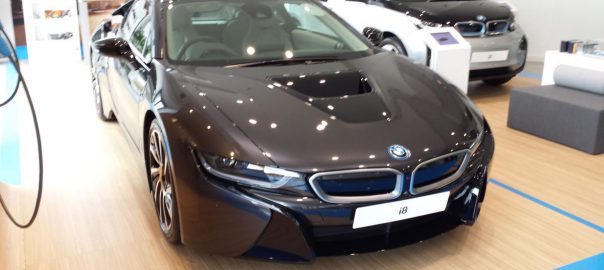
BMW i8 in Sophisto Grey (Image: T. Larkum)

BMW i8 Gallery

During a test drive of the BMW i3 I took the opportunity to photograph a pair of i8’s on show there.

BMW i8 in Sophisto Grey (Image: T. Larkum)

The i8 is a rather good looking car by any account.

BMW i8 in Sophisto Grey (Image: T. Larkum)

Of course, it is marred by the fact that it has a fossil fuel engine as well as an electric motor, giving it only about 20 miles of electric range.

BMW i8 in Sophisto Grey (Image: T. Larkum)

But then no car is perfect.

BMW i8 in Ionic Silver (Image: T. Larkum)

My thanks to Vines of Guildford BMW for arranging the visit.

BMW sees chance for full autonomy by 2021

BMW has confirmed it has ‘the chance’ to deliver a self-driving car with complete Level 5 autonomy by 2021, according to its senior vice president for autonomy Elmar Frickenstein. This matches the date of their upcoming next-generation flagship, the iNext – a collaboration with Mobileye

However, as the turning point looms around 2020 for when self-driving moves from concept tech to serious deployment, a timeline split is developing between more careful established players and assertive new challengers. Issues beyond the tech’s capability also weigh on the date of its deployment.

As usual, Tesla is the most bullish, saying it is already ready for full autonomy, if only it were allowed to do so. This is despite several high-profile crashes last year.

The next closest deadlines come from challenger Nvidia, now aggressively competing against Intel’s Mobileye. It expects its Level 3 autonomous chips to be available in cars by 2018, with Level 4 following by 2019. Level 5 autonomy requires no human intervention under any scenario, whereas at lower forms, Level 3 requires a steering wheel for the driver to take over in case of a problem. Level 4 means the car can drive itself in most environments. Most cars currently on the road are below these at Level 2.

This Level 4 Nvidia 2019 deadline is in time for the typical 2020 self-imposed deadlines of OEMs. Volvo, Audi and Ford aim to have Level 5 autonomous cars on the road by 2020 or 2021.

BMW too hopes to reach Level 4, or even Level 5, autonomy by 2021, but is most confident about achieving Level 3 by then. Its head of autonomous driving Elmar Frickenstein said it is in progress to deliver a Level 3 autonomous car by 2021, but could actually produce Level 4 or 5 autonomous cars in the same year. He said:

‘We believe we have the chance to make level three, level four and level five doable.’

He added to Reuters that

‘the decision on which levels to release would depend in part on the market, and that cars with more autonomy might first be produced in small batches for single fleets.’

Chipmaker Nvidia’s CEO Jen-Hsun Huang has also said carmakers may speed up their plans given technological advances and that fully self-driving cars could be on the road by 2025. However, Nvidia does not even agree with its partner Bosch, the world’s largest auto supplier, which gives a timeline as much as six years longer (2031) to reach full autonomy, and would not even be drawn on a time for when fully autonomous cars would be deployed.

Read more: Autovista Group

BMW i3

New BMW i3 the best electric car this side of a Tesla

Not cheap, but charming, fun and with seriously practical performance and range.

It’s funny how perceptions change. When I was young in a sepia-toned world the drivers who were on the receiving end of most abuse were those behind the wheels of BMWs. Arrogant, aggressive and antagonistic with an addiction to tailgating was the accepted caricature of this firm’s car owners.

Times have changed though. BMW, for all its massive sales success in Ireland in the past 15 years, now has a slightly less combative image, one of classiness and desirability with a little less of the disdain from those unable to afford one.

BMW i3
BMW i3

With the i3, there is the chance for BMW to slip seamlessly into full-on caring and sharing mode. The little electric car has been around since 2014, but had failed to make much of a dent in Irish buyers’ collective consciousness, mostly down to a combination of being small, with a big price tag and, well, electric.

For all the talk of Ireland being a perfect test case for the introduction of electric motoring, few brave souls have taken on the mantle of early adopter. A combination of cost, lack of infrastructure and that ever-present spectre of range anxiety has held people back.

Fortunes

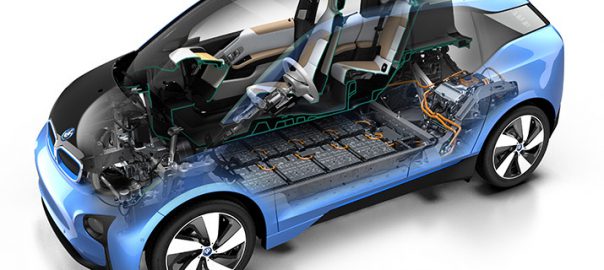
Well, BMW has answered that in part by boosting the range of the i3 to a much more acceptable level. While the lithium-ion battery pack hasn’t been made physically larger, it has increased in capacity, to a very healthy 33kWh (up from 22kWh) and the i3’s part-carbon-fibre structure, light but strong and costing BMW several fortunes to develop, was always there to make the most of any extra range.

In fact, one-charge range climbed to 300km on the European NEDC (New European Driving Cycle), but cognisant that the official test has been thoroughly undermined in the public eye, BMW says 200km is a more realistic day-to-day figure.

So it proves. A writer must write of what they know, so I can only speak of how the i3 performed on my own regular driving cycle, but it is significantly improved.

I was testing the ‘REX’ version, the range-extender, which uses a tiny two-cylinder moped engine and a seven-litre tank of petrol to keep the batteries alive should you run out of charge with mileage still to go to get home. It adds, generally, around 100-120km of extra range, easing many the furrowed brow.

Read more: Irish Times

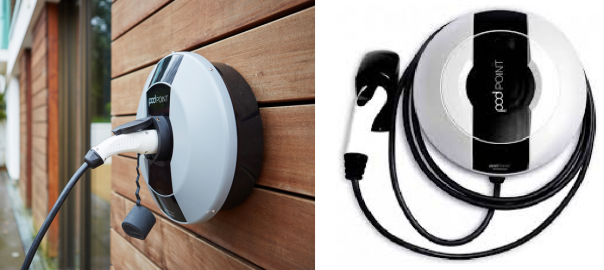
Untethered and Tethered Charge Points (Image: POD Point)

Choosing a Charge Point

When buying an electric car it is nearly always worthwhile to get a dedicated charge point installed at home.

It’s more convenient than an ‘occasional use’ or ‘granny’ (13 Amp) charge cable because you don’t need to reel it up and put it away each time.

Home Charging a Renault ZOE with a Dedicated Charge Point (Image: Charging Solutions)
Charging a Renault ZOE with a Home Charge Point (Image: Charging Solutions)

It will also be significantly faster because a dedicated charge point can provide more power without the risk of overheating. Also some electric cars, such as the Renault ZOE, don’t come with such a cable and buying one yourself can be very expensive (£500+).

The good news is that the installation of domestic charge points is subsidised by the UK government.

There are 3 decisions to be made when selecting the type of charge point for your car:

  • Tethered or Untethered
  • Connector Types
  • Power Level


Tethered or Untethered

There is usually the choice of a ‘tethered’ cable (it is fixed to the charge point) or an ‘untethered’ cable (it plugs into and can be removed from the charge point).

Untethered and tethered charge points (Image: Chargemaster)
Untethered and Tethered Charge Points (Image: Chargemaster)

Untethered has the advantage of allowing different cables to be connected (for example you can use the same charge point for a Nissan Leaf and a Renault ZOE). However, most people choose tethered because it avoids the inconvenience of connecting a cable whenever you need to charge (usually daily). It also reduces the risk of the cable being stolen.

A charge point with a tethered cable will usually cost more than an untethered one (typically about £50 more) because of the cost of its cable.

Untethered and Tethered Charge Points (Image: POD Point)
Untethered and Tethered Charge Points (Images: POD Point)

If you choose untethered you will need to use your own cable to connect to the car; it is the same cable that would be used to connect to a public charging point. It may come free with the car, for example the Renault ZOE or the Nissan Leaf with the 6.6kW charge option come with one. Otherwise you will need to buy one (we can advise you on suppliers).


Connector Types

All untethered domestic charge points supplied in the UK come with a Type 2 socket on the charge point, just as all public charge points now have (or at least officially should have) Type 2 sockets. Similarly all charge cables have a Type 2 plug at the charge point end.

Type 1 (5 pin) and Type 2 (7 pin) connectors

If the cable is tethered then you need to tell the installer the type of plug you want at the car end. This will depend on the car:

  • Type 1 socket: Nissan Leaf, Mitsubishi Outlander PHEV, Kia Soul EV
  • Type 2 socket: Renault ZOE, BMW i3, Tesla, VW e-Golf and Hyundai IONIQ

The Type 2 or ‘Mennekes’ connector is the official standard in Europe and should eventually replace the Type 1.


Power Level

A dedicated charge point can provide higher powers than a typical occasional use charging cable which will run at 10 Amps, equivalent at 230 Volts to 2.3 kilowatts. The charge will take place at the highest power that both the charge point can provide and the car can use.

There are two common power levels:

  • 16A = 3.5kW: This is the maximum charge level of the Nissan Leaf 3.3kW, the Mitsubishi Outlander and the VW e-Golf.
  • 30A/32A = 7kW: This is the maximum charge level of the Nissan Leaf 6.6kW, BMW i3, Kia Soul EV and Hyundai IONIQ. The standard Renault ZOE can use this level, in fact anything up to 22kW.

The higher power reduces the charge time so a typical EV battery will charge in about 8 hours at 16A but in about 4 hours at 32A.

It may be best to install the highest power charge point you can afford; even if your current car can’t use all the power, the next one almost certainly will be able to.

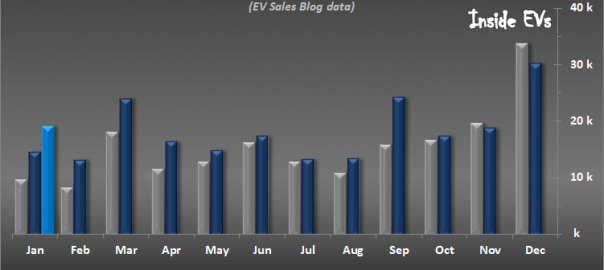
Plug-In Electric Car Sales In Europe – January 2017 (Image: InsideEVs)

Europe: 31% More Plug-Ins Sold In January 2017 – Renault ZOE In Charge

Europe began 2017 with solid growth of plug-in electric car sales, up 31% year-over-year according to the EV Sales Blog report. In total, roughly 19,000 units were sold, which is not only the best January ever, but also one of the better months ever.

Renault ZOE took an early lead with 2,602 sales (up 80 percent) after securing 1st place in 2016.

Plug-In Electric Car Sales In Europe – January 2017 (Image: InsideEVs)

In second place was the BMW i3 (1,818), which gives us one way to compare sales of different battery sizes. Renault is seeing better sales of the new 41-kWh ZOE, while i3 continues to sell the 33-kWh i3. Obviously, these cars are quite different, but with EVs, range does matter. And, if BEV sales are so tightly connected to battery pack capacity/range and price, we are eager to see the Opel Ampera-e later this year.

Nissan LEAF keeps seeing strong sales in Europe, taking 3rd place in January with 1,386 sales (up 29%). This EV’s battery increase – from 24 kWh to 30 kWh – wasn’t all that dramatic, and the Japanese manufacturer needs to do more soon. The top three BEVs sold in Europe totaled 5,806 units, which was 30.5 percent of all plug-in car sales. Tesla sold some 819 Model S (#7) and 586 Model X (#11) EVs.

Read more: Inside EVs

BMW i3 Wins Best Electric Car 2017

BMW continues to make headway with its flagship ‘i’ range, with the BMW i3 94Ah having recently won the Best Electric Car in the £20,000 – £40,000 category at the What Car? Car of the Year 2017 awards. The annual awards are the UK motoring industry’s highest accolades, demonstrating just how far the BMW i concept has come since its establishment in 2013.

The BMW i3 94Ah was praised for its 50% improvement on range between charges – now a maximum of 195 miles – as well as for its interior quality, sustainable production values and usability.

The ethos of the BMW ‘i’ range is sustainability to its very core. From renewable energy used in the making of its interior carbon fibre, to the recycled materials used throughout its construction, the BMW i3 spearheads the carbon-free car market.

On a practical level, the BMW i3 now comes with direct current (DC) rapid charging as standard, allowing it to be fully charged in less than 3 hours [edit – this is obviously wrong, BMW mean 40 minutes – the writer must have got confused! Trevor]. With a 0-62mph time of 7.3 seconds and a top speed of 93mph, the BMW i3 continues to make its mark on the electric car market.

Visit the What Car? Best Electric Car award feature here.

Source: BMW.co.uk