Category Archives: Wind Power

Climate change: Fossil fuel emissions from electricity set to fall – report

The world will likely use fewer fossil fuels to produce electricity this year in a “turning point” for planet-friendly energy, a new report says.

It would be the first ever annual drop in the use of coal, oil and gas to generate electricity, outside of a global recession or pandemic.

As a result, fewer warming gases would be released during energy production.

The authors attribute the expected change to a boom in renewable energy led mainly by China.


Wind and solar now produce 12% of global electricity with enough wind turbines added in 2022 to power almost all of the UK.

Renewables are set to meet all growth in demand this year, the study from energy analysts Ember says.

Making electricity is the single biggest contributor to global warming, responsible for over a third of energy-related carbon emissions in 2021.

So phasing out coal, oil and gas in this sector is seen as critical in helping the world avoid dangerous levels of climate change.

This new study looks at data from countries representing 93% of global electricity demand.

Read more: BBC

It’s Time to Go Green!

If you would like to know more about Solar Panels and the PowerBanx range of home battery systems, and get a free instant quote, please complete our online form:

Blades Being Installed on Turbine 5, Yelvertoft Wind Farm (Image: T. Larkum)

SSE Renewables installs world’s deepest offshore wind turbine foundations in Scotland

SSE Renewables has announced the installation of the world’s deepest offshore wind turbine foundations at what it claims will become Scotland’s largest offshore windfarm off the coast of Angus.

The foundation, also known as the “jacket”, had been transferred to the Seagreen wind farm on the 7 April by contractor Seaway 7. It was then taken by a submersible crane vessel, the Saipem 7000, to be installed on the seabed. The foundations weigh about 2000 tonnes each.


SSE has beaten its own record, from October 2022, when it installed foundations at a depth of 57.4 metres (188 feet). The latest foundations have been installed at 58.6 metres below sea level. It is the 112th jacket to be installed at the wind farm, which will have 114 turbines.

The project is a £3 billion joint venture between SSE Renewables and TotalEnergies. SSE said the final turbine foundation would be installed later this week.

SSE recently announced plans to build the UK’s largest offshore windfarm at Berwick Bank in Scotland. The project could generate 4.1GW of electricity and is situated 38km off the coast of East Lothian. A final decision on the project is expected later in 2023.

Read more: Current+

It’s Time to Go Green!

If you would like to know more about Solar Panels and the PowerBanx range of home battery systems, and get a free instant quote, please complete our online form:

Blades Being Installed on Turbine 5, Yelvertoft Wind Farm (Image: T. Larkum)

Wind power could save UK households £250 per annum compared to gas, says RenewableUK

Wind power could save each UK household nearly £250 in savings per year compared to gas, says new analysis conducted by RenewableUK.

The analysis showed that the 19GW of wind farm capacity that won Contracts for Difference (CfDs) support will generate around 93TWh by the time it is all operational in 2027. This is around 30% of the annual UK electricity generation at present. This will be at a total cost of £5 billion.


Blades Being Installed on Turbine 5, Yelvertoft Wind Farm (Image: T. Larkum)

RenewableUK stated that the equivalent cost of getting that electricity from gas would be around £26 billion at current prices, so this represents a saving to consumers of over £20 billion, with every UK household benefitting by £246 a year.

The CfD scheme has been a resounding success for the wind industry. The most recent CfD auction saw offshore wind farms win contracts at a fixed electricity price four times cheaper than the current cost of gas power stations. Auction Round Four saw the five offshore wind projects win contracts to secure a strike price of £37.35/MWh.

As well as this, CfD projects are predicted to pay back £25 this winter, and around £45 a year to each household from next winter. This is set to continue to grow as more low cost windfarms come online.

Read more: Current+

It’s Time to Go Green!

If you would like to know more about Solar Panels and the PowerBanx range of home battery systems, and get a free instant quote, please complete our online form:

Milton Keynes 'Mushrooms' Charging Hub (Image: T. Larkum)

Labour unveils ‘mammoth’ multi-billion offshore wind and EV charging pledges

A Labour government would take the UK’s offshore wind capacity to 52GW within the next 10 years and invest billions in EV charging infrastructure, the party has said.

Ahead of shadow energy secretary Rebecca Long Bailey’s speech at the party’s conference today, the party unveiled a raft of clean energy pledges designed at ramping up the country’s renewables portfolio and enabling a widespread adoption of electric vehicles.

Milton Keynes 'Mushrooms' Charging Hub (Image: T. Larkum)
Milton Keynes ‘Mushrooms’ Charging Hub (Image: T. Larkum)

The pledges feed into previously-announced plans to overhaul the UK’s power system, starting with the “immediate” renationalisation of transmission and distribution grids.

The plans also feed into a wider policy agenda, spoken of by Labour deputy leader John McDonnell yesterday, focusing on a UK equivalent of the Green New Deal to tackle climate change, which McDonnell described as the primary political question of today.

Offshore wind and a People’s Power Plan

Labour has pledged to create a ‘People’s Power Plan’, wherein the government will take a 51% stake in as many as 37 new offshore wind farms, to be built in the UK. Those offshore wind farms would swell the country’s offshore wind capacity to 52GW by 2030, marking a significant contribution towards renewable output.

It said the intent for the public to own a majority stake in new developments was designed to prevent private and foreign public firms dominating deployment of offshore wind as they are now. Last week’s offshore wind CfD results, wherein the asset class clinched record low strike prices of £39.65/MWh, saw the third round principally won by companies including SSE, Equinor, Innogy and Statkraft.

Speaking at the conference today, Long Bailey also said that the country could not “rely on the market to act fast enough”.

Labour has also committed that 80% of all profit generated from the public’s stake in new offshore wind would be redirected to new renewable generation, wider energy system improvements and to aid the “climate transition”.

Read more: Current News

Solar-plus-EVs economics to trigger a ‘relentless and irreversible decline’ for oil, report states

The economics of combining solar and other renewables with electric vehicles is becoming so compelling that the oil sector faces a “relentless and irreversible decline”, a new report from BNP Paribas has concluded.

The report, dubbed ‘Wells, wires and wheels’, examines the link between mobility, energy and capital investments, introducing the concept of ‘energy return on capital invested’ (EROCI).

That metric focuses on how much useful energy or mobility would be returned from a specific capital outlay in competing technologies, with the report squarely focusing on oil’s return for petrol and diesel-fuelled vehicles and renewables alongside battery electric vehicles.

The bank’s analysis concludes that for the same capital outlay, wind, solar and battery EVs can deliver between 6.2 and 7-times more useful energy than oil if it’s priced at US$60 per barrel, roughly the same price as Brent Crude is today.

As a result, BNP Paribas has said that the economic and environmental benefits of combining solar and electric vehicles as “irresistible”.

Furthermore, the report argues that the economics are so compelling that the oil sector has “never before in its history” faced the kind of threat that renewables and EVs now pose, and stressed the need for oil and gas companies to ramp up their investments in renewables and battery storage if they are to survive.

Read more: Solar Power Portal

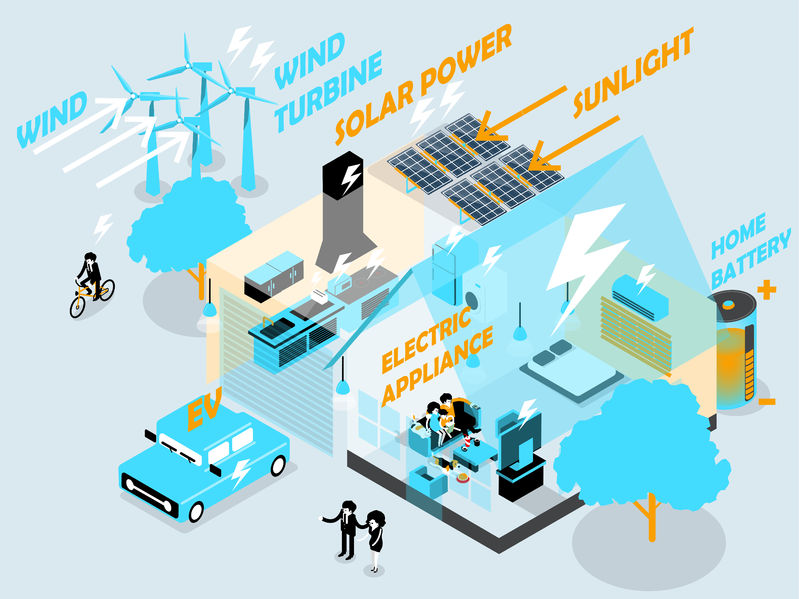
The Transition Trinity: Electric Car, Solar and Home Battery

Fuel Included was founded in 2014 in response to the threat of global warming. Our aim is to promote sustainable technologies at affordable prices, a mission that becomes ever more important as global climate changes accelerate.

59210374_EnergyHome_IsometricGraphic_123RF
Initially we concentrated on electric cars but as they become increasingly mainstream we are able to focus on other green technologies. We now offer our own home battery system, the PowerBanx, to go along with solar panel installs.

While the Global Energy Transition often seems to be about big infrastructure projects, like offshore windfarms and grid battery storage, what’s happening at the home level is arguably more important, in terms of the impact on the individual and on the future requirements for national grids.

For years we have seen the rise of solar power as it becomes cheaper and undercuts other forms of power generation. More recently, we have seen the spread of electric vehicles (EV), as the replacement of fossil fuel vehicles accelerates.

Finally we are seeing the widespread introduction of battery systems (such as our PowerBanx) into homes; all already have solar and many already have an EV.

Read more: LinkedIn


Drop in wind energy costs adds pressure for government rethink

Tories urged to look at onshore windfarms which can be built as cheaply as gas plants and deliver the same power for half the cost of Hinkley Point, says Arup

Building windfarms in the windiest places, such as Whitelee in East Renfrewshire, would cut opposition from Tory heartlands in the English shires, says Arup. Photograph: Danny Lawson/PA

Onshore windfarms could be built in the UK for the same cost as new gas power stations and would be nearly half as expensive as the Hinkley Point C nuclear plant, according to a leading engineering consultant.

Arup found that the technology has become so cheap that developers could deliver turbines for a guaranteed price of power so low that it would be effectively subsidy-free in terms of the impact on household energy bills.

France’s EDF was awarded a contract for difference – a top-up payment – of £92.50 per megawatt hour over 35 years for Hinkley’s power, or around twice the wholesale price of electricity.

By contrast, Arup’s report found that windfarms could be delivered for a maximum of £50-55 per MWh across 15 years.

ScottishPower, which commissioned the analysis, hopes to persuade the government to reconsider its stance on onshore windfarms, which the Conservatives effectively blocked in 2015 by banning them from competing for subsidies and imposing new planning hurdles.

Keith Anderson, the firm’s chief operating officer, told the Guardian that onshore wind could help the UK meet its climate targets, was proven in terms of being easy to deliver, and was now “phenomenally competitive” on price.

“If you want to control the cost of energy, and deliver energy to consumers and to businesses across the UK at the most competitive price, why would you not want to use this technology? This report demonstrates it’s at the leading edge of efficiency,”

he said.

The big six energy firm believes that with a cap on top-up payments so close to the wholesale price, onshore windfarms would be effectively subsidy-free – but the guaranteed price would be enough to de-risk projects and win the investment case for them.

Read more: The Guardian

Blades Being Installed on Turbine 5, Yelvertoft Wind Farm (Image: T. Larkum)

Britain’s wind turbines catch breeze of a rising industry

The sound made by 100 tonnes of steel and carbon fibre rotating 400 feet overhead is surprisingly understated. Each whoosh of the 260 foot blades spans an area the size of the London Eye and generates enough electricity to power the average British home for 24 hours.

Blades Being Installed on Turbine 5, Yelvertoft Wind Farm (Image: T. Larkum)
Onshore Wind Farm (Image: T. Larkum)

There are 32 of these 8MW turbines in the second phase of Dong Energy’s Burbo Bank wind farm spinning off the Merseyside coast.

They are the most powerful ever, dotting an area the size of almost 6,000 football pitches within the Irish Sea, each one a beacon of Britain’s global dominance in the booming offshore wind industry.

Benj Sykes, the UK boss for Dong Energy’s wind power business, predicts he may be cutting the ribbon on turbines with double this power capacity by 2024.

“If you wind the clock back four or five years, this scale of technology was considered very ambitious. Now, you can see them in reality, commercially deployed. It’s very difficult to say where we will ultimately get to,”

he says.

Wind turbines have already more than doubled their power capacity since Dong Energy constructed the first phase of Burbo Bank in 2007 with 3.7MW structures. By the mid-2020s turbines may double again and a capacity of 15MW could be spinning in Europe’s waters.

As the efficiency and power potential of each turbine increases, costs keep falling.

Read more: The Telegraph

Arctic sea ice under the midnight sun (Image: Solent News/Rex/Shutterstock)

Could a £400bn plan to refreeze the Arctic before the ice melts really work?

Temperatures are now so high at the north pole that scientists are contemplating radical schemes to avoid catastrophe

Arctic sea ice under the midnight sun (Image: Solent News/Rex/Shutterstock)

Physicist Steven Desch has come up with a novel solution to the problems that now beset the Arctic. He and a team of colleagues from Arizona State University want to replenish the region’s shrinking sea ice – by building 10 million wind-powered pumps over the Arctic ice cap. In winter, these would be used to pump water to the surface of the ice where it would freeze, thickening the cap.

The pumps could add an extra metre of sea ice to the Arctic’s current layer, Desch argues. The current cap rarely exceeds 2-3 metres in thickness and is being eroded constantly as the planet succumbs to climate change.

“Thicker ice would mean longer-lasting ice. In turn, that would mean the danger of all sea ice disappearing from the Arctic in summer would be reduced significantly,” Desch told the Observer.

Desch and his team have put forward the scheme in a paper that has just been published in Earth’s Future, the journal of the American Geophysical Union, and have worked out a price tag for the project: $500bn (£400bn).

It is an astonishing sum. However, it is the kind of outlay that may become necessary if we want to halt the calamity that faces the Arctic, says Desch, who, like many other scientists, has become alarmed at temperature change in the region. They say that it is now warming twice as fast as their climate models predicted only a few years ago and argue that the 2015 Paris agreement to limit global warming will be insufficient to prevent the region’s sea ice disappearing completely in summer, possibly by 2030.

“Our only strategy at present seems to be to tell people to stop burning fossil fuels,” says Desch. “It’s a good idea but it is going to need a lot more than that to stop the Arctic’s sea ice from disappearing.”

The loss of the Arctic’s summer sea ice cover would disrupt life in the region, endanger many of its species, from Arctic cod to polar bears, and destroy a pristine habitat. It would also trigger further warming of the planet by removing ice that reflects solar radiation back into space, disrupt weather patterns across the northern hemisphere and melt permafrost, releasing more carbon gases into the atmosphere.

Read more: The Guardian