Energy storage is heralded as the critical technology that will make widespread adoption of renewable energy possible. Storage bottles sunlight, addressing a key drawback to solar energy — that it can’t provide electricity when the sun isn’t shining. Energy storage also cures additional utility ailments from grid resiliency to power smoothing.
Due to a rise in incentives and a drop in storage costs, the market for this storage is heating up in the U.S. The market is expected to grow 250 percent just this year.
California is leading the energy storage market thanks to Assembly Bill 2514, which requires state utilities to procure 1.3 GW of storage by 2020. Now California’s three largest investor-owned utilities, Southern California Edison (SCE), Pacific Gas and Electric (PG&E) and San Diego Gas & Electric, are installing cost-effective storage solutions. SCE, for example, invested in a wind farm in the Mojave Desert equipped with giant lithium-ion batteries. The East Coast is following California’s example. New York recently budgeted $25 million to promote storage development.
While the utility-scale market gets most of the attention, a quietly growing storage market segment with a lot of potential is residential solar. After all, residential solar is a fast growing solar market segment — increasing 49 percent in 2014. Unsurprisingly it offers immense opportunity for storage.
A positive view of renewables from an oil publication
In April, 2010, BP took the front page, and held it for months, as it struggled to plug the blowout on the bottom of the Gulf of Mexico that would cough up 3 or 4 million barrels.
The Deepwater Horizon disaster was a bitter reminder of the coming difficulties and risk involved in getting what is left of the world’s oil reserves up and out of places that are a lot harder to get at – deep sea, where pressures are extreme; the arctic, where conditions are even more challenging; tar sands, the poster child for too much carbon; and in thousands of small, disparate patches, where ‘tight oil’ comes from driving water, sand and a few chemicals into fissures miles underground. In the U.S., these wells average around 100 barrels a day (see chart below). Herding cats does not seem a likely way to make the U.S. the swing producer to knock Saudi Arabia off its perch.
Things got harder for explorers as 2014 came to an end, and the price of Brent, the international benchmark, was well on its way to a total 61 percent fall in under 12 months. The question is not so much whether the price of oil will be high enough to get the next trillion barrels out of the ground (roughly the current world rate of consumption for another 30 years); it is whether or not the climate can “afford” to have that happen. Peak oil, whether from insufficient supply or demand, makes for an interesting cocktail party discussion. It has even become a political litmus test. However, it is largely irrelevant. Sheik Yamani’s dictum, that the Stone Age did not end because we ran out of stones, should not be dismissed.
It looks like affordable home energy storage could finally be coming available in the UK
Maturing and more affordable storage technology promises to “revolutionise” the UK solar PV market, according to a panel at today’s Solar Finance and Investment Conference.
Ray Noble, consultant to the Renewable Energy Association, said that while some storage technologies were 10 to 20 years away from being realised, technological advancements in lithium ion batteries – driven largely by the automobile sector – had meant that storage batteries for residential installations could be affordable within two or three years.
The timeline fits well with projections conducted by industry analysts, with IHS having previously forecast grid-connected energy storage installations to surpass 6GW in 2017, almost treble the 2GW+ estimate for 2015.
This article argues that Australia has all the ingredients to be the world’s leading market on battery storage: Lots of solar, high prices, and a consumer base that is independent, cost conscious and distrustful of incumbents. It’s from Renew Economy.
There is no doubt that Australia is going to be at the leading edge of battery storage, that is because of the huge number of solar panels already on household rooftops, the high electricity costs (particularly network charges), and the excellent solar resources.
But there is more than that behind the reason so many global battery storage developers are targeting Australia as their first big market, and a test case to the world. It is also about the unique approach Australians have to their energy supplies, a healthy cynicism about the incumbent utilities, and a yearning for energy independence.
Australia, according to Greg Bourne, the chairman of the Australian Renewable Energy Agency, is about to enter the “iPhone” moment in battery storage.
“It would appear that energy storage has arrived!” Bourne told the Australian Energy Storage conference in Sydney. “Of course it’s been around for quite a time in some form or other but just like 2007 was the iPhone moment; 2015 might be seen as the Tesla moment!”
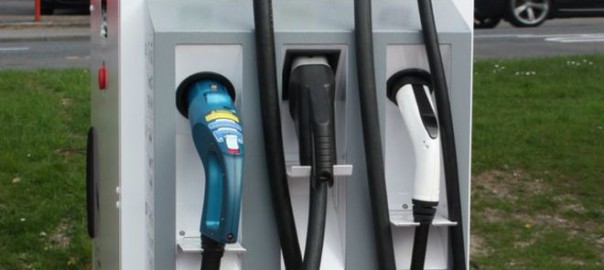
A solar powered rapid charger which can recharge an electric vehicle in 40 minutes has been installed in Dorset
The unit at Poole Civic Centre is the first of its kind in the UK to be installed by a council as part of a government scheme.
It draws its power from solar panels and is faster than standard chargers which take 8-12 hours.
The rapid charger with three standard charging points draws its power from solar panels (Image: Borough of Poole)
Eighteen chargers are to be installed in Dorset following a £900,000 Department for Transport grant.
During daylight hours, the rapid charger with three standard charging points is powered by a 135kWp solar panel installation on the roof of a nearby multi-storey car park.
Ian Potter, the council’s cabinet member for transport, said: “We hope other organisations will follow our lead and install solar panels on their buildings to generate carbon free electricity.”
Six of the rapid chargers are set to be installed in Poole, five in Bournemouth and seven in the rest of Dorset.
Fossil industry faces a perfect political and technological storm
The IMF says we can no longer afford the economic wastage of fossil fuels, turning the green energy debate upside down as world leaders plan a binding climate deal in Paris
The political noose is tightening on the global fossil fuel industry. It is a fair bet that world leaders will agree this year to impose a draconian “tax” on carbon emissions that entirely changes the financial calculus for coal, oil, and gas, and may ultimately devalue much of their asset base to zero.
The International Monetary Fund has let off the first thunder-clap. An astonishing report – blandly titled “How Large Are Global Energy Subsidies” – alleges that the fossil nexus enjoys hidden support worth 6.5pc of world GDP.
This will amount to $5.7 trillion in 2015, mostly due to environmental costs and damage to health, and mostly stemming from coal. The World Health Organisation – also on cue – has sharply revised up its estimates of early deaths from fine particulates and sulphur dioxide from coal plants.
The killer point is that this architecture of subsidy is a “drag on economic growth” as well as being a transfer from poor to rich. It pushes up tax rates and crowds out more productive investment. The world would be richer – and more dynamic – if the burning of fossils was priced properly.
This is a deeply-threatening line of attack for those accustomed to arguing that solar or wind are a prohibitive luxury, while coal, oil, and gas remain the only realistic way to power the world economy. The annual subsidy bill for renewables is just $77bn, trivial by comparison.
Even before she got behind her desk in Whitehall, Amber Rudd, the new energy secretary, was promising to “unleash a new solar revolution”.
A million people now live in homes with solar panels on the roof, and she says that number needs to increase further.
Yet the residents of one small town in Cornwall need no extra persuasion.
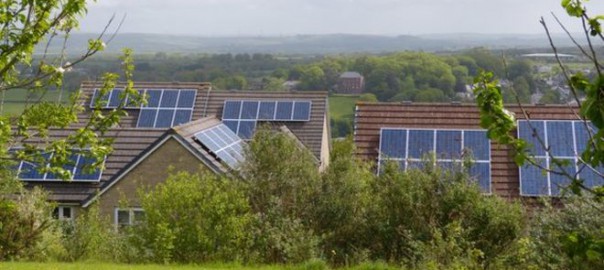
Around 500 houses in Wadebridge on the Camel estuary already have panels on their roofs – nearly 10% of homes in the area – making the town a contender for the solar power ‘capital’ of the UK.
“It is fairly likely from the information we’ve been able to gather that Wadebridge has the highest concentration of panels in the country,” says Jerry Clark, of the town’s Renewable Energy Network.
Cornwall, with 1,541 sunshine hours every year, is particularly rich in this resource.
Residents of Wadebridge have been amongst the fastest in the UK to install solar panels
But people living anywhere in the UK can also benefit.
Providing you are prepared to invest at least £5,000 – and wait for a decade to get your money back – the eventual savings could be considerable.
A new report shows that renewable energy investment in the United Kingdom hit a record high in 2014, with electricity generated from renewables increasing by 20% as well.
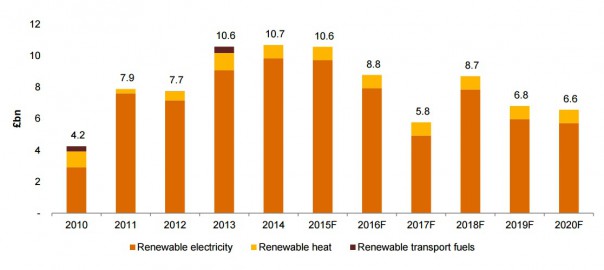
In fact, in 2014, not only did renewable energy investment hit a record of £10.7 billion, but renewable jobs increased by 9% as well.
Nevertheless, the authors of the report — PricewaterhouseCoopers (PwC) and Innovas, and commissioned by the UK’s Renewable Energy Association (REA) — are sure to warn that complacency will severely hurt the country’s renewable energy industry, especially in light of future decisions about Feed in Tariffs (FiT), the Renewable Heat Incentive (RHI), and transport.
The specifics of the report include a total electricity generation of 64,404GWh in 2014, up 20% from 53,667GWh in 2013. This news comes only a few weeks after the Renewable Energy Association announced that the UK’s renewable energy industry saw a 9% increase in jobs, with regions such as the East Midlands, North West, London and Scotland showing stronger than average employment growth. These are promising figures for the UK renewable energy industry, with the UK’s 2020 obligations quickly coming up.
“We are delighted that renewable energy sources are becoming an ever greater contributor to the UK’s energy mix,” said Dr Nina Skorupska, Chief Executive of the Renewable Energy Association. “Today’s figures show excellent progress in a number of sectors, both in terms of generation and installed capacity.”
However, according to the REA, the growth rate required to meet these 2020 obligations — 15% of the UK’s energy (including electricity, transport, and heat) from renewable sources by 2020 — currently sits at 16%, one of the highest rates in the European Union.
Subsequently, newly re-elected Prime Minister David Cameron has some serious decisions to make regarding the FiT review and whether or not to extend the RHI, which has only been allocated funding through to April 2016. And according to the REA, “renewable transport remains stagnant” ahead of the UK government needing to make a decision on the Renewable Transport Fuel Obligation.
“But we cannot be complacent,” Dr Skorupska continued. “Our analysis shows that where regulatory and financial support for renewable energy has been stable and sufficient, there has been considerable success, but where there has not, technologies have either stalled or gone backwards.
“In light of the growth rate for renewables needed for the UK to meet its 2020 targets, it is vital that the new government demonstrates the necessary leadership and ambition to enable our industry to thrive.”
The country’s investment figures also surged over 2014, though there are similar concerns over the future of the industry’s investments.
According to the report, 2014 saw investment of £10.7 billion, its highest levels, bringing the total investment into the UK renewables industry up to £50 billion forecast for the end of this year.
Historical and forecast investment in renewables 2010-20 (Image: PwC)
“2014 has been another strong year for investment in the renewable energy sector, bringing the total investment since 2010 to £40 billion,” said Ronan O’Regan, director, Renewables and Cleantech, PwC. “The majority of investment during 2014 was in renewable electricity generation, attracting almost £10 billion of capital, with solar the big winner representing £4.5 billion of investment.
“However, reaching the 2020 targets is estimated to require a further £50 billion of investment, The sector will be looking to the new Secretary of State to provide the investor certainty through to the end of the decade and beyond both in terms of funding and technology preferences.”
Up to 200,000 business and household customers in New South Wales face extended blackouts of up to a week, or even more, following the dramatic storms in the Sydney region and to its north.
And the impact could have as galvanising an effect as Hurricane Sandy had on the New York region of the United States – causing utilities, business and household customers to consider battery storage and even micro grids.
NSW has more than 260,000 households with rooftop solar, but any houses with solar on their roof would still be without power, because their inverters are usually connected to the grid. So when the grid goes down, the inverters go down too.
The only way to be able to use that solar power is to have battery storage and a special battery storage inverter, which effectively creates its own mini grid, and can operate on its own when the main grid goes down.
“Every storm we get a surge of inquiries,” says Glen Morris, the vice president of the Australian Energy Storage Council, and the owner of a solar-storage business. (Morris also lives in an off-grid community).
“People realise that if they have got solar PV and a grid connected inverter it doesn’t work when the power goes down, so they must have storage.”
Muriel Watt, head of energy policy at renewable energy consultants IT Power Australia, says the number of customers looking at battery storage were likely to increase dramatically as a result of the blackout, and when an estimated 146,000 households in NSW come off their premium 60c/kWh tariff next year.
“With so many households now having PV, it is making even more sense for them to consider adding storage and an inverter which allows them to switch to off-grid mode,” Watt said.
“This would at least keep the lights on and prevent the ‘fridge defrosting. Japanese people have been very aware of this option after losing power for weeks after the Kobe earthquake, but prices for PV and batteries have fallen considerably since then.
“Cost effectiveness is never the only consideration for household investments – emergency power would rate quite high on the list if we are to have more frequent severe weather events.”
As for costs, Morris says it is currently making a 10-15 year payback. But like Watt, he says that is not the main consideration.
But, he notes, the cost of battery storage is coming down quickly – around 20 per cent in 2014 for lithium-ion batteries, and another 25 per cent fall expected in 2015, battery manufacturers tell him. That is the same price trajectory as solar modules over the past 5 years.
How much storage was needed depended on what the customer needed. One household recently installed a 4kWh battery storage system, but because they were careful with their energy use, that was enough for a full day.
Many households or businesses would want storage just to ensure the TV, lights and radio are kept on, and possibly the fridge. Others use storage to bank the output from their solar panels and use later in the day.
That’s because new owners are either getting paid little or nothing to export back to the grid, or are prevented from doing so.
Businesses, particularly those with refrigeration needs who find they are paying $40,000 to $50,000 for a back up generator with high maintenance, are also finding rooftop solar and battery storage is a cheaper and more effective alternative.
Some forecasts suggest that within a few years, it will be economic for households in city suburbs to disconnect from the grid. Some suggest one-third may do so within the next few decades.
Right now, though, Morris says even the market operator does not know how many battery storage systems are in place. That’s because most people installing storage are adding it to pre-existing solar systems.
Michael Anthony, from Solar360, says the bulk of his company’s business is now centred around storage. He says about 40-60 new storage systems are being installed each month, much of it in regional areas, but also in the city – both for businesses and households.
“Most dealers are trying to sell just solar, but they haven’t understood that adding storage gives a better result.”
Anthony says the levelised cost of energy for added battery storage systems is at the same level as grid power.
Ironically, Morris was speaking from the northern NSW town of Ballina, where he was hosting a course on battery storage for technicians from the local network operator.
The main grid operator in the Sydney, Hunter region, Ausgrid had to put out a warning on Wednesday in response to reports that desperate households and businesses – facing another week without power – were rushing to hardware stores to buy generators.
Morris said this was both illegal, and stupid. Generators could only work when powering appliances directly. If they are fed into a household wiring system, they can be incredibly dangerous, both for the occupants and network linesmen.
POMONA, Calif. — The future of American energy, according to one widely held view, will include solar panels and wind turbines continuing to proliferate, churning out ever more electricity and eventually eclipsing fossil fuels to help offset the forces of climate change.
With the cost of renewable technologies falling sharply, that vision is starting to take shape, especially in areas with abundant sunshine or steady wind. Here in California, the state is making such quick progress toward its goal of getting 33 percent of its electricity from renewable sources by 2020 that Gov. Jerry Brown raised the ante earlier this year, setting a target of 50 percent by 2030.
The shift sounds simple in theory — plug more solar and wind into the mix, and unplug more coal- or gas-burning power plants, sparing the world millions of tons of greenhouse gases.
But the reality is more complex. Because of the variable nature of these renewable sources — no electricity is generated when the sun goes down or the air is still — they add strains to the system of transmitting and distributing power.
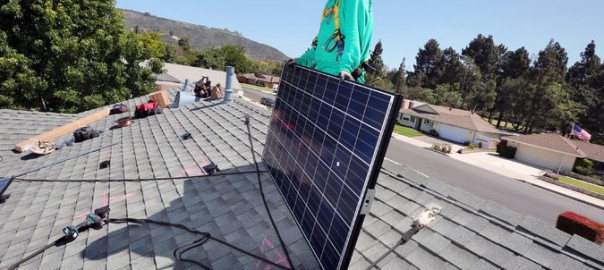
A solar panel being installed at a home in Camarillo, Calif. The state aims to get 50 percent of its energy from renewable sources by 2030. (Image: J.E. Flores/NYT)
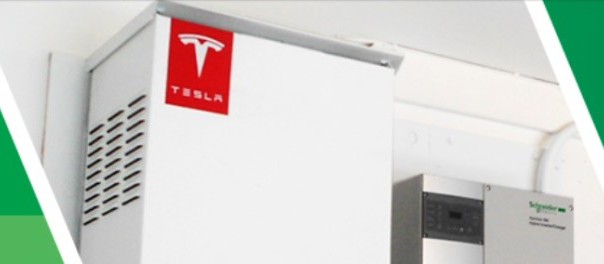
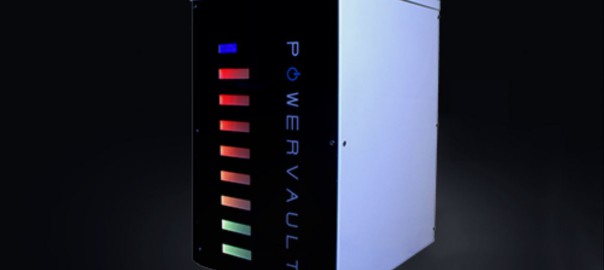
Batteries have long been seen as one of the main ways to work more renewables into the electrical grid, by storing electricity during times of excess generation and releasing it when needed. Now, spurred by mandates in California and other states to deploy storage, by the rise of rooftop solar systems, and by falling prices as Tesla Motors and other companies make plans to produce vast numbers of lithium-ion cells, batteries are set to play a significant part in the nation’s power supply.
“We can see the role of batteries playing out in different locations around the grid,” said Ravi Manghani, an analyst with GTM Media and author of a recent forecast for the energy storage industry over the next five years. “We expect that every year, we’re going to see on average 100 to 250 percent growth,” he added. “And most of that will be in batteries.”
Challenges remain, however. Despite plummeting prices, large battery systems generally are not yet economical for helping to integrate renewables on a broad scale. Instead, utilities and other companies are using them for different purposes.
“Let’s call it a stretch goal,” Imre Gyuk, who directs a Department of Energy program that has sponsored demonstration projects for energy storage, said of plans for vast deployment of batteries for integrating renewables. Costs still have to come down more, he said, and not just for the cells, but for the control equipment as well.
There are several ways that the electrical grid can cope with more renewables — by large consumers of electricity agreeing to have their power reduced at critical times, for example, a concept called demand response. And there are other ways to store electricity, such as pumping water, compressing air, spinning flywheels, or even making ice.
Battery systems, which feature racks of cells wired together, and are capable of storing large amounts of power and releasing it over an hour or longer, have some advantages over other storage methods. They can supply power nearly instantaneously and handle continual cycling between charging and discharging. And as the manufacturing of batteries and control systems scales up, it will be easier and cheaper to deploy “plug and play” systems, rather than designs that are unique to each situation.
A large battery storage project in Notrees, Tex., illustrates the current economics. Built in 2013 for about $44 million by Duke Energy Renewables (with the Department of Energy contributing half of the amount), the project consists of thousands of lead-acid battery cells near a large wind farm.
Greg Wolf, the president of Duke Energy Renewables, said the company found it hard to sell large electricity users so-called firmed wind, in which stored power from the battery is used to supplement the wind turbines to provide assured blocks of electricity at certain times.
“There was little interest from customers willing to pay for that,” Mr. Wolf said. “That has not evolved as much as some folks, including ourselves, thought.”
Instead, he said, the grid operator in Texas was interested in the Notrees battery as a fast-response source to regulate the frequency of the electrical current, which keeps the grid stable.
Maintaining a reliable grid is a high-wire act for operators, who struggle to keep a balance between the supply of electricity from generation sources and demand for it from customers. Batteries are especially valuable because they can respond quickly, adding more power to the system in a second or less.
Fossil-fuel plants that are often kept on standby for this purpose can take a few minutes or more to reach a level where they can provide the same service, Dr. Gyuk said. And all the while, fossil-fuel plants are emitting greenhouse gases.
Here at a Southern California Edison laboratory in the shadow of the San Gabriel Mountains, scientists and engineers are doing some of the fundamental work to help make widespread battery storage happen.
Accompanied by the steady thrum of electric current, batteries — lithium-ion cells like those used in electric cars and other types — sit in rows of sealed testing chambers. The batteries are undergoing continuous charge-discharge cycles in heat and cold, dripping humidity and desert dryness, to simulate the conditions they may face when deployed on the electrical grid.
“We’re trying to better understand their performance,” said Loic A. Gaillac, who manages the utility’s advanced energy storage group. “Ultimately, we want to get a sense of what degradation you see on the system and how long they last in the field.”
In 2013, California mandated that by 2020, Southern California Edison and the state’s two other large investor-owned utilities add a huge amount of storage — about 1.3 gigawatts, or more than 10 times the amount of storage deployed worldwide in 2011.
“We felt there were enough opportunities now where storage could be cost effective,” said Carla Peterman, a member of the California Public Utilities Commission, which oversees implementation of the mandate. “But we still recognized that this was a nascent industry.”
Mark E. Irwin, Southern California Edison’s director of technology energy storage, said that for now, the utility is most likely to use batteries to relieve its distribution system of peak loads that would otherwise require expensive improvement of wires and other equipment.
California has also set a priority to develop distributed generation, in particular moving away from large centralized solar farms and toward residential or neighborhood-scale solar power. Batteries will no doubt play a greater role in this, Mr. Irwin said.
“It will make it easier for people to put renewable systems out on the local grid,” he said.
“But in the meantime, storage has to find a way to first walk,” he added. Helping to defer upgrading costs, he said, is one way to get storage started.
“It’s the first business case,” Mr. Irwin said. “But it won’t be the last.”