Category Archives: Solar Power

Tesla Powerwalls for Home Energy Storage Hit U.S. Market

To Steve Yates, the best thing about his new Tesla Powerwall is that he doesn’t have to worry anymore about the lights going out during a storm. Or maybe it’s how cool an addition it is to the entryway of his house in Monkton, Vermont.

“I’ve always wanted to have a backup power source,” said Yates, who was without electricity for 36 hours during Hurricane Irene in 2011. He also admires the Powerwall’s sleek white contours. “It’s kind of art-deco looking.”

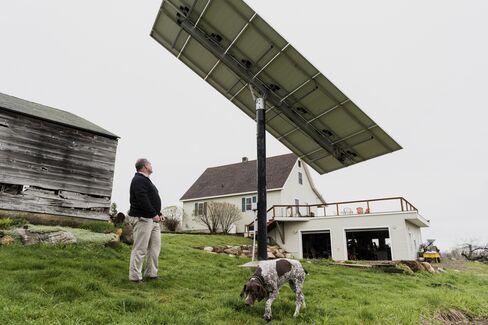
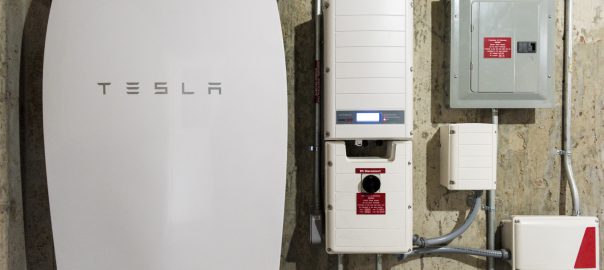
Solar panel linked to a Tesla Powerwall.
Photographer: Ian Thomas Jansen-Lonnquist/Bloomberg


A year after Elon Musk unveiled the Powerwall at Tesla Motors Inc.’s design studio near Los Angeles, the first wave of residential installations has started in the U.S. The 6.4-kilowatt-hour unit stores electricity from home solar systems and provides backup in the case of a conventional outage. Weighing 214 pounds and standing about 4-feet tall, it retails for around $3,000. But hookup by a trained electrician is required, as is something called a bi-directional inverter that converts direct-current electricity into the kind used by dishwashers and refrigerators. The costs add up quickly — which has fueled skepticism about Musk’s dream of changing the way the world uses energy.

Tesla Energy's home battery, Powerwall, is seen newly installed in the home of Steven YatesÊ in Monkton, Vermont on Monday, May 2, 2016.
Tesla Energy’s home battery, Powerwall, is seen newly installed in the home of Steven Yates in Monkton, Vermont
 Net-metering policies, which allow residential solar customers to sell their excess solar electricity back to utilities, have limited the appeal of home batteries in many states. But that’s shifting: Net metering is being phased out in some states, making storage more attractive.

“The picture is rapidly changing across several markets,” said Yayoi Sekine, an analyst for Bloomberg New Energy Finance. “Changes to net-metering policies and implementation of time-of-use rates will improve the case for residential energy storage systems going forward.”

Read more: Bloomberg

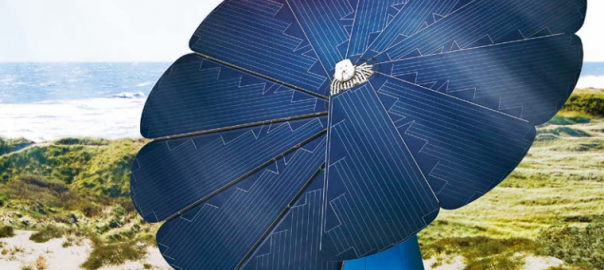
SmartFlower solar PV (Image: Green-Mole)

Launch of Solar SmartFlower

Wouldn’t it be wonderful if each of us could produce all clean energy we need
right in our backyards? And wouldn’t it be a cherry on the top if the same photovoltaic
system could simply be plug-&-play like any other normal home appliance?

SmartFlower solar PV (Image: Green-Mole)

At smartflower, we have stopped asking such questions. Instead, we have
answered them – with smartflower POP, the world’s first all-in-one solar system.

Thanks to its extraordinary construction and the perfectly synchronised components,
the system delivers, on an average, approx. 4,000 kWh per year, thus
fulfilling the complete average electricity requirement of a household in the central
European region.

Smartflower Promo from ImagePlay on Vimeo.

smartflower POP represents changing times. The size of the system alone is no
longer the measure of all things. What counts is a fairly constant production
rate during the course of the day, in order to enable a more effective use of the
produced energy. smartflower POP achieves a degree of self-utilisation of
around 60% – a significant improvement over a comparable rooftop unit, which
averages just around 30%. Now that is what we call smart!

Source: Green Mole press release

We can ditch fossil fuels in 10 years, if we want to

Patterns show that the move to cleaner energy would be quick if there was a concerted effort.

506079846_oil_rig_unk

The quest to end the use of fossil fuels might not be as daunting as you think. A University of Sussex study claims that humanity could drop coal and oil within a decade, based largely on historical evidence that many tend to overlook. Professor Benjamin Sovacool notes that energy transitions have happened quickly whenever there was a combination of “strong government intervention” with economic or environmental incentives to switch. It only took 11 years for the Canadian province of Ontario to abandon coal energy, for example, while nuclear power surged to 40 percent of France’s electricity supply within 12 years. In the case of fossil fuels, it’s a combination of climate change worries, dwindling resources and advanced technology that could step up the pace.

The researcher admits that these handovers tend to move slowly if left to their own devices, such as the decades it took for electricity to see widespread adoption. However, Professor Sovacool argues that the mainstream notion that these transitions must happen slowly doesn’t really hold water. They just need a concerted, collaborative effort, he says.

Of course, actually creating that effort is another matter. While electric cars and renewable energy are quickly hitting their stride, there’s also stiff opposition from the fossil fuel industry (and the politicians that protect it) to the sort of regulation that would speed up the use of cleaner power sources. Also, developing countries seldom have the luxury of dropping fossil fuels — it’d cost too much, or leave too many people without reliable electricity. An accelerated transition might not happen until the political and economic advantages are so overwhelming that even the staunchest opponents concede defeat.

Source: Autoblog

Ecotricity acquires SunEdison UK solar business

Ecotricity, Britain’s leading green energy company, today announced that it has acquired the home rooftop solar business of SunEdison.

ecotricity-acquires_sunedison_uk-solar-business_ecotricity

Before exiting the UK, SunEdison had built a portfolio of nearly a thousand rooftop solar installations, a product known as the Energy Saver Plan.

The news comes on the day SunEdison Inc. filed for bankruptcy in the U.S.

Dale Vince, Ecotricity founder, said:

“This is an exciting and important step for Ecotricity. As a company, we want to help more people generate their own power at home.

“The government’s cuts to the feed-in tariff, and its broader attack on the renewables industry, have caused a significant problem for companies like SunEdison: we have seen some go bust and others quit the UK market as a result, losing a lot of jobs as a result.

“This is our first step into the domestic solar market, and as the price of the technology continues to fall, we’re confident that it’s only a matter of time before we can resume the work SunEdison started and help more homes take advantage of solar power.”

Ecotricity, who now supply approaching 200,000 customers from a fleet of wind and sun parks, last made an acquisition in 2014 when they rescued small windmill company Evance from administration – uniting Evance with other supply chain companies, Ecotricity formed a new small windmill company called Britwind.

Dale said:

“We see a big future for renewable technology of this scale in Britain – small wind and rooftop solar will allow more people to generate their own power at home, decentralising the energy sector and putting power in the hands of the people.”

Source: Ecotricity

Red Tesla Model S (Image: T. Larkum)

Why Would You Power A Clean Electric Car With Dirty Energy?

Buying a Tesla might lead to greener choices elsewhere

Red Tesla Model S (Image: T. Larkum)
You’ll want to know how the electricity is produced, right? (Image: T. Larkum)

NEW YORK — It’s one thing to get people to care about the price of energy. It’s quite another challenge to get them to care about the source of energy and its environmental impact.

But buying an electric car — presumably, in part, to reduce one’s carbon footprint — may push people to think about where the electricity to power that vehicle comes from, according to one early investor in Tesla Motors.

“The electric vehicle is like a Trojan horse for energy literacy,”

Nancy Pfund, managing partner at the venture capital firm DBL Partners, said during a panel discussion at the Bloomberg New Energy Finance Summit in Manhattan on Monday morning.

Pfund said she noticed the possible linkage a decade ago, when DBL first invested in Tesla, which sells luxury electric cars, and its sister company, SolarCity, which markets solar power systems. Both are chaired by billionaire Elon Musk.

“In the early days of Tesla, early adopters would buy the Roadster or the Model S, and weeks later we’d see an uptick in solar adopters,” she told The Huffington Post in an interview. “They’re really examples of the connection between transportation and the green electrical grid.”

The idea is that no one wants to go greener by buying a battery-powered electric vehicle only to charge it with electricity generated from burning coal or gas.

Most Americans buy electricity from utility companies that produce energy by burning fossil fuels or generate power from water flow, wind turbines or solar panels. A small but growing number of people generate power from rooftop solar panels or backyard wind turbines and then sell any excess energy to the utility companies. To really go green, people need batteries to store their own clean energy for later use.

If purchasing an electric car focuses the buyer on other ways to access cleaner energy and use it in lower quantities, that can work to improve the whole system.

“Anytime you get people to be more literate and understand where something is coming from, they have a voice,” Pfund added. “And a more engaged and vocal population will demand more energy choices.”

Read more: Huffington Post

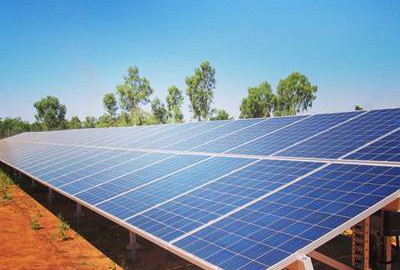
Solar Power (Image: ARENA)

Wind and Solar Are Crushing Fossil Fuels

Record clean energy investment outpaces gas and coal 2 to 1

Solar Power (Image: ARENA)

Wind and solar have grown seemingly unstoppable.

While two years of crashing prices for oil, natural gas, and coal triggered dramatic downsizing in those industries, renewables have been thriving. Clean energy investment broke new records in 2015 and is now seeing twice as much global funding as fossil fuels.

One reason is that renewable energy is becoming ever cheaper to produce. Recent solar and wind auctions in Mexico and Morocco ended with winning bids from companies that promised to produce electricity at the cheapest rate, from any source, anywhere in the world, said Michael Liebreich, chairman of the advisory board for Bloomberg New Energy Finance (BNEF).

“We’re in a low-cost-of-oil environment for the foreseeable future,” Liebreich said during his keynote address at the BNEF Summit in New York on Tuesday. “Did that stop renewable energy investment? Not at all.”

Read more: Bloomberg

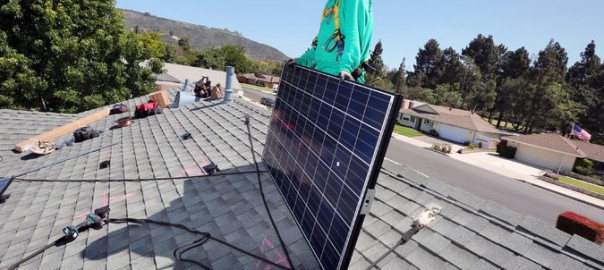
A solar panel being installed at a home in Camarillo, Calif. The state aims to get 50 percent of its energy from renewable sources by 2030. (Image: J.E. Flores/NYT)

Many Homebuyers Are Searching For Solar

FAIRFIELD, Conn. — Environmental experts addressed the Greater Fairfield Board of Realtors Wednesday, explaining what sorts of sustainable bells and whistles the savvy homebuyer is looking for these days.

“Solar is the new granite countertop,”

said Bob Wall, associate director of marketing and outreach at Clean Energy Finance and Investment Authority, or CEFIA.

Workers for SolarCity installing solar panels (Image: JE Flores/NYTimes)

Homes on the market with existing solar panels, modern insulation and sustainable landscaping are getting noticed by a new breed of buyers, he and others said.

About 300 homes in Fairfield currently use some form of solar cells, said Scott Thompson, chairman of the town’s Clean Energy Task Force. When the town announced its Solarize Fairfield initiative recently, about 75 homeowners signed up to learn more.

“It’s really incredible what’s happening,” he said.

Last year, an AP environmental science class at Fairfield Warde High School studied about 16,300 rooftops in town — via Google — to see which would be good candidates for solar cells. The town sent letters to about 5,500 homes that fit the criteria, Thompson said.

The next informational workshop will be held at 7 p.m., April 28, at the Fairfield Public Library.

Elizabeth DiSalvo is an architect at Trillium Architects, which won the 2016 CT Green Building Council’s Award of Excellence. She said her firm focuses on building homes that are energy efficient, sustainable and healthy.

She promoted the idea of “greening” the multiple listings services by letting buyers know if a home boasts state-of-the-art water, heating, cooling and air-quality features.

“We care passionately about this,” she said.


Read more: Daily Voice

Fleet of 150 Renault ZOE for smart solar charging project

  • Renault has signed a letter of intent with the Dutch Utrecht City Council, ElaadNL and LomboXnet on Smart Solar Charging for electric vehicles.
  • The signature took place during the state visit to Paris of King Willem-Alexander and Queen Máxima of the Netherlands, under the schedule of Franco-Dutch Economic Year 2015-2016.

76331_Solar_ZOE_Renault

THE SMART SOLAR CHARGING NETWORK PROJECT

Renault, Europe’s leading electric vehicles manufacturer, and its Dutch economic partners Utrecht City Council, ElaadNL and LomboXnet signed a letter of intent in Paris on 11 March 2016 to develop a Franco-Dutch framework of smart solar charging solutions for electric vehicles.

The signature ceremony was attended by Renault’s Laurens van den Acker, SVP Corporate Design and Guillaume Berthier, EV sales Director; in presence of the king and queen of the Netherlands, the Dutch minister of trade, Lilianne Ploumen and the French Foreign Affairs Ministry’s secretary of state for European affairs, Harlem Désir.

SMART-CHARGE SYSTEMS FOR ELECTRIC TRANSPORT

According to the letter of intent, the city of Utrecht could be the testing ground for the solar smart-charge project. Renault, Europe’s leader in electric vehicles, would supply a fleet of 150 Renault ZOE models through 2017 to the city. ElaadNL would handle management of infrastructures and the smart-charge standard, and LomboXnet would take charge of installing the network of unique public charging terminals powered by a 44 kW grid connection. Grid operator Stedin would be involved to balance supply and demand of the grid.

Phase one of the project would involve setting up 1,000 smart solar-charge stations, powered by 10,000 photovoltaic panels in the Utrecht region. Infrastructure installation would run side by side with development of a car-share service of electric cars, powered by renewable energy, for Utrecht residents. The Renault ZOE R.Access connectivity and 22 kW charging make it ideal for car-share and smart charging applications.

Phase two of the project would proceed with the partners developing a vehicle-to-grid ecosystem, with the network of solar chargers capable of both charging the electric cars and of feeding energy stored in the batteries of parked cars onto the grid to meet demand peaks. This could be the starting point for a new system storing renewably sourced energy.

STEPPING UP THE ENERGY TRANSITION

Through its pioneering work on EVs and their batteries, Renault contributes to the energy transition in the automotive industry by reducing the use of fossil fuels. Renault, through smart charging experiments, increases the proportion of renewable energy EVs use. One of the goals of the Smart Solar Charging Project developed by Renault, ElaadNL, LomboXnet and the Utrecht City Council is to make a substantial contribution to reducing the carbon footprint not only of the auto industry but of all sectors consuming electricity.

ElaadNL researches and tests the possibilities for smart charging on behalf of the dutch grid operators. With innovative techniques ElaadNL can charge electric cars in a smart way, exactly at the right moment. With Smart Charging, the abundance of electricity from the sun and wind is used to charge our cars. Live off the wind and drive on the sun!

In June 2015, LomboXnet introduced in Utrecht a world-wide scoop: a charging station making Smart Solar Charging accessible worldwide. This charging station can charge and discharge (vehicle-to-grid, V2G), establishing the foundation for a new local energy system based on local energy sources and local storage. The unique charging station is developed in a consortium of GE, Stedin, Vidyn, Last Mile Solutions, Utrecht Municipality and led by LomboXnet.

By implementing the vehicle-to-grid project on a regional scale, the region of Utrecht creates – together with partners like Renault – a large living lab for innovative smart grid solutions. This show case implements not only green power, but ensures also clean air zero emissions in the city and region of Utrecht. Thus, Utrecht makes way with Healthy Urban living. Not only to continuously improve its leading position as the most competitive region of the EU (according to Eurostat) but also to inspire other metropolitan regions as well.

Source: Renault Media
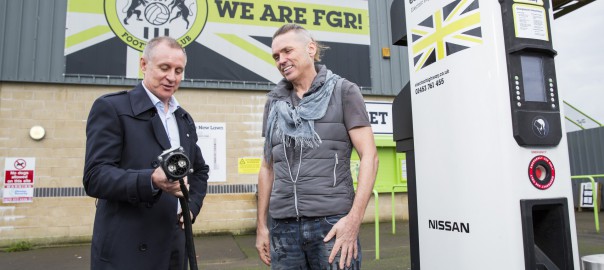
Drive like the wind: Electric Highway

“Five years ago, it was said that one of the main reasons people weren’t buying electric cars was because of a lack places to charge them – and the main reason more places to charge weren’t being built was because not enough people were buying electric cars – classic chicken and egg stuff,” says Dale Vince, former new age traveller and outspoken founder of the world’s first green energy company, Ecotricity. “We decided to break that impasse.”

AG_SOUTHAUSTRALIA_VISIT_Ecotricity

Vince received an OBE from the Queen for services to the environment in 2004. In 2011, Ecotricity created the Electric Highway, the first national network of fast chargers in Britain. Free, compatible with all electric vehicles on the market, and powered by the wind and the sun, it is now the most comprehensive charging network in Europe.

Vince says:

“We built Britain’s first electric supercar, the Nemesis, in 2010 – we wanted to show the true potential of electric cars and demonstrate how we can get around without fossil fuels. We had to shake the old image of the electric car first. The next step was to tackle the infrastructure problem, which led us to conceive of the Electric Highway.”

With Ecotricity pumps covering the entire motorway network in Britain, as well as strategic A-roads, ports and airports, electric cars are now reality in Britain – as owners travel the length and breadth of the country, literally from John O’Groats to Lands’ End.

Vince started by installing essentially three-pin plugs on the British motorway network. These would take eight hours to charge a car. Fast forward five years and there are now multiple charging networks across Britain, but the Electric Highway still leads the way, with nearly 300 Electricity pumps across the British motorway network that can charge in as little as 20 minutes.

Every charge uses Ecotricity’s 100% green energy, from the wind and sun – enabling electric cars to reach their true potential, zero emission free driving. And it’s been completely free to use since 2011, to encourage more people to make the switch.

“Our work fits in perfectly with the target the whole world agreed to in Paris last year,” adds Vince, “to limit global temperature rise to 2 degrees or less. To achieve this, we simply must stop burning fossil fuels by 2050, and that requires nothing short of a revolution in the three biggest areas of impact – energy, transport and food. The revolution is already underway on British roads.”

Transport is currently one of the biggest contributors towards our personal carbon footprints, so the Electric Highway network offers a solution to one of the world’s greatest problems.

Source: Atlas of the Future

Electric vehicle sales to boom in 2016

2015 proved to be an interesting year for energy and climate issues both globally and in the UK. Will 2016 hold more of the same?

Forecasting is a dangerous business, but here are six predictions you should keep an eye on.

1) The showdown on oil prices between Saudi Arabia and the US will intensify, and the Saudis will eventually break.

It looks like oil and gas prices are going to remain low for the foreseeable future, panicking both the oil industry in Saudi Arabia and the shale gas industry in the US.

The big question is whether Saudi Arabia can keep production high and prices low long enough to bankrupt enough of the American shale industry. The answer may come by the end of 2016 and several factors point to the Saudis breaking first.

For one, despite losses for the oil industry, low oil prices benefit many sectors in the US, especially as consumers now have more spending money in their pockets. However for Saudi Arabia, an oil-dependent economy, low prices are a clear loser.

4) Hybrid sales will fall; electric vehicle sales will boom and become the hot energy news item of 2016.

etron-statics-258_Etron_i3-Outlander_AutoExpress

More so than renewables, low-carbon vehicles are an area where you might expect low oil prices to present a difficulty as they will encourage more people to stick with their regular car.

Sales of hybrid vehicles, which many people do compare to standard combustion vehicles in purchasing decisions, will likely fall. Conversely, electric vehicle purchases tend to be made by consumers who are less sensitive to price changes, evidenced by increased EV sales in 2015 despite low oil prices. In addition, a significant portion of EV sales are in industrial, commercial and public sectors where EV mandates play a strong role.

This prediction, like most others included here, differs significantly from OPEC’s delusional World Oil Outlook. On EVs it forecasts only a moderate increase in sales all the way out to 2040. OPEC dismisses EVs as a threat because it says it will take until 2040 for battery costs to fall by 30-50%, enough to make them viable options. It’s a particularly bold prediction as battery costs have fallen by about 50% in last five years alone.

Expect to see media interest in head-to-head races between the silent rockets and a lot of interest in three big 2016 releases: the Chevy Volt, the Nissan LEAF and the Tesla Model X.

Read more: New Economics