Category Archives: Prepping and Collapse

Severe Flooding, Against a Background of Wind Turbines: November 2012, Tyringham, Bucks. (Image: T. Larkum)

Parliamentary group warns that global fossil fuels could peak in less than 10 years

British MPs launch landmark report on impending environmental ‘limits’ to economic growth

Severe Flooding, Against a Background of Wind Turbines: November 2012, Tyringham, Bucks. (Image: T. Larkum)
Severe Flooding, Against a Background of Wind Turbines (Image: T. Larkum)

A report commissioned on behalf of a cross-party group of British MPs authored by a former UK government advisor, the first of its kind, says that industrial civilisation is currently on track to experience “an eventual collapse of production and living standards” in the next few decades if business-as-usual continues.

The report published by the new All-Party Parliamentary Group (APPG) on Limits to Growth, which launched in the House of Commons on Tuesday evening, reviews the scientific merits of a controversial 1972 model by a team of MIT scientists, which forecasted a possible collapse of civilisation due to resource depletion.

The report launch at the House of Commons was addressed by Anders Wijkman, co-chair of the Club of Rome, which originally commissioned the MIT study.

At the time, the MIT team’s findings had been widely criticised in the media for being alarmist. To this day, it is often believed that the ‘limits to growth’ forecasts were dramatically wrong.

But the new report by the APPG on Limits to Growth, whose members consist of Conservative, Labour, Green and Scottish National Party members of parliament, reviews the scientific literature and finds that the original model remains surprisingly robust.

Authored by Professor Tim Jackson of the University of Surrey, who was Economics Commissioner on the UK government’s Sustainable Development Commission, and former Carbon Brief policy analyst Robin Webster, the report concludes that:

“There is unsettling evidence that society is tracking the ‘standard run’ of the original study — which leads ultimately to collapse. Detailed and recent analyses suggest that production peaks for some key resources may only be decades away.”

Read more: Medium

Inception the Movie (Image: Warner Bros)

Britain’s property market is on the cusp of a crash as household finances reach breaking point

Britain’s property prices are skyrocketing but household earnings and savings can’t keep up.

Couple this with the amount of debt Britons are taking on and it looks like the UK’s property market is heading for a crash.

Why? — Because getting a mortgage is possibly the most debt you’ll take on in one go and rates can’t stay low forever. Eventually they’ll rise and so will monthly payments.

If household wages fail to keep pace as payments rise, they’ll be stretched further and further.

The average price to buy a house in Britain now stands at £291,504, according to the Office for National Statistics. Meanwhile, the average London property price is at a huge £551,00o.

Analysts say that the fundamental supply and demand balanced is so skewed that the only direction houses will go is up.

Research from the Royal Institution of Chartered Surveyors, estate agent Savills, the Council of Mortgage Lenders, and bank analysts has said prices will continue to rise over the next five years. Even a study published by Santander showed average house prices across the country will more than double to around £500,000 over the next 15 years.

Technically, this should be correct. There is way too many people looking to buy a home and way too little to go around.

But there are three key charts from the latest note from Citi FX’s strategy note entitled “UK’s increasing dependence and increasing vulnerability” which demonstrate how household finances can be considered being at breaking point.

And if rates do rise soon then more people will fall behind with payments which will trigger a real-estate fire sale and increasing defaults.

Read more: Business Insider

Severe Flooding, Against a Background of Wind Turbines: November 2012, Tyringham, Bucks. (Image: T. Larkum)

Do I need a bug out bag in the UK?

In case you were wondering. A bug out bag is typically a backpack containing enough items to sustain you for three days, or 72 hours. Thought by some, particularly Americans, as an essential item to have with you at all times. The reason for having a bug out bag is in case of natural or unnatural disasters. Or as some would call it. The zombie apocalypse.

Those that have bug out bags are often thought of as being ‘doomsday sayers’ or a bit strange. Particurly when you consider what Americans will include in their bug out bags. Which includes weapons for self defence.

Do I need a bug out bag in the UK?

But hang on a minute. Before we go down the ruling it out as a bit ott. Should we not consider our own situation in this country. The UK.

Severe Flooding, Against a Background of Wind Turbines: November 2012, Tyringham, Bucks. (Image: T. Larkum)
Severe Flooding (Image: T. Larkum)

Taking recent events and history in the UK as an example.

In the last couple of years we have been stuck in overnight traffic jams due to snow. Without electricity for three days. Stuck in a traffic jam for 7 hours because of a fatal accident. And more recently been flooded out of our homes. Admittedly, you don’t need to head for the hills and live like Grizzily Adams during these events, but just think how much easier our life’s would have been with a little preparation. The key is to think where you are most likely to be sent during an evacuation. The chances are that it will be a village hall or similar. It will also be more comfortable than trying to live in the woods. So it’s unlikely that you’ll need animal snares, knifes for skinning animals etc.

So do I need a bug out bag?

Perhaps not to the extent that the Americans go to. But I do think that a little common sense and a little forethought will help massively. Self reliance in such situations can make a very unpleasant situation tolerable. Think of a bug out bag not as a survival option for when the apocalypse comes, but more as a ‘comfort’ option, when you need to leave home quickly or get stuck in your car.

Read more: Midlife Crisis Man

Severe Flooding, Against a Background of Wind Turbines: November 2012, Tyringham, Bucks. (Image: T. Larkum)

Organic farming ‘could be key to feeding the world as global warming takes hold’

Major study finds chemical-free agriculture restores the soil and can produce higher yields than ‘conventional’ methods

Severe Flooding, Against a Background of Wind Turbines: November 2012, Tyringham, Bucks. (Image: T. Larkum)

Organic farming – long held to be irrelevant in tackling world hunger – could be key to feeding the world as global warming takes hold, one of the biggest studies ever to be carried out into the “contentious” practice has concluded.

The research, which has reviewed hundreds of studies stretching back over four decades, not only overturns conventional wisdom but contradicts Britain’s official Food Standards Agency, which has repeatedly attacked chemical-free agriculture. It adds to emerging evidence that it may be more productive and profitable than conventional farming in the long term, especially in developing countries, and says it can provide an “ideal blueprint in addressing climate change”.

Read more: Independent

Getting Older After the Apocalypse

Every now and then the Internet serves up something perfectly pitched to what you assumed were your own very individual fears.

On Thursday, for me, that was Romie Stott’s “futurist vision of retirement planning” at The Billfold. Planning for the eventual end of paid work isn’t just difficult because life is expensive and saving money is hard, she points out — it’s also difficult because the world is ending.

Okay, that might be my fears talking. But Ms. Stott does note that climate change over the next several decades will, at the very least, affect certain popular retiree destinations: “If your retirement dream includes a beach house, lake house, Florida, or New Mexico, add four to 11 degrees to the daily forecast; that’s the EPA’s best prediction for 2100 AD.”

That may sound relatively tame, but she also mentions booming populations of disease-bearing insects, and increasingly catastrophic storms. It’s predictions like this that, for years, have made me think of retirement planning not just in terms of 401(k)s but in terms of learning to build a fire.

Read more: NY Times

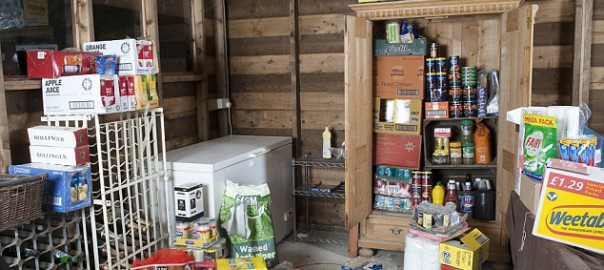
Reserves: The Shaws have enough food and water to last them a year, stored in their garage (Image: M. Large/Daily Mail)

Stocking up for Doomsday

An amusing article from December 2011 – I suspect more families are stocking up now.

Picture the scene: It’s the end of January 2012 and already it is clear the year to come will make that which has just passed seem something of a picnic. The last strains of Auld Lang Syne had barely faded before Greece defaulted on its debts. Over the next few weeks, Italy and Spain will follow.

Reserves: The Shaws have enough food and water to last them a year, stored in their garage (Image: M. Large/Daily Mail)

Across Britain and the Continent, bank after bank goes down, a domino effect exacerbated by panicking customers desperately withdrawing their savings. Where three years ago the giants of High Street banking were seen as too big too fail, now they are too big and too many for any Government to save.

Panic ensues. Within hours, the cashpoints are empty of money and the supermarket shelves stripped bare.

To make matters worse the country is hit by freezing weather. As temperatures plummet and snow falls, the road network stalls to a grinding halt, while large swathes of the country are hit by electricity blackouts.

The warning by economists that Britain is just ‘nine meals from anarchy’ is brutally borne out. Unlike last summer, the rioters on the streets aren’t looking for trainers and flat-screen TVs — just food.

An absurd fantasy? Perhaps so, but in an increasingly uncertain world, such a scenario can no longer be dismissed out of hand. And strange as it may seem, it’s one that many believe is worth preparing for.

Read more: Daily Mail

100 Things You Can Do To Prepare Yourself for Peak Oil

This is the followup 49-100 peak oil tools as written by Sharon Astyk. To read tips #1-49 read here

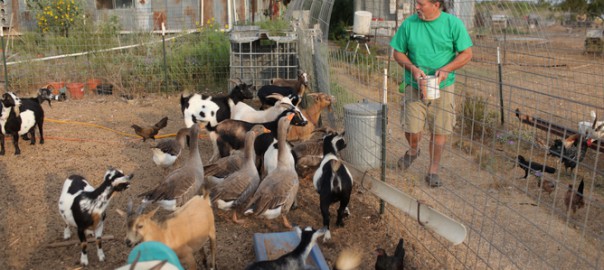
Floresville, Texas: Paul Range feeds his brood of livestock. Each can serve as a food source if things get bad. (Photo Credit: National Geographic Channel/ Sharp Entertainment)

49. Invite someone new to your house once every month. Try and expand your community and circle of friends regularly. Invite people to eat with you regularly – sharing food is an important part of community building.

50. Attend zoning meetings and consider running for zoning board. Work to amend local zoning laws to allow green building, composting toilets, clotheslines, small livestock, cottage businesses, front lawn gardens and other essentials.

51. Have a large house and not a lot of people in it? Consider a roommate, or borders. This will make you more economically stable and also expand your community and local resources. If you currently rent an apartment, consider sharing housing with a roommate.

52. If your community doesn’t have a food coop, start one now. There is a great deal of information on the web here: This can be a powerful tool for creating local food economies.

53. Consider creating a community currency. They keep money local and encourage small businesses and sustainable economies.

54. Sometimes you get more by giving things away than by selling them. Do you have something you don’t need? Extra produce? Spare time? Give extra tomatoes to a neighbor, offer spare items to friends, go over and help out someone who could use it. Good deeds mostly return to us.

55. Build an in-law apartment, or set your home up so that elderly family members can live comfortably with you when the time comes. Sit down and talk to them before the problem becomes acute, and tell them that you want them with you. It is easier to move elderly folks in with you before things become difficult.

56. Take time to get to know children in your neighborhood, especially teenagers. Make friends with them, talk and listen respectfully. Consider inviting them to apprentice with you on some work, or join in a work project (don’t forget to pay them for their help). Older children and teenagers need *meaningful* work – they need to know their contribution matters. Make sure it does.

57. Get to know local farmers and encourage them to fill gaps in your local food system – get together with neighbors and friends and create a market for local wheat, local dried beans, and other foods that are often grown industrially. If farmers know that even small quantities of these foods, locally grown, would be welcome, they will grow them.

58. Create a community festival to showcase local agricultural products, arts or other truly local creations and skills. Instead of focusing on simply drawing tourists, emphasize activities that bring the community together as part of it – dances, demonstrations of skill, children’s activities.

59. Draw attention to your local watershed, and on your vulnerabilities in that regard. Will you be competing with other communities? Are there areas of waste to be dealt with? Wetlands to be preserved? Make assuring a safe, long term water supply a community priority.

60. Create local educational systems – resist regionalizing schools and advocate for the creation or recreation of neighborhood school and library systems. Build homeschooling coops, and set up library branches at walkable sites. Encourage extension programs, community college branches and everything you can to make education more local.

Read more: Organic Consumers

(Image: D. Bacon/Shutterstock/Economist)

10 Ways to Identify a Closet Prepper

This article made me smile!

Although an increasing number of people are adapting to the realities of more expensive and declining energy, and a permanently depressed economy, many are still… shall we say, circumspect, about their activities. They may have been driven underground after encountering ridicule or denial from friends and family, or perhaps are just are leery about random people showing up at their door when crunch time arrives.

Prep-dar n. Informal 1. The keen observation skills and attention to detail which allow you to identify other people who are aware of, and covertly preparing for, peak oil. 2. A shortened version of “prepper radar”.

So how do we find these fellow prep enthusiasts, so we can join forces, help each other, and make our communities stronger? You could check out your local Transition initiative, or search online for a peak oil meet-up in your area. However, some of these undercover peak-oil-preparers may be people you already know…. friends, acquaintances, work buddies, even family – you just have to figure out who they are.

(Image: D. Bacon/Shutterstock/Economist)
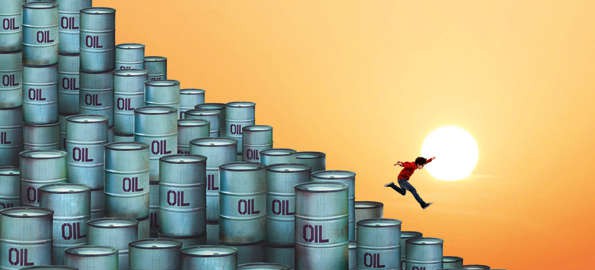
Oil Mountain (Image: D. Bacon/Shutterstock/Economist)

To help you find them, here are the top ten clues that should set your Prep-dar buzzing. You might know a closet prepper if he or she:

10. Gives you a Bo-Go flashlight, first-aid kit, or copy of Just In Case: How to be self-sufficient when the unexpected happens for Christmas.

9. Knows the difference between the IEA and the EIA; and/or calls the EIA “the most incompetent bungling liars in the government.”

8. Is overheard exclaiming “But Sharon Astyk/Richard Heinberg/James Howard Kunstler/Dmitry Orlov/Matt Simmons/Gail the Actuary says ____________!”

7. Sends you articles published by The Oil Drum, Energy Bulletin, or Life After the Oil Crash , “FYI.”

6. Stores any type of food in a bucket.

5. Is fired after a happy hour at which she tells the boss he’ll be doing hard labor when “TSHTF.”

4. Privately admits to cashing out their entire 401(K) to purchase gold, ammunition, and prime farmland.

3. Complains of marital discord arising from arguments about the number of chickens that might fit on a quarter-acre lot, or the excessive amount of lawn which has been converted to okra production.

2. Tends to use terms like Cantarell, TEOTWAWKI or Hirsch Report after a few glasses of wine.

and finally…..

1. Offers to share seeds, teach you to can tomatoes, help you compost, build a raised garden bed, plant a fruit tree for you, car-pool, chop firewood, give you fresh eggs, set up a rain barrel, or show you how to use a solar cooker.

In that case, who cares if they know about peak oil – you want to be their friend!

You might as well have fun as you change

A thought-provoking view (from 2012)

I spend much of my life making the case for changing one’s life (and not just one’s life – for supporting political and social change that is associated with it) in fairly radical ways, very quickly. I spend a lot of my time writing about this, and periodically I get on a train or a bus or something and go stand up in front of people and make the same case. I know this is a diffcult thing for many people, whose infrastructure envelopes them and pushes them powerfully towards a particular way of life, so I try to make good arguments for doing it now. I make moral arguments, about the use of a fair share. I make political arguments about not giving our money to causes we abhore. I make economic arguments. I make the argument that it will probably be a lot easier to adapt later if we have some practice.

But in the last year or two, I’ve been debating with myself how necessary I think these arguments actually are. Don’t get me wrong – I think there are still compelling moral arguments to choose to live in a certain way, and to support certain responses to climate change and depletion. For me personally, these are the most compelling possible reasons for doing this – even if climate change and depletion weren’t a reality, the truth is that Americans can only consume as they do if they tell themselves that other people in the world really won’t mind if they take more than their share, and of course, we all know that’s complete nonsense.

But I also think that the days of being able to choose to live with less are probably over. My prediction for the coming decade is pretty simple – we’re headed fairly rapidly into a time past all choosing. If the “aughts” were about the growing recognition that things are going to change, the teens, I think are now about the growing reality of that change – the recognition that none of us have the resources, or the wealth, or the immunity from changing circumstances to resist change for very long. The question is how we will change, not whether we will.

What do I mean by this? I mean that whether it comes from a worldwide economic crisis (begun already, not nearly as resolved as people say, and likely to be ongoing), from the gradual end of growth, from carbon finally being priced appropriately at the mine/well/etc…, from the costs of dealing with a rapidly increasing number of natural disaster linked to our lack of ecological awareness, from actual energy shortages or simply extremely volatile energy prices, from rising poverty and unemployment that absorb more and more of us or from failing infrastructure as we face the costs of not maintaining our sewers, electric greed, soil, water systems…. it is going to be increasingly impossible for most of us to go on as we have been.

It is no accident that the bills come due pretty much all at once in this decade. This is the decade, for example in which we can probably expect to firmly establish our oil peak, and if the promise of shale fails, as it may, our gas peak as well. This is the decade in which we run out of money to pay the Medicare bill (2017) and in which we have really begun to see the growing consequences of climate change – an ice free summer arctic, the first one in which we expect really big waves of climate refugees, etc…  This is the decade in which our deferred maintenence will begin to come due as more and more of the things we’ve left undone come back and bite us in the ass. This is the decade when we begin paying for all the things we were borrowing for in the last few years. How do we know this is true? Well, the most obvious reason is that these things are already happening.

Source: Casaubons Book

Crisis Preparation

I don’t think I’m yet convinced that in the UK we need to worry too much about being prepared for disasters. However, I found these articles interesting and worthy of ‘bookmarking’ to consider later.

100 Items to Disappear First

“From a Sarajevo War Survivor”

1. Generators (Good ones cost dearly. Gas storage, risky. Noisy…target of thieves; maintenance etc.)
2. Water Filters/Purifiers
3. Portable Toilets
4. Seasoned Firewood. Wood takes about 6 – 12 months to become dried, for home uses.
5. Lamp Oil, Wicks, Lamps (First Choice: Buy CLEAR oil. If scarce, stockpile ANY!)
6. Coleman Fuel. Impossible to stockpile too much.
7. Guns, Ammunition, Pepper Spray, Knives, Clubs, Bats & Slingshots.
8. Hand-can openers, & hand egg beaters, whisks.
9. Honey/Syrups/white, brown sugar
10. Rice – Beans – Wheat
11. Vegetable Oil (for cooking) Without it food burns/must be boiled etc.,)
12. Charcoal, Lighter Fluid (Will become scarce suddenly)
13. Water Containers (Urgent Item to obtain.) Any size. Small: HARD CLEAR PLASTIC ONLY – note – food grade if for drinking.
14. Mini Heater head (Propane) (Without this item, propane won’t heat a room.)
15. Grain Grinder (Non-electric)
16. Propane Cylinders (Urgent: Definite shortages will occur.
17. Survival Guide Book.

Read more: The Power Hour

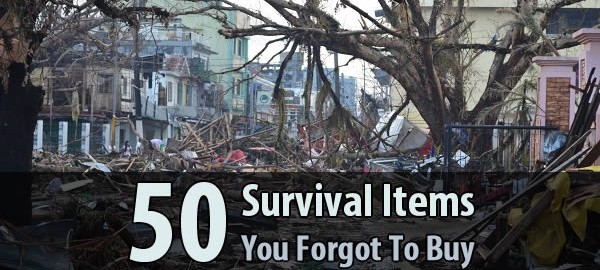
50 Survival Items You Forgot To Buy

1. Acoustic Instruments – For entertainment and morale.
2. Aluminum Foil – Great for all sorts of things like cooking food, boiling water, enhancing antennas, keeping sunlight out, etc.
3. Axes – How else will you chop firewood?
4. Baby Wipes – Really easy way to keep clean.
5. Baseballs, basketballs, footballs, etc. – Playing ball is a great way to stave off boredom and keep morale up during hard times.
Credit Card Knife
6. Bicycle Gear – If gasoline is in short supply, you might need your bike to get around. That means you’ll need a bike pump, extra tubes, etc.
7. Book lights – It’s difficult to read by candlelight and you don’t want to waste your flashlight’s batteries. Book lights are cheap and last a long time.
8. Books – You might be surprised how much free time you have after the SHTF. Now’s your chance to read those books you always meant to read (like Atlas Shrugged).
9. Bug Spray – There is usually a major lack of proper sanitation after a disaster, especially if there isn’t running water. That means there will be more roaches and other critters. There might also be a lot more mosquitoes.
10. Bullion Cubes – These make boring meals much more delicious.

Read more: Urban Survival Site