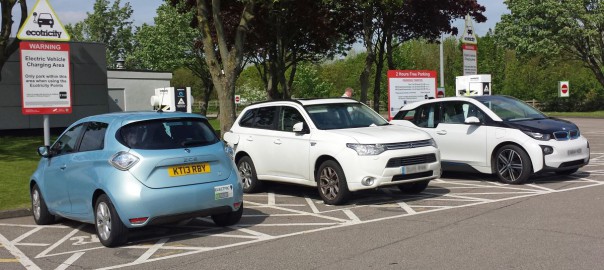
Outlawing the sale of internal combustion engine vehicles will help tackle the climate emergency, says shadow business secretary
A Labour government will aim to end the sale of cars with internal combustion engines by 2030, as part of its plans to tackle the climate emergency.
The party is to begin talks with the car industry and trade unions to explore the policies needed to achieve the goal. It says it wants to help an “under siege” industry switch to electric car production.
It comes as measures to phase out the internal combustion engine gathering pace across Europe. Earlier this month, Denmark called for a plan to phase out diesel and petrol cars and allow a ban on their sale by 2030. It was backed by 10 other EU countries.
Labour has already pledged to provide £3bn to invest in electric car models and technology. It will exempt new investment in plant and machinery from business rates. Another £2bn will go towards the construction of three battery plants.
Tensions are rising in up to 34 counties in California as residents begin feeling the effects of Pacific Gas and Electric Co’s decision to cut power to around 800,000 customers as a way to avoid potential wildfires in the area.
Amidst the chaos, Tesla owners who have installed rooftop solar and Powerwall 2 batteries are reporting that they are weathering the widespread power outage with no problems.
PG&E’s shutdown has received widespread criticism among CA residents and officials alike. In a statement to The San Francisco Chronicle, Rep. Jared Huffman described the power provider’s strategy as a “lousy set of choices.” Michael Wara, director of the climate and energy policy program at Stanford University, added that the widespread outage shows that the company cannot operate their system safely during challenging times. CHP officers have even started looking into an incident involving a PG&E vehicle in Colusa County that appeared to have been shot at by a disgruntled resident on Wednesday morning.
Tesla showroom (Image: T. Larkum)
This is particularly prominent among gas stations in the state, many of which require power to function. Only a few gas stations remain operational in CA amid the power outage, resulting in long lines of vehicles as owners attempt to acquire fuel. Ali Alezzani, a manager of an Exxon station on San Pablo Avenue in El Cerrito, noted to the Chronicle that tensions are currently so high, some gas car owners almost got into fights while they were waiting for their turn at the pump. Videos taken of gas stations across the state hint at extremely long wait times as large numbers of car owners line up for a chance to acquire fuel.
A Labour government would take the UK’s offshore wind capacity to 52GW within the next 10 years and invest billions in EV charging infrastructure, the party has said.
Ahead of shadow energy secretary Rebecca Long Bailey’s speech at the party’s conference today, the party unveiled a raft of clean energy pledges designed at ramping up the country’s renewables portfolio and enabling a widespread adoption of electric vehicles.
Milton Keynes ‘Mushrooms’ Charging Hub (Image: T. Larkum)
The pledges feed into previously-announced plans to overhaul the UK’s power system, starting with the “immediate” renationalisation of transmission and distribution grids.
The plans also feed into a wider policy agenda, spoken of by Labour deputy leader John McDonnell yesterday, focusing on a UK equivalent of the Green New Deal to tackle climate change, which McDonnell described as the primary political question of today.
Offshore wind and a People’s Power Plan
Labour has pledged to create a ‘People’s Power Plan’, wherein the government will take a 51% stake in as many as 37 new offshore wind farms, to be built in the UK. Those offshore wind farms would swell the country’s offshore wind capacity to 52GW by 2030, marking a significant contribution towards renewable output.
It said the intent for the public to own a majority stake in new developments was designed to prevent private and foreign public firms dominating deployment of offshore wind as they are now. Last week’s offshore wind CfD results, wherein the asset class clinched record low strike prices of £39.65/MWh, saw the third round principally won by companies including SSE, Equinor, Innogy and Statkraft.
Speaking at the conference today, Long Bailey also said that the country could not “rely on the market to act fast enough”.
Labour has also committed that 80% of all profit generated from the public’s stake in new offshore wind would be redirected to new renewable generation, wider energy system improvements and to aid the “climate transition”.
Electric vehicles could make up nearly half the fleet of passenger cars and trucks by 2040. But oil and gas companies are striking back.
The oil industry is trying to crush the booming electric car movement.
Groups backed by industry giants like Exxon Mobil and the Koch empire are waging a state-by-state, multimillion-dollar battle to squelch utilities’ plans to build charging stations across the country. Environmentalists call the fight a reprise of the “Who Killed the Electric Car?” battles that doomed an earlier generation of battery-driven vehicles in the 1990s.
Electric cars charging in Milton Keynes (Image: T. Larkum)
Oil-backed groups have challenged electric companies’ plans in 10 states, according to utility commission filings reviewed by POLITICO, waging regulatory and lobbying campaigns against the proposals. The showdown is taking place as utilities, eager to increase the demand for power, push for approval to build charging networks in locations such as shopping centers and rest stops in more than half the nation.
“Fossil fuel interests control 90 percent of the transportation fuel market in the U.S. and are really feeling threatened,” said Gina Coplon-Newfield, director of the electric vehicle initiative at the Sierra Club.
The counterattack involves an array of trade associations and industry-funded political groups representing every segment of the petroleum sector.
Estate agents have been urged to automatically disclose air pollution figures to home buyers.
The industry trade body said providing this information should now be standard practice.
“Air quality is now public information, and it will never not be again,” said Mark Hayward, chief executive of NAEA Propertymark.
His comments came as a new website was launched which details air pollution by postcode.
The site, called addresspollution.org, uses data from King’s College London to give the level of nitrogen dioxide.
House price hit?
The website has been created by the Central Office of Public Interest (COPI), a not-for-profit campaign, the Times newspaper reports.
The site is currently limited to properties in London. It shows the concentration of nitrogen dioxide in the air and compares it to the World Health Organization’s annual legal limit of 40 micrograms per cubic metre. Long term exposure to high concentrations of the gas have been linked to early deaths.
Humphrey Milles, its founder, said he thinks it could have an impact on where new homes are built, and that data such as this should be used to determine where schools and homes for the elderly are built.
“The data shows this is isn’t just something that you are exposed to on the road, this pollution is in the air in our homes,” he said.
In April 2019, Hans-Werner Sinn and his co-authors started a lively discussion about battery-electric vehicles and their CO2 emissions compared to conventional diesel vehicles.
At thinkstep, we welcome such public discourse, because it’s important to present different perspectives on such complex challenges and to think critically about the transition to more efficient and effective energy and mobility. With a strong background in and continuous experience with the topic, we would like to contribute a few additional comments to the discussion.
EVs charging (Image: T. Larkum)
1. E-Vehicle Production Volume Influences Comparisons
On the one hand, holistic technology comparisons, which take into account the manufacturing, use and disposal of vehicles, are nothing new. thinkstep has made many such comparisons, some of which have been published [1-3]. In those considerations, we repeatedly emphasized that an electric vehicle first has to reach a certain mileage to compensate for the emissions resulting from the production of its large battery. Increasing the volume of green energy in a grid mix in relationship to non-renewable energy sources will reduce the overall emissions associated with that grid mix. So, increasing the number of electric vehicles in production should ideally cause us to generate more renewable energy so as to improve the environmental footprint of electric vehicles in contrast to conventional vehicles.
The current debate about this topic has included arguments from all sides. Among other things, the arguments concern the lack of comparability between diesel and electric vehicles. Of course, there are some significant differences between those two types of vehicles, such as range, maximum drive power and the torque curve. While diesel vehicles have an advantage with range, the electric vehicle is ahead in the other two categories. There is a certain number of people who doubt the importance of making such comparisons, but such comparisons are necessary even though unavoidable differences between the products are part of equation.
2. Emissions from Battery Production Are Key
However, much more important is the quantification of emissions from battery production, which is a particularly critical parameter in the comparison of the two vehicle types. The battery production study [4], cited by Sinn and his co-authors, shows the immense range of values published to make such comparisons and the relevance of the energy demand and the corresponding CO2 emissions. A closer look at this parameter reveals how important the production volume is for energy consumption per battery capacity and, accordingly, that the CO2 emissions resulting from battery production fall sharply with larger production volumes (Figure 1). Therefore, the CO2 emissions determined by the authors do not represent large-scale battery production, but rather are based on early, smaller production quantities.
3. The Source Of Your Electricity Matters
In addition, the corresponding electricity procurement is of immense importance. The use of electricity with low CO2 emissions—in particular, through the company’s own production of electricity from renewable energy—significantly reduces the carbon footprint of the battery. The same applies to the constantly advancing optimization of battery technologies, such as through higher storage capacities and more efficient production processes (e.g., due to the economies of scale already discussed). Electric vehicle manufacturers continue to keep a close eye on all of these developments. However, the same efficient production measures do not lead to the same improvements for a combustion vehicle, because the majority of a combustion engine’s CO2 emissions are generated during the use phase (when the vehicle is driven).
Study finds EVs are less polluting even after taking battery production into account
Battery electric vehicles in the UK produce half the CO2 of a traditionally fuelled car, even when their battery production is taken into account, according to new research.
A study from Imperial College London has found that the increased use of renewable and low-carbon energy generation in the UK means that, on average, charging an EV produces just a quarter of the CO2 emitted by a petrol or diesel engine.
Taking into account the production of an EV’s battery as well the CO2 emissions associated with charging it over its lifetime, the study found an EV’s CO2 contribution was around half that of an equivalent internal combustion engine (ICE) vehicle.
It also suggested that the “decarbonising” of the UK’s electricity supply could reduce their environmental impact further.
Oil consumption continues to rise in the U.S. and around the world, but as electric vehicles keep growing as a percentage of vehicle sales, there will ultimately be a tipping point on multiple fronts.
The first will be manufacturers investing in more EVs to ultimately overtake internal combustion engines, which is happening today from Tesla (NASDAQ: TSLA) to General Motors (NYSE: GM) to Porsche.
The bigger tipping point will be a peak in oil consumption that the world will (likely) never look back from. We don’t know when peak oil will happen, but given the cost reduction of EVs and the focus on reducing emissions around the world, it’s only a matter of time.
EV sales are still booming
There’s no question that Tesla has led the EV revolution the last decade, and it’s helping drive the industry’s growth. According to the website Inside EVs, Tesla has already sold 99,525 Model 3, S, and X vehicles in the U.S. through July 2019, and total U.S. EV sales across all manufacturers were 176,174 thru seven months of 2018, a 14.5% increase from 153,854 a year ago.
Global electric vehicle sales were 1,105,405 in the first six months of this year, a 46.9% jump from 752,690 a year ago. It’s this growth on a global level that’s going to lead to that tipping point.
No matter where you look, EV sales are going up. And in 2020 and 2021, there will be even more options coming to the market from Porsche, Ford, Kia, Mini, and many more.
The future is not looking bright for oil, according to a new report that claims the commodity would have to be priced at $10-$20 a barrel to remain competitive as a transport fuel.
The new research, from BNP Paribas, says that the economics of renewable energy make it impossible for oil to compete at current prices. The author of the report, global head of sustainability Mark Lewis, says that “renewable electricity has a short-run marginal cost of zero, is cleaner environmentally, much easier to transport and could readily replace up to 40% of global oil demand”.
The oil industry faces a disruption on the same scale as that which has hit the European utilities sector over the last decade, he adds.
The sun sets on drilling (Image: Pexels)
The report, Wells, Wires, And Wheels… Eroci And The Tough Road Ahead For Oil, introduces the concept of the Energy Return on Capital Invested (EROCI), focusing on the energy return on a $100bn outlay on oil and renewables where the energy is being used to power cars and other light-duty vehicles (LDVs).
“For a given capital outlay on oil and renewables, how much useful energy at the wheel do we get? Our analysis indicates that for the same capital outlay today, new wind and solar-energy projects in tandem with battery electric vehicles will produce six to seven times more useful energy at the wheels than will oil at $60 per barrel for gasoline powered light-duty vehicles, and three to four times more than will oil at $60 per barrel for light-duty vehicles running on diesel,” says Lewis.
Mark Lewis is global head of sustainability research at BNP Paribas Asset Management.
The number of electric cars may be increasing, but there are challenges for charging infrastructure and energy storage.
Oil prices will need to fall to between $10 and $20 per barrel if it is to remain competitive in the mobility sector, according to a recent report from BNP Paribas Asset Management.
The report’s author, Mark Lewis, told CNBC’s Squawk Box Europe Friday that such a view reflected how the economics of renewables were changing “very dramatically” and the way in which electric vehicles were becoming more competitive.
The sun sets on drilling (Image: Pexels)
“We have to be very clear here,” Lewis, who is global head of sustainability research at BNP Paribas Asset Management, added.
“What we’re saying is if you’re comparing investing money in renewable energy in tandem with electric vehicles, you can get six to seven times the energy yield at the wheels – useful energy, mobility – for the same capital outlay as you can spending on oil at the current market price of $60 a barrel, and then refining it into gasoline and using it in an internal combustion engine, which loses 80% of the energy as heat.”