All posts by Trevor Larkum

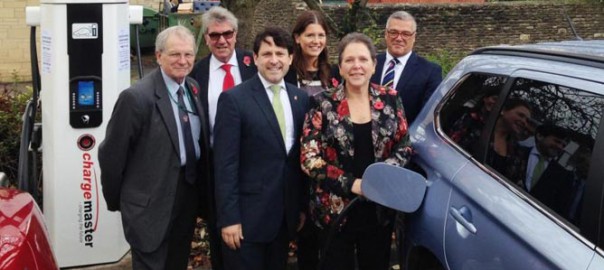
Triple Standard RAPID EV Charger For Wiltshire (Image: Chargemaster)

Triple Standard RAPID EV Charger For Wiltshire

The UK’s latest EV quick charging network, RAPID EV, installed by Chargemaster across six sites in Wiltshire, is now open for business.

UK’s Minister for Transport, Baroness Kramer, officially opened the network during a special event held Monday, November 3 2014.

The RAPID EV network has been set up by Wiltshire Council and partially funded by the UK government’s Office for Low Emission Vehicles.

The charging points, located in public parkings in Salisbury, Melksham, Warminster, Trowbridge, Corsham and Chippenham, are of the type that can charge an electric car to 80 percent of its capacity in a little over 20 minutes.

Chargemaster said each charging point is ‘triple-standard’ with three separate plugs to connect to the widest possible range of electric vehicles, including a DC 44 kilowatt CHAdeMO plug, a DC 44 kilowatt CCS Combi plug and an AC 43 kilowatt Type 2 plug.

Baroness Kramer mentioned in her speech all six RAPID EV charge points are free for EV drivers to use, with only normal parking charges applying at each of the sites.

“More and more people are switching to plug-in vehicles, with more than 5,000 sold in the last three months,” said Transport Minister Baroness Kramer. “We need the right infrastructure to keep building that momentum. Providing charge points like these means people can be confident that they can charge their car when they are out and about.”

All RAPID EV charging points are said to be linked to Chargemaster’s national POLAR network, with access via the POLAR charging card, as well as smartphone APP based access at www.polarinstant.com.

Source: Hybrid Cars

Mercedes’ first electric car goes on sale

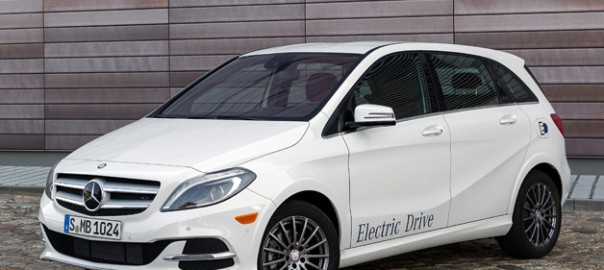
Mercedes-Benz has opened the order books for its first fully electric car in Germany; the new B-Class E-Cell.

Based on the combustion B-Class hatchback, the new E-Cell model is due to go on sale across Europe later this month.

But details have already emerged about price and specifications that customers in Germany can expect to enjoy, giving us a better idea of what to expect when the B-Class arrives here.

According to details emerging from Germany, the E-Cell will be available to lease from €399 a month (around £312 a month and based on a 3 year, 30,0000 kilometre contract hire agreement with a €8,473.31 deposit).

To buy the new model, costs from €39,151 (£30,621.61) – making around £8,000 more than an entry-level combustion B-Class, and therefore highly affordable once government grants are taken into account.

Strong performance

Fitted with a 132kW electric motor, offering max torque of 340Nm, the new B-Class will deliver on performance too, with a 0-62mph time of 7.9 seconds (almost as good as the best in the B-Class range, the B220 Sport 7G DCT 4MATIC, at 7.5 seconds).

There will also be a 124 mile range – comparable to that of the Nissan LEAF.

There is also a choice of three drive modes; Economy Plus, Economy and Sport.

With the lithium ion battery pack safely tucked under the floor, the B-Class offers impressive 501 litres of boot space and is offered in a choice of three trims; Style, Urban and the exclusive Electric Art.

Mercedes will also offer Range Plus as an option, which can extend the range of the E-Cell by around 18 miles. The driver simply presses the Range Plus button on the dash to extend the range. This option also include a heated windscreen, various insulation measures and heat-insulating, dark-tinted glass.

There is also an optional radar-based, regenerative braking system (€416.50) which uses data from Collision Prevention Assist Plus system to either increase or reduce to zero, as appropriate, the level of regeneration and therefore deceleration.

To protect pedestrians and cyclists, an acoustic vehicle alerting (€119) is also offered and generates a specific Mercedes-Benz sound up to a speed of 18mph.

The B-Class Electric Drive will come as standard with a charging cable for wallbox and public charging stations (faster charging, Mode 3) although a charging cable for a domestic socket will also be offered at no extra cost.

For an extra €297.50, customers can order a combination of a charging cable for a standard household socket (Mode 2) and a charging cable for wallbox and public charging stations (faster charging, Mode 3).

More details of a UK-bound B-Class E-Cell are due to be released in the coming weeks as order books are expected to be opened here too this month.

Source: Green Car Website

Leave the oil in the soil! Indigenous representatives from communities resisting oil extraction all over the world marched together at the front of the recent 400,000-strong New York climate march (Image: J. Pope/Bold Nebraska)

Ending the oil age

Big Oil’s days are numbered – but the industry could still take us all down with it. From divestment to disruption, Jess Worth explores how the transition to an oil-free future is being hastened.

Leave the oil in the soil! Indigenous representatives from communities resisting oil extraction all over the world marched together at the front of the recent 400,000-strong New York climate march (Image: J. Pope/Bold Nebraska)

In September 2014, the $860 million Rockefeller Foundation made an historic announcement. Timed to coincide with massive marches for climate action all over the world, the fund revealed it was going to divest from fossil fuels. Following in the footsteps of the World Council of Churches, the British Medical Association and Stanford University, the latest major institution to make such an announcement is also the most symbolic. Because the Rockefeller fortune owes its very existence to oil.

The Rockefeller story is also the story of the rise and fall of the first ‘oil major’. Standard Oil, founded by John D Rockefeller in 1870, soon came to control the burgeoning US oil industry, from extraction to refining to transportation to retail.

It built an unprecedented monopoly that ultimately became so publicly despised that the US government stepped in and broke it up – birthing Exxon, Mobil and Chevron, among others. But by then, Standard had already set the Western world on a path to oil dependence that we are still shackled to, chain-gang-style, today.

The forced break-up created the Rockefeller millions. A century later, those millions are being used to make a dramatic point: we are witnessing the beginning of the end of the oil age.

Read more: New Internationalist

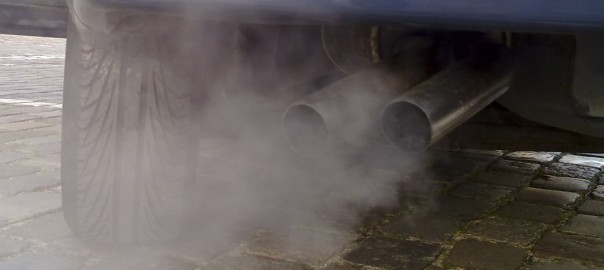
Car exhaust pollution (Image: Wikipedia)

Electric Cars: The Next Health Kick?

A 2013 MIT study concluded that in the United Kingdom more people suffer premature deaths from breathing in auto emissions than from auto accidents

Back in the 1980s, I interned at the EPA. An older employee told a story of a public hearing to illustrate how Americans are confused in their thinking about risk. The EPA was proposing a cleanup solution for a toxic waste dump which would reduce risk of premature death down to one in one million residents.
A local resident stood up and passionately argued that any risk was unacceptable, no matter the cost. “EPA has to reduce risk to zero,” she exclaimed to rousing applause.

Following the hearing, she went outside and lit up a cigarette – increasing her risk of premature death much greater than living next to this superfund site.

Americans are great at hating some risks and ignoring others.

One risk that we have collectively ignored is the health impact of automobile emissions.

Where there is combustion, there are bi-products which severely impact the human respiratory system. These emissions can cause coughing, lung irritation, lung cancer and cardiovascular disease. They can cause or contribute to premature death in the young, the elderly and individuals with respiratory issues, such as asthma, as well as cause pulmonary problems in developing fetuses.

Cars are a significant source of these pollutants. In a number of states, including my home state of New Jersey, car and truck emissions are the largest source of air pollution – greater than the power sector or industry. And in all states, pollution is elevated close to roads. The US EPA, asserts that the concentration of Nitrogen Oxide is 30 to 100 percent greater closer to highways.

So how dangerous are these emissions? Probably greater than you think.

A 2013 MIT study concluded that in the United Kingdom more people suffer premature deaths from breathing in auto emissions than from auto accidents. Closer to home, the California Air Resource Board estimates that more than 9000 California deaths a year are caused by air pollution from cars and trucks. And the American Lung Association and Environmental Defense Fund released a study in May that argues that a transition to electric cars in California would prevent 600 heart attacks and 38,000 asthma attacks annually in that state alone.

Read more: Energy Biz

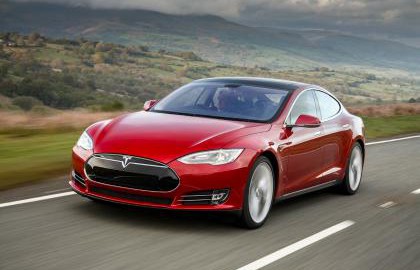
Tesla Model S (Image: AutoExpress)

Tesla announces new finance deals for Model S

Manufacturer promises to buy back Tesla Model S electric car for 50 per cent of original value

Tesla has revealed the new finance packages available to private buyers of the Model S. The company claims that the deals have been created from the ground up rather than as copies of plans offered by other manufacturers.

The financing will be offered through Tesla’s partner, Alphera Financial Services. The main news is that Tesla promises that the resale value guarantee, the price given to customers when their three-year agreement comes to an end, will be 50 per cent of the base purchase price of the 60 kWh Model S electric car.

Tesla claims that the new programme has no gimmicks, and offers customers the option to sell the car back to the company once the three years is over, or extend the hire purchase agreement for longer.

Buyers will have to put down a 15 per cent deposit initially, with the choice of a 48-, 60- or 72-month contract. With an interest of 5.9 per cent APR, monthly costs will be around £820 month. The agreement limits mileage to 15,000 miles per year, with owners charged 17p per mile if they go past this.

Georg Ell, Tesla’s UK Country Director, said:

“We understand that many customers enjoy the simplicity of a Hire Purchase but also may seek some assurance of the future value of Model S. We want to do the right thing for customers, so we’re delighted to be able to offer this transparent and fair financing programme.”

Source: Auto Express

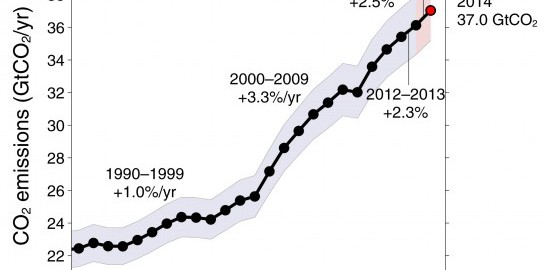
Carbon emissions are still going up (Image: ShrinkThatFootprint)

11 Charts that will help you understand climate change

Every year a disparate collection of 88 wonks from 68 organisation in 12 countries work tirelessly to produce the Global Carbon Budget.

I think of it as a high powered pictured book alternative for anyone who can’t stomach the IPCC’s summary for policy makers (or just wants the data).

Here are 11 of the most thought provoking charts from this year’s report:

1) Carbon emissions are still going up

Carbon emissions are still going up (Image: ShrinkThatFootprint)

Another 2.3% in 2013 with projections that it will rise a further 2.5% in 2014.

2) Coal is the major source of growth

Coal is the major source of emissions growth (Image: ShrinkThatFootprint)

Coal was responsible for 59% of emissions growth in 2013, oil was 18%, gas 10%, and cement 12%.

Read more: Shrink That Footprint

UK electric car sales surge in 2014

Industry figures show sales growth outpacing diesel and petrol equivalents, although volumes remain small

Electric cars, hybrids and other alternatively-fuelled vehicles (AFVs) are increasingly grabbing market share from traditional petrol and diesel models, new industry figures reveal.

The latest statistics from the Society of Motor Manufacturers and Traders (SMMT) show 9,955 AFVs were registered in September, a 56% rise on the same time last year.

This accounted for 2.3% of the total market – a 44% year on year rise – in a month that saw a 5.6% rise in overall registrations compared to September 2013. Diesel and petrol vehicles saw registrations grow just under 6% and 4% respectively, but diesel’s market share remained static, while petrol fell one percentage point as a result of the growth in registrations.

According to the SMMT, 37,842 AFVs have been sold during 2014, a more than 50% increase on the same point a year ago, while market share has also grown from 1.4% in 2013 to 1.9% this year.

UK October 2014 Electric Car Sales (Image: SMMT/BusinessGreen)

An SMMT spokesman told BusinessGreen the AFV market is seeing the benefit of more models coming onto the market – there are now more than 20 plug-in vehicles available compared to six in 2011 ranging from hatchbacks and saloons to SUVs and sports cars – while consumers are increasingly aware of the advantages of zero emissions driving. He added:

“We do expect this trend to continue in the future as a number of models increases. Infrastructure is being well-supported by government at the moment, and as long as that continues there’s no reason why the market for plug-in vehicles shouldn’t grow even more in the coming months and years.”

Read more: Guardian

Tesla Model S taxi in Amsterdam (Image: Taxi Electric)

Tesla’s Model S gets new taxi role in Amsterdam

At around £50,000, a Tesla Model S is a desireable car, but hardly the sort of vehicle to bring electric driving to the masses.

As a result there are probably hundreds if not thousands of wannabe Telsa owners in the country.

But one company is giving commuters to get a chance to experience the Model S by running it as a taxi.

The Netherland’s Taxi Electric firm offers the Model S as part of its Amsterdam fleet of electric vehicles, which until now has consisted just of Nissan LEAF cars.

One of Europe’s leading markets for electric vehicles, the Model S will be right at home in Amsterdam with its new Nissan brothers; even if it is rather an unusual mini-cab.

Hiring the Model S should be easy as Taxi Electric has also just signed a deal with Cabforce – a European-wide advanced-booking service for taxis and minibuses, which helps makes it easy to book and pay for cabs while abroad.

As part of an environmentally-friendly initiative, all of the Cabforce / Taxi Electric green transport options are now flagged up under the new Cabforce Green branding.

Tommi Holmgren, co-founder of Cabforce, says:

“Our transport solutions might be green, but we’re certainly not ‘green’! We’ve got a lot of experience in this industry and we know what business travellers want – efficient, professional service with a touch of class to ensure their pre-booked journeys are always hassle free”.

Read more: Green Car Website, InsideEVs