We have written at length about the new Electric Vehicle Experience Centre (EVEC) that has just been opened in Milton Keynes by Chargemaster. It provides help and advice on electric cars, and provides the opportunity to test drive a range of vehicles.
In association with the EVEC, the AA has launched an electric car driving course. In an AA-Populus Survey of 16,000 drivers, one third said they want to start learning to drive again – but in an electric car.
AA Driving School and Drive Tech trainers have developed the Drive Electric experience in conjunction with Chargemaster. It provides a free one-hour electric driving lesson and it is aimed at showing people how to get the best out of an electric car.
It may eventually go nationwide but is being trialled initially in the Milton Keynes area. More information is available here: AA Trust Launches Drive Electric.
In addition to the generous incentives the UK Government provides for electric cars, there are additional incentives in Scotland. Primarily these are a loan towards purchasing an electric car and a grant towards the cost of a charge point.
Scotland hosts first electric car rally – Stirling to Glasgow
Electric Vehicle Loan
The interest-free Electric Vehicle Loan, funded by Transport Scotland (an agency of the Scottish Government), currently offers drivers in Scotland loans of:
up to £35,000 to cover the cost of purchasing a new pure electric / plug-in hybrid vehicle
up to £10,000 to cover the cost of purchasing a new electric motorcycle or scooter
The loan has a repayment term of up to six years. The purchased electric vehicle, motorcycle or scooter should be the only plug-in vehicle owned by the applicant and must be eligible for the ‘plug-in car, motorcycle and van grants’ funded by the Office for Low Emission Vehicles (OLEV). Second hand vehicles are not eligible.
With the exception of an initial deposit, applicants must not have made any other payment towards the purchase of the vehicle before receiving a loan offer under this programme as funding is not provided retrospectively.
The program is administered by the Energy Saving Trust, and expires at the end of March 2018. For more details see Electric Vehicle Loan.
Home Charge Point Funding
Energy Saving Trust can provide £500 funding towards the cost of a 32 amp home charge point installation. This is on top of the £500 provided by the Office for Low Emission Vehicles (OLEV).
The typical cost for a home charge point and installation is approximately £1000. As part of its Electric Vehicle Homecharge scheme, OLEV currently offers applicants £500 towards this cost. EST will provide up to £500 further funding on top of this. For the cost covered by OLEV you will not need to make any payment to your supplier, as they will receive this money from OLEV directly. For the costs above what OLEV cover, you will have to pay your supplier and the Energy Saving Trust will then provide you with your (up to £500) reimbursement. Any remaining costs above the £500 provided by OLEV and the £500 provided by the Energy Saving Trust you would need to pay for yourself.
Milton Keynes isn’t just the best place in the world for electric car charging, it also has a remarkably friendly parking policy for electric cars. This allows for free parking with a parking permit, and also at designated charge points without a permit.
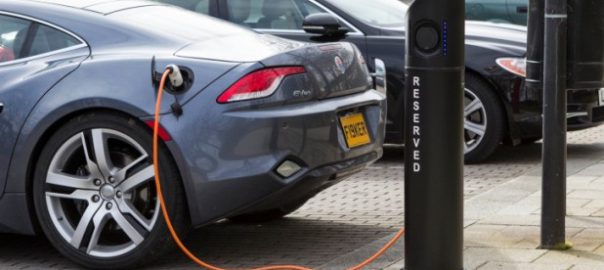
Electric cars in charge point bays – there is no ‘RESERVED’ marking so they do not need to be plugged in
Parking Permit
The bulk of parking spaces around Central Milton Keynes are Standard Tariff (so-called ‘purple’) bays – and electric cars can park in these spaces for free with a Green Parking Permit (GPP). There are an impressive 15,000 of these parking spaces in CMK. Applications for the GPP are made through the Milton Keynes Council website.
Purple bays are arranged around the outside of most of the Milton Keynes blocks, with the exception of the main shopping centre blocks which are Premium Tariff (‘red’).
In addition, the GPP allows for free parking in Off Street Standard Tariff Car Parks (there is one of these off Avebury Boulevard) and in Premium Tariff and Peak Permit Parking (‘black/red stripes’). These latter are typically at the ends of blocks close to the shopping areas.
The Council provides a handy Milton Keynes Parking Map (PDF) with a colour key which indicates the different tariff locations.
Charge Point Parking
Furthermore, electric cars can park at charging points for free, independent of any Permit, even though many of these locations are actually in the expensive Premium areas. It can therefore become a little complicated determining the exact restrictions that apply. The Council website states:
All rapid chargers (currently available for 2 hours only) and electric vehicle spaces with ‘Electric Vehicle Charging Only‘ marked on the signage, can only be used by electric vehicles that are plugged in and charging. Electric vehicle motorists do not need to pay to park if parking in these spaces whilst they are plugged in and charging.
We also operate dual restriction bays which are reserved for electric vehicles only during 7am – 10am and 4pm – 6pm. During the core hours of 10am – 4pm any vehicle can use the spaces, subject to the surrounding parking restriction. Electric vehicles do not have to pay to park in these bays.
A ‘RESERVED’ charge point in CMK – the car must be plugged in (Image: One MK)
A simpler way to understand this, as it was explained to me by a council official, is that there are no restrictions on an electric vehicle parking in a charge point bay for free, except that if the charge point has “RESERVED” painted down its side then the EV must be plugged in.
Milton Keynes Station Parking
Milton Keynes is a major commuter town with many people driving to MK Station to take the train to London. The parking at the station is not included in the Council scheme. However, it also provides free parking for electric cars under a scheme provided by London Midland, the operators of the rail line (this scheme also covers other stations along the line). I have detailed this scheme previously: Free Electric Car Parking at Milton Keynes Station.
Milton Keynes has probably the greatest concentration of electric car charging points of any location in the world. This arguably makes it the best candidate destination city for electric car drivers anywhere in the world.
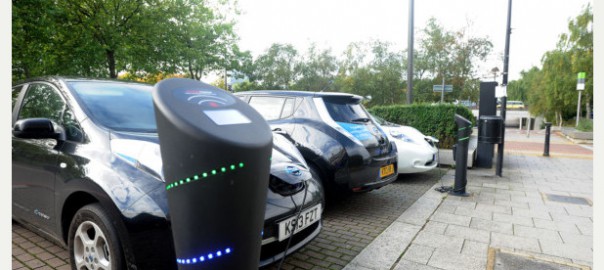
Electric cars charging in Milton Keynes (Image: T. Larkum)
Of course, those are difficult statements to confirm since there aren’t international league tables of such things. However, a look at international charge point maps like Plugshare certainly seems to indicate that it has as many standard power charge points (some 170) as other candidate ‘hot spots’ such as Los Angeles in the US and Oslo in Norway. If you look further into the density of high power rapid chargers (56) it appears to win hands down against all comers.
Charge Point Locations
More to the point, however, is that charge point locations are very well organised in Milton Keynes. While in other cities the growth and placement of charge points appears to be organic, i.e. nearly random, they are well placed in MK. Specifically the city centre is arranged in blocks on a grid (in the American style) and charge points are placed along at least one and usually both of the long sides of each block. One block can have as many as a dozen standard speed chargers.
The rapid chargers are arranged more strategically. In the city centre there is one rapid to every one or two blocks. Outside the centre, in the suburbs, there is one to every second or third housing estate.
Rapid Chargers next to Milton Keynes Central railway station (Image: T. Larkum)
The result of having so many charge points in Milton Keynes is that anyone can visit the city in an electric car and be confident of finding somewhere to charge for the return journey. With a typical EV range of 80 miles this means that MK can welcome visitors from as far afield as Southampton in the south, Gloucester in the west and Nottingham in the north – they won’t have to charge on the way in or back home.
Chargemaster / Polar Network
The charge points in MK are part of the Polar network operated by Chargemaster. Therefore to make use of them it’s necessary to use a Polar app or swipe card, either on subscription (Polar Network) or Pay As You Go (Polar Instant).
With that arranged, it is possible to find a charge point near almost anywhere in the city centre. Their locations can be seen on the council’s charge point map (PDF) and on the online Polar Live map.
This makes MK the perfect place for EV owners, whether visiting occasionally for shopping or commuting in daily for work.
There are many incentives available to encourage drivers to move from polluting petrol and diesel cars to electric cars. They come from national and local government, car manufacturers, suppliers and independent organisations.
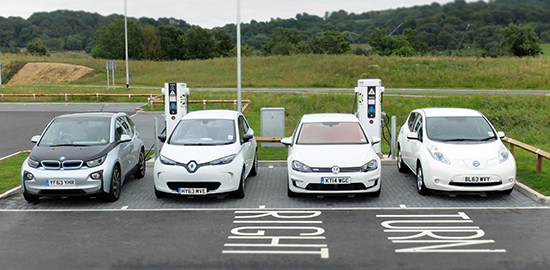
Electric Car Line-up (Image: Go Ultra Low)
Here we provide a brief summary of the main incentives currently provided to electric car drivers by the national government.
UK Government
Plug-in Grants
The UK government provides a grant off the cost of a new electric car as follows:
£4500 off cars with ‘CO2 emissions of less than 50g/km and can travel at least 112km (70 miles) without any CO2 emissions at all’. Examples include the Nissan Leaf, Renault ZOE, BMW i3 and Hyundai IONIQ Electric.
£8000 off vans with ‘CO2 emissions of less than 75g/km and can travel at least 16km (10 miles) without any CO2 emissions at all’. Examples include the Mitsubishi Outlander Commercial, Nissan e-NV200 and Renault Kangoo ZE.
Note that the grants are capped at 35% of the purchase price for cars and 20% for vans. Plugin Hybrids (PHEVs) with a retail price above £60,000 are not eligible (including the BMW i8 and Porsche Panamera).
There are three grant schemes available to help fund the cost of installing charge points:
The Electric Vehicle Homecharge Scheme (EVHS) provides grant funding of up to 75% towards the cost of installing electric vehicle chargepoints at domestic properties across the UK.
The Workplace Charging Scheme (WCS) is a voucher-based scheme that provides support towards the up-front costs of the purchase and installation of electric vehicle charge-points, for eligible businesses, charities and public sector organisations.
The On-street Residential Chargepoint Scheme (ORCS) provides grant funding for local authorities towards the cost of installing on-street residential chargepoints for plug-in electric vehicles.
The Homecharge Scheme is the one that’s relevant for most electric car owners. Essentially it means that you can get a charge point installed at home for a few hundred pounds rather than at the full price of nearer £1000. For more details see Government Grant for Electric Car Home Charge Point.
Vehicle Excise Duty (‘Road Tax’)
Vehicle Excise Duty (VED), also known colloquially as ‘road tax’, is a tax levied by the government on every vehicle on British public roads, and collected by the Driver and Vehicle Licensing Agency (DVLA). Major changes have been introduced for vehicles registered after 1st April 2017.
The current situation can be summarised as follows:
All-electric cars are exempt from VED (they pay at a rate of £0 per year) if they have a list price of less than £40,000.
Conventional cars and plugin hybrids are charged in the first year at a rate that depends on their emissions. Plugin hybrids are charged £10 less than conventional cars.
Thereafter conventional cars are charged £140 per year while plugin hybrids are charged £130 per year.
All vehicles with a list price of more than £40,000 pay an additional £310 per year for 5 years from the second year. For electric cars this mostly affects the Tesla Model S and Model X, but could impact high end versions of the BMW i3 and Mitsubishi Outlander, for example.
Tesla Model S – tax is boring but electric cars are not (Image: T. Larkum)
Company Car Tax (‘Benefit in Kind’)
If you have use of a car for personal transport, and that car has been supplied by your employer, it will be considered a taxable perk by HMRC – a ‘benefit in kind’ (BIK). The Benefit-in-Kind (BIK) is then taxed at your appropriate personal tax rate (usually collected through PAYE).
Petrol and diesel BIK rates depend on the car’s CO2 emissions, and there is a large matrix of rates covering different emission categories up until the scheme changes again in 2020. In summary:
Petrol cars are in the range 13% (technically 9% but see below) for low emissions to 37% for high emissions in 2017 (but starting at 16% in 2018 and 19% in 2019).
Diesel cars are in the range 20% to 37% in 2017 (but starting at 22% in 2018 and 25% in 2019).
All-electric cars are at 9% in 2017 (13% in 2018 and 16% in 2020)
From this we can see that all-electric cars are effectively taxed the same as a very low emission petrol car. However, in practice there are no conventional petrol cars that have such low emissions – they are all plugin hybrids – so in effect all-electrics and most PHEVs are taxed at the same rate of 9%, and the smallest petrol car and biggest PHEVs (e.g. Mercedes C350e) will start at 13%. A typical petrol car like a Ford Focus will be taxed at something more like 30%.
Note that proposed tax changes for 2020-21 are generally even more favourable for EVs, with the BIK being determined by the electric range. It could be as low as 2% for EVs with a range greater than 130 miles (and 5% for a range greater than 70 miles).
Of course, tax is always a complex issue and you should take advice on your personal situation.
Update: We’ve added a blog post about capital allowances for businesses here.
If you want to charge your car away from home, and can’t get by with a 13 Amp ‘granny cable’, then you will need to join one or more of the national charging networks. That gives you access to the public charging points available around town centres and on the motorway and trunk road systems.
There are a number of sites where you can look up charging points, including:
In an occasional series I will cover the biggest networks: Electric Highway, Polar Network, POD Point and so on. Here we begin with the Electric Highway, created by Ecotricity and now owned and operated by Gridserve.
“Our low-cost, rapid and high power charging infrastructure is reaching every corner of the UK, covering 85% of the UK’s motorway network.
We provide rapid and high powered charging at some of the lowest rates in the UK. Our next generation chargers are supported by renewable energy from our solar farms.”
My BMW i3 on charge on an Ecotricity DBT rapid charger at Corley Services (Image: T. Larkum)
Our View
If you join just one network it probably has to be the Electric Highway (EH) as they have a virtual monopoly on charging at motorway service areas (the exception being Tesla with their Superchargers). The good news is that the majority of services now have at least one rapid charger, an increasing number have two and some have even more. So for long distance driving with your electric car you can pretty much get around most of England by charging at motorway services. Coverage outside England (in Scotland and Northern Ireland, and particularly in Wales) is however poor.
The reliability of Ecotricity charge points has historically been quite poor, but this has started to improve since the takeover by Gridserve.
Curiously, apart from at motorway services the majority of EH rapid chargers are in the car parks of IKEA superstores (due to a partnership deal between them – see IKEA Electric Vehicle Charging).
The majority of EH rapid chargers were large white units manufactured by DBT-CEV. These provide DC charging at 50kW for CCS (BMW i3 etc.) and Chademo (e.g. Nissan Leaf and Mitsubishi Outlander) connectors, and AC charging at 43kW (Renault ZOE). Typically the first ones installed were ‘single headed’ with just Chademo cables for the Leaf. Later they were ‘double headed’ with the addition of a Type 2 cable for the ZOE. Current installs are ‘triple headed’ with the addition of a CCS cable for the i3 and Hyundai IONIQ.
My Renault ZOE charging at an Ecotricity 22kW medium-fast charger (Image: T. Larkum)
Note that most EVs with a Type 2 connector (not the Leaf or Outlander) can be charged with any rapid through the Type 2 cable but only the ZOE can use it at full power (43kW or 22kW). Some can use it at reduced power (e.g. the i3 can use 11kW) but most will drop down to 7kW, like charging at home. You should use the CCS or Chademo connector for rapid charging, and only use the Type 2 if these aren’t working (it will be much slower).
Before using DBT rapids Ecotricity installed a small number of ‘medium’ chargers providing 22kW. Some of these are still in place and can be seen alongside the DBT ones; again, you should make sure that you understand which charger and cable/connector is most appropriate for your circumstances.
Volkswagen e-Up charging outside the Experience Centre (Image: T. Larkum)
The biggest manufacturers of all-electric cars sold in Europe are Nissan with their Leaf in 1st place in terms of sales (and e-NV200 van in 5th), Tesla with their Model S in 2nd place, and Renault with their ZOE in 3rd place. These manufacturers are, of course, Japanese, American and French respectively. What is interesting is that there is only one German entrant in the top 5, BMW with their i3 at 4th place, despite the fact that German manufacturers dominate the European market for fossil-fuelled cars.
Volkswagen Passat GTE (Image: T. Larkum)
The Germans do make electric cars – Mercedes has the B Class Electric and Volkswagen has the e-Golf and e-Up – but they appear to make no effort to market them. Historically they have also had lacklustre range and high prices. The bottom line is that they haven’t sold in significant numbers.
Volkswagen Passat GTE (Image: T. Larkum)
German Plugin Hybrids (PHEVs)
Instead it seems that German manufacturers have decided that the plugin hybrid (PHEV) combining an electric drivetrain with a conventional petrol engine is what people want. Or at least they see it as an intermediate step towards full electrification. Considering PHEVs, the top 10 sales now include Mercedes with the C350e in 2nd place (after the Mitsubishi Outlander), the BMW 330e in 4th place and the Volkswagen Golf GTE at 6th place.
Volkswagen Passat GTE (Image: T. Larkum)
In fact, Volkswagen has arguably embraced PHEVs more than any other manufacture. They currently offer both of their two biggest selling cars, the Passat and the Golf, in PHEV form as the ‘GTE’. Both of them offer the ability to commute (up to about 20 miles) on electricity with the option of using petrol for longer distances – they also have pretty good 0-60 times too.
Volkswagen Golf GTE (Image: T. Larkum)
VW on the Rise
With these cars in the vanguard, and with the e-Up and newly improved e-Golf to come, Volkswagen may soon make significant inroads into plugin sales in the UK.
Volkswagen Golf GTE (Image: T. Larkum)
These were some of the thoughts that came to me looking at the row of EVs charging outside the Milton Keynes Electric Vehicle Experience Centre (EVEC). Of the eight cars, three were from Volkswagen (so nearly 40%). We ourselves are looking to start offering VW plugins soon, and I’m sure we’ll see VW as an EV brand on the rise from here on.
Volkswagen Golf GTE (Image: T. Larkum)
As ever, if you want to test drive any of the cars mentioned here just get in touch.
The Government has just announced that Britain is to ban sale of all diesel and petrol cars and vans from 2040. The writing is on the wall, with some sources saying that most cars sold will be electric as soon as 2025. If you want to learn about what’s coming, and how owning an electric car is going to affect you, then this guide is for you.
I have been driving an electric car for four years; first a Renault ZOE (48,000 miles) and now a BMW i3. Through my blog sites at Fuel Included and My Renault ZOE I have answered tons of questions about home charging. I decided it was about time to put all the answers together in one place, in a downloadable eBook.
Click on the image, enter your name and email, and download your free guide.
If it leaves any questions unanswered, just get in touch (contact details here and in the eBook).
I saw my first autonomous electric pod in Milton Keynes today while taking a lunchtime walk.
Although I’ve followed the development of the Lutz Pathfinder for a few years, this was the first time I’ve seen one ‘in the flesh’. It appeared to be undergoing testing on undeveloped land on the eastern side of the city centre.
Unfortunately what’s not clear in the picture is that it’s stationary. Someone is hunched down on the far side with a laptop.
There weren’t cars only on display inside the Electric Vehicle Experience Centre (EVEC) at the launch. There were also a large number charging up outside, presumably getting ready for test drives for the public for the opening the next day.
Electric cars ready for free test drives in Milton Keynes (Image: T. Larkum)
The large numbers and broad range of EVs available was impressive.
How about a quick quiz: can you identify them all? The answers are given below.
Electric cars ready for free test drives in Milton Keynes (Image: T. Larkum)
Of course, whether you own an EV or are considering your first, you’re welcome to test drive any of the vehicles on show for free. Just get in touch and we’ll help arrange it.
Answers to the Quiz: these are the electric cars waiting to give test drives (from nearest the camera to furthest away):