All posts by Repost

foxaon / 123RF Stock Photo

Electric vehicle sales expected to grow 50% in 2021

Global electric-vehicle sales will grow 50% or more next year, while sales of internal combustion engine vehicles are expected to grow 2% to 5%.

That’s the view of analysts at Morgan Stanley, who in a note to clients on Friday also predicted that global EV penetration would top 4%, rising to 31% by 2030.

The year 2021 “is shaping up to be a critical year for EV adoption and (internal combustion engine) de-adoption that will dictate the pace of multiple expansion, contraction, consolidation and proliferation” among the stocks, Morgan Stanley analyst Adam Jonas said in the note.

Investor interest in electric-vehicle and adjacent stocks continued unabated this week, as exemplified by Tesla Inc. TSLA, +5.96% closing the books on $5 billion worth of shares in just one day.

foxaon / 123RF Stock Photo

In other news this week:

Analysts at Morgan Stanley estimated that Tesla has a $20 billion “war chest” to fund expansion plans in 2021, which include two factories going up in Germany and in Texas and new vehicles such as the Cybertruck, its pickup truck.
Tesla Chief Executive Elon Musk made waves this week. Speaking at The Wall Street Journal’s CEO Council annual event, Musk confirmed he has moved to Texas, where his company is building a factory. He took jabs at California and Silicon Valley, which influence in the world he called “too much.”
Nio Inc. late Thursday announced that it plans to sell at least 60 million American depositary shares, with an additional 9 million shares available to underwriters. Nio stock dropped more than 4% in after-hours trading following the announcement, and on Friday dropped nearly 7%.

Nio ADRs have gained nearly 950% this year, compared with gains of around 13% for the S&P 500 index. SPX, -0.35%

Nio’s and Tesla’s moves followed XPeng Inc., which said Monday it planned to sell 40 million ADRs. Li Auto Inc. announced last week its own plan to sell 47 million new ADRs. Both stocks struggled in the wake of those announcements.
Despite the momentary dips amid stock offerings, EV stocks are enjoying a 2020 stock surge that is more widespread than Nio’s jaw-dropping 2020 gains. Tesla is up 625% this year, while XPeng is up more than 111% and Li Auto around 100%.

Electric vehicle company Electric Last Mile Inc. has agreed to go public via a merger with a blank-check company, or special purpose acquisition corporation, Forum Merger III Corp. FIII, +2.73%
The deal would value Last Mile at about $1.4 billion, and once it closes, likely in the first quarter, the combined company will be renamed Electric Last Mile Solutions Inc. and trade on Nasdaq under the ticker “ELMS.” The company plans to launch electric delivery vans later in 2021.

Read more: MarketWatch

It’s Time to Go Green!

If you would like to know more about Solar Panels and the PowerBanx range of home battery systems, and get a free instant quote, please complete our online form:

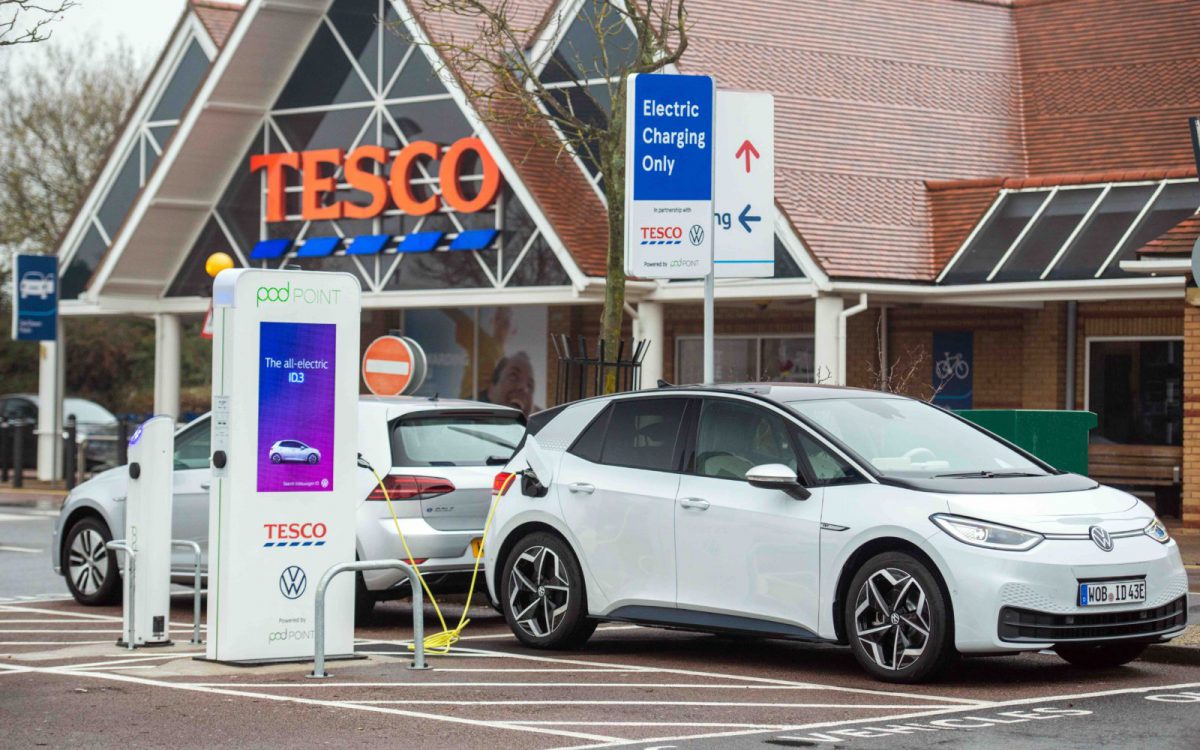
POD Point Rollout at Tesco Stores (Image: Tesco/POD Point)

EDF launches its cheapest EV tariff under GoElectric umbrella

EDF has launched its cheapest electric vehicle (EV) tariff to date to help make it easier and cheaper for drivers to switch.

The zero carbon GoElectric 35 tariff offers an off-peak rate of 4.5p/Kwh, which EDF is claiming to be the cheapest on the market. For this tariff, off peak is classified as 12am-5am daily. At this rate, it would allow customers to fully charge a standard 40kW Nissan Leaf for £1.80.

The GoElectric single rate is also available, offering a fixed price, as well as the GoElectric 98 tariff which offers 98 hours of off-peak electricity per week at 9p/kWh, which EDF said is ideally suited for high consumption households or high mileage drivers with bigger batteries that need to be recharged for longer. For this tariff, off peak is classified as all weekend and 9pm-7am on weekdays.

POD Point Rollout at Tesco Stores (Image: Tesco/POD Point)

Drivers also have the option to lease an EV through EDF from £170 a month for a Skoda CITIGOe iV, or buy an EV smart home charger. Earlier this year the supplier acquired EV charging firm Pod Point and in 2019 acquired battery storage and EV charging firm Pivot Power.

It also powers ubitricity’s EV charging network with 100% renewable energy, and in September was awarded a contract with the Crown Commercial Service to help accelerate the electrification of public sector fleets.

It isn’t the only supplier to launch an EV tariff, with others on offer including ScottishPower’s SmartGreen EV tariff and the 1 Year Fix and Drive tariff offering up to 2,000kWh of electricity free per year if charging overnight launched by SSE Energy Services before it was acquired by OVO.

Read more: CURRENT

It’s Time to Go Green!

If you would like to know more about Solar Panels and the PowerBanx range of home battery systems, and get a free instant quote, please complete our online form:

Dacia Spring 2021 (Image: Dacia.co.uk)

Even The World’s Oil Giants Are Getting Ahead Of The Electric Vehicle Curve

In a virtual press conference recently, Dan Yergin, energy guru and vice-chair of IHS Markit recounted the stunned surprise that a Middle Eastern oil executive had recently shared with him upon traveling to California and seeing the plethora of Teslas on the road.

It was a foretelling sign, he said, one that spoke volumes not just about oil’s future but also about climate security. Could EV’s really displace demand for all that petroleum this executive was trying to sell?

Indeed, even the most oil-leveraged countries are now coming to terms with such future shock. “We are seeing the impact of climate change with the various extreme events: the Australian fires, the cyclones and the droughts,” says Dr. Thani Ahmed Al Zeyoudi, Minister of the Ministry of Climate Change and the Environment for the United Arab Emirates, in an earlier interview with this reporter. “We can no longer pass this to future generations to deal with.”

Dacia Spring 2021 (Image: Dacia.co.uk)

The UAE, which just discovered 22 billion barrels of unconventional oil reserves, says that it is planning on a world with no oil — that it is investing in green energy projects domestically and in new technologies all over the world. The country is home to several solar plants, hosting one of the world’s largest: the Noor Abu Dhabi. It generates more than 1,100 megawatts of power.

Yes, “peak oil” and climate change are interrelated. Enter electric vehicles, which according to Bloomberg New Energy Finance will gain speed: it says that EVs are now 10% of the global passenger market. But that number will grow to 28% in 2030 and 40% in 2040. Why? National policies will favor decarbonization while the cost of batteries that power the cars will keep falling. The cost of EVs and cars with an internal combustion engine will even out in the mid-2020s, it says.

And China and Europe are where the growth will occur: 72% of all such cars by 2030. That’s because their governments are taking bold action to curb CO2 and to get folks to decarbonize their transportation. The United States, it adds, will fall a bit behind but it will catch up by 2030. UAE’s Abu Dhabi National Oil Company proudly proclaims that the country has to be ready to celebrate the sale of its last barrel of oil. Right now, renewables make up 10% of its generation portfolio.

Read more: Forbes

It’s Time to Go Green!

If you would like to know more about Solar Panels and the PowerBanx range of home battery systems, and get a free instant quote, please complete our online form:

Citroen e-C4 (Image: citroen.co.uk)

Citroen e-C4 electric review

Citroen’s first proper go at an electric family car has been successful, offering good all-round ability with a unique character

Pros
Very comfortable and refined
Practical family transport
Great charging capability

Cons
Soft chassis can feel a bit loose
Some rivals offer a longer range
Light steering doesn’t inspire confidence

PSA – the parent firm of Peugeot, Vauxhall, DS and Citroen – is on something of an electrification mission, with lots of new electric cars popping up from each of its brands. However, while its sister brands have had electric cars on sale for over 12 months, Citroen is only just launching its electric effort – the e-C4. It shares much of its DNA with the Peugeot e-2008 and DS 3 Crossback E-TENSE, yet retains a character all of its own.

While in the metal the C4 has a very distinct crossover vibe, the French manufacturer labels this as a family hatchback rather than an SUV. Forget the protective cladding and slightly raised ride height – Citroen’s latest electric car has been developed to take on the Nissan Leaf and Volkswagen ID.3.

Citroen has set the e-C4 apart from its Peugeot and DS siblings in appearance, but underneath it uses the same 50kWh battery and 134bhp electric motor as those cars. The result is a 0-62mph time of 9.7 seconds, a 93mph top speed and a 217-mile range on a charge.

Citroen e-C4 (Image: citroen.co.uk)

The Citroen e-C4 also benefits from the same 100kW charging technology as its stablemates, which allows for a 80% rapid charge in just 30 minutes. Topping up at home from a 7kW wallbox overnight takes around seven and a half hours.

Citroen is keen for the e-C4 to be a viable family-car option, so particular attention has been paid to its interior and to practicality. In the e-C4’s cabin, quality is very good and a distinct step up from Citroens of old; standard digital dials and large touchscreen give a high-tech feel, while clever practical touches like hidden storage ahead of the gearlever and a tablet holder on the passenger side make it adept at dealing with family life. The boot measures in at 380 litres – just five litres off the Volkswagen ID.3’s – and there’s decent room in the back seats despite the sloping roof.

The car’s unique approach is also apparent once you’re on the road. Citroen’s ‘Progressive Hydraulic Cushions’ suspension is standard across the range, so the e-C4 sticks to the brand’s traditional comfort-orientated approach as it ably takes the edge off any nasty lumps and bumps in the road. It’s not perfect, however; the system can feel slow to react at lower speeds, while faster changes of direction often cause the car to feel loose or a little unwieldy.

The e-C4’s light steering helps with parking, but we’d prefer a little more weight for extra confidence at higher speeds. It’s less of an issue on the motorway, where the e-C4 really excels on refinement and comfort. Performance from the e-C4’s electric motor is adequate: punchy but without making you feel queasy with every prod of the accelerator. A dedicated ‘B’ mode ramps up the regenerative braking to good effect.

Read more: Driving Electric

It’s Time to Go Green!

If you would like to know more about Solar Panels and the PowerBanx range of home battery systems, and get a free instant quote, please complete our online form:

2020 Renault Zoe (Image: Renault)

Electric car sales soar and diesels plummet in boost for Boris Johnson’s green roads plan

Sales of electric vehicles have more than doubled in the last year while diesel purchases have plummeted by over half.

Analysis of official industry figures show 86,291 pure electric cars have been registered so far this year, up from 37,850 during 2019. Diesel sales dropped 58 per cent from 583,488 in 2019 to 246,389 this year.

In another dramatic change, sales of plug-in hybrid vehicles eclipsed diesels for the first time last month. In November, 18,062 plug-ins were sold compared to 15,925 diesels, according to the RAC’s analysis of figures from the Society of Motor Manufacturers and Traders.

The figures are a boost for the Prime Minister’s plan to ban sales of new petrol and diesel cars from 2030 and of plug-in hybrids from 2035.

But electric vehicles still account for just 0.3 per cent of the cars on Britain’s roads.

2020 Renault Zoe (Image: Renault)

Sales website Auto Trader warns demand is five years behind what is needed for a 2030 ban to succeed with buyers put off by upfront costs and a lack of street charge points.

High upfront costs and a lack of chargers on residential roads have been blamed for stagnating demand, with EVs still considered an unnecessary luxury by many households.

The bosses of BMW and Honda Europe are among senior industry leaders who have criticised the 2030 ban as poorly thought-through.

Buyers are being put off by concerns over EV range and a lack of on-street charge points.

A third of households in Britain have no off-street parking, meaning a large proportion of the population has no easy access to a charger.

Buyers have also been put off by costs. Entry-level EVs are around £5,000 more expensive than equivalent petrol models, even with the Government’s £3,000 plug-in car grant taken into account.

However, the RAC said the latest EV sales figures are encouraging.

Read more: Daily Mail

It’s Time to Go Green!

If you would like to know more about Solar Panels and the PowerBanx range of home battery systems, and get a free instant quote, please complete our online form:

Charging Station in Sunderland (Image: Fastned)

Britain’s first electric car forecourt opens TODAY: First of 100 new ‘future-proof’ stations has been completed in Essex with 36 vehicle chargers

Britain’s first charging station dedicated to electric cars has opened to customers today.

Gridseve’s pioneering Electric Forecourt is located near Braintree, Essex, and is the first of 100 sites to be built across the country in the next five years as part of a £1billion nationwide programme.

The one-stop-shop for electric car owners features 36 EV chargers and a services building featuring ‘best of British’ retailers, including WH Smiths and the Post Office.

The aim is to provide a reliable and comprehensive network of charging stations to supply the growing number of electric vehicle drivers.

With Boris Johnson rubber-stamping a ban for the sale of new petrol and diesel cars in 2030, already surging demand for EVs is set to sky-rocket in the next decade and beyond.

However, among the major concerns with electric vehicle ownership is range anxiety and the lack of charging infrastructure.

Grideserve says it will ease that burden with the proposal of building over 100 of these sites across Britain in the next five years.

Speaking at the grand opening of the Braintree site, Toddington Harper, founder and chief executive of Gridserve – and who also claims to be named after Toddington Services in Bedfordshire – said: ‘Today’s announcement represents a major milestone in achieving Gridserve’s purpose to deliver sustainable energy and move the needle on climate change.

Charging Station in Sunderland (Image: Fastned)

‘It’s our collective responsibility to prevent greenhouse gas emissions rising further, and electric vehicles powered by clean energy represent a large part of the solution.’

At the groundbreaking location – which is adjacent to Great Notley, just off the A131 and with links to Stansted Airport, Chelmsford, Colchester and the busy M11 motorway – is 36 charging devices in total.

They range from 7 kilowatt-hour (kWh) devices to 22kWh chargers suitable for the likes of the Renault Zoe and there are also six Tesla Superchargers.

In addition, there are 90kW rapid chargers and even 350kW devices.

The only vehicle capable of accepting charge from the latter system is the Porsche Taycan electric sports car, but Gridserve says the inclusion of the devices will ‘future-proof’ the site.

The powerful devices should replenish the batteries of the latest plug-in models in between 20 and 30 minutes – in which time drivers can head into a state-of-the-art building with shops including a Costa Coffee, WH Smith and Booths high-end supermarket.

The facility also includes a waiting lounge, free superfast WiFi, high-end washrooms, dedicated kid’s area, a well-being zone with exercise bikes that generate electricity, and business meeting room pods.

It will also be used as an educational centre for electric vehicles, with a number of models on site for visitors to poke around.

Drivers can pay for electricity at the forecourt using their debit or credit card. The initial cost will be 24p per kWh of charging, which is currently the lowest ultra-high power charging rate on the market.

It means a typical charge from 20 per cent battery capacity to 80 per cent costs under £10 for the average electric vehicle.

Read more: This Is Money

It’s Time to Go Green!

If you would like to know more about Solar Panels and the PowerBanx range of home battery systems, and get a free instant quote, please complete our online form:

The Moment Of The Electric Vehicle Has Arrived

As more governments commit to shortening the deadlines on banning the sale of internal combustion vehicles, and with more and more manufacturers launching all-electric models across all price ranges, the market seems finally to be starting to change: interest in this type of vehicle in the UK has shot up by 500%, while sales across Europe have reached half a million units so far in 2020. It is increasingly common to have friends who have bought an electric car.

Tesla is now worth $500 billion dollars, while Volkswagen, which has built the largest production plant for electric vehicles in Europe, has started selling its ID.3, which has been the best-selling electric vehicle on the continent in October. Manufacturers such as GM and BMW are scaling up their ambitions in the electric segment, while 28 companies are launching ZETA, the Zero Emissions Transportation Association, a lobby with the main objective of creating the economic, social and political environment that will allow electric vehicles to account for 100% of sales in the United States by 2030.

Tesla Model 3

In Europe, taking into account the composition of the grid, electric vehicles are already three times cleaner than their petrol equivalents. In California, not only are they not concerned about the number of electric vehicles skyrocketing, but they are being proposed as one of the solutions to the state’s energy production infrastructure problems. In fact, several manufacturers have already abandoned Donald Trump’s initiative that sought to soften California’s tough emissions legislation: what happens in California, the most important automotive market in the United States and one of the largest in the world, usually has a great influence on the auto industry.

Japan, which has recently declared a climate emergency, has also brought forward the date for the ban on the sale of diesel and petrol vehicles to 2030. This is causing concern in Australia, which also drives on the left, but has no car industry, and fears that if it does not keep in step, it could see its market for right-hand-drive fossil fuel vehicles severely undersupplied.

There is now tremendous competition within the technologies related to electric vehicles and batteries: a new stage in which the application of continuous improvements has made this type of vehicle the logical option for the future, also linked to the development of autonomous driving.

Read more: Forbes

It’s Time to Go Green!

If you would like to know more about Solar Panels and the PowerBanx range of home battery systems, and get a free instant quote, please complete our online form:

VW e-Golf (Image: Volkswagen.co.uk)

Top 10 plug-in hybrid hatchbacks 2020

Our favourite plug-in hybrids from the more affordable end of the spectrum.

Thanks to CO2-based taxation rules and growing environmental concerns, the idea of running a large, diesel-powered saloon or estate as a company car is, in 2020, a pretty unattractive one for the vast majority of people.

As these rules get ever stricter, a similar shift is starting to occur further down the food chain too; the small capacity petrol and diesel hatchbacks that might have once appealed as an entry-level company car are starting to become increasingly expensive ownership propositions. From a financial point of view, it likely won’t be too long until the prospect of running a mid-spec, oil-burning Volkswagen Golf for work is about as seemingly nonsensical as running a six-cylinder BMW might be today.

Thankfully, plug-in hybrids are more widely available, and cheaper, than ever before. But a greater focus on affordability doesn’t necessarily mean you have to give up on things like interior quality, driving fun or practicality. Here are some of the best everyday PHEVs from the humbler end of the spectrum – be they hatchbacks, compact estates or crossovers.

1. Volkswagen Golf GTE
When it came to the job of being a refined, easy-driving plug-in hybrid, the previous Golf GTE was a pretty slick operator. What it lacked, however, was some of the dynamic pep that was essential for it to be taken seriously as an eco-friendly alternative to the excellent Mk7 GTI.

VW e-Golf (Image: Volkswagen.co.uk)

This new, Mk8 version retains a healthy amount of what made the last Golf GTE a good PHEV, but brings an additional smattering of athleticism and engagement to the table too. Grip levels are good, its steering accurate and responsive, and body control is usefully tight. Make no mistake, it’s still not quite as focused as its purely petrol powered stablemate, but by PHEV standards the new GTE has enough talent about it to keep keener drivers interested.

It now has a larger 13kWh battery too, as opposed to the 8.8kWh that appeared in the last one. This means its claimed electric range is now up to 39.7 miles on the WLTP cycle – though you’d be hard-pressed to cover that much ground in the real world. Still, that figure combined with a CO2 rating of 26g/km means the GTE slots into the 10% BIK band.

Admittedly, with a price tag of just under £36,000 the GTE is one of the pricier cars on this list. But owing to the fact that it’s also most entertaining to drive, it earns its place at the top of the pile.

2. Mini Countryman Cooper S E ALL4
Mini is growing and maturing as a car brand, and that’s evident in this second-generation Countryman – a car that is more practical and multi-faceted than before, and is also available as an impressive, if expensive, plug-in hybrid with around 27 miles of electric range on the WLTP cycle

Back to top
Like all Minis, the Countryman Cooper S E is characterful, desirable, quite firmly sprung and spirited to drive – but it also offers decent space for passengers and luggage, four-wheel drive, a combined 221bhp of peak petrol-electric power, 284lb ft of torque and the potential for sub-7.0sec 0-62mph sprinting.

The car’s off-road ability is to be taken with a large pinch of salt, but if its value for money is considered in light of everything it offers, Mini-brand desirability included, it’s an appealing option – and one fully deserving of a top-half place in this chart.

3. Renault Megane Sport Tourer E-Tech
Only the estate version of Renault’s stylish Megane is offered with a plug socket and an electric motor; the French firm hasn’t yet launched an electrified take on the standard hatch.

Read more: AUTOCAR

It’s Time to Go Green!

If you would like to know more about Solar Panels and the PowerBanx range of home battery systems, and get a free instant quote, please complete our online form:

SWARCO eVolt is supplying 45 charging units, including 11 of its Rapid Chargers capable of charging two vehicles simultaneously in 30 minutes, across 28 sites in East Lothian (Image: eVolt)

Electric cars can display green number plates from next week: Government incentive to promote battery vehicles starts on 8 December

Zero emissions electric cars will be able to display green number plates from Tuesday 8 December as part of the Government’s efforts to boost sales of battery vehicles.

The special registration plates – which have a green flash on one side – can be used on new and existing fully-electric cars from next week to differentiate them from motors with internal combustion engines.

By easily identifying zero-emission vehicles, transport secretary, Grant Shapps, said it will help ‘local authorities design and put in place new policies to incentivise people to own and drive them’.

While no further details have been revealed as yet, it could open the door for electric vehicles to be given special privileges, such as access to bus lanes and parking in town and town centres.

The British Number Plate Manufacturers Association confirmed the impending arrival of the green plates.

It says the Department for Transport and the Office for Low Emission Vehicles had given the green light for the plates to be used from 8 December and that they can be retro-fitted to existing electric cars, as long as they emit no CO2 emissions.

In June, Shapps said the special number plates would help the Government to ‘drive a green economic recovery’ and achieve net zero emissions by 2050.

SWARCO eVolt is supplying 45 charging units, including 11 of its Rapid Chargers capable of charging two vehicles simultaneously in 30 minutes, across 28 sites in East Lothian (Image: eVolt)

He suggested that drivers could benefit from local initiatives such as cheaper parking and cost-free entry into zero-emission zones where those with a green number plate will be recognised as eligible.

The plates will be identifiable by a green flash on the left-hand side – the choice design out of three options put forward last year.

The transport minister said: ‘A green recovery is key to helping us achieve our net zero carbon commitments while also promoting economic growth.

‘Green number plates could unlock a number of incentives for drivers and increase awareness of cleaner vehicles on our roads, showing people that a greener transport future is within our grasp.

‘We’re supporting small businesses to develop the transport tech of the future through a multi-million pound investment, ensuring that UK businesses remain at the forefront of low carbon innovation and research.’

While Shapps, the owner of a Tesla Model 3 electric car himself, has backed the arrival of the plates, motor industry insiders have questioned the impact of the incentive.

The RAC said the plates could become a ‘badge of honour’ for some drivers and foster resentment among existing drivers of petrol and diesel vehicles.

Edmund King, AA president, said he supported the concept by revealed that a survey of thousands of members revealed that just over a third supported the scheme to make EVs stand out from conventional cars.

Read more: This Is Money

It’s Time to Go Green!

If you would like to know more about Solar Panels and the PowerBanx range of home battery systems, and get a free instant quote, please complete our online form:

Renault ZOE Van (Image: Renault)

Scottish firm drives away with UK’s first Renault Zoe electric van

A SCOTTISH family firm is leading the way on low-emission vehicles after taking delivery of the UK’s first Renault Zoe electric van.

Staff at Stirling-based duct cleaning specialists Perfect Service Solutions will use the van to travel around Scotland and Northern England meeting clients and carrying out site visits.

The new Renault Zoe, launched in July, is the third electric vehicle in the company’s fleet and was chosen for its range of up to 245 miles.

The move is the latest environmentally friendly drive by Managing Director Simone Hart Sibbald and her team who have been switching their fleet to hybrid and electric for a number of years, with plans to have an entire fleet of electric vehicles by 2026.

Ms Hart Sibbald said: “The new Renault Zoe van is an important investment which forms part of our overall sustainability strategy.

Renault ZOE Van (Image: Renault)

“We are determined to lead the way for our industry in cutting carbon emissions and ensuring we are as environmentally friendly as possible.

“The UK Government plans to ban the sale of petrol and diesel cars by 2030 but we want to be ahead of the curve so it’s our intention that all our vehicles will be electric by 2026.

“We’re pleased to be the first company in the UK to drive the new Renault Zoe electric van which is the perfect fleet vehicle for our Field Service Teams.

“It’s amazing to own the first one in the country which was so new it wasn’t even registered on the DVLA’s database of vehicles when it first arrived in Scotland.”

The van, which can be charged from a high-voltage rapid charger in 70 minutes, will be used by Service Manager James McMurdo for managing field teams, meeting clients and for site visits.

Perfect Service Solutions Relationships & Service Director Rod Leach said: “Our first two electric vehicles had a maximum range of 130 miles which wasn’t really viable for us as our service teams operate throughout the UK.

“The new Renault Zoe van has an industry-leading range of up to 245 miles from a single charge which is much better.”

The firm has also improved its green credentials with a recent move from paper to a new app which automates the records and evidence clients require to comply with insurance and duct cleaning legislation.

Read more: SCOTTISH Business News

It’s Time to Go Green!

If you would like to know more about Solar Panels and the PowerBanx range of home battery systems, and get a free instant quote, please complete our online form: