All posts by Repost

London’s ULEZ sparks demand for hybrid and electric vehicles

Leading car buying website says the zone has upped interest – particularly for plug-in hybrids.

The introduction of London’s new ultra-low emission zone (ULEZ) has triggered consumer interest in electric and hybrid cars, according to one of Britain’s leading new-car websites.

Designed to improve air quality in the capital, the ULEZ sees vehicles failing to meet the required emissions standards charged extra to enter the Congestion Charge zone. Petrol-powered cars must comply with at least the Euro 4 standard to avoid the £12.50 charge, while diesels need to meet the much more recent Euro 6 standard.

Figures from Carwow show how the ULEZ’s arrival earlier this month caused noticeable spikes in Londoners’ searches for electric, hybrid and plug-in hybrid vehicles. Inside the M25, Carwow says quote requests for plug-in hybrid vehicles risen 25 percent since the beginning of April, while interest in electric cars has risen 14 percent. Demand for standard hybrid vehicles, such as the Toyota Prius, also increased, but only by around six percent.

Read more: Motor1

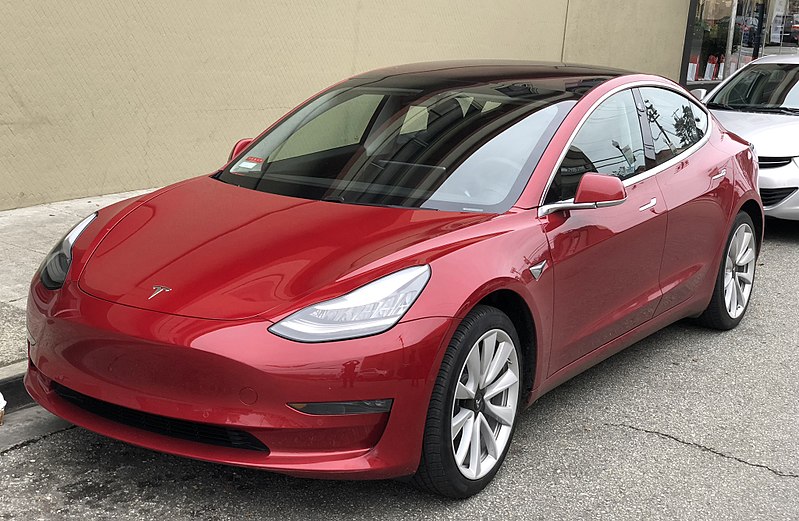
Tesla Model3 (Image: Wikimedia/Carlquinn)

Tesla Model 3 Performance Crushes Fossil BMW M3 Around Race Track

Top Gear magazine has track tested the Tesla Model 3 Performance head to head against fossil fans’ favorite sports saloon, the BMW M3.

The track times were conducted on the 2 mile Thunderhill Raceway Park West circuit, with the Tesla coming in a significant 2 seconds ahead of the (more expensive) BMW. Fossils must now accept all-round inferiority in the performance realm.

Top Gear Magazine’s head-to-head also found — unsurprisingly — that the Tesla beat the BMW on pure acceleration, as well as on their 0–100–0 mph acceleration-and-braking tests. It’s worth noting also that the price of the Tesla came in at more than a thousand dollars below that of the BMW M3.

Tesla Model3 (Image: Wikimedia/Carlquinn)

A lead of almost 2 seconds on a 2 mile track (with lap times around 85 seconds in total) is significant. Both vehicles were stock without modifications, and were lapped by the same driver.

On the feel of the two vehicles around the track, the testers found that for the BMW, compared to the Tesla:

“when you floor it, the throttle response is glacial by comparison, and the accompanying racket isn’t quite as glorious as you remember — more of a distraction from listening to what the tyres are doing and getting on with the business of going fast.”

They also noted the superiority of the Tesla’s ride for normal daily driving, away from the track:

“Where the BMW’s comfort and refinement is conceded quite a bit to unlock its track potential, the Tesla is utterly uncompromised…”

Read more: Clean Technica

Renault K-ZE electric supermini (Image: Autocar)

New Renault K-ZE 2019 review

The China-only Renault K-ZE has the potential to be the Dacia of the electric age, offering a 150-mile range for less than £13,000

Verdict: 4*
Decent electric range, reasonable performance and impressive quality standards – all at an affordable price. If Renault could add ESP and bring the K-ZE to the UK for less than £13,000, it could repeat the success it found with Dacia in the early 2000s. In fact, the K-ZE has the ability to surpass all other petrol-powered city cars, which due to upcoming emission standards, won’t be quite so affordable any more.

Solid build quality at “shockingly affordable” prices: that’s how Renault made Dacia such a huge success around the world. Now, Renault is getting ready to repeat this coup with an all-new electric vehicle. In China, the French car maker has just presented the K-ZE, which will be built and sold in the world’s largest EV market this summer – before being rolled out globally at a later date.

Groupe Renault CEO Thierry Bolloré told us: ”This is not a Chinese project. It is a global project”. And even if he won’t mention specific regions, there is no doubt Europe is near to the top of the firm’s list. Especially when conventional cars like the Clio will struggle to meet exacting emissions standards due in the coming years.

Renault K-ZE electric supermini (Image: Autocar)

While most of the industry takes its aim at Tesla, the cheap and cheerful K-ZE is a breath of fresh air. At 3.73m-long, with four proper seats (with a fifth as a spare) and a 300-litre boot, this is a small car with big aspirations. Renault claims a reasonable 150-mile real-world electric range and all for a price of around £13,000 before the usual government subsidies.

Read more: Autocar

Milton Keynes 'Mushrooms' Charging Hub (Image: T. Larkum)

Finding a place to charge your EV is easy with Google Maps

If you’ve ever driven to an electric vehicle (EV) charging station only to find that all ports are occupied, you know that you could end up waiting in line for anywhere between minutes to hours—which can really put a damper on your day when you have places to go and things to do.

Starting today, you can see the real time availability of charging ports in the U.S. and U.K, right from Google Maps–so you can know if chargers are available before you head to a station. Simply search for “ev charging stations” to see up to date information from networks like Chargemaster, EVgo, SemaConnect and soon, Chargepoint.

Milton Keynes 'Mushrooms' Charging Hub (Image: T. Larkum)
Milton Keynes ‘Mushrooms’ Charging Hub (Image: T. Larkum)

You’ll then see how many ports are currently available, along with other helpful details, like the business where the station is located, port types and charging speeds. You’ll also see information about the station from other drivers, including photos, ratings, reviews and questions.

Read more: Google Blog

Charging Station in Sunderland (Image: Fastned)

Fastned brings fast charging to UK with country’s maiden 350kW charger

Fastned’s has laid claim to installing the UK’s first 350kW capacity fast charger in Sunderland.

The station has two 175kW chargers which are enabled for 350kW charging for all full electric vehicles when required, in addition to four 50kW chargers.

All electricity supplied to drivers will be sourced from solar and wind, with solar panels on the canopy of the station.

Charging at the new fast-charging station will initially be free until a payment system is activated later on this year. From there, payments can be made through an EV charge card, debit/credit card, Apple Pay or Android Pay. It will also be possible to charge with the Fastned App, which allows for automatic charging.

Funding for the station came from the Go Ultra Low Cities Grant and the European Regional Development Fund. It was designed, built and operated by Fastned and is owned by the North East Joint Transport Committee.

Read more: Current News

All Electric Dust Carts Hit The City Of London

Plans for the UK’s first fully electric refuse fleet have been revealed as Veolia has signed a new tech-driven City of London waste contract.

The City of London Corporation has awarded the pioneering new waste collection service, street cleansing and ancillary services contract – which got going on Saturday April 6.

As part of the contract, the City Corporation aims to become the first authority in the UK to run a fully electric fleet of Refuse Collection Vehicles (RCVs).

Veolia’s RCVs will be equipped with 360-degree cameras and audible warning reversal systems to improve safety.

The vehicles will use on-board weighing equipment to digitally record bin weights at residential properties, enabling recycling performance to be efficiently calculated. And street cleaners will carry hand-held devices for on-the-go reporting and job completion.

All vehicles will be digitally tracked to monitor and auto-allocate cleansing tasks dependant on geographical location and capacity.

The contract will deliver 74 solar auto-compacting BigBelly bins which send notifications to collection crews when they are full, allowing more waste to be collected.

Read more: Twin FM

Kia Soul EV 2020 (Image: Kia.com)

Kia Soul EV hatchback (2020 – ) review

The Kia Soul EV is a small, all-electric SUV-like hatchback that rivals cars like the Hyundai Kona Electric, Volkswagen e-Golf and Nissan Leaf. It arrives in the UK in late 2019.

The Soul EV builds on the funky charm of its predecessor by maintaining the quirky styling, but upping the performance dramatically. It’s zippy to drive and boasts a very impressive 280-mile range on a single charge. If you’re in the market for an electric car, it’s definitely one of the first cars to check out.

Kia Soul EV 2020 (Image: Kia.com)

The Soul has always been a bit different from the mainstream, and this latest version continues that trend. It’s got narrow headlights and the familiar boxy shape that continues from previous incarnations, and is slightly larger than the car it replaces. Exact UK specs haven’t yet been announced, but expect all models to have full LED headlights and at least 17-inch alloy wheels, as well as a choice of vibrant paint colours and options to have a different coloured roof.

The interior design of the Soul is a bit more funky than other models in the Kia range. You’ll even be able to specify an ambient lighting system that pulses in time with whatever music you’re playing. The seating position is high, looking out over the bonnet, and visibility is pretty good thanks to the boxy shape.

Read more: Autotrader

BMW i3 120Ah (Image: BMW)

Twilight of combustion engine comes for Germany

The completed combustion engine fitted into a BMW M5 is a 1,200-piece puzzle that weighs more than 181 kg (400 pounds).

There are about 150 moving parts whose interlocking precision can catapult a six-figure sports car to 97 kph (60 mph) in 3.3 seconds.

The engine under the bright lights of the vast BMW factory hall in Dingolfing, Germany, has come together from a web of hundreds of suppliers and many, many hands.

The electric-vehicle motor produced in the same factory is different in almost every respect: light enough for a single person to lift, with just two dozen parts in total, and lacking an exhaust, transmission, or fuel tank. The battery cells themselves are mostly an industrial commodity, products bought in bulk from someone else. No one brags about the unique power of BMW’s electric drivetrain.

Yet, this slight battery-driven motor can outgun the combustion engine in BMW’s fastest performance car from a standstill at a traffic light.

BMW i3 120Ah (Image: BMW Group)

The fact that both combustion engines and electric motors find themselves inside the same 18,000-person complex in Dingolfing, BMW’s largest in Europe, makes it a microcosm of a shift overtaking automakers the world over.

A visitor can see that 625-hp engine–more than twice as powerful as the original from 1985, a luxury product relentlessly branded as “the ultimate driving machine” — then walk around the corner and see its small electric replacement. You start thinking the better slogan might be “the ultimate combustion engine.” As in: last of its kind.

Read more: Autonews

Study explains how electric vehicle improves air quality and climate outlook

The study published in the journal Atmospheric Environment provided evidence that making a switch to electric vehicles would improve overall air quality and lower carbon emissions.

Washington: is it possible for electric vehicles to improve air quality and climate outlook? Recent research has thrown light on the efficacy of electric vehicles.

The study published in the journal Atmospheric Environment provided evidence that making a switch to electric vehicles would improve overall air quality and lower carbon emissions.

The study quantified the differences in air pollution generated from battery-powered electric vehicles versus internal combustion engines.
The researchers found that even when their electricity is generated from combustion sources, electric vehicles have a net positive impact on air quality and climate change.

“In contrast to many of the scary climate change impact stories we read in the news, this work is about solutions,” said Daniel Horton, senior author of the study.

“We know that climate change is happening, so what can we do about it? One technologically available solution is to electrify our transportation system. We find that electric vehicle adoption reduces net carbon emissions and has the added benefit of reducing air pollutants, thereby improving public health,” added Horton.

To quantify the differences between the two types of vehicles, the researchers used emissions remapping algorithm and air quality model simulations.

They used these methods to closely examine two pollutants related to automobiles and power emissions: ozone and particulate matter. Both are main components of smog and can trigger a variety of health problems, such as asthma, emphysema and chronic bronchitis.

To fully account for the complexity of changes to air pollution chemistry, the researchers took multiple variables into consideration including potential electric vehicles adoption rates, Generation of electric vehicle power supply, including our current combustion-dominant mix, combustion-only sources and enhanced emission-free renewable, geographical locations, and seasons and times of the day.

Ozone levels decreased across the board in simulations of warmer weather months. In the wintertime, however, ozone levels increase slightly but are already much lower compared to summer due to a chemical reaction that occurs differently during times of lesser winter sunlight.

“Across scenarios, we found the more cars that transitioned to electric power, the better for summertime ozone levels,” said Jordan Schnell, first author of the study.

“No matter how the power is generated, the more combustion cars you take off the road, the better the ozone quality,” Schnell added.

Read more Economic Times India

Cheap Motoring

Electric Car Price Tag Shrinks Along With Battery Cost

Choosing an electric car over its combustion-engine equivalent will soon be just a matter of taste, not a matter of cost.

Every year, BloombergNEF’s advanced transport team builds a bottom-up analysis of the cost of purchasing an electric vehicle and compares it to the cost of a combustion-engine vehicle of the same size. The crossover point — when electric vehicles become cheaper than their combustion-engine equivalents — will be a crucial moment for the EV market. All things being equal, upfront price parity makes a buyer’s decision to buy an EV a matter of taste, style or preference — but not, for much longer, a matter of cost.

Every year, that crossover point gets closer. In 2017, a BloombergNEF analysis forecast that the crossover point was in 2026, nine years out. In 2018, the crossover point was in 2024 — six years (or, as I described it then, two lease cycles) out.
Cheap Motoring

The crossover point, per the latest analysis, is now 2022 for large vehicles in the European Union. For that, we can thank the incredible shrinking electric vehicle battery, which isn’t so much shrinking in size as it is shrinking — dramatically — in cost.

Analysts have for several years been using a sort of shorthand for describing an electric vehicle battery: half the car’s total cost. That figure, and that shorthand, has changed in just a few years. For a midsize U.S. car in 2015, the battery made up more than 57 percent of the total cost. This year, it’s 33 percent. By 2025, the battery will be only 20 percent of total vehicle cost.

Read more: Bloomberg