All posts by Jo

POLAR charging network to be powered with 100% renewable electricity

  • UK’s largest electric vehicle charging network switches to 100% renewable energy
  • Electric drivers benefit from a reduced emissions footprint from POLAR charging points
  • Cost of POLAR network membership remains the same with no price increase
The UK’s largest electric vehicle (EV) charging network, POLAR, which includes Charge Your Car sites, is switching to 100% renewable electricity from 1st August.

The electricity consumption of the POLAR network, operated by Chargemaster, will be certified and matched to energy generated from renewable sources by OVO Energy, one of the UK’s largest independent energy providers. It means that every mile driven by EVs charging on the POLAR network will be matched by renewable energy.

The electricity consumption of the POLAR network, operated by Chargemaster, will be certified and matched to energy generated from renewable sources; meaning every mile driven by EVs charging on the POLAR network will be matched by renewable energy.
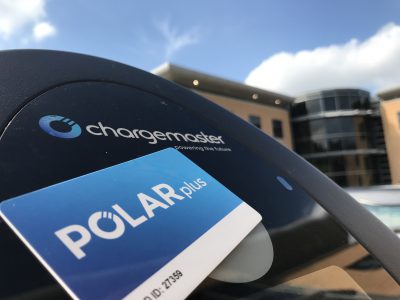
Chargemaster, the UK’s largest provider of electric vehicle charging infrastructure, provides over 40,000 EV drivers with access to more than 5,600 public charging points in the UK across the POLAR and Charge Your Car networks. Combined, they represent more than 40% of all the charging points in the UK and, in the first half of 2017 supplied vehicles with more than 500,000 kWh of electricity.

The POLAR network is growing significantly, with Chargemaster installing more than 250 of its UK-manufactured Ultracharge rapid chargers this year. POLAR plus membership, which provides unlimited access to charging points in the network (over 85% of which are free to use) costs just £7.85 per month and will not increase with the switch to renewable energy. In addition, new members benefit from free membership for the first three months.

Electric vehicles already reduce local air pollution, as pure electric vehicles, and plug-in hybrid and range-extender models running in electric mode, produce no tailpipe emissions.

Even when charged with electricity from the National Grid, the emissions footprint of electric motoring is still lower than the average new car in the UK. However, this benefit is increased if electric vehicles are charged using renewable energy, which ensures that electric motorists are truly ‘zero emission’, with no fossil fuel-generated electricity used when charging.

David Martell, Chief Executive of Chargemaster said,

“Switching POLAR, the UK’s largest EV charging network, to renewable energy is great news for EV drivers in the UK. It reduces the overall emissions of electric motoring, removing the upstream footprint of electricity generation in the same way as drivers have eliminated their tailpipe emissions.”

Source: Chargemaster

Is the Tesla Model 3 launch today the D-Day for electric cars? I think so

It is hard to overstate the significance of today’s Tesla Model 3 launch at the Fremont California factory. It very well could be the beachhead that electric cars need to tip the scales over gasoline cars in the US and the world.

Will we be witnessing history tonight? Let’s put it into perspective…

Tesla has over 400,000 reservations for the vehicle which haven’t been road tested by the public as of this writing, haven’t been in showrooms and really hasn’t been even seen in person by all but a few lucky folks. Keep in mind that at the beginning of this year there was only just over half a million EVs on US roads and just slightly more in all of Europe or China.

Tonight’s event will be the beginning of an order of magnitude change. If you want to compare Tesla to Apple, this is making a great electric car available to many more people akin to lowering the price of an iPhone from $600 to $200 (a drop by two thirds) and making it available to a much broader swath of the world.

Do people love their Teslas like Apple folks love their iPhones? Let’s have a look at Consumer Reports numbers (right) of Tesla people who would buy another vehicle from the company.  Tesla is a whopping 15 percentage points above the field and the only maker that is even in the same ballpark is Porsche at a significant 7 points behind.

If the Model 3 is as great as us early believers think it will be, the car will fundamentally change how we move around. Gas stations, oil changing locations, transmission shops will start to disappear and be replaced by huge charging stations between major metropolitan areas. Oil infrastructure including tanker boats and trucks will disappear. Cities will become quieter. Air will become cleaner.

In their place, people will put solar on their rooftop to make free energy. The grid will need to be reinforced but it will grow stronger and more resilient.
The multi-trillion dollar fossil fuel industry will try to buy delays from the government and sway the public with misinformation but at the end of the day, the math simply doesn’t work out. Even if you don’t believe the science of climate change, EVs are better, faster, more fun cars and they move people around more cheaply than gasoline powered vehicles.

Read more: electrek

Europe Notes 54% Growth Of Plug-in Car Sales In June, ZOE Sells 4K

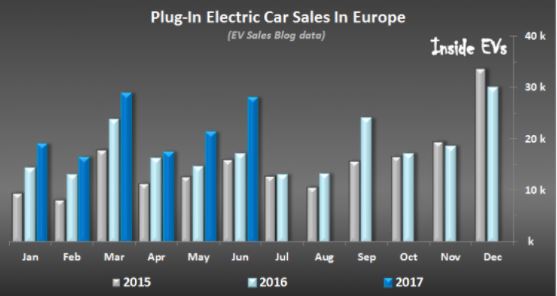
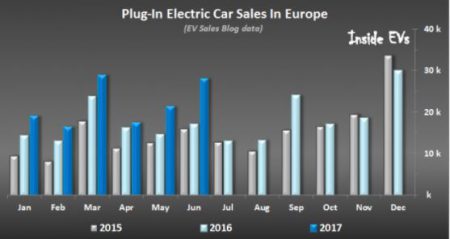
It’s getting better and better in Europe for plug-in vehicles, as some 54% growth was noted in June, with total sales for the month reaching more than 28,000.

Plug-In Electric Car Sales In Europe – June 2017 (data via EV Sales Blog)

The half year numbers have also crested 133,000 (which is up 30% year-over-year), and encourages us that the 250,000 mark will be easy to achieve in 2017 given the traditional year-end weighting of EV sales.

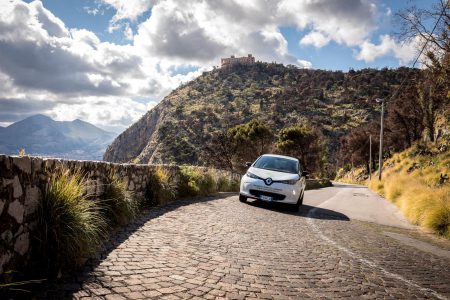
The Eco Tour di Sicilia and Renault ZOE

Overall plug-in market share stands at 1.5%.

Specific to the EVs themselves, the Renault ZOE shines in June, exceeding 4,000 sales – more than double the second best result from the BMW i3!

Models within Top 5 in June or Top 5 YTD:

  • Renault ZOE #1 – 4,189 (#1 17,146 YTD)
  • BMW i3 #2 – 1,634 (#3 10,260 YTD)
  • Nissan LEAF #3 – 1,590 (#2 11,007 YTD)
  • Tesla Model X #4 – 1,552 (#8 5,613 YTD)
  • Mitsubishi Outlander PHEV #5 – 1,435 (#4 9,294 YTD)
  • Tesla Model S #6 – 1,373 (#5 6,580 YTD)

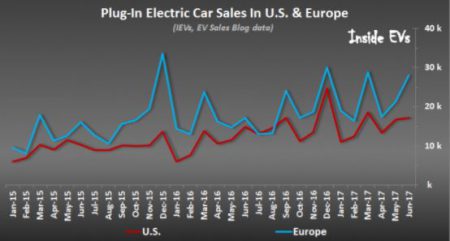
Here is comparison of U.S. and Europe results:

Plug-In Electric Car Sales In Europe – June 2017

Source: Inside EV’s

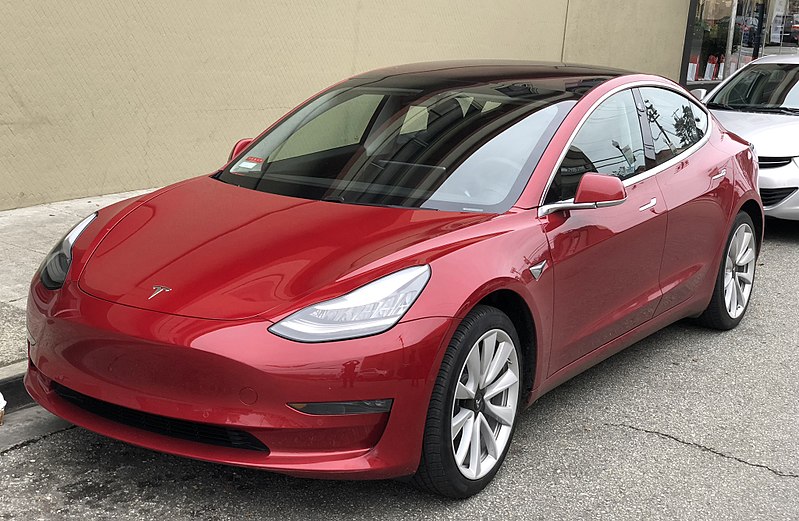
Tesla Model3 (Image: Wikimedia/Carlquinn)

Elon Musk hands over first Tesla Model 3 electric cars to buyers

With half a million orders for the $35,000, 350km-range vehicle, the upstart carmaker faces its biggest test

Tesla boss Elon Musk has handed over the first of what he hopes will be a mass-market electric car to employee buyers, setting the stage for the biggest test yet of the company’s plans to revolutionise the auto industry.

Tesla Model3 (Image: Wikimedia/Carlquinn)

Outside Tesla’s factory in Fremont, California on Friday night, Musk showed off the $35,000 Model 3 which has a range of 220 miles (350 km) on a charge that marks a departure from the company’s earlier luxury electric cars.

Hours before the event, Musk acknowledged it would be “quite a challenge” to build the car during the early days of production.

“We’re going to go through at least six months of manufacturing hell,”

Musk told journalists.

The over half a million reservations are up from about 373,000 disclosed in April 2016. Customers pay $1,000 refundable deposits for the car, which is eligible for tax credits. Any new buyers would likely not receive their car until the end of 2018, Musk said.

A longer-range version of the car is priced at $44,000 and will drive 310 miles (500 km) on a single charge. The cars feature a streamlined dashboard devoid of buttons or knobs, with a touchstream display to the right of the driver.

Tesla faces major hurdles living up to the Model 3 hype. The 500,000 vehicles Tesla vows to produce next year are nearly six times its 2016 production.

Were Tesla to produce, and sell 500,000 cars per year, the company would likely outsell the BMW, Mercedes, or Lexus brands in the United States.

Production delays and quality issues marred the launches of Tesla’s Model S and Model X vehicles, and the company blamed production problems for a shortfall during the second quarter of this year. Musk has said a simpler Model 3 design will greatly reduce potential assembly-line problems.

Tesla has burned through more than $2bn in cash so far this year ahead of the launch. A troubled Model 3 launch could heighten the risks for the company, while a steady delivery of Model 3s could generate a stream of cash that would allow Tesla to avoid going again to the capital markets to fund its operations.

Read more: The Guardian

Electric cars are getting ever more attainable

You’ve probably seen the news that the Government is planning to ban the sales of new petrol and diesel cars by 2040, instead encouraging drivers to invest in electric cars in a bid to improve air pollution.While we’re not saying you should rush out to part exchange your petrol or diesel car for an EV, the experts at Cap HPI have pointed out that now seems to be a good time to buy a secondhand BMW i3.

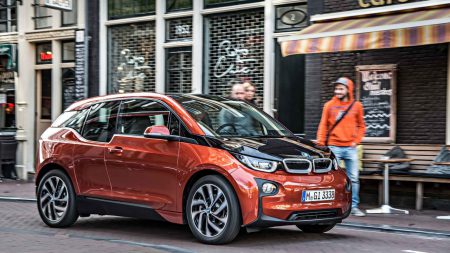
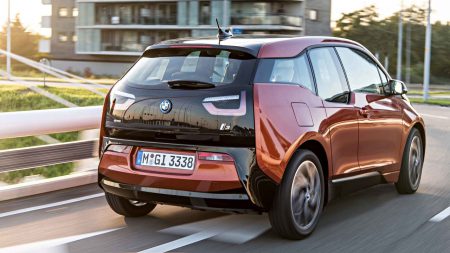
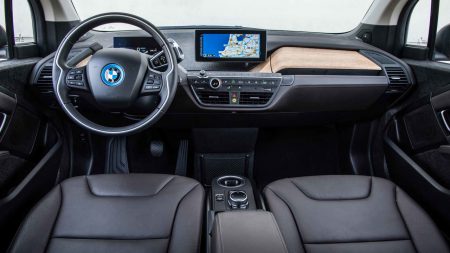
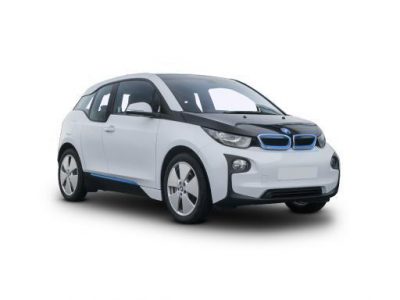
BMW i3

More than 10,700 new alternatively-fuelled vehicles (AFVs) were registered in the UK last month – meaning they now account for a record 4.4% of cars on our roads. This growth in electric and hybrid vehicles has worked wonders for their residual values, which have increased by 7% on average this year – and this is only set to increase as interest builds.

It’s hard to believe that early examples of the futuristic BMW i3 are now three years old, but Cap HPI’s valuation experts have noticed that they’ve now halved in value, meaning you could pick one up for less than £15,000. New, a regular BMW i3 would have been £30,925.

BMW i3

The smart money, however goes on the BMW i3 Range Extender, which can be picked up from around £17,000. Again, that’s a 50 percent saving over new.

“Interestingly it appears to be the range extender models which is driving the recent strong performance as values of pure electric have struggled of late,”

said HPI’s motoring expert Chris Plumb.

“The BMW i3 is a popular choice and is a great second hand buy. It brings a good level of specification and badge prestige.

“The optional range extender can increase the range of the BMW i3 in comfort mode from up to 125 miles to a total of 206 miles. The small, rear-mounted, quiet two-cylinder petrol engine powers a generator that maintains the charge of the battery at a constant level, so that the BMW i3 can continue to drive electrical.”

BMW i3

It’s yet to be confirmed whether the Government’s plans will allow for the sales of cars with a petrol engine – even when, like the i3, combined with an electric motor. Although the regulations will only affect new cars (and the rules aren’t coming into force until 2040), expect more legislation to reduce harmful emissions in the near future – particularly in urban areas. A £15,000 secondhand BMW i3 could save you a lot of money in the long run.

Source: Motor1

Government car ban: which is the best used electric car you should buy?

THE Government has said it will ban all diesel and petrol powered cars from 2040 bringing the curtain down on the era of the internal combustion engine.

Ministers unveiled their court-mandated plans for meeting EU limits on harmful nitrogen dioxide pollution this morning.

They include a £255 million fund to help local authorities come up with ways to improve air quality, ranging from improving public transport and changing road layouts, to charging zones for polluting vehicles if other measures don’t work.

The BMW i3 – one of the UK’s most popular EVs

But much of the focus was on plans to end the sale of all conventional petrol and diesel cars by 2040, to help tackle air pollution and climate change emissions.

The impending shake-up is already having an impact on the electric car market.

Consumer interest in electric vehicles is soaring. The market for alternatively fuelled vehicles (AFVs) saw a record market share of 4.4 per cent in June with more than 10,700 hitting the roads, a rise of 29 per cent.

At the same time the overall used market for electric vehicles has seen values increasing by 7 per cent this year.

Motoring expert Chris Plumb from hpi said:

“Interestingly it appears to be the range extender models which is driving the recent strong performance as values of pure electric have struggled of late. The BMW i3 is a popular choice and is a great second hand buy. It brings a good level of specification and badge prestige.

“The optional range extender can increase the range of the BMW i3 in comfort mode from up to 125 miles to a total of 206 miles. The small, rear-mounted, quiet two-cylinder petrol engine powers a generator that maintains the charge of the battery at a constant level, so that the BMW i3 can continue to drive electrical.”

A used BMW i3 with 15,000 miles on the clock has a used value of £14,650 against a new price of £30,925.

The made-in-Sunderland Nissan Leaf with the 30KWh power train is attracting higher used values than the lower powered 24kWh battery pack as it has a larger range.

According to Nissan, the Leaf has an official range of up to 124 miles (4kWh) or up to 155 miles (30kWh).

Source: The York Press

‘It’s the future of motor travel’: readers on driving electric vehicles

With the UK planning to ban petrol and diesel cars and vans in 2040 we asked you what it’s like to drive the vehicle of the future.

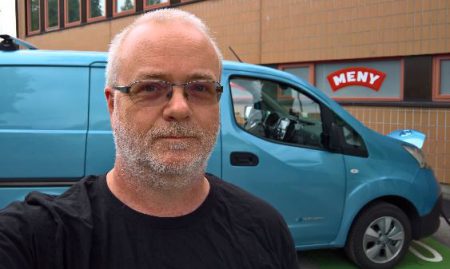
Øivind Johansen with his e-NV200 charging at Teie, Nøtterøy in Vestfold county. Photograph: Øivind Johansen

Amid fears that rising levels of nitrogen oxides pose a major risk to public health, Britain plans to ban all new petrol and diesel cars and vans from 2040. As part of the government’s much-anticipated clean air plan it has said the move is needed because of the unnecessary and avoidable impact that poor air quality was having on people’s health.

With the inevitable demise of diesel and petrol vehicles we asked electric car drivers to tell us what it’s like to drive one, and why they are the future.

Christine Burns, 64, retired, Manchester: ‘The UK government’s policy isn’t really a policy – the market will get there before’
Drives a Nissan Leaf

In an electric car you glide around in virtual silence like a limousine, but it can also out-accelerate the boy racers at the traffic lights! A scheme where I live in Manchester, means I only have to pay £20 a year to have free access to chargers across the city. There are almost a dozen kerbside and car park chargers inside a 1-2 mile radius of my home, plus I can charge from empty to full in around four hours for less than £3 on domestic electricity.

Benefits of electric cars include a low-cost mileage, no road tax, no congestion charge and low servicing costs. They’re also easy to drive with just one pedal, and there’s no smelly flammable refuelling involved. People tend to be curious when they find out I have an electric car and want to know more especially as there are a lot of myths like low acceleration. However, charging infrastructure could definitely be improved in the UK.

The UK government’s policy isn’t really a policy. Saying you’ll ban internal combustion engine car sales in 23 years from now doesn’t make sense, as the market will get there long before that. Norway plan the same by 2025 so why can’t we?

Øivind Johansen, 52, craftsman, Vestfold, Norway: ‘Electricity is much cheaper’
Drives a Nissan Leaf and e-NV200

It’s beautiful to drive. And with just forward and reverse they are not difficult to drive. There is no clutch or shifting of gears. They are peaceful, without any noise and there are no stinking fuels. I just plug it in at home. It’s pre-warmed in the winter and pre-cooled in the summer which is wonderful when going to work. They’re fun. I’ll never go back to fossil fuel cars.

Where I live in Norway, most people have their own houses which makes it easy to install chargers outside. There are normally charging stations every 50km with most places having at least two. What it comes down to though is money. It’s expensive to pay for diesel and electricity is much cheaper. I can drive 10km for around 10p. They’re also so much cheaper, both in parts and repair. We save around £6,000-7,000 a year by not using a diesel car.

I think the UK government’s plan is too little too late. It’s crazy when you think about how much oil is burnt every day by internal combustion engine cars. I’m just glad to be able to do my bit for the environment.

Read more: The Guardian

Inventing electric cars is easy – now UK needs to reshape itself

The UK faces a challenge to prepare for a new automotive revolution, with electric vehicles set to overtake petrol ones from 2040.

Electric car sales are expected to overtake petrol by 2040

When the automotive revolution kicked off at the beginning of the 20th century, the dominant technology wasn’t petrol – it was electric.

The cars were slow, with a top speed of around 20mph, but – unlike petrol – they didn’t smell, they didn’t need gears and they didn’t need starting with a hand crank.

For pottering around the city, they were unbeatable.

However, by the 1920s, they were in decline. Petrol became much cheaper and the road network expanded, meaning the limited range of electric cars became a problem.

The combustion engine took over – a lead it wouldn’t relinquish until today.

Two companies, aided by governments around the world, have pushed the revival in electric: Toyota and Tesla.

The Toyota Prius made hybrid vehicles mainstream. Then Tesla terrified traditional automakers by fully embracing electric.

The breakthrough was batteries. As smartphones became more popular, the lithium-ion technology they use kept on improving. That could be applied to vehicles too.

Today, all manufacturers are competing to squeeze as much juice as possible from the battery.

The price of buying an electric vehicle will be the same as a petrol one from next year, according to analysts at UBS, and by 2024, one in three cars sold in Europe will be electric.

Morgan Stanley estimates electric car sales will overtake petrol globally by 2040 – meaning the UK Government’s ban on the sale of petrol and diesel isn’t as drastic as they’d like you to think.

But governments worldwide have been crucial to electric’s growth.

California provided nearly $5bn (£3.8bn) in grants to Tesla while, across Europe, electric car sales have been driven by subsidies. When Denmark scrapped them in 2016, sales fell by 60%.

The European Union is also imposing tougher emissions standards from 2019.

Read more: Sky News

HYUNDAI IONIQ NAMED ‘BEST GREEN TECHNOLOGY’ IN TOP FLEET AWARDS

A panel of fleet industry experts has named the Hyundai IONIQ as the ‘Best Green Technology’ for businesses. Judges of the 2017 BusinessCar Fleet Technology Awards – the ‘Techies’ – said the choice of three electrified powertrains for fleets was the most significant factor in giving it the top prize.

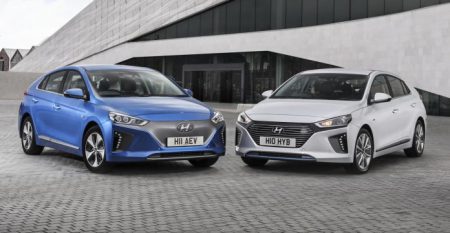
Hyundai IONIQ

The Hyundai IONIQ is unique in offering separate hybrid, full electric and plug-in hybrid powertrains within one body type. It enables business car decision-makers to specify the IONIQ that best meets the needs of their drivers, depending on driving style, travel frequency, and the distances typically covered.

The capabilities of the zero-emission IONIQ Electric are perfect for fleets focused on their carbon footprint or the lowest BIK rates for users. Completing the line-up of powertrain choices in 2017 is the IONIQ Plug-in Hybrid, offering ultra-low CO2 emissions of just 26g/km and a BIK rate of just 9% for 2017/18. Users can experience up to 39 miles of pure electric driving, with a total range of 680 miles.

Hyundai Motor’s Fleet team worked hard to ensure the IONIQ is as competitive as possible for fleets. The IONIQ Electric is best-in-class for service, maintenance and repair costs, with the lowest prices at both the 3yr/30,000-mile and 5yr/50,000-mile points. Vehicle benefit tax for the pure-electric model is just 7%, which means the cost for company car users starts from £405 per year – just £33.75 per month.

The innovative use of ecologically sensitive materials in IONIQ’s cabin adds to its green credentials for environmentally-conscious fleets. Recycled plastic is combined with powdered wood and volcanic stone for the interior door covers, providing the same quality appearance as conventional oil-based plastics.

Debbie Wood, BusinessCar’s editor, said; “Environmental concerns around transport have never been so topical and fleets are constantly on the lookout for greener solutions to help reduce their overall carbon footprint. This years’ Green Techies award proved to be a fiercely competitive category – but the Hyundai Ioniq emerged as the clear favourite.

Read more: The Leader

Solar Charge Points charging electric cars (Image: T. Larkum)

Electric cars: everything you need to know

From how to charge them to whether they are really better for the environment

Solar Charge Points charging electric cars (Image: T. Larkum)

How will I charge an electric car?

The first generation of electric-car buyers have been people with homes where it is easy to plug one in.

“The vast majority of Nissan Leaf customers are [families with] 2.4 children, mums and dads, with off-street parking,”

said Gareth Dunsmore of Nissan Europe.

“Tomorrow that won’t be the case.”

Dunsmore envisages charging points becoming ubiquitous at workplaces, and at shopping centres, railway stations, hotels and cinemas. For longer journeys, rapid chargers that can recharge a car’s battery in 30 minutes will increasingly proliferate across motorway service stations and at conventional refuelling stations.

For drivers living on terraced streets, the answers are not so simple but solutions are beginning to emerge. For example, Kensington and Chelsea council is running a trial with a UK energy company and German firm to add charging sockets to street lamps.

I’m worried about the battery running out – should I be?

Most mass market electric cars today have a range of 100-150 miles before the battery runs flat. Some of the top-end cars, such as Tesla’s electric sports cars, can run for 334 miles before needing a plug socket.

While that may not sound much compared to the 400-500 miles or more that a petrol or diesel car can manage before refilling, most car journeys in the UK would easily be accomplished in an electric car. Half of journeys are one to five miles; 38% are for five to 25 miles and only 2% are for 50 miles and more.

Of course, some people will need to go much further – and that’s where plug-in hybrids come in, using a petrol engine to run an electric motor after the battery runs out.
Improving battery technology is expected to extend even pure electric cars’ ranges to about 400 miles within a decade.

Are they cheaper?

Londoners in an electric car can already enter the congestion charge zone for free. If the government’s anti-pollution drive leads to more towns and cities imposing an air quality zone, that could lead to more tolls, from which electric cars are likely to be exempt.

Read more: The Guardian