All posts by Jo

Coral reefs cannot grow fast enough to keep pace with rising sea levels, finds study

Sea floor is getting lower as erosion gets worse

Coral reefs are failing to keep pace with rising sea levels, increasing the depth of the sea and removing a natural form of storm defence, according to a new study.

Researchers were stunned by the amount of reef lost due to erosion at sites in the Pacific off Hawaii, Florida’s Atlantic coast and in the Caribbean, saying it had resulted in water depths not predicted to occur until 2100.

Dead Elkhorn coral near Buck Island in the US Virgin Islands. As coral reef structure degrades, valuable habitat for marine life is lost and nearby coastlines become more susceptible to storms, waves and erosion

They said it was evidence that an “Anthropocene reef crisis” had begun.

Corals are facing an array of problems from bleaching caused by the rising temperatures and ocean acidification to dredging and pollution from the land.

The iconic Great Barrier Reef has been so badly affected that one leading environmental writer was moved to write its obituary.

In the new study, researchers examined two sites in the Florida Keys, two in the US Virgin Islands and also the waters around the Hawaiian island of Maui.

The sea floor was found to be lower at all five sites by anything from nine to 80 centimetres.

All five reefs had lost large amounts of coral, sand and other sea floor materials to erosion.

Dr Kimberly Yates, of the US Geological Survey, said: “Our measurements show that seafloor erosion has already caused water depths to increase to levels not predicted to occur until near the year 2100.

“At current rates, by 2100 sea floor erosion could increase water depths by two to eight times more than what has been predicted from sea level rise alone.”

Writing in the journal Biogeosciences, the researchers warned that the deeper water would increase coastal erosion, storm surges and tsunami hazards.

Read more: Independent

Open-road driving in an electric BMW i3: are we tripping?

Okay, so the BMW i3 is a city car, right? BMW designed it as such and has made no secret of that fact. But what if you aren’t a German living in a large city and in possession of a strong sense of propriety and common sense?

What if, for example, you are a Kiwi who decides it would be a good idea to take an electric vehicle (EV) designed specifically for city life and do a road trip the entire length of the country? She’ll be right mate, it’s a car, after all. That’s what they do, right?

Well, yes and no. But the i3 is still a BMW, remember, and that means even if it was intended specifically for urban dwelling, it is still unusually attracted to open roads and corners.

So it was that I found myself in the same BMW i3 on two different road trips. One was the first leg of an epic journey from the very bottom of New Zealand to the very top. That’s right; Bluff to Cape Reinga. The other was a smaller affair, but up north of Auckland to, erm, drink coffee.

Oh, and by the way, this was the pure electric version of the i3, not the one that packs a small two-cylinder petrol “range extender” engine. You know, the sensible one to take on a long distance road trip.

The epic road trip was part of Leading the Charge, organised by the Better NZ Trust to promote awareness of electric vehicles and clean air and stuff.

All very worthy, but let’s get that i3 out on the open road and get some coarse South Island chip seal under those skinny tyres.

Okay so yes, the i3’s ride is noticeably firm on these roads (and, indeed, most NZ highways), but it is not intrusive. Road noise over the coarse chip seal is noticeable as well, but this is more down to the fact that there is no engine noise to mask it.

Of course power is one thing the i3 doesn’t lack and it absolutely belts up to the legal open road speed limit. Close attention has to be paid to keep it on the legal side.

While the official 0-100kmh sprint is 7.2 seconds, the sheer bulging electrical torqueyness makes it feel far quicker than that.

Cruising is effortless in the i3 on the open road, with overtaking just as silently efficient as the charge up to 100kmh.

Speaking of charging, the i3 now boasts a range of around 200km; at a fast-charging station, it takes around 30 minutes to get it to 80 per cent.

And that is where the other, smaller, more coffee-influenced road trip came in.

Read more: Stuff


Charging points for electric cars could be made available across South West Wales

More charging points could be made available across South West Wales to cater for an increase in electric cars

An electric car show in Swansea has prompted calls for electric car chargers to be placed over Wales

More charging points could be made available across South West Wales to cater for an increase in the use of electric cars.

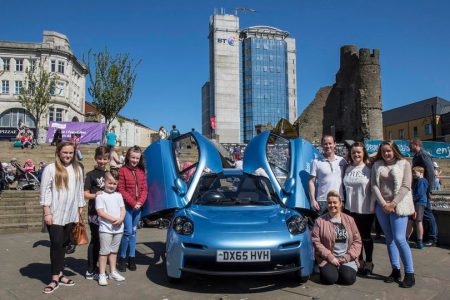
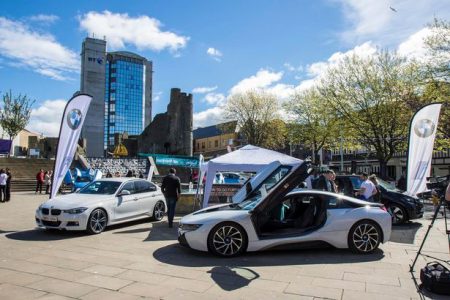
A Clean Air Roadshow organised by Swansea Council took place in Castle Square on Saturday to showcase electric and hydrogen vehicle technology.

Electric cars owned by the authority and Swansea University were on display, as well as a battery-powered one-man from the 1980s car known as the Sinclair C5, while there were also live shows from Titan the friendly robot.

Following the event Swansea Council announced it is exploring the concept of introducing more charging points in collaboration other public bodies in South West Wales.

Martin Nicholls, director of place at Swansea Council, said:

“The Clean Air Roadshow was a great success, with many thousands of visitors coming along to Castle Square from across South Wales and beyond on the day to discover electric and hydrogen vehicle technology.

“With the profile of this type of technology being raised, it’s important we explore how we can help in terms of ensuring the right infrastructure is in place to support it.

“That’s why we’re working closely alongside our local authority, university and health board partners across the region on a study that could see more electric vehicle charging points in place in future all the way from Neath Port Talbot and through the Swansea Bay City Region to Pembrokeshire.

“We support technology of this kind because it’s sustainable and helps Swansea cut its carbon footprint as we look to become a greener, more environmentally aware city.

“We already have a number of electric vehicles in our council fleet, which are used by staff in departments including recycling and corporate building and property services. These numbers are due to grow over coming months.

“This builds on the work that’s already on-going to promote and improve other forms of sustainable transport in Swansea, including cycling.”

An electric car show in Swansea has prompted calls for electric car chargers to be placed over Wales

Read more: Wales Online


Plug-in electric does what you’d expect from a normal car, which is a good thing

“Electric cars are taking over! Autonomous cars will rule the road! The end of oil is nigh!”

Sigh. If you’re like me, you’re tired of all the rhetoric of how the auto industry is on the cusp of major change, like, any day now. Hell, I spent enough time reading my dad’s old copies of Popular Mechanics from the 1960s and ’70s. If you believed those stories, then today we should all be soaring over roads in flying cars, gently setting down in our suburbia-heaven driveways after a long day of work, your wife greeting you at the door in a dress and pearls with a martini in hand.

We all know how that worked out. As for autonomous cars, they are at least 10 to 15 years from being viable on a mass scale – there’s no way they could even get out of the driveway in Canadian winters with current technology. And electric vehicles (EVs), while having come a long way in the last 20 years, still make up less than 1 per cent of all vehicles sold in North America. Gasoline-guzzling trucks and SUVs are by far the biggest sellers here. So, considering all the facts, you’ll excuse me if I’m more than a little skeptical on how soon this sea of change will come.

Ah, not so fast: I just had a chance to drive “the future,” and I admit I was impressed. And what impresses me the most about it has nothing to do with sci-fi wizardry or space-age design; no, what impresses me is that it’s almost completely, well, normal.

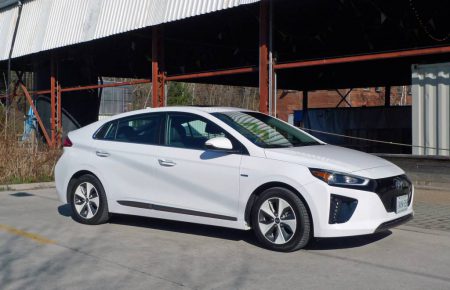
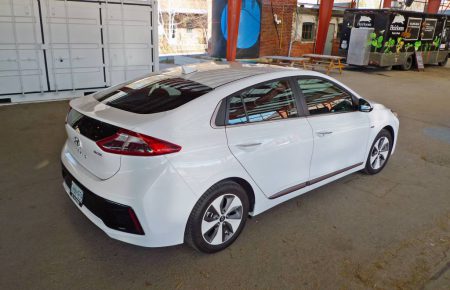
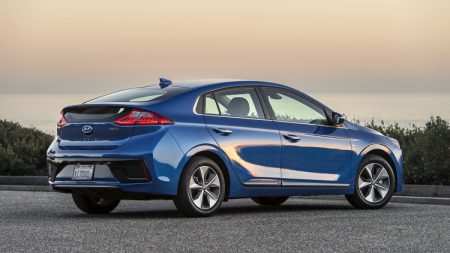
This is the new Hyundai Ioniq, a full-on, battery-powered electric vehicle. Only, you wouldn’t necessarily know it’s an EV if you saw it in someone’s driveway; the only giveaways being the word “electric” on the trunk lid (obvious) and the closed faux-grille at the front (not so obvious). No, this is not an overblown golf cart or futuristic science experiment; the Ioniq is a handsome car that fits in with the rest of Hyundai’s design language – not to mention any other car on the road. The front-wheel-drive hatchback has a wheelbase of 2,700 millimetres, about the size of the compact Elantra; LED lights fore and aft give this top-of-the-line Limited model a more upscale look, while the body-coloured wheels are a nice touch, too.

Inside, it’s more of that normal – no, don’t worry, that’s a good thing, especially as it continues the upscale feel. Nicely textured soft materials on the dash and doors, subtle bronze-coloured accents, simple, well laid-out controls, and a nifty TFT screen for the instrument cluster, which changes colours and details depending on the drive mode. In fact, this Ioniq Limited has an impressive list of features to coddle its passengers: adaptive cruise control, heated seats both front and rear, automatic climate control and a giant 8-inch infotainment screen, among many others.

The ride is comfortable, handling is competent for a sedate compact hatchback (though the steering is vague and over-boosted), the interior is roomy and relatively quiet and it looks sharp. Overall, the Ioniq would be a good choice for someone in the market for a compact hatch. In other words, this electric car is like a normal car.

Read more: Driving.ca

Survey Says: 85% Percent Of Electric Vehicle Owners Are Happy They Switched From Gas

EV-Box’s survey of over 850 electric drivers shows that 85% are happy having switched to electric driving. While insufficient charging infrastructure is raised as a concern by most (55%) of the EV drivers.

The main reason to initially purchase electric vehicles turns out to be a contribution to a more sustainable future (51%), although we still believe the “EV grin”, the smooth driving experience and advanced technology is something that will win over consumers in the long run.

Also interesting to note, is that 55% of those surveyed say they have never used a public DC fast charging station. Further to that, some 56% indicate that retail areas are the top locations to add charging facilities.

“A survey of over 850 electric drivers based in Europe and North America, as well as a “Manifesto for Electric Mobility”, was released publicly during rEVolution 2017, an annual gathering for e-mobility thought leaders that brought together 240 industry participants on the 14th of March in Amsterdam.

The e-mobility manifesto was created by a group of 12 thought leaders from EV-Box, ENGIE, EVConsult, Renault, Jaguar Land-Rover, E-Laad, The Municipality of Amsterdam, Urban Foresight, and Fastned, all of whom shared their vision on the future of e-mobility and what drivers, businesses, associations, and government can do to increase adoption of electric cars as well as improve the experience for the user.

Amongst many insights and recommendations, the manifesto clearly states that to increase the pace of transition towards sustainable mobility for electric vehicles, the following has to happen:

  • For the general e-mobility stakeholders: To cooperate and implement interoperability between different countries and EV charging providers;
  • For the charging providers and operators: To enable direct and mobile payments. Drivers should be able to pay for any charging session with any method, hassle-free;
  • For the semi-public charging facilities: To empower and support the expected rise of electric vehicle adoption by installing smart charging infrastructure at their parking sites;
  • For the automotive manufacturers: Create new services that allow drivers to charge their car in an easier way, and begin producing new batteries that can be charged faster
  • For the Governments: To assist the charging providers in standardizing their services and products by implementing more public charging stations, and create or continue financial incentives to motivate their citizens to acquire an electric vehicle.

The full manifesto has been shared publicly and can be accessed at www.ev-box.com/manifesto.

As per the survey, the insights are shared in the manifesto as well; the most notable findings are as follows:

  • 51% of electric drivers say that contributing to a sustainable future is the main reason to purchase an electric car
  • 55% of electric drivers are unhappy with the current availability of charging points
    47% of electric drivers want to have online connectivity on their home charging station to track and bill their charging sessions
  • 42% of electric drivers say that the main incentive to buy a charging station is to charge faster
  • 55% of electric drivers have never used a public fast (DC) charging station
  • 56% of all electric drivers rank retail areas as the top location to add charging facilities

The survey was answered by electric vehicle drivers, with the majority of respondent’s male (91%) and above 45 years old (58%). The respondents come from The Netherlands (40%), United States (35%) and 32 other European and North American countries, including United Kingdom, Canada, Norway, and Germany.”

Source: Inside EVs

Shell Joins CharIN Group, Will Add Chargers At Fuel Stations

Shell, an integrated energy and petrochemicals company, has now become one of the core members of CharIN e. V. (aka the Charging Interface Initiative e. V.)…which we guess is a good thing?

The company of course is still mostly engaged in refueling conventional cars with petrol, but it would now also like to be best prepared for the future of transportation; and as such, participate in an industry collaboration in the development of a common standards for electric charging technology.

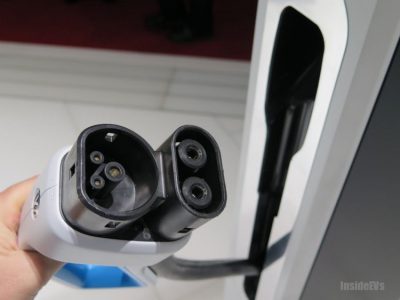
European CCS

“Shell is pleased to join CharIN as a Core member, and looks forward to being an active participant looking at charging infrastructure, communication and grid integration.”

This year, Shell intends to install charging stations primarily in the UK, followed by expansion into other countries.

At the same time, Shell also seems to be interested in smart home charging:

“Shell is already actively developing systems designed to serve the growing number of customers driving electric vehicles. From 2017, Shell will launch electric vehicle fast charging at a selection of Shell forecourts in the UK, with other countries to follow, to serve the ‘on the go’ charging needs of customers.

Shell is also in the early stage of launching an offer to customer fleets in Europe and the US, delivering more efficient charging for their electric vehicles via the use of Shell’s own smart charging technology. This technology can help to both reduce charging costs for customers and integrate this new demand effectively into the power grid. Smart charging technology also optimises the integration of renewable energy sources, by shifting the charge of electric vehicles to a period of the day when supply of electricity from those sources is high. Shell is also developing a R&D technology programme on electric vehicle charging and infrastructure.”

Matthew Tipper, Vice President Shell New Fuels said:

“A range of different fuels and vehicle technologies will be needed to meet growing demand for transport in a low carbon energy future. Electric vehicles are one of these solutions. We are pleased to join CharIN and take part in the efforts to develop common standards for the technology that will support the increasing number of electric vehicles on the roads wherever and however they charge”.

Source: Inside EVs

Cheap Motoring

EVs: Is the grass really greener with electric vehicles?

In the last decade the challenges faced by fleet managers have dramatically changed. From fuel price volatility to changes in technology that allow fleet managers to monitor vehicle usage and efficiencies – the job for a fleet manager is considerably different to ten years ago. One thing that has remained, however, is the strive towards greener fleet management.

Changes in corporate and social regulations which increase sustainability plus growing demand for cost reductions encourage fleet managers to source greener alternatives that aren’t too costly.

Despite everyone talking about it, there is a surprising lack of clarity to help managers make the right moves towards greener fleets. There are several hurdles to get over before the process can begin, staff buy-in and initial upfront costs, to name a few – however once these are addressed, there are so many benefits.

1. Electric Vehicles (EV)

Fleet managers wanting to make a conscious effort to be greener should look to switching their fleets to electric vehicles. EVs have often had a perception challenge surrounding battery range, with many citing this as a major reason for not investing in EV. Yet, in recent years, Plug-ins, Hybrid and EV technology and range has increased to up to 500km, bringing about a significant change.

As infrastructure improves, more public charge points are available and most EVs come with smart technology that allows you to locate the nearest charge point to your location.

‘Refuelling’ is minimal cost and once the actual foundations have been put in place e.g. installing dedicated equipment, charging can take place at home or work.

2. Cost reduction and savings

Reducing overall costs for any manager is a constant uphill battle. For a fleet manager, keeping an eye on costs is probably the number one challenge and the pressure to save money is persistent. Volatile fuel prices means it can be tricky to keep a handle on predicted costs and some fleet managers can find themselves trying to make cuts in other places, like maintenance.

The government has also put in place schemes to incentivise anyone thinking about making the switch; low or zero road tax and exemption from the London Congestion Charge are both benefits of moving to the renewable energy way of driving.

With low carbon dioxide emissions comes low tax. Businesses with low CO2 emissions benefit from corporation tax relief and allowances as well as lower national Insurance payments.

3. Hybrids and Plug-ins

Another consideration is to look at the use of Hybrid and plug-in hybrid vehicles. This option gives drivers the best of both worlds and is probably most chosen by those wanting to go green but aren’t entirely confident in full EVs yet.

As mentioned previously, one of the big hesitations among drivers when switching from fuel to EV is ‘what if I run out of charge and become stranded’. Fleet managers who face hesitation from nervous drivers worried about being stranded with no means of charging should take a look into hybrid vehicles as they could be just the solution they need.

4. Good brand reputation

Companies that are seen to be making greener decisions and moves are praised. Most organisations now have carbon reduction or corporate social responsibility targets and it’s very much seen as ‘the thing to do’.

Sustainability is the buzzword for many businesses and some big players are investing efforts and money into activity that is driving their social efforts into the public eye. But this shouldn’t be the only reason for adopting greener initiatives.

Read more: Fleet News

Hyundai announces pricing for Ioniq Electric subscription service

When we first drove the Hyundai Ioniq Electric, we learned about a unique subscription program that would be available for Hyundai Ioniq Electric buyers in California.

Instead of a traditional purchase or lease, it would be a no-haggle program with unlimited mileage and service and wear items covered. At the time, though, Hyundai didn’t have pricing set for the program. Now it does.

It also has a name. It’s called Ioniq Unlimited+. The way it works is that after a consumer has their credit approved, they put down an initial $2,500 payment, and then pay a set monthly fee for the 36-month term. Pricing varies depending on the trim level of Ioniq Electric. The base model has a monthly fee of $275, the Limited goes for $305, and the Limited with the “Ultimate” package costs $365 per month. All of those prices are before tax.

The advantages to this program over a typical lease are in all the included goodies. The initial tax, title, license and fees are covered with the down payment, drivers have no mileage caps, and charging, service, and wear items are all covered for 50,000 miles. If you’re interested, hopefully you live in California, since that’s the only state in which the program is offered. But, if the program is successful, there may be a chance it expands to other models and regions.

Source: autoblog