Recent studies have suggested that electrically powered vehicles could become more affordable within the next five years.
The revolution of electric cars got off to a somewhat slow start in the UK, but figures have been slowly improving over the last few years with sales in 2015 reported to be around 49,700.
With the battery pack accounting for around 25 per cent of the overall price, electric cars were somewhat unaffordable on their initial launch.
However, research conducted by Nature.com highlighted battery pack prices (measured by the cost per kilowatt-hour) fell by around 80 per cent between 2010 and 2016, causing vehicles sales to soar in the UK.
Using current trends and patterns, optimistic researchers have predicted electric car battery prices might pass the affordability threshold soon after 2020, with overall sales figures said to be at a staggering 1.6 million in the UK alone.
However, more conservative forecasts have predicted vehicle battery packs will hit the affordability threshold by 2030, with sales figures estimated to be at around 13.6 million.
Four decades ago, the electric car looked set to be an acceptable commuting vehicle within a few years.
From 1977: “The electric car seems inevitable. As oil resources dwindle, it will appear far more prudent to develop an automobile powered by electricity, charged by an already-in-place power generation system, than to invest in huge plants to produce synthetic gasoline. Electric automobiles would snuggle nicely into a large, unexploited niche in the electric economy by recharging at night when electric demand is low and power plant capacity idle.
“But as yet electric cars have proven abysmal technical failures. For example, in its 1975 tests of two electric cars on the market, Consumer Reports magazine found ‘major safety and operating problems.’ The cars performed poorly, not even living up to their modestly advertised abilities. They accelerated sluggishly, balked at hills, and petered out at inopportune times. The magazine declared that ‘it would be foolhardy to drive either car on any public road.’ The electric cars now on the market have a range of only about 30 miles at 50 miles per hour, with 0-to-30 acceleration times of about 12 seconds. What’s more, the cars were not significantly cheaper to run than comparable gasoline-powered subcompacts.
“Two test electric vehicles recently commissioned by the Energy Research and Development Administration could mark some resurgence for the electric car. The two electric car versions are being built for E.R.D.A. by General Electric Co. and AiResearch Manufacturing Co.
“Both vehicles will possess about the same range and performance characteristics—70 miles between charges, 60-mile-an-hour speeds, and 0-to-30 m.p.h. in about eight seconds. They will also both be about the size and weight of a conventional subcompact, and will operate for about the same costs as a conventional car.”
BRUSSELS – The European Commission is considering the introduction of a ‘zero emission vehicles’ (ZEV) mandate.
If translated into legislation this means that Europe’s car makers will have to comply with minimum quotas for the production and sales of zero emission vehicles. Such a move will give an unprecedented push to the supply of electric vehicles in Europe, while putting an end to the transport sector’s stubborn CO2 emissions which have seen no significant decline over the past decade and still remain higher than in 1990.
he introduction of a ZEV mandate is being deliberated as the EU regulation setting CO2 standards for new cars and vans (together referred to as light duty vehicles) is currently undergoing reform. Late last year the Commission conducted a public consultation, to which Bellona submitted its views, strongly supporting the tightening CO2 standards, and the inclusion of a targeted mechanism, mandating quotas for the sales of zero emission vehicles. The Commission’s legislative proposal is expected later this year, following which it will be handed over to the European Parliament and Member States.
Meeting the EU’s target of reducing CO2 emissions from transport by 60% and eliminating the use of fossil fuels in cars by 2050 will necessitate immediate efforts to transition to a low- and zero-emission transport sector. Existing CO2 legislation has fallen short in doing so however, largely as a result of the inadequacy of the EU vehicle emission testing regime (the NEDC test) which has accompanied fuel economy standards and thus allowed car makers to systematically cheat their way into compliance.
Global warming will not affect everyone equally. Here we look at seven key regions to see how each is tackling the consequences of climate change
It could have been the edge of the Sahara or even Death Valley, but it was the remains of a large orchard in the hills above the city of Murcia in southern Spain last year. The soil had broken down into fine white, lifeless sand, and a landscape of rock and dying orange and lemon trees stretched into the distance.
A long drought, the second in a few years, had devastated the harvest after city authorities had restricted water supplies and farmers were protesting in the street. It was a foretaste of what may happen if temperatures in the Mediterranean basin continue to rise and desertification grows.
All round the world, farmers, city authorities and scientists have observed changing patterns of rainfall, temperature rises and floods. Fifteen of the 16 hottest years have been recorded since 2000. Carbon dioxide and other greenhouse gas emissions steadily climb. Oceans are warming and glaciers, ice caps and sea ice are melting faster than expected. Meanwhile, heat and rainfall records tumble.
The evidence for the onset of climate change is compelling. But who and where is it hitting the hardest? How fast will it come to Africa, or the US? What will be its impact on tropical cities, forests or farming? On the poor, or the old? When it comes to details, much is uncertain.
Mapping the world’s climate hotspots and identifying where the impacts will be the greatest is increasingly important for governments, advocacy groups and others who need to prioritise resources, set goals and adapt to a warming world.
Plug in Hybrid options are beginning to cascade across the entire lineup of BMW’s core offerings. BMW designates these PHEVs as the iPerformance line with the marketing tag line; “Charging is optional, thrilling is not”. The X5-40e was the first to market in October 2015, then came the 330e in March of 2016, followed by the 740e nine months later. Now, it’s the 5 Series that’s getting the “e” treatment, with the introduction of the 530e iPerformance.
BMW of North America was kind enough to allow me an exclusive extended test drive of their latest iPerformance offering. Having it for nearly three weeks, I was able to get a good feel for how well the eDrive system works, how it performed, and what to expect in terms of fuel efficiency.
The 530e iPerformance comes with a turbocharged 2-liter inline 4-cylinder engine which, along with the synchronous electric motor combine for an output of 255hp and 310 lb-ft of torque. That’s enough power to propel the rear wheel drive 530e from 0-60mph in 6.1 seconds, and 5.8 seconds for the xDrive version (which I had), according to BMW. Top speed is 146 mph, and the maximum speed in all electric mode is 87 mph.
However, I noticed that the maximum speed in all electric mode diminishes as the state of charge depletes. So, while you start out with a top speed of 87 mph, it may be as low as 65 mph once the battery state of charge is under 10%.
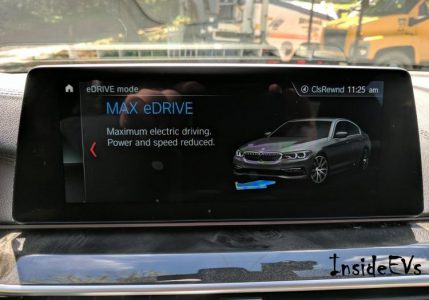
In MAX eDRIVE mode, the 530e will remain in all-electric mode up to 87 mph, until the battery is depleted. However, if the driver fully depresses the accelerator, the ICE will fire up to supply added power.
There are three driving modes: Max eDrive, Auto eDrive and Battery Control. The car defaults to the blended mode of Auto eDrive, which combines the gas and electric power supply to increase efficiency. In Auto eDrive the car decides when it’s best to be in all electric mode, and when to blend the power. It works very well, and I was pleased to see the car wants to drive in electric mode as much as possible, and only turns on the ICE when more power is needed or when the battery SOC is low.
I found that this is probably the most efficient mode to use if you are driving long distances. If you’re going to be driving less than 40 miles, the Max eDrive mode would be the best choice. It keeps the car in all electric mode until the state of charge is depleted, and then the ICE kicks on.
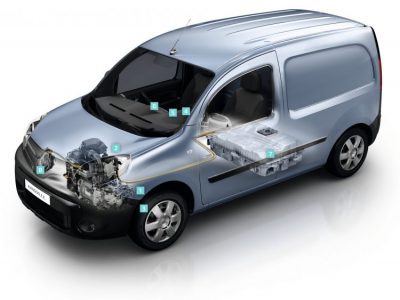
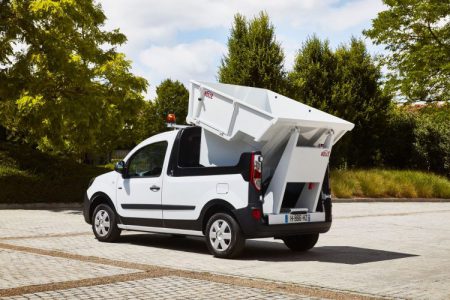
This summer Renault is introducing four major upgrades for the Kangoo Z.E. – a new battery, a new motor, a new charger and the incorporation of a heat pump for the climate control system.
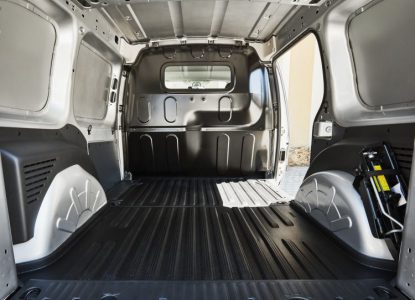
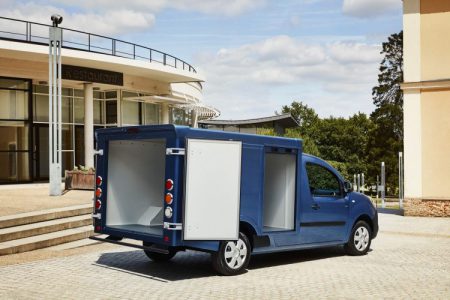
Renault Kangoo Z.E. (Z.E. 33)
The battery option is the new Z.E. 33 (33 kWh), which extends range by around 50% compared to previous one:
270 km (168 miles) NEDC compared to 170 km
200 km (124 miles) real range in the summer (previously 125 km)
120 km / 135 km (84 miles) with heat pump in the winter
The new electric motor is still rated at 44 kW (225 Nm), but this time it’s all-Renault designed and produced, which should help with costs.
On-board charger power has (thankfully) doubled to 7 kW (now required 6-hours for a full recharge).
And finally, for the very first time in an electric LCV, there is a heat pump. Additionally, Renault has implemented a pre-heating feature. All welcome additions.
Milton Keynes already has a great reputation for its support of Electric Vehicles, from its vast infrastructure of electric charge points to the UK’s first Electric Vehicle Experience Centre due to open later this month.
Now TESLA the American automaker, energy storage and solar manufacturer has set up shop in Milton Keynes Intu shopping centre, displaying their high end electric cars in an impressively slick showroom.
Strolling past this afternoon it was certainly eye catching and there seemed to be a genuine buzz from many passers-by when they noticed the giant letters spelling ‘TESLA’.
The two story car showroom isn’t the first to appear in the Milton Keynes Shopping Centre, a Mercedes store appeared a few weeks previous. This new trend seems to coincide with a greater change and understanding of how consumers are now purchasing. The idea of viewing a car in a showroom and then ‘shopping online’ for the best price is becoming ever so much more the norm, much like shopping for the latest smart TV.
Panasonic Corp. sees the future of solar on car rooftops.
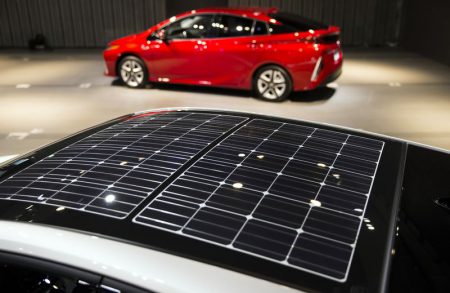
The Osaka-based electronics maker has started producing a 180-watt array of solar cells that can be fixed to the roof of an automobile. In February, Panasonic announced that its photovoltaic module would be used on the roof of Toyota Motor Corp.’s latest Prius plug-in hybrid.
Cars represent a potentially lucrative new outlet for solar cells in an industry where intense competition from Chinese manufacturers has pushed down prices sharply. That’s prompting some manufacturers to adapt solar cells for everything from home roofing tiles and the outer skins of buildings to backpacks and tents.
Solar panels on the roof of Toyota Motor’s Prius plug-in hybrid vehicles (PHV). Photographer: Tomohiro Ohsumi/Bloomberg
“Car roofs have the potential to become a new market for solar panels,” Shingo Okamoto, the general manager at Panasonic who was in charge of developing the technology, said. “We made history in the auto industry and in the solar industry with the sun powering mass-produced cars for the first time in the world.”
New Market
Cars could hold the promise of a giant new market for solar panels from Panasonic, which also is partnered with Tesla Inc. in making batteries at its Gigafactory outside Las Vegas. There are 264 million cars and light trucks in operation in the U.S., according to the National Automobile Dealers Association.
Others are noticing the potential. Tesla Chairman Elon Musk tweeted in November that his company’s Model 3 car may come with a solar roof. He’s also beginning to sell a type of roof tile for homes featuring embedded photovoltaics. Nissan Motor Co. offers an add-on solar panel option for its Leaf electric cars, giving extra charge to systems such as the air conditioners and radios, according to Nicholas Maxfield, a spokesman for the company.
Mayor of London Sadiq Kahn has revealed the proposals that will help achieve his aim of dramatically cutting vehicle emissions in the capital. The plan is to make London’s transport network zero-emission by 2050.
The Ultra Low Emission Zone and T-Charge proposals are already confirmed to come into force in the near future, but zero-emission zones will be launched in phases, with central London and town centres first from 2025, inner London between 2035 and 2040, and a blanket London-wide zone by 2050.
Between now and 2025, a ‘major expansion in electric vehicle charging points’ is planned, along with the installation of at least 15 hydrogen refuelling stations in and around London. These investments in infrastructure will continue in a significant manner to encourage expansion until at least 2035.
In terms of public transport, all new buses bought will be hybrid, electric, or hydrogen, before all buses operating in the capital being zero-emission of hybrid from 2030. All buses will be zero-emission between 2035 and 2040.
All new taxis will need to be zero-emission capable from the beginning of next year, with the same rule for new private hire vehicles by 2025. From 2030, only zero-emission capable taxis and private hire vehicles will be able to operate in London.
The overall aim of these proposals is to improve air quality and reduce congestion. Despite a predicted expansion in London’s population to 10.5 million over the next 25 years – with a forecast additional 5 million trips each day by 2041 using current models – Kahn’s plans aim to cut the number of car journeys by three million each day.