All posts by Jo

Elon Musk: more than half of new vehicles will be electric and almost all autonomous in the US within 10 years

We have recently seen several projections about the adoption of electric vehicles from different companies and research groups, like Morgan Stanley, Bloomberg, and even OPEC. Most of them predict that about half of new vehicle production will be electric at some point between 2035 and 2040.

Now Tesla CEO Elon Musk jumps in with his own prediction, which is unsurprisingly much more aggressive.

At the National Governors Association today, Musk said that he expects “more than half of new vehicles” will be electric in the US within the next 10 years or roughly 10 to 15 years ahead of most predictions. He said:

“I think things are going to grow exponentially. There’s a big difference between 5 and 10 years. My guess is probably in 10 years more than half of new vehicle production is electric in the United States.”

We gave a similar prediction back in May when Morgan Stanley projected that electric vehicle sales will surpass gas-powered cars by 2040. We suggested that due to rapidly falling battery costs, there will be a point between 2020 and 2025 when all-electric powertrains reach cost parity with internal combustion engines before accounting for the cost of operation (gas and maintenance savings).

At that point, there will be virtually no reason for buyers to want gas-powered cars over battery-powered cars and automakers will divert all their investments to electric vehicles.

Musk specifically referred to new vehicles coming to market in the US – stating that it will take a few more years until all production is electric and then a few more to replace the existing fleet.

Interestingly, Tesla’s CEO added that it will likely happen even sooner in China, where they have been more aggressive with their regulations. He even referenced the fact that virtually all automakers (except for Tesla) are asking the Chinese government to slow down their electric car mandate.

Furthermore, while he expects over 50% of new vehicles to be electric in the US within 10 years, he thinks that “almost all” new vehicles will be autonomous within the same timeframe. Add another 10 years and he thinks that all vehicles will not even feature a steering wheel anymore.

Read more: Electrek
Elon Musk’s big battery brings reality crashing into a post-truth world

For months, politicians and fossil fuel industry have lied about the viability of renewables. Now Tesla’s big battery in South Australia will prove them wrong

Elon Musk’s agreement to build the world’s largest battery for South Australia isn’t just an extraordinary technological breakthrough that signs coal’s death warrant. It’s potentially a game changer in the way we do politics, reinserting the importance of basic reality into a debate which has been bereft of it for too long.

There’s been a lot written in recent years on the idea that we are living in a “post-truth” world. Climate writer David Roberts brought it to my attention around 2010, when I was grappling with the idea that dinosaur politicians and rent-seeking corporates not only weren’t telling the truth about climate change and energy: they were actively dismissive and destructive of the very idea of truth.

While we got a taste for it in Australia under Tony

“don’t believe anything I haven’t written down”

Abbott’s government, the idea sprang into the global mainstream last year with Donald Trump’s election campaign and the Brexit bus.

It seemed that truth no longer mattered. Facts were not just unimportant, but barriers to be smashed through with rhetoric. Demonstrating beyond reasonable doubt that a politician was lying no longer had any impact. Even when people agreed that he (usually) was lying, they still supported him, because he activated a frame or a value that drove their political decision-making.

Read more: The Guardian

Big Oil Just Woke Up to Threat of Rising Electric Car Demand

  • OPEC quintupled forecast for battery powered cars in last year
  • Oil majors and automakers diverge on outlook for EVs

The world’s biggest oil producers are starting to take electric vehicles seriously as a long-term threat.

OPEC quintupled its forecast for sales of plug-in EVs, and oil producers from Exxon Mobil Corp. to BP Plc also revised up their outlooks in the past year, according to a study by Bloomberg New Energy Finance released on Friday. The London-based researcher expects those cars to reduce oil demand 8 million barrels by 2040, more than the current combined production of Iran and Iraq.

Growing popularity of EVs increases the risk that oil demand will stagnate in the decades ahead, raising questions about the more than $700 billion a year that’s flowing into fossil-fuel industries. While the oil producers’ outlook isn’t nearly as aggressive as BNEF’s, the numbers indicate an acceleration in the number of EVs likely to be in the global fleet.

“The number of EVs on the road will have major implications for automakers, oil companies, electric utilities and others,”

Colin McKerracher, head of advanced-transport analysis at BNEF in London, wrote in a note to clients.

“There is significant disagreement on how fast adoption will be, and views are changing quickly.”

BNEF expects electric cars to outsell gasoline and diesel models by 2040, reflecting a rapid decline in the cost of lithium-ion battery units that store power for the vehicles. It expects 530 million plug-in cars on the road by 2040, a third of worldwide total number of cars.

Read more: Bloomberg

Electric cars charging in Milton Keynes (Image: T. Larkum)

Electric car revolution: calculating the cost of green motoring

More battery-powered vehicles would mean cleaner air and quieter streets – but also a drain on the National Grid and less fuel duty to the Treasury

Electric cars ready for free test drives in Milton Keynes (Image: T. Larkum)

Streets will be quieter, the air will be cleaner, people will spend less time at petrol stations and car factories might even return to Britain’s shores if the country switches to electric cars in a dramatic, widespread fashion.

But widespread adoption of battery-powered vehicles would not be without challenges too. A large-scale switchover to electric cars could create problems for power grids, could mean roads lined with charging poles and it could also leave a big hole in public coffers as fuel duty dries up.

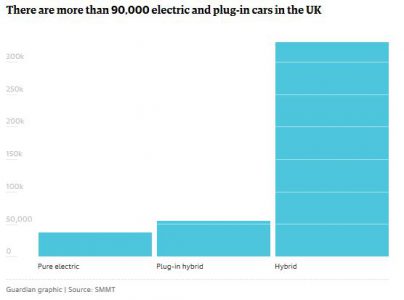
With just over 90,000 fully electric and plug-in hybrid cars now on UK roads, such risks and benefits might look a way off.

But this week big changes have been announced. On Wednesday Volvo said it will only launch electric or hybrid cars from 2019 and just a day later Emmanuel Macron’s new government pledged that France will ban diesel and petrol cars by 2040. Battery-powered travel could be coming far sooner than previously thought.

According to research published this week by Bloomberg New Energy Finance the proportion of fully electric new cars sold in the UK will be one in 12 by 2030 – up from one in every 200 today.

The surge in electric cars will have to be accompanied by thousands of new charging points to plug them all in.

Today there are around 4,000 publicly accessible locations with 13,000 plug sockets. Of the 13,000, a fifth are so-called rapid charging connections that will top up a Nissan Leaf, the UK’s best-selling pure electric car, in half an hour.

Read more: The Guardian

UK electric and plug-in car registrations hit record high

More electric and plug-in hybrid cars were registered during the first half of 2017 than in any previous six-monthly period.

More than 22,400 plug-in models were registered between January and June 2017, a rise of 14.3% on 2016 and 53.8% up on the same period in 2015.

June exceeded all previous non-plate-change months with 4,405 new plug-in models sold during the month (33% up on June 2016). Demand from private buyers has driven growth with 44.9% more consumers opting for plug-in hybrid and electric power between January and June 2017, compared to the same period last year.

Transport minister Jesse Norman said: “It is great to see that electric and plug-in hybrid cars are helping more UK motorists to cut fuel costs and emissions.

“The total number of plug-in cars on our roads is at record levels, with the latest figures showing that there are now over 100,000 plug-in cars and vans registered in the UK.

“The UK is a world leader in tackling climate change and the Government is committed to supporting the transition to a low carbon economy and improving air quality. Our aim is that nearly all cars and vans on our roads are zero emission by 2050.”

The Nissan Leaf was the UK’s best selling plug-in car in the first six months of 2017, while BMW’s plug-in hybrid 3-Series saloon was one of the year’s biggest growers, rising 79.9% following its launch last year.

Poppy Welch, head of Go Ultra Low, said:

“Month after month we’re seeing record levels of registrations, demonstrating that the public awareness and appetite for electric and plug-in vehicles is growing.

“They are fast becoming a serious consideration for an increasing number of motorists who are switching on to the cost-saving and environmental benefits of driving an electric car.”

Read more: FleetNews

The post-Brexit future of the UK’s electric transport industry

According to the latest edition of the International Energy Agency’s Global EV Outlook, the number of electric cars in motion has to reach 600 million by 2040 in order for the current greenhouse gas emission target of temperature increases below 2°C to be reached and maintained.

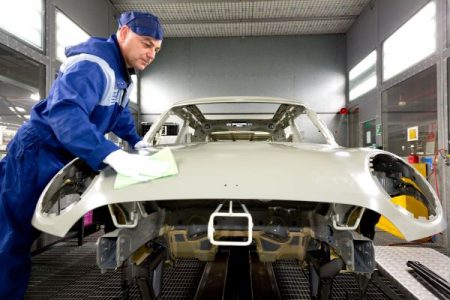
A MINI chassis receives a polish at BMW’s Oxford plant. Source: BMW

Currently, we are nowhere near this figure, as only 0.2% of total light-duty vehicles were EVs in 2016. The figure is estimated to rise to 20 million vehicles by 2020, without taking into account regional politics. Is this estimate realistic when regional political uncertainty is included in the equation? Take, for example, the European perspective –Brexit could have a negative impact on the EV industry, especially under a Conservative government which was more inclined to drop the European gas emission targets a year ago. A year after the Brexit vote, relations between Europe and the UK may be looking at a bleak future, but neither should be short of ambition to make the best of their decarbonisation efforts.

Immediate reactions

A year ago, the Brexit vote triggered the immediate reaction of the British automotive sector to demand from the UK Government protection of the current tariff arrangements, as according to SMMT’s estimations a change in import tariffs could result in an increase of up to £1,500 per purchase if the retailers were unable to cover the additional costs.

Additionally, a report by PA Consulting has estimated that the cost of assembling a car in Britain could increase by £2,370 in the event of a hard Brexit. With more than 30 manufacturers based in the UK, accounting for over £69.5 billion of annual turnover, such an unfavourable change in tariff arrangements with the EU would cause stagnating sales, as the EU still remains the biggest market for vehicle parts from the UK.

Threats of relocating the plants outside of the UK were raised by carmakers, such as Nissan, whose production of Nissan Leaf EV in Sunderland accounts for 400,000 units annually. Nissan went as far as suing the Leave campaign for using their logo. On the other hand, BMW tried to remain cool-headed, hinting that its production network spread out across 31 locations in 14 other countries provides enough flexibility for the manufacturer to relocate the production of new models, such as the first battery-powered version of the Mini expected to go on sale in 2019.

In the window of Brexit negotiations, the ambition of UK-based manufacturers still remains focused on developing electric power trains. Depending on the final tariff arrangements in the near post-Brexit future, the electric transport industry might be negatively affected by the fleet of consumers to cheaper alternatives, meaning that more electric incentives have to be provided by the UK Government. However, there are positive consequences for British manufacturers to get up to speed with their own EVs.

Read more: Electrans

Electric cars to account for all new vehicle sales in Europe by 2035

Falling battery costs to drive sales but European carmakers will lose out to rivals in the US and Asia, forecasts Dutch bank

All new cars sold in Europe will be electric within less than two decades, driven by government support, falling battery costs and economies of scale, a Dutch bank has predicted.

However, ING warned that with battery-powered vehicles accounting for 100% of registrations in 2035 across the continent, European carmakers would lose out to their rivals in the US and Asia who already lead on battery production.

The forecast is much more aggressive than most other projections, such as the UK’s National Grid which on Thursday said it expects 90% of new cars in Britain to be electric by 2050.

France’s commitment last week to banning new petrol and diesel car sales by 2040 suggests it also thinks the roll-out of electric vehicles will be slower than ING’s report expects.

However, the bank said that it believed pure electric cars would “become the rational choice for motorists in Europe” sometime between 2017 and 2024, as their car showroom prices fall, their ranges increase and charging infrastructure becomes more widespread.

By 2024, the report’s authors forecast that in Germany the cost of ownership for an electric car – including buying and fuelling it – would be the same as a conventional petrol or diesel model.

Read more: The Guardian

Fleet in focus: Chargemaster

Chargemaster uses electric vehicles on its own fleet to prove to companies that plug-in cars make good business sense, John Maslen discovers.

The company behind the country’s biggest electric vehicle (EV) recharging network is now using its fleet to prove the significant potential of zero-emission motoring in business.

Chargemaster is used by thousands of private owners, businesses and councils, with more than 50,000 customers across the UK and Europe. In the UK, it operates the Polar network, which has more than 5,000 recharging points.

It is also the official charging partner for most of the leading plug-in vehicle manufacturers, including BMW, Kia, Mercedes-Benz, Mitsubishi, Nissan, Renault and Toyota, along with a range of other fleet providers, such as leasing giant Alphabet.

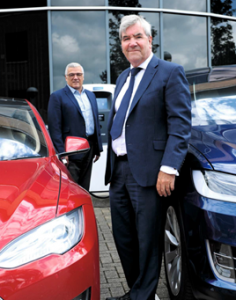
For Chargemaster’s founder and chief executive officer, David Martell, the company’s own vehicle choice is a public vote of confidence in the future of electric vehicles within the fleet market.

He says:

“We are showing customers through our vehicle choices that we are serious about the potential growth in the market. We are also giving them confidence that plug-in vehicles are a viable fleet choice.”

Chargemaster operates a fleet of around 40 electric cars, including battery electric vehicles (BEV), range-extenders and plug-in hybrid electric vehicles (PHEVs).

They are used for everything from management cars to vehicles for sales staff and pool cars, with models including the BMW i3, Nissan Leaf, Mitsubishi Outlander, Renault Zoe, Vauxhall Ampera, Volkswagen e-Golf and Tesla Model S.

From its Luton headquarters, the company serves customers throughout the country, so different types of technology are allocated for different types of usage.

For example, drivers who cover higher mileages, such as sales staff, will receive range-extenders or PHEVs, while managers with lower mileages can operate BEVs.

Read more: FleetNews

OVO Vehicle-to-Grid (V2G) charging (Image: T. Larkum/Fuel Included)

UK to fund research into letting electric cars return power to grid

Vehicle-to-grid technology could help meet demand for electricity at peak times, with owners paid in money or free parking

OVO Vehicle-to-Grid (V2G) charging (Image: T. Larkum/Fuel Included)

British businesses will be able to bid for £20m of government funding for undertaking research and trials of vehicle-to-grid technology, which officials believe holds “enormous potential” benefits for drivers and the energy system.

The announcement comes on the heels of a week of good news for electric car manufacturers and battery-makers.
Volvo said it was turning its back on cars powered solely by an internal combustion engine, France declared it would ban sales of diesel and petrol cars by 2040 and Tesla revealed plans to build the world’s largest battery storage plant in South Australia.

There are now more than 90,000 electric or plug-in hybrid cars on UK roads, which currently only draw electricity from the grid when owners recharge them overnight at home or for half an hour at rapid charging stations in towns, cities and motorway service stations.

But with vehicle-to-grid, their batteries could also provide services to local power networks and National Grid – returning electricity to the grid at times of peak demand, or filling the gap if the output from windfarms or solar panels were suddenly less than expected.

Read more: The Guardian

Nissan Expects 20% Of Its European Sales Will Be EVs By 2020

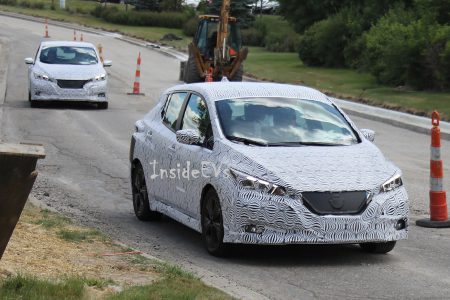
Nissan must be pretty sure of finding success with the next generation 2018 LEAF (which debuts in September), as the Japanese company expects that up to 20% of its new auto sales in Europe to be zero emission in just 3 years time. Nissan has also stated that two more all-electric vehicles will arrive between now and the end of this decade.

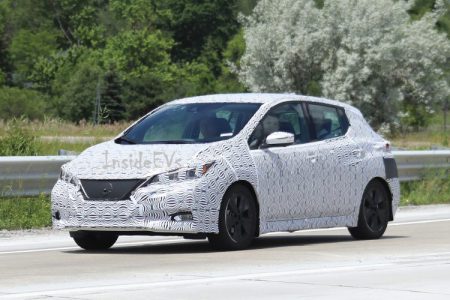
2018 Nissan LEAF spyshot

The statement on EV sales in Europe comes from Gareth Dunsmore, Electric Vehicle (EV) Director for Nissan Europe, after the French environment minister hinted at end of gas and diesel sales entirely by 2040.

“By 2020, where the market conditions are right, I’m confident we’ll be selling up to 20 percent of our volume as zero emissions vehicles and this will only grow,”

Dunsmore via Reuters.

What does 20% mean for Nissan in raw sales?

Well, in fiscal year 2016 Nissan sold 735,725 vehicles in Europe, so 20% of that would be more than 147,000 EVs! That’s a lot, but if the new LEAF is reasonably priced, and the new offers are competitive, then it also seems doable at the same time.

As for those “other” offerings: Freshly minted Nissan CEO Hiroto Saikawa has said his company will bring two new all-electric vehicles to market over the next two years, while recently retired Nissan Chief Engineer Shiro Nakamura gave some background on what those new EVs might be, as he said Nissan plans for a BEV sedan and a utility vehicle.

The pending arrival of the new 2018 Nissan LEAF has had little effect on current generation sales…thanks to some deep discounting!

In 2016 Nissan sold some 23,000 EVs (18,500 LEAFs and less than 4,500 e-NV200).

But what do we really like about this 20% figure Nissan is putting out there? It’s the fact that Nissan isn’t just talking about a new EV to being introduced in 2020, or an ambitious fleet goal set for so far away that they can’t be accountable for it (like 10 years from now)…but one that is only some ~30 months away.

Source: Inside EVs