Monthly Archives: August 2019

Audi e-tron (Image: Audi)

The best cars eligible for zero per cent benefit in kind in 2020

The government has announced that it is reducing the amount of company car tax that buyers of electric vehicles will be charged in a bid to accelerate the switch to zero-emission vehicles.

For 2020, buyers of all-electric vehicles will be charged zero per cent benefit in kind, with this increasing to one per cent in 2021 and two per cent in 2022.

That means there are potentially massive tax benefits to be had for company car drivers who make the switch – but which EVs are best to take advantage of these savings? We’ve outlined some of our favourites.

Audi e-tron

If you’re looking for a company car, premium appeal, lots of space and a long range are important – and that’s where the e-tron comes in.

Audi e-tron (Image: Audi)

Audi’s first vehicle built to be an EV from the ground up has won plaudits for being a great-to-drive electric SUV that doesn’t require compromises to own. With a range of 237 miles and the ability to charge at 150kW, range anxiety should be a thing of the past.

Read more: AOL
Cheap Motoring

Electric car models to triple in Europe by 2021

The number of electric car models available to consumers in Europe is expected to triple by 2021, says a European environmental lobby group.

The uptake of electric cars has been stalling, blamed on a lack of charging infrastructure and higher prices.

Latest data shows carmakers will offer 214 electric car models in 2021, up from 60 models at the end of 2018.

More affordable options could see consumers switch from petrol and diesel cars sooner than anticipated.

Analysis by the European Federation for Transport and Environment (T&E), based on data by research firm IHS Markit, suggests that car manufacturers are now ready to embrace car electrification.

Cheap Motoring

In 2021, carmakers are forecast to bring 92 fully electric models and 118 plug-in hybrid models to market.

If they stick to these plans, 22% of vehicles produced could have a plug by 2025, which would enable manufacturers to easily meet the EU’s car CO2 emissions target of 95g/km by 2025.

The biggest electric car production plants will be in Germany, France, Spain and Italy, the data shows. Some 16 large-scale lithium-ion battery cell plants are confirmed or due to begin operations in Europe by 2023.

“Thanks to the EU car CO2 standards, Europe is about to see a wave of new, longer range, and more affordable electric cars hit the market,” said Lucien Mathieu, a transport and e-mobility analyst at T&E.

“That is good news, but the job is not yet done. We need governments to help roll out electric vehicle charging at home and at work, and we need changes to car taxation to make electric cars even more attractive than polluting diesel, petrol or poor plug-in hybrid vehicles.”

Read more: BBC

Electric Vehicle Sales Are Exploding In Europe

The next two years are likely to be the tipping point for electric vehicles (EVs) going mainstream in Europe, as the number of electric car models on the European market is set to more than triple in the next three years, Transport & Environment (T&E), Europe’s leading clean transport campaign group, says in a new analysis.

According to T&E, which analyzed the upcoming offerings using data from authoritative industry source IHS Markit, the number of EV models made across the European Union (EU) will jump from around 60 models available at end-2018 to a total of 214 battery electric (BEV), plug-in hybrid (PHEV), and fuel cell (FCEV) models in 2021, and further up to 333 models in 2025.

“Until recently, the EV market was limited to a niche of early adopters but tomorrow’s landscape will be very different as EVs enter a new phase and near the mass market,” the report from T&E says.

Based on IHS Markit’s light vehicle production forecast data and in-house T&E analysis, the production of EVs in Europe is set to surge six-fold between 2019 and 2025, reaching more than 4 million cars and vans. This production volume would account more than a fifth of the EU car production volumes.

EV manufacturing will be replacing diesel-fueled car making across Europe, with the largest production sites in western Europe—Germany, France, Spain, and Italy, T&E’s analysis shows. In central and eastern Europe, Slovakia, the Czech Republic, and Hungary are also expected to be significant EV production centers.

Read more: Oil Price

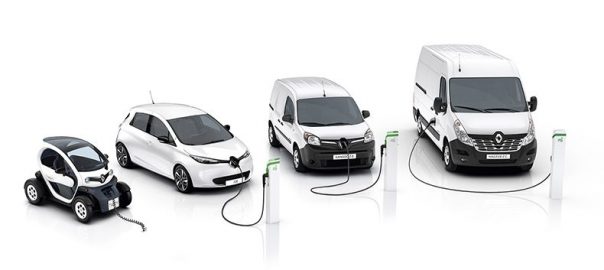
The Renault Electric Z.E. Range (Image: Renault)

Renault EV Sales Strongly Increase In June 2019: 3rd Best Month Ever

Both the Renault ZOE and the Kangoo Z.E. sell like hot cakes

Renault noted a very strong electric car sales results in June 2019, delivering some 6,418 cars (excluding Twizy), which is 45% more than a year ago.

After six months, sales amounted to 30,659 YTD (up 43%):

  • Renault ZOE (passenger and commercial versions) – 5,309 (up 49%) and 25,686 YTD (up 44%)
  • Renault Kangoo Z.E. – 1,036 (up 22%) and 4,759 YTD (up 31%)
  • Renault Master Z.E. – 73 (up 3,550%) and 214 YTD (up 1,845%)

A great June (the third-best month ever) means that the unveiling of the all-new Renault ZOE Z.E. 50 in mid-June didn’t decrease demand for the outgoing generation of ZOE – at least not immediately.

Renault lineup – from left Twizy, ZOE, Kangoo Z.E., Master Z.E.

This past month BEVs accounted for close to 2.4% of all cars sold by Renault globally and 3.9% in Europe (where almost all Renault EVs are sold).

Source: Inside EVs

MG ZS EV (Image: Auto Express)

New MG ZS EV 2019 review

Can MG’s ZS EV match the established players in the compact electric SUV class?

Verdict 4 stars
The MG ZS EV isn’t about to set new benchmarks on dynamics. But as an overall proposition, with that aggressive pricing, the practicality and low running costs factored in, it is by far the best effort yet from the ‘reborn’ MG brand. And one that deserves to find its place as a real alternative to the likes of the Renault Zoe and Nissan Leaf – particularly amongst electric car customers, second-car families and company car choosers, who tend to be more focused on ease of use and battery ranges than they are the badge on the nose.

The MG ZS has garnered a reputation for being one of the more practical small SUVs on the market – a vehicle that sits between the likes of the Nissan Juke and Qashqai on size, while competing hard on price. Now, though, the range is being bolstered by the ZS EV – a pure-electric version that has the potential to radically shift MG’s brand perception with British buyers.

MG ZS EV (Image: Auto Express)

In fact, if the stories about pent-up demand for small EVs are indeed true, the ZS EV surely has the potential to become MG’s best-selling vehicle in the UK. That’s because the British division has access to decent supply of the vehicle, which is made in China, where MG and sister firm Roewe shifted 140,000 EVs in 2018 alone, and a recently opened battery factory can supply up to 300,000 vehicles per year. When the likes of the Hyundai Kona Electric and even the Kia e-Niro are stifled by long waiting lists, there’s a clear opportunity for MG to steal more than a few customers.

The ZS EV can’t compete with those Korean models on range but then, it’s undercutting them both on price anyway (and then some – more of that later). The battery capacity is 44.5kWh – enough, under the tougher WLTP test regime, for an official range of 163 miles – some way short of the e-Niro’s 282 miles, but pretty much on a par with the likes of the current 40kWh Nissan Leaf (168 miles). The WLTP city range, incidentally, is 231 miles – a sign of how much more sympathetic urban driving is to battery life.

Read more: Auto Express

Engenie maps out plans to double UK rapid chargers by 2024

Engenie is set to double the number of rapid chargers in the UK, installing over 2,000 by 2024.

The move comes after a £35 million investment commitment from European infrastructure fund Cube Infrastructure Fund II.

In May, data from Zap-Map revealed there were 2,189 rapid chargers across the country. This figure has since increased to 2,296 at 1,573 locations. Engenie’s plans for the installation of over 2,000 chargers will effectively double the number of rapid chargers in the UK.

The rapid charging points are to be installed at accessible public sites, including supermarkets and retail parks. By the end of this year, 100 sites are to have rapid chargers installed.

Engenie’s charge points don’t require a membership of connection fee, operating a contactless payment method. The 50kW chargers are compatible with all EVs currently on the market.

Read more: Current News