Monthly Archives: December 2018

Hyundai Kona Electric (Image: Hyundai)

Hyundai Kona Electric vs Mitsubishi Outlander PHEV vs Toyota C-HR

Is the all-electric Hyundai Kona a better SUV buy than a Mitsubishi Outlander PHEV or the hybrid Toyota C-HR?

As emissions regulations become ever more stringent, car manufacturers are increasingly looking for ways to cut down their models’ CO2 outputs – or eradicate them altogether.

This in turn means buyers who take the plunge have to fork out less money on their vehicles’ running costs. But if you’re looking to buy an Alternative Fuel Vehicle, what’s the best way to go?

Hyundai Kona Electric (Image: Hyundai)

There are many different types of technology in the marketplace, so to make sure you choose the right approach for your needs we’ve lined up three of the best alternatively-fuelled SUVs on sale today. In the all-electric camp is the Hyundai Kona Electric, our favourite affordable EV. Representing plug-in power is the Mitsubishi Outlander PHEV, Britain’s best-selling plug-in hybrid car, and flying the flag for conventional hybrid technology is the Toyota C-HR.

We really like all three models because of their ability to save fuel (or energy). So over the course of this test we’ll outline exactly how the tech in each car works, how to get the most from them and what you can expect from them day to day as we pick a winner.

Hyundai Kona Electric

If you’re looking at an electric car there’s a growing number to choose from, but the Hyundai Kona Electric is our current favourite affordable EV. Here we’re running the rule over the 39kWh model in Premium trim, at £28,720.

Electric cars are all about easy performance, and there’s plenty present here. The Kona Electric covered 0-60mph in 8.6 seconds (the fastest of the three cars), with an instant and impressive hit from 0-30mph. Acceleration tails off after this, but there’s still enough zip at motorway speeds for overtakes.

This is where the Kona is most comfortable, absorbing bumps with a welcome level of elasticity. Around town it’s also good; it’s just on twistier country roads (when the Kona’s chassis is being asked to cope with more) where it loses composure. It’s never uncomfortable, though.

Read more: Auto Express

Electric Car Line-up (Image: Go Ultra Low)

What could lead to an electric vehicles inflection point?

Traditional auto manufacturers and middle distillate refiners should be wary that a niche technology could be about to snowball into full-scale disruption

Clayton Christiansen’s classic business book The Innovator’s Dilemma argues that value to innovation is an S-curve, with a long initial phase of relatively slow value growth followed by an explosive ramp-up once the disruptive innovation reaches an inflection point. Data from China and the US and China suggest that electric vehicles (EVs) might be at least close to hitting said point.

Electric Car Line-up (Image: Go Ultra Low)

“If you look at how policy is currently lined up, … EVs will be taking a 20% market share for new vehicles in China by 2025,” says Hui He, senior researcher and policy analyst at the San Francisco-based International Council on Clean Transportation (ICCT). The ICCT analyses policy to suggest likely outcomes, and the data says the 2025 outcome is likely. In August, Chinese EV sales hit 100,000 units, a new monthly record, putting cumulative EV sales for the year to date at 600,000. The most optimistic forecasts for full year 2018 sales were just shy of 1m at the start of year but may now need to be revised to at least 1.1m and even as much as 1.3m, as, like in the US, Chinese auto sales tend to be at their strongest in the year’s final four months.

In a Chinese new vehicle market expected to reach 29.2m units this year, EVs may take a 3.8% market share. Next year, with a forecast 1.7% increase to 29.7m new vehicles, EV sales could top 1.6m, or a 5.4% market share, and well on target to reach 20% by 2025 if not before.


Staying alert

The key to achieving a disruption innovation break-out is maintaining high annual growth rates once overall volumes grow to material levels. In the Chinese EV market’s infancy, 100% year-on-year growth rates were unsurprising. But the market, even at much higher sales levels, is still maintaining a 45% growth rate.

The ICCT’s He sees two key Chinese aims in fostering the rapid adoption of EV—the first being reduced air pollution, and the second developing world-leading EV car makers. What established auto manufacturers and the refiners that supply their fuel may have underestimated, says He, is China’s history of supersizing markets through bold policy initiatives.

China’s EV market also merits drilling into the headline figures. “A lot of analysts look at the quantity of EVs being sold, but it is also important to look at types,” says He. “In China’s Tier 2 cities outside the mega-regions, 70% of EVs sold are dedicated electric ultra-minis. They have more limited range, but are cheap, and the growth rate has been incredible.” China has, in effect, two separate EV car markets, and, according to He, adoption rates in the Tier 1 cities have been lagging their smaller counterparts. When Tier 1 cities start to catch up, that could extend the country’s high growth rate for longer.

In the US, EVs’ share of the new vehicle market looks set to surpass 2% this year, with a 75% annual growth rate. In California, their market share was close to 5% in 2017, and will climb above 8% in 2018. Relatedly, the US’ EIA predicted that 2019 gasoline demand was expected to be flat for a fourth consecutive year.

Read more: Petroleum Economist

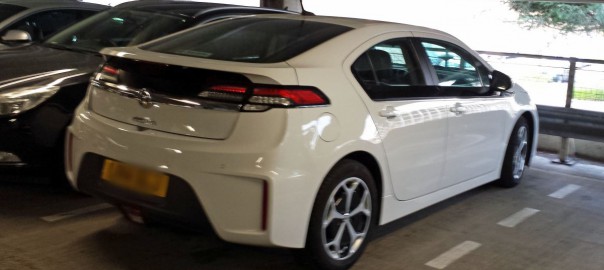
Vauxhall Ampera in Milton Keynes Central railway station multi-storey (Image: T. Larkum)

GM cuts workers and plants as it shifts focus to electric vehicles

The company is cutting 15 percent of its workforce and shuttering five plants.

General Motors announced today that is planning to lay off 15 percent of its contract workers, shutter five plants in North America, and discontinue production on six vehicle models next year. The move comes as part of a major restructuring of the car manufacturer that has been suffering from lagging sales. Going forward, GM intends to focus on electric and autonomous vehicle programs, just like basically every other car maker.

As many as 14,000 salaried and contract workers will be out of work as a result of GM’s new roadmap. The company is also “unallocating” resources to plants in Oshawa, Ontario, Canada; Detroit, Michigan; Warren, Michigan; White Marsh, Maryland; and Warren, Ohio. The decision puts the future of those plants in limbo, but they will at least see a decrease in production if not a complete shut down.

Vauxhall Ampera in Milton Keynes Central railway station multi-storey (Image: T. Larkum)
Vauxhall Ampera (rebadged Chevrolet Volt) (Image: T. Larkum)

In addition to major slashes to its assembly lines, GM will also cease production on six vehicles, according to USA Today: Cadillac XTS and CT6, Buick LaCrosse and Chevy Impala, Cruze and Volt. The decision to cut out the Volt, a plug-in hybrid vehicle, seems odd given GM’s promise to focus on electric cars. It also marks the death of one of the cars lauded as a success for the company following its bankruptcy in 2009. The decision follows fellow American automaker Ford’s decision to kill off production of most of its vehicles earlier this year.

Read more: Engadget

Nissan Leaf (Image: Qurren/Wikipedia)

Longer-range Nissan Leaf intro reportedly delayed due to Ghosn scandal

Nissan doesn’t want chairman’s arrest to overshadow the Leaf’s debut.

When it introduced the second generation of the Leaf electric car in 2017, Nissan promised that a “higher power, longer range version at a higher price” would arrive in 2019. However, with Nissan chairman Carlos Ghosn embroiled in a scandal, it seems we’ll have to wait a little longer for that long-range Leaf.

Nissan Leaf (Image: Qurren/Wikipedia)

Reuters quoted an unnamed Nissan spokesperson as saying the introduction of the long-range Leaf has been delayed because of Ghosn’s legal troubles. The automaker reportedly wants to time the car’s introduction, “to ensure that this important product unveiling could receive the coverage it merits.” The car was reportedly scheduled to debut this week at events in Japan and Amsterdam. Nissan apparently has not yet set a date for the reveal of the new model, and it’s unclear whether or by how much this delay will set back the retail launch of the bigger-battery Leaf in 2019.

Read more: CNet

BMW i3 and i3S 120Ah (Image: BMW Group)

BMW i3 (120 Ah) driven: little EV, bigger battery

Another new i3?

Yup, another. In its brief life the i3 has had an improved battery, a facelift, and a warmed-over ‘s’ version. And now both the normal i3 and the i3s get a bigger-capacity battery again.

How big?

BMW calls it 120Ah. Twice the capacity of the original i3, and so roughly double the range, all done by improving the battery’s internals, at no increase to its size or weight. The Renault Zoe has done the same thing over the years, and the Leaf is about to.

BMW i3 and i3S 120Ah (Image: BMW Group)

But Ah (amp hours) isn’t a proper measure of the energy it can store, unless you know the voltage. What you need to know, then, is the gross energy storage, which is 42.2kWh (kiloWatt hours).

Sorry…?

You can compare that with a Nissan Leaf (40kWh) or Hyundai Kona Electric (64kWh in its top version). Think of those energy numbers as the size of the electric tank, just as you’d look at the size of the fuel tank in a combustion car.

But even that isn’t the whole story if you want to know the range. As with petrol cars, you need to know the efficiency too. Sort of electric mpg.

So how does the i3 really do?

It’s pretty efficient because it’s light – under 1,300kg is good for an EV – and aerodynamic and rolls on tall skinny tyres. Put all that together and you have an efficiency of around 4.4 miles/kWh.

That gives a range of about 180-193 miles WLTP. The i3s is the slightly less efficient one of the pair.

Enjoy it?

Yup. The new i3s is slightly more powerful than the i3, at 183bhp vs 170. Torque is up from 184lb ft to 199. Hardly enough of a difference to matter. What you will notice is it sits on a wider track and firmed-up springs, anti-roll bars and dampers.
The result is it’s the most fun to drive of all the affordable EVs. The Leaf is soft and gentle. The Kona is torque-steery and a bit ragged, if quick. The i3s is also quick – doing 0-62 with zero fuss in 6.9 seconds. And it’s quite a fun steer, its front wheels gripping decently (the original i3 understeered) and its rear ones getting the power down well. You can lean on it in corners and feel it working beneath you. Sure, it’s tall so it pitches and bobs around when it’s bumpy, but even so, I had a laugh.

Which did what to your range?

OK, tore a bit of a hole out of it. I got about 135 miles-worth out of a charge, driving like I stole it, so was doing only 3.3 miles/kWh. But be aware I’d earlier driven down the same road – in Portugal – in a new 320i and got about 20mpg. There are absolutely no straights, and absolutely no traffic, for endless mile upon fabulous mile. Hills, hairpins, tight esses, the lot.

Read more: Top Gear

Blades Being Installed on Turbine 5, Yelvertoft Wind Farm (Image: T. Larkum)

British Gas launches new tariff for EV drivers

British Gas has launched Green Drive Nov 2020, a new smart time-of-use tariff for electric vehicle users.

It offers cheaper electricity for seven hours, between 12.30am and 7.30am, for users to charge their car.

Electric vehicle drivers use up to 80% more electricity if they charge at home, according to British Gas. They can benefit from tariffs which pass on cheaper overnight wholesale electricity costs.

Blades Being Installed on Turbine 5, Yelvertoft Wind Farm (Image: T. Larkum)
Yelvertoft Wind Farm (Image: T. Larkum)

“Customers who choose this tariff will have peace of mind that if they charge their electric car overnight they can take advantage of lower prices. We want to offer our customers different types of tariffs that suit their individual needs and help them understand their energy usage.

“This is our first residential EV product. Over the coming months, we will launch further electric vehicle charging services to both residential and business customers,” said Peter Simon, customer propositions and product director at British Gas.

The smart tariff is dual fuel, fixed until November 2020 and has no exit fees.

Source: Fleet News

Electric vehicle sales to ‘see a big lift’ over the next 2 to 3 years

  • Electric vehicle sales are likely to jump over the next two to three years as prices fall and more options are made available to customers, according to Evy Hambro, BlackRock’s global head of thematic and sector investing.
  • Customers will have more opportunities to move away from traditional combustion engines to electric vehicles and their options will not be restricted to only certain auto suppliers, he told CNBC’s “Squawk Box.”
  • Earlier this year, the International Energy Agency predicted that electric vehicle ownership will jump to about 125 million by 2030, spurred by policies that encourage the purchase of clean-running cars.

Electric vehicle sales will likely jump over the next two to three years as prices fall and more options are made available, according to BlackRock’s global head of thematic and sector investing.

Customers will have more opportunities to move away from traditional combustion engines to electric vehicles and their options will not be restricted to only certain auto suppliers, Evy Hambro told CNBC’s “Squawk Box” on Thursday.

“I think we’re at this tipping point of change,” Hambro said. “Over the next two years, we’re going to see this massive extension of breadth of models, we’re going to see price point of entry drop as well. We’re expecting to see a big lift in electric vehicle sales over the next two to three years.”

Earlier in the year, the International Energy Agency predicted that electric vehicle ownership will jump to about 125 million by 2030, spurred by policies that encourage the purchase of clean-running cars. That would mark a big jump from 2017 when the agency estimated there were 3.1 million electric vehicles in use.

That’s because most traditional automakers are now investing to create their own electric vehicles. For example, Volkswagen recently said it will spend about $50 billion on new plants, electric cars, autonomous driving and other mobility services in an attempt to be the most profitable maker of electric cars.

Read more: CNBC