Monthly Archives: December 2018

Kia e-Niro EV (Image: Kia)

Kia e-Niro SUV (2019 – ) review

The Kia e-Niro is a five-door small electric SUV which will be competing with the likes of the Hyundai Kona electric, Nissan Leaf, Hyundai Ioniq and smaller Renault Zoe.

Arguably, the two biggest buzzwords in motoring right now are ‘SUV’ and ‘electric’. The Kia e-Niro is both, which means it’s probably on to a winner. The size and range of the e-Niro, along with its reasonable price, make it a very tempting package, that could sway some reluctant folk towards electric motoring. It does have a very credible rival in the Hyundai Kona electric, though.

The e-Niro is a small SUV, but its styling makes it look more like a raised-up estate car than a chunky off-roader. The electric version of the Niro has a few design features to differentiate it from the hybrid and plug-in hybrid variants, but it has been kept relatively conventional, and doesn’t look too futuristic. As it’s an electric car, the grille is closed off, and this is where the integrated charging port is. It also has redesigned air intakes, new LED daytime running lights, and a few blue trim highlights about the place. As well as redesigned front and rear bumpers, the e-Niro comes with new 17-inch alloy wheels.

The e-Niro’s interior is pretty conventional, too. If you’ve been in any other new Kia, you’ll recognise the solidly built interior. You’ve got some nice soft-touch plastics on the dashboard and in all the important places, but there are some hard, grainy plastics further down in the cabin.

Like the exterior, there are a few bits exclusive to the e-Niro. The most obvious is that there’s no traditional ‘gear stick’, which has been replaced by a rotating dial drive selector. That same panel houses buttons for the electronic parking brake – compared with the foot-operated parking brake of the hybrid – heated seats, heated steering wheel, parking sensors and the auto-hold function.

Design wise, there are some bright blue trims, along with some subtle mood lighting and high-gloss black panels (which will quickly get covered in fingerprints) on the doors.

The 8.0-inch infotainment system is easy to use from the driver seat, with clear graphics and logical menus. It’s better than the system in the Hyundai Kona electric and Renault Zoe, and as easy to use as the Nissan Leaf’s system.

Read more: Auto Trader

VW e-Golf (Image: Volkswagen.co.uk)

Why Volkswagen Needs to Sell 600,000 More Electric Cars Per Year

Volkswagen estimates it must sell 600,000 more electric vehicles per year to meet the drastic new CO2 emissions goals released by the European Union on Monday.

To align with the targets, carmakers must reduce carbon dioxide emissions in new fleets by 15% by 2025, and 37.5% by 2030. At the same time, light commercial vehicles’ emissions must reduce 31% from 2021 levels by 2030.

Germany was hoping for a maximum reduction of 30%, Handelsblatt reports.

VW e-Golf (Image: Volkswagen.co.uk)

“The plan we have drawn up for transition is not enough to fulfill this transformation,” Volkswagen CEO Herbert Diess said this week regarding the emissions goals. Automakers have no choice but to get with the program or potentially face billion-euro fines.

Sources familiar with Volkswagen’s plans told Handelsblatt that the company had calculated it must sell 1.2million electric cars in Europe in 2030 to meet the previous emissions targets. To meet the new CO2 targets, however, that would need to increase to 1.8 million electric vehicles — or 45% of its total sales. Currently, VW and all of its related brands sell 4 million passenger vehicles annually in Europe.

Read more: Fortune

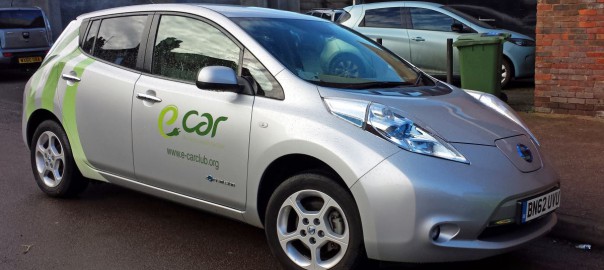
Picking up the Leaf in Wolverton early in the morning (Image: T. Larkum)

Baby Named Lief after Nissan Leaf

HONOLULU (KHON2) – Friday, Oct. 26, 2018 was anything but normal for Lori Kohara and Kyle Shimoda, who were expecting their second baby.

“I had contractions the night before so I couldn’t sleep the night before,” Kohara said.

She knew the baby was coming that day.

“In our birthing class they told us treat it like any other day,” she said.

And that’s what they did, Kohara working from home throughout the day.

Picking up the Leaf in Wolverton early in the morning (Image: T. Larkum)
A similar Nissan Leaf (Image: T. Larkum)

Kohara said it was her last day of work before maternity leave. She thought she had another two weeks to prepare for the baby.

“I finished my last meeting at 4 p.m., and I told Kyle [my husband], I’ll hop in the shower and then we’ll head to the hospital,” she said.

They grabbed their things and walked to the car. Kohara’s dad driving while the couple sat in the back seat.

“Maybe about three minutes after we left, my water breaks, and I’m like ‘oh my goodness,’ Kohara said.

“The first thing that goes through my mind is there goes the seat,” Kyle Shimoda said laughing.

The family got on the freeway at Kahala, but didn’t make it far.

Read more: Khon2

Nico Rosberg Formula E Gen2 car at 2018 Berlin E-Prix (Image: Wikimedia/KAgamemnon

How Formula E is driving the electric cars of the future

You only have to look at the line-up for this season of Formula E, the world’s top all-electric racing series, to see how much it means to road-car manufacturers: Audi, BMW, Jaguar and Nissan were all on the grid for the fifth season’s opening round, the Saudia Ad Diriyah E-Prix in Riyadh, on Saturday. Porsche and Mercedes are due to join that quartet for the 2019 edition.

Many of the planet’s largest household-name carmakers are lining up to get involved – and in doing so, use Formula E as a high-profile research-and-development arena for future vehicles bought and driven by us regular folk. Additional evidence comes via the fact that McLaren’s Applied Technologies arm is behind the batteries used by Formula E cars, while a new supporting single-manufacturer series, the Jaguar I-Pace eTrophy, uses the road-going electric SUV as its basis.

Nico Rosberg Formula E Gen2 car at 2018 Berlin E-Prix (Image: Wikimedia/KAgamemnon

Indeed, Panasonic Jaguar Racing driver Mitch Evans, 24, provided a direct personal link. “I drove the I-Pace quite early on when it was a concept car,” he explains. “I also did a drag race against a Tesla – and won. So I’ve done quite a lot with it – and for sure I’d like to have one parked up in my garage.

“A lot of the feedback that I give to my technical team [in Formula E] will then get passed on to Jaguar Land Rover. At the moment, both in the automotive industry and the motorsport industry, electric motors are developing at a similar rate, so a lot of the information and the technology, you can use it either way. The future cars you’ll see on the road, you’ll start to have a bit of a direct impact from what we’ve learnt in Formula E.”

His teammate, former Formula One driver Nelson Piquet Jr, 33, agrees. “Efficiency, the power-train, the hardware, the way we do things – these are all things that we learn and we end up giving the ‘secrets’ to the engineers who are going to build cars for the industry. Then they try to find ways to adapt that to integrate that into the road cars.”

Antonio Felix da Costa won the Ad Diriyah E-Prix for BMW i Motorsport. The Munich manufacturer says: “The main driving force behind BMW i Motorsport is the development of innovative technology in the field of electromobility. The Formula E project is already providing valuable impetus in the development of [BMW concept] iNEXT and the next generation of BMW i models. The borders between production and motor racing development are more blurred at BMW i Motorsport than in any other project.

Read more: The National

Zappi 2018 EV Charge Point (Image: myEnergi)

Government sets July 2019 date for smart EV charging deadline

The government has confirmed that only ‘smart’ electric vehicle chargepoints can be installed from July next year.

In an announcement this morning, roads minister Jesse Norman and automotive minister Richard Harrington confirmed the phase-out date for older generation EV chargers, fulfilling a policy pledge first unveiled in October last year.

The government defines smart chargers as those which can be remotely accessed and capable of receiving, interpreting and acting on signals. Those capabilities will allow EV charging patterns to be remotely assessed and managed by a third-party, essentially protecting distribution grids from surges in demand.

Zappi 2018 EV Charge Point (Image: myEnergi)

In October last year the Department for Transport published its draft Automated and Electric Vehicles Bill, which established a number of broad stroke proposals for how the government planned to improve the country’s EV charging infrastructure.

The adoption of smart EV chargers formed a central point of that strategy and, now, the government has followed through by enforcing a firm deadline for their installation.

Harrington said: “Today’s measures will make it easier for consumers to move towards electric vehicles, helping us power towards a cleaner, greener future.”

Read more: Current News

The Long And Winding Road Will Lead To Tens Of Millions Of Electric Vehicles Being Sold

When Tesla founder Elon Musk appeared on the television magazine show 60 Minutes last Sunday, he acknowledged that the timing of his latest electric vehicle rollout had been slowed. But he nonetheless restated that he is committed to something far more profound — decarbonization of the automotive and energy sectors.

His goal, overall, is to make sure we leave behind a healthier planet for those who follow — that the technologies to which he pursues get mainstreamed and become economically attractive for all drivers. To that end, he wants his efforts to electrify the automotive sector to be the catalyst that prompts the entire industry to mass produce those vehicles. The odds?

Transport will drive energy demand. And growing markets in China, India and the Middle East are expected to increase oil demand by 12% between now and 2035, says Wood Mackenzie. But the advisory firm adds that these same locations will be the ones to widely employ electric cars. That will occur because of advances in electric batteries, which Wood Mackenzie thinks will hit pay dirt by 2027.

Electric car sales are expected to overtake petrol

“The threat from electric vehicles (EVs) beyond 2025 is material. Sales are growing exponentially and have outpaced expectations, boosted by faster than anticipated battery improvements,” it says.

It predicts EVs to grow from about 5 million today to 100 million by 2035, as the current fleet of cars is retired and as battery technologies improve — those that allow such cars to travel further before they would have to be plugged in. Today EVs comprise about 1.5% of the auto market.

Read more: Forbes

New 450kW EV charger from BMW and Porsche is as fast as filling up with petrol

BMW and Porsche’s prototype 450kW FastCharge unit can give 62 miles of range in just three minutes, once vehicle technology catches up

A new electric vehicle charger capable of delivering 100km (62 miles) worth of charge in just three minutes, and fully charging an EV’s batteries in just 15 minutes, has been developed by a number of German companies, including BMW and Porsche.

The companies’ 450kW (kilowatt) FastCharge system – while still a prototype – trebles the charge rates of the world’s rapid chargers’ at present, and promises “to make charging electric vehicles as fast and convenient as fuelling with petrol”.

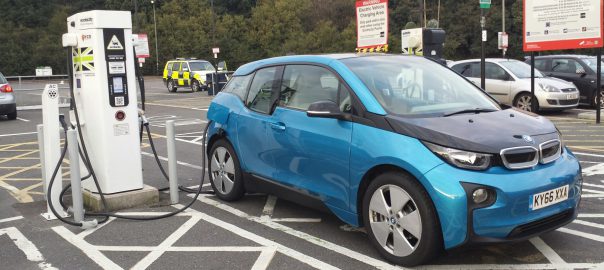
When operating at its maximum 450kW capacity, it has proven capable of replenishing a BMW i3 (fitted with a “specially developed high-voltage battery”) from 10 to 80 per cent in just 15 minutes, and delivering 62 miles of range to a Porsche research vehicle in just three minutes.

While not technically a ‘full’ charge, this is representative of a full charge in real-world conditions, as manufacturers advise against recharging to 100 per cent, and most owners are unlikely to allow their batteries to drop below 10 per cent.

Read more: Auto Express

Nico Rosberg Formula E Gen2 car at 2018 Berlin E-Prix (Image: Wikimedia/KAgamemnon

This Is the Year Electric Car Racing Gets Real

As Formula E kicks off its fifth season on December 15, huge automakers like Porsche, BMW, and Mercedes-Benz are finally joining the electric-racing circuit. Is this the beginning of the end of internal-combustion racing?

Porsche quit the Super Bowl.

The German automaker rattled the racing industry when it announced it was pulling out of Le Mans Prototype 1, the top class of the FIA World Endurance Championship (WEC). Even if you haven’t heard of this league, you have heard of its premier event: the 24 Hours of Le Mans, known as the Super Bowl of auto racing for the past 90 years. Nevertheless, Porsche is disassembling its LMP1 team to prepare for a leap to Formula E, the all-electric racing series, for its 2019/20 season.

Following Formula E’s debut four years ago, plenty of auto enthusiasts saw the circuit as a fool’s errand—surely motorsports fans raised on the roar of internal combustion would never love the zip and whine of electric cars rounding a track. But the league has risen from side attraction to headliner event, and it’s happening because Porsche is just one of many manufacturers shifting resources from combustion-engine racing to electric. Audi ditched Le Mans a year ago to enter Formula E, and Nissan, BMW, and Mercedes-Benz are also entering the electric circuit, which begins its fifth season on December 15. It’s a big step up for Formula E from its first season, when only a single automaker, Renault, was involved as a factory team.

Nico Rosberg Formula E Gen2 car at 2018 Berlin E-Prix (Image: Wikimedia/KAgamemnon

Why? Racing isn’t just sport and frivolity. Car companies put hundreds of millions of dollars each year into motorsports to develop technologies that trickle down to the cars we drive on the street, technologies that let future family sedans use more fuel-efficient engines or let SUVs send less pollution out the tailpipe. Dollars always lead back to the company’s main business of selling road vehicles.

So, in an era when car companies are pledging to electrify their entire lineups in the 2020s, it shouldn’t come as a surprise that those companies want to invest their racing dollars in electric tech. Rather than EVs and hybrids complementing the main business of selling combustion road cars, EVs are to become the main business.

Read more: Popular Mechanics

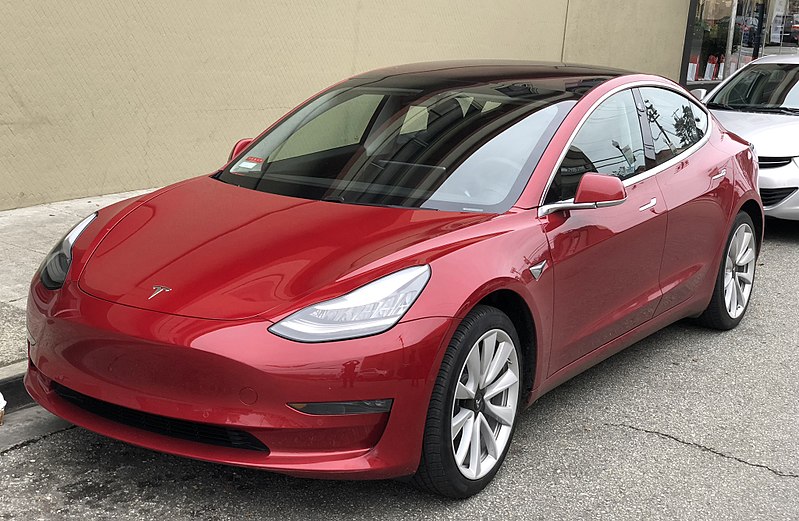
Tesla Model3 (Image: Wikimedia/Carlquinn)

New Tesla Model 3: European prices and specs revealed

The Tesla Model 3 is now on sale in select European markets, with first deliveries penned in for February 2019

Tesla has outlined European specifications and prices for the Model 3, and first European reservation holders will have been invited to begin placing their final orders.

In the United States, the Model 3 has been on sale for well over a year and deliveries are well underway, with production totalling over 50,000 units in the third quarter of 2018.

Tesla Model3 (Image: Wikimedia/Carlquinn)

With European sales finally beginning, two configurations of the Model 3 are available from market launch – the Model 3 Long Range Dual Motor All-Wheel-Drive, and the recently revealed, BMW M3 baiting Model 3 Performance.

Both models are expected use a 75kWh battery pack, and have been homologated under the new WLTP testing procedure with an official range of up to 338 miles on a single charge. As for the Model 3 Performance, Tesla claims that the European specification model achieves 0-62mph in 3.7 seconds, with top speed clocked at 155mph. No European performance figures have been published for the regular Long Rane Dual Motor AWD model, but Tesla’s American configurator claims 0-60mph in 4.5 seconds, with a top speed of 145mph.

Read more: Auto Express

2019 Kia e-Niro review: the family EV that banishes range anxiety

Earlier this year, we were seriously impressed by the new Nissan Leaf. The original mainstream electric car had, in second-generation guise, moved the game on again. Those seeking a (relatively) affordable EV need look no further.

But it’s a sign of how quickly the electric car market is developing that the new Leaf has already been outsmarted by a brand-new electric car from Kia: the e-Niro. The firm is very excited by it, and says it simply won’t be able to meet expected demand when it goes on sale in April 2019.

Why the excitement? Because, unlike the now-meagre 40kWh battery pack in the Leaf, it offers a far greater capacity of 64kWh. The range improves accordingly: in latest-era WLTP testing, the Leaf achieves 168 miles. The e-Niro can cover 282 miles. That’s a vast, 114-mile advantage.

Of course, it costs more – adding capacity to batteries is expensive – but it’s not as pricey as you’d think. After the Plug-in Car Grant, the Leaf costs from £26,190, or £29,390 in top-spec guise. Kia’s only selling the e-Niro in range-topping First Edition form – for (post-grant) £32,995.

For early adopters, more range is more important than paying less. Kia already has an enormous advantage here. And, as we’ll see, it’s not the only area in which the e-Niro betters the Leaf.

First impressions

The Kia Niro has been on sale for a couple of years, first as a hybrid and later as a plug-in hybrid. The e-Niro is the third electrified version – making it the only crossover SUV on sale with three choices of alternative fuel power.

It sits neatly between the Ceed family hatch and the Sportage SUV. Length of 4,375mm makes it 115mm shorter than a Leaf, but it’s wider and taller. It’s visually squarer too, a more space-efficient shape than the angular Leaf, with contours on the sides taking the edge off its boxiness.

You can tell an e-Niro apart from a regular Niro because the electric version has new front and rear bumpers. The front end has lots of blue accents and ‘arrowhead’ daytime running LEDs. It also has a closed-off grille, into which the charge socket is integrated. Polished 17-inch alloys are standard.

Read more: Motoring Research