As sales of electric cars keep increasing we are seeing more and more of them on the road. That simply reflects the rising demand as everyone now knows they will be transitioning away from fossil-fuel cars.
We saw one result of that today. We’re on our way to Devon on holiday in our i3, and called in at Chieveley Services to charge.
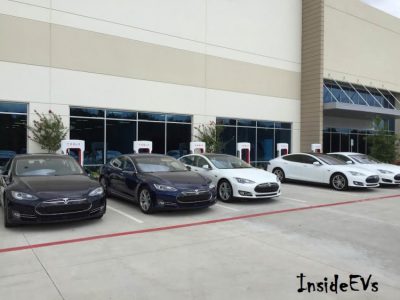
On arriving, there was a Tesla Model S charging at one of the Ecotricity pumps, the one with the CCS connector that the i3 needs. After a brief discussion he kindly agreed to move to the other pump so we could charge.
Once we were charging we went inside for lunch, and I monitored the charging on my phone. As it approached 100% we headed back to it only to find a charging queue for the first time ever!
The Tesla had gone and been replaced by a Nissan Leaf. Waiting to charge were a second Leaf and a Renault ZOE. We moved out of the way for the second Leaf, but the ZOE probably had a half hour wait ahead of it.
This type of situation will probably become increasingly common as more EVs hit the road, at least in the short term. Eventually it is hoped that we’ll see all petrol stations, and perhaps most parking spaces, changed over to be charging points.
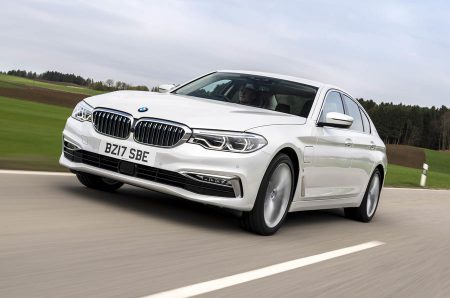
Plug-in hybrid version of BMW’s 5 Series is well-placed to take sales away from its higher-end diesel siblings. Strong performance and handling with favourable running costs.
BMW 530e iPerformance
What is it?
This is the first plug-in hybrid 5 Series. It’s not the first hybrid 5 Series, that being the ActiveHybrid 5 available with the last-generation model range. Less than one percent of the 15,000 or so Fives BMW sells here yearly have been part-electric. The ActiveHybrid 5 was expensive, equipped with six cylinders and 302bhp, 149g/km CO2 performance to suit the US, which is why it made little ground here.
BMW hopes that will change, dramatically, with this new 530e iPerformance hybrid, which is a plug-in propelled by a 181bhp 2.0 litre TwinPower Turbo petrol engine and a 112bhp electric motor. The crucial difference lies in some key numbers: the 530e’s £44,765 list price is £770 more than for a 530d SE and £7405 more than for a 520d Efficient Dynamics, while its 46g/km CO2 emissions score it a 9% BIK rating compared to the 520d ED’s 23% and the 530d’s 26%. That’s vastly more competitive than for the ActiveHybrid 5 and enough, BMW thinks, to see it selling around 5000 plug-in 5 Series in a full year.
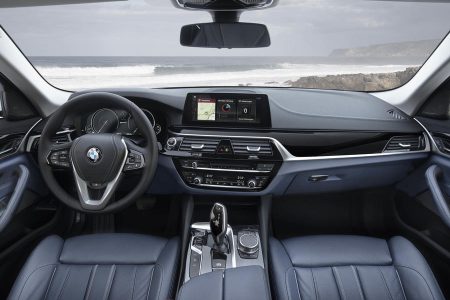
BMW 530e
What’s it like?
Start your trip with a fully charged battery and it’s on electric power that you’ll initially travel unless you’ve heavy with the throttle, in which case the petrol engine momentarily assists.
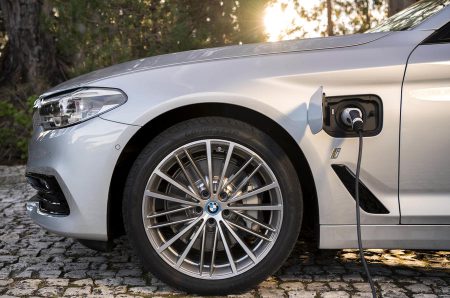
The 9.2kWh lithium-ion battery will realistically allow a 22-mile range, and in near total silence, the only sound being the tyres’ hum. The car remains tranquil even when the petrol engine kicks in, although the four-pot produces a pleasing internal combustion rasp if you ask plenty of it. The transition from one to the other is tremor-free, as you’d expect, and it’s easy to forget that you’re in a hybrid car at all, the ‘Auto eDrive’ driving mode enabling the car to select the optimum mix of power sources depending on the driver’s demands and the terrain advice supplied by the sat-nav. And while it may be saving fuel, the 530e is not slow, breaking 62mph in 6.2sec: pretty rapid for a car that’s partly about economy.
BMW 530e
This twin-engined zest is complemented by a lithe, confident chassis that delivers a supple and sophisticated ride that’s as pleasing as this car’s quiet agility. Only the steering lets it down, the weight at the rim feeling curiously mushy, although it points the car accurately. As always with hybrids, there’s diversion to be had from monitoring the car’s energy usage and the game of trying to see how far you can go on amperes alone.
The AA Trust is launching the first ever free of charge EV driving course in collaboration with Chargemaster.
AA Trust’s chairman Edmund King
The course was launched following an AA Populus survey of 16,239 drivers, of which 32% said they want to learn to drive in an EV.
Drivers were asked, to what extent would you be interested in a free one-hour electric vehicle driving lesson – aimed to show you how to get the best out if an EV – in your local area?
32% were interested (16% extremely interested, 16% interested)
33% males interested, 30% females
35% younger drivers (18-24, 25-34) interested as opposed to 31% older drivers (65+)
Drivers in London were more interested (35%) followed by those in West Midlands and South West (34%)
Drivers in North East least interested (26%) followed by those in eastern region (28%)
Those in Scotland, Wales and Northern Ireland also showed high levels of interest.
AA Driving School and Drive Tech trainers developed the experience in conjunction with Chargemaster and will be piloted in Milton Keynes with a view to be rolled out nationally.
AA Trust’s chairman Edmund King said: “We are approaching a tipping point as more and better electric cars come on stream.
“We want to help drivers understand this exciting new technology at the EV experience centre but we also want to help them get the most out of their electric cars.
“Drive electric sessions, conducted by AA instructors, can either be carried out in the driver’s own electric car, or in one of the EV experience centre’s test drive fleet. The EV Experience and Drive Electric experiences be really put Milton Keynes on the map as the most go-to EV City in the world.”
Chargemaster’s chief executive David Martell said: “The number of electric vehicles in the UK is continuing to grow, and we recently marked the 100,000th plug-in car registration in the UK.
“To get more people driving electric vehicles, getting them behind the wheel is key. The EV experience centre aims to do exactly that, and the drive electric experience sessions from the AA Trust will be a great way to help consumers better understand electric vehicles and how easy they are to live with and how to get the best out of them when driving.”
It was really only a matter of time, and now the world’s top oil companies are seeing EVs as a viable and permanent threat.
Tesla continues to lead the pack with U.S. plug-in sales, but the Chevrolet Volt and Bolt, Toyota Prius Prime, and Nissan LEAF are all faring well, and the outlook for EVs continues to improve. (via Josh B/InsideEVs)
Though makers of EVs are still much more bullish about the timeline for mass adoption, several oil producers are taking note, and many are beginning to change their initial conclusions. BP and Exxon Mobil have bumped up their estimates this year, and OPEC has quintupled its future sales forecast for plug-in EVs.
Bloomberg New Energy Finance (BNEF ) believes that EVs will sell better than ICE vehicles by 2040, totalling 530 million plug-ins on the road at that time, which will account for one-third of the world’s vehicles. According to a study by BNEF, by 2040 EVs will lower the global oil demand by eight million barrels. Chief of advanced-transport analysis at BNEF in London, Colin McKerracher, shared in a note to clients:
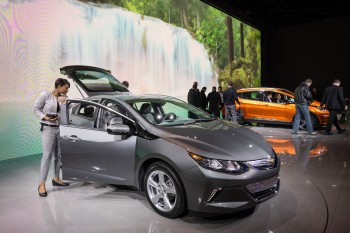
The Chevrolet Volt and Chevrolet Bolt EV on display Friday, February 12, 2016 at the Chicago Auto Show in Chicago, Illinois. (Photo by Steve Fecht for Chevrolet)
“The number of EVs on the road will have major implications for automakers, oil companies, electric utilities and others. There is significant disagreement on how fast adoption will be, and views are changing quickly.”
“What oil companies and car companies are saying is diverging. This is a trillion dollar question, and somebody is going to be wrong.”
Though these estimates will continue to diverge, the truth is that both sides of the equation are seeing that the popularity of EVs is and will continue to increase, which will drop the demand for fossil fuels. While oil companies may be attempting to make it seem like they aren’t concerned, multiple recent forecasts sing a vastly different tune.
OPEC’s previous 2040 estimate was 46 million EVs, and now the group representing 14 nations is forecasting 266 million.
Exxon Mobil initially predicted 65 million electric cars by 2040, but has now upped it to 100 million.
Norwegian-based Statoil ASA sees an electric vehicle market share of 30 percent by 2030.
The International Energy Agency raised its 2030 EV fleet size from 23 million to 58 million.
BP bumped its future outlook up by a whopping 40 percent, to 100 million plug-ins on the road by 2035.
Obviously, these estimates are markedly different, but the trend is the same. OPEC’s recent oil market report shows that due to EV sales, oil demand in Asia could see significant declines as soon as next year.
There are many variables, which make these type of estimates difficult. Fuel cost and battery costs are two of the most obvious, but another gray area lies in government support and subsidies (or lack thereof).
According to BNEF, top world automakers combined plans show estimated sales of six million EVs per year as soon as 2025, and eight million by 2030, and these estimates continue to rise.