Monthly Archives: July 2017

BMW 530e iPerformance Test Drive

Plug in Hybrid options are beginning to cascade across the entire lineup of BMW’s core offerings. BMW designates these PHEVs as the iPerformance line with the marketing tag line; “Charging is optional, thrilling is not”. The X5-40e was the first to market in October 2015, then came the 330e in March of 2016, followed by the 740e nine months later. Now, it’s the 5 Series that’s getting the “e” treatment, with the introduction of the 530e iPerformance.

BMW of North America was kind enough to allow me an exclusive extended test drive of their latest iPerformance offering. Having it for nearly three weeks, I was able to get a good feel for how well the eDrive system works, how it performed, and what to expect in terms of fuel efficiency.

The 530e iPerformance comes with a turbocharged 2-liter inline 4-cylinder engine which, along with the synchronous electric motor combine for an output of 255hp and 310 lb-ft of torque. That’s enough power to propel the rear wheel drive 530e from 0-60mph in 6.1 seconds, and 5.8 seconds for the xDrive version (which I had), according to BMW. Top speed is 146 mph, and the maximum speed in all electric mode is 87 mph.

However, I noticed that the maximum speed in all electric mode diminishes as the state of charge depletes. So, while you start out with a top speed of 87 mph, it may be as low as 65 mph once the battery state of charge is under 10%.
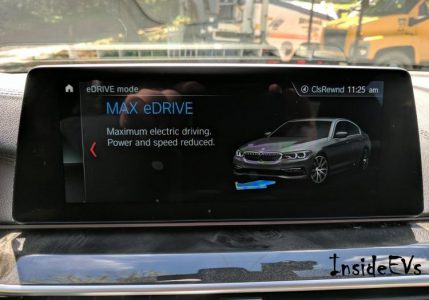
In MAX eDRIVE mode, the 530e will remain in all-electric mode up to 87 mph, until the battery is depleted. However, if the driver fully depresses the accelerator, the ICE will fire up to supply added power.

There are three driving modes: Max eDrive, Auto eDrive and Battery Control. The car defaults to the blended mode of Auto eDrive, which combines the gas and electric power supply to increase efficiency. In Auto eDrive the car decides when it’s best to be in all electric mode, and when to blend the power. It works very well, and I was pleased to see the car wants to drive in electric mode as much as possible, and only turns on the ICE when more power is needed or when the battery SOC is low.

I found that this is probably the most efficient mode to use if you are driving long distances. If you’re going to be driving less than 40 miles, the Max eDrive mode would be the best choice. It keeps the car in all electric mode until the state of charge is depleted, and then the ICE kicks on.

Read more: Inside EVs


New Renault Kangoo Z.E. Gets Larger Battery, Motor, Charger And Heat Pump

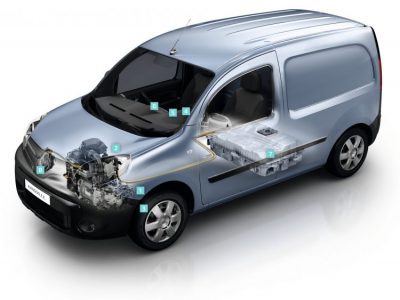
This summer Renault is introducing four major upgrades for the Kangoo Z.E. – a new battery, a new motor, a new charger and the incorporation of a heat pump for the climate control system.

Renault Kangoo Z.E. (Z.E. 33)

The battery option is the new Z.E. 33 (33 kWh), which extends range by around 50% compared to previous one:

  • 270 km (168 miles) NEDC compared to 170 km
  • 200 km (124 miles) real range in the summer (previously 125 km)
  • 120 km / 135 km (84 miles) with heat pump in the winter

The new electric motor is still rated at 44 kW (225 Nm), but this time it’s all-Renault designed and produced, which should help with costs.

On-board charger power has (thankfully) doubled to 7 kW (now required 6-hours for a full recharge).

And finally, for the very first time in an electric LCV, there is a heat pump. Additionally, Renault has implemented a pre-heating feature. All welcome additions.

Renault Kangoo Z.E. (Z.E. 33)

Read more: Inside EVs
TESLA store pops up in Milton Keynes Shopping Centre

Milton Keynes already has a great reputation for its support of Electric Vehicles, from its vast infrastructure of electric charge points to the UK’s first Electric Vehicle Experience Centre due to open later this month. 

Now TESLA the American automaker, energy storage and solar manufacturer has set up shop in Milton Keynes Intu shopping centre, displaying their high end electric cars in an impressively slick showroom.

Strolling past this afternoon it was certainly eye catching and there seemed to be a genuine buzz from many passers-by when they noticed the giant letters spelling ‘TESLA’.

The two story car showroom isn’t the first to appear in the Milton Keynes Shopping Centre, a Mercedes store appeared a few weeks previous. This new trend seems to coincide with a greater change and understanding of how consumers are now purchasing. The idea of viewing a car in a showroom and then ‘shopping online’ for the best price is becoming ever so much more the norm, much like shopping for the latest smart TV.

f

Panasonic Joins Push to Put Photovoltaics on More Car Roofs

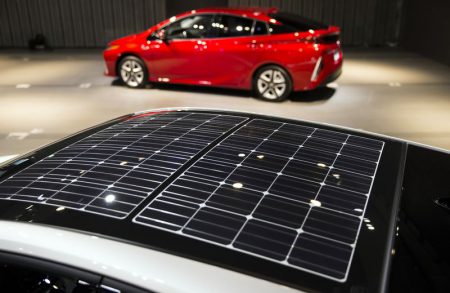
Panasonic Corp. sees the future of solar on car rooftops.

The Osaka-based electronics maker has started producing a 180-watt array of solar cells that can be fixed to the roof of an automobile. In February, Panasonic announced that its photovoltaic module would be used on the roof of Toyota Motor Corp.’s latest Prius plug-in hybrid.

Cars represent a potentially lucrative new outlet for solar cells in an industry where intense competition from Chinese manufacturers has pushed down prices sharply. That’s prompting some manufacturers to adapt solar cells for everything from home roofing tiles and the outer skins of buildings to backpacks and tents.

Solar panels on the roof of Toyota Motor’s Prius plug-in hybrid vehicles (PHV). Photographer: Tomohiro Ohsumi/Bloomberg

“Car roofs have the potential to become a new market for solar panels,” Shingo Okamoto, the general manager at Panasonic who was in charge of developing the technology, said. “We made history in the auto industry and in the solar industry with the sun powering mass-produced cars for the first time in the world.”

New Market

Cars could hold the promise of a giant new market for solar panels from Panasonic, which also is partnered with Tesla Inc. in making batteries at its Gigafactory outside Las Vegas. There are 264 million cars and light trucks in operation in the U.S., according to the National Automobile Dealers Association.

Others are noticing the potential. Tesla Chairman Elon Musk tweeted in November that his company’s Model 3 car may come with a solar roof. He’s also beginning to sell a type of roof tile for homes featuring embedded photovoltaics. Nissan Motor Co. offers an add-on solar panel option for its Leaf electric cars, giving extra charge to systems such as the air conditioners and radios, according to Nicholas Maxfield, a spokesman for the company.

Read more: Bloomberg Technology

Mayor reveals zero emission London transport plans

Mayor of London Sadiq Kahn has revealed the proposals that will help achieve his aim of dramatically cutting vehicle emissions in the capital. The plan is to make London’s transport network zero-emission by 2050.

The Ultra Low Emission Zone and T-Charge proposals are already confirmed to come into force in the near future, but zero-emission zones will be launched in phases, with central London and town centres first from 2025, inner London between 2035 and 2040, and a blanket London-wide zone by 2050.

Between now and 2025, a ‘major expansion in electric vehicle charging points’ is planned, along with the installation of at least 15 hydrogen refuelling stations in and around London. These investments in infrastructure will continue in a significant manner to encourage expansion until at least 2035.

In terms of public transport, all new buses bought will be hybrid, electric, or hydrogen, before all buses operating in the capital being zero-emission of hybrid from 2030. All buses will be zero-emission between 2035 and 2040.

All new taxis will need to be zero-emission capable from the beginning of next year, with the same rule for new private hire vehicles by 2025. From 2030, only zero-emission capable taxis and private hire vehicles will be able to operate in London.

The overall aim of these proposals is to improve air quality and reduce congestion. Despite a predicted expansion in London’s population to 10.5 million over the next 25 years – with a forecast additional 5 million trips each day by 2041 using current models – Kahn’s plans aim to cut the number of car journeys by three million each day.

Read more: Next Green Car

Continental joins BMW partnership as Germany pushes forward with autonomy

The joint venture in autonomous driving by BMW, Mobileye and Intel has gained another partner in German automotive parts and tyre company Continental.

As the development of the technology continues at a pace, manufacturers are finding themselves in needs of an alliance with technology companies to ensure they can keep up with the demand required to meet launch targets. The BMW venture will see Continental play a role in the commercialisation of the platform, which will be sold to other vehicle manufacturers.

Frank Jourdan, member of the Executive Board of Continental AG and head of the Chassis & Safety division, comments:

‘We have already had very good experience in working with the BMW Group through jointly successfully completed development and series projects. Contributing development and integration for the partnership is a recognition of our extensive competence in the field of automated driving. The cooperation with the core partners involved represents the unique opportunity to drive ahead and get this technology of the future to our roads more quickly.’

Speaking on behalf of the partnership, Klaus Fröhlich, member of the board of management of BMW AG for development, adds:

‘Every new Tier One partner brings us a step closer to our goal: We intend to bring safe autonomous driving to series production by 2021 and actively shape this technology. With our non-exclusive approach to this technology of the future we will deliver a safe, fast and cost-efficient solution that is highly attractive also for other manufacturers.’

The group added Delphi to the partnership in May 2017, while Mobileye was bought by Intel earlier in 2017, the technology giant seeing the need to integrate the autonomous specialist into its ranks.

Read more: Autovista Group

BMW 530e PHEV review: An electric car revolution

AS ELECTRIC cars become ever-more mainstream this BMW 530e is the latest example of new technology becoming normal.

BMW 530e is another example of how normal electric cars have become

BMW’s new plug-in hybrid version of the already-successful 5-Series could revolutionise the electronic market, especially among business drivers. Plug-in hybrid vehicles work by combining a petrol engine with an electric motor and battery.

That means the car can run on electric power for around 30 miles before the engine kicks in. Alternatively, both the engine and electric motor can work in tandem with the electric one running the car at lower speeds or under light acceleration, switching to or working with petrol when more performance is required.

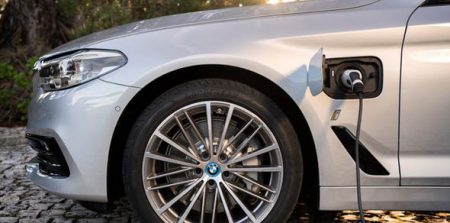
It takes a sharp eye to even spot that this 530e is the plug-in hybrid version of BMW’s 5-Series saloon, introduced earlier this year. Only details like a blue tint to the grille, blue lining to the BMW badge on the alloy wheels and the eDrive logo on the rear door pillar, as well as the giveaway charge point flap behind the nearside front wheel, mark out this as the ultra-low emission 5-Series.

The car is the new plug-in version of the already popular 5-Series

The plug-in hybrid takes the 5-Series to new efficiency levels, which isn’t surprising as it’s the first rechargeable one. The 2.0-litre turbo-petrol engine and 83kw electric motor combine to produce 252bhp, returning an average fuel economy figure of 141.2mpg, though that number is entirely dependent on how much time the car runs on electric rather than petrol, and the emissions figure is 46g/km.

That’s important for company car drivers because anything below 50g/km means lower monthly tax bills. It is also eligible for a £2,500 government grant off the purchase price. The battery helps performance too, giving the 530e a 0 to 60mph acceleration of 6.2 seconds. It is electronically limited to 146mph.

There are three driving modes for how the battery and engine work. In the Auto eDrive setting, the car decides whether to use electric or petrol based on how hard the driver is pressing the accelerator and the car’s speed.

Below 60mph and when not accelerating too hard the battery is employed. Push harder or get to higher speeds and the car switches to petrol. It’s essentially like a regular hybrid, such as Toyota’s Prius.

Read more: Express

The U.K. Wants to Lead World in Driverless and Electric Vehicles

The U.K. government plans to invest more than 800 million pounds ($1 billion) in new driverless and zero-emission vehicle technology as it seeks to boost its economy while leaving the European Union.

Investment in research and new recharging infrastructure is intended to make Britain a “leader” in electric and autonomous vehicles, Queen Elizabeth II said in a speech marking the state opening of Parliament in London on Wednesday. The technology may be worth 28 billion pounds to the economy by 2035, the government estimates.

In order to deliver on that goal, the government will:

  • Extend mandatory vehicle insurance to cover the use of automated vehicles
  • Set a target for almost every car and van to be zero emission by 2050
  • Allow government to require motorway service areas and large gasoline stations to install electric vehicle recharging points
  • Require a set of common standards for charging points so they can be used widely across all vehicles
  • Invest 200 million pounds in researching and testing driverless car infrastructure and 600 million pounds during the course of this Parliament in supporting the ultra-low emission vehicles, sums which had been previously announced

The measures were welcomed by businesses, which had been concerned that Prime Minister Theresa May’s focus on withdrawing Britain from the European Union would push issues like air pollution down the agenda.

“It is encouraging to see the government’s desire to make the U.K. a leader in new industries and enhance its role on the world stage,”

said Nick Molho, executive director of the Aldersgate Group, an alliance of business leaders, politicians and non-profit groups that’s pressing the Treasury on environmental policies.

Read more: Bloomberg