I saw my first autonomous electric pod in Milton Keynes today while taking a lunchtime walk.
Although I’ve followed the development of the Lutz Pathfinder for a few years, this was the first time I’ve seen one ‘in the flesh’. It appeared to be undergoing testing on undeveloped land on the eastern side of the city centre.
Unfortunately what’s not clear in the picture is that it’s stationary. Someone is hunched down on the far side with a laptop.
Nitin Gadkari said the government would “not allow any technology that takes away jobs”.
He said India needed to recruit about 22,000 more commercial drivers and would be opening 100 training facilities to address the need.
India’s road system and sometimes chaotic traffic makes it a difficult place to develop the technology.
The Hindustan Times reports Mr Gadkari as saying:
“We won’t allow driverless cars in India. I am very clear on this.
“In a country where you have unemployment, you can’t have a technology that ends up taking people’s jobs.”
However, he did not rule out the idea of a future change of policy.
“Maybe some years down the line we won’t be able to ignore it, but as of now, we shouldn’t allow it,”
he added.
Inderpreet Kaur, an analyst at research firm Ovum said:
“The ministry has cited job losses as a reason behind banning autonomous cars in India, a bigger challenge would be to have ready infrastructure for these self-driving cars.”
Google, BMW, Tesla, Audi and Uber are among businesses working hard to be the first to bring truly autonomous cars on to roads.
Self-drive technology trials, both for private cars and commercial vehicles, are being carried out around the world.
Google has been testing self-drive cars in California and other states since 2012.
Paris began a three-month test of self-driving buses at the beginning of the year, and in the UK a consortium of companies plans to test driverless cars on motorways in 2019, while others are testing cars in off-road sites, including in London.
Commenting on the decision on Twitter, Indian congressman Gaurav Pandhi tweeted:
“The BJP (Bharatiya Janata Party) said the same when Rajiv Gandhi talked about introducing computers to India. They haven’t really changed.”
A fully electric version of the Mini will be built at the Cowley plant in Oxford, BMW has said.
The carmaker said the model would go into production in 2019, with Oxford the main “production location” for the Mini three-door model.
However, the electric motor will be built in Germany before being shipped to Cowley for assembly.
BMW said it had “neither sought nor received” any reassurances from the UK on post-Brexit trading arrangements.
The electric vehicle will be based on the 3-door hatchback model
Last year, the government faced questions about the “support and assurances” given to Nissan before the company announced that new versions of its Qashqai and X-Trail would be made in the UK.
And there have been reports that Toyota agreed to invest in the UK after receiving a letter reassuring the Japanese carmaker over post-Brexit arrangements.
‘Vote of confidence’
About 360,000 Minis are made each year, with more than 60% of them built at Oxford. But BMW has built up an alternative manufacturing base in the Netherlands amid concerns about Britain’s suitability as an export hub after Brexit.
BMW has warned about the damage of Brexit uncertainty, and in May chief executive Harald Krueger said the company had to remain “flexible” about production facilities.
UK Business Secretary Greg Clark hailed BMW’s announcement as a “vote of confidence” in government plans to make Britain
“the go-to place in the world for the next generation of vehicles”.
On Monday, he set out plans to invest in development of battery technology in the UK.
Mr Clark met BMW’s head of sales and marketing, Ian Robertson, at the company’s headquarters in Munich in January and March this year. The two also held meetings at Westminster in March and June.
David Bailey, professor of industry at Aston University, said the true test of the global car industry’s desire to invest in the UK would come next year:
“I don’t think it [BMW’s decision] tells us much about Brexit and the form of trade barriers we may face in the future.
“The big decisions will be about future models [which would have redesigned bodies], both at Mini and at companies like Vauxhall when they announce their new models in the next couple of years.”
There weren’t cars only on display inside the Electric Vehicle Experience Centre (EVEC) at the launch. There were also a large number charging up outside, presumably getting ready for test drives for the public for the opening the next day.
Electric cars ready for free test drives in Milton Keynes (Image: T. Larkum)
The large numbers and broad range of EVs available was impressive.
How about a quick quiz: can you identify them all? The answers are given below.
Electric cars ready for free test drives in Milton Keynes (Image: T. Larkum)
Of course, whether you own an EV or are considering your first, you’re welcome to test drive any of the vehicles on show for free. Just get in touch and we’ll help arrange it.
Answers to the Quiz: these are the electric cars waiting to give test drives (from nearest the camera to furthest away):
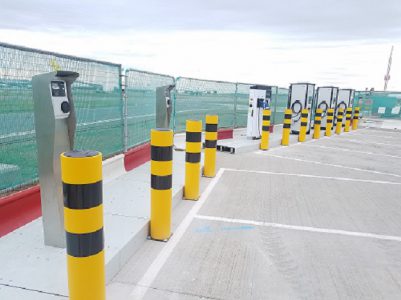
eVolt’s 200th electric vehicle (EV) Rapid Charging unit has been supplied to Heathrow Airport, after the charge point supplier was awarded the contract to provide the UK’s largest airport with 18 of its units in phase one.
The significant milestone has been achieved as a result of the hard work of Freemantle Electrical – the selected EV charger and infrastructure installer for the initial phase of works. The chargers were installed using a specific new designed EVCI-Go modular plinth system developed by Freemantle that allows wiring through the plinth system, which avoids any major civils works and speeds up the installation process. The Airport selected eVolt as its supplier of EV charge points following a competitive tender where multiple suppliers were reviewed.
The new Rapid charging units have been installed at eight of the airport’s airside locations including the Airside Operations Facility (AOF). They will be used by Heathrow Airport’s growing fleet of EVs run by Heathrow Airport Limited and its tenants assisting in everyday operations.
Richard Freemantle, Managing Director at Freemantle Electricals, says eVolt came highly recommended:
“The reliability of eVolt’s charging units is well known and that was key to Heathrow Airport Limited’s selection,” he says. “Its units are well maintained and have a high up-time, meaning the Airport’s EVs will be able to operate with maximum performance.”
Three Compact Rapid charging points, that can simultaneously charge two EVs to 80% battery capacity in 30 minutes at 50kW DC and 43kW AC, have been installed, taking the number of eVolt Rapid charging units installed in the UK to over 200. A Semi-Rapid Raption 22kW Triple charging unit that charges an EV to 80% in one hour has also been installed. This is ideal for fast top-up charges and utilises the latest modular power technology for enhanced reliability and performance.
The contract also includes the supply of eVolt 7kW and 22kW AC Wall mount charging units, which typically take up to four hours to charge an EV (battery size dependent). It is expected that these will be used to provide charging to ‘off-duty’ EVs, ensuring that when a shift starts the vehicles are able to make use of a full charge.
Justin Meyer, General Manager of eVolt UK, says:
“We are seeing increasing opportunities with major public transport hubs looking at ways to reduce emissions,” he says. “It’s a testament to our equipment’s reliability and performance that 200 Rapid charging units, the most technical and desired in terms of charging time, are operational.”