Daily Archives: July 17, 2017

Renault Kangoo ZE small electric van now on sale with longer range

French automaker Renault has given its small light commercial electric vehicle a handful of upgrades, including a significantly longer battery range.
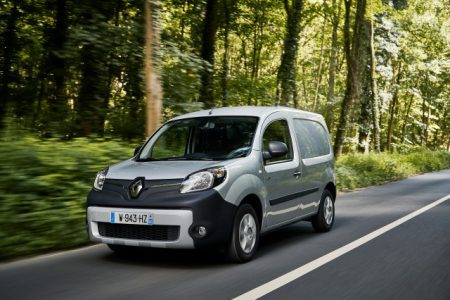
Renault Kangoo ZE 2017

The Renault Kangoo ZE is now officially on sale with a longer rated range, a more powerful charging system, and a heat pump to keep the little van efficient in the coldest temperatures.

Renault revealed the Kangoo ZE back in 2010 as an electrified option for light commercial vehicle buyers, even before its 2012 Renault Zoe subcompact electric hatchback.

An electrified Master ZE joined the smaller van earlier this year. Just shy of six months later, the Kangoo ZE updates should receive a warm welcome from commercial-vehicle buyers with an eye for efficiency.

Rated range for the updated electric van jumps from 170 kilometers (105 miles) to 270 kilometers (167 miles) on the New European Driving Cycle.

Renault Kangoo ZE 2017

However, Renault acknowledges the NEDC’s shortcomings, noting that a real-world range of 120 km (74 miles) to 200 km (124 miles) may be more likely.

That’s still a jump from its previous non-NEDC estimates of 80 to 125 km (50 to 77 miles).

The longer range is due to a new 33-kilowatt-hour battery, which was developed between Renault and LG Chem.

Read more: Green Car Reports

Paris to host on-demand driverless vehicle service

Europe’s first on-demand driverless vehicle service on open roads is set to begin operating in France later this year.

Delphi Autonomy

The pilot service, a collaboration between Delphi and French-based public transport operator Transdev, will see autonomous vehicles operating in Saclay, a Paris suburb, and Rouen in Normandy.

In Paris, initially one shuttle will operate along a fixed route from the train station to the campus of the University of Paris-Saclay.

In Rouen the service will operate in an area of the city where there is currently no public transport, and will initially consist of two driverless Renault Zoe cars.

Customers will be able to use a smartphone app to book a ride in the vehicles, which will be tracked by a remote control and command centre. A driver will initially sit in on the journeys to monitor the vehicles, but by 2018 the companies hope to operate the service without a driver on-board.

For the pilot the companies have chosen the so-called “last-mile” of public transport – the journey between a train or bus station and the commuter’s place of work, for example – as it is seen as an area of particular need, according to Serge Lambermont, director of automated driving at Delphi.

“People like to travel by public transport, but this last mile, how to get from your subway station to your destination, is an inconvenience,”

he said.

“So if you can arrive with the ticket already on your smart phone connecting you to an automated, mobility-on-demand taxi or pod system, which takes you on to your location, you take all the inconvenience out.”

The vehicles will be equipped with a range of different sensors, designed to complement each other. Each vehicle will be fitted with short range radar, for example, with sensors at each corner and two at either side, as well as one forward facing image radar and one rear facing long range radar.

Read more: The Engineer

Ford sees ‘strong push’ for electric vehicles

The head of Ford’s electric van programme has outlined the company’s strategy for promoting electric vehicles to commercial users, and said there is a ‘strong’ desire to reduce vehicle emissions within the business sector.

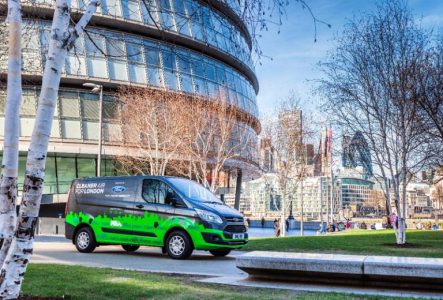
From autumn 2017 Ford will be trialling 20 hybrid electric Transit vans across London

Mark Harvey, director of Ford’s electrified van programme spoke to airqualitynews.com ahead of his presentation to the LowCVP conference in London this week, at which he revealed details of the company’s trial of 20 plug-in hybrid Transit vans for commercial users in the capital (see airqualitynews.com story).

The 12-month Transit plug-in hybrid trial will involve users including Transport for London, Metropolitan Police, British Gas and Addison Lee and will commence later this year.

Ford has revealed that the trial will use a telematics system to collect data on each vehicles’ financial, operational and environmental performance to understand ‘how the benefits of electrified vehicles could be maximised’.

Mark Harvey, director of Ford’s electrified van programme. Picture: Spencer Griffiths

Mr Harvey explained that the trial forms part of a wider commitment by the car maker to target the electrical vehicle market. He said: “Within Ford we have announced that we are investing $4.5 billion globally in electrified vehicle programmes between now and 2020 and that will deliver 13 new electrified vehicles in that time, of which the Transit Hybrid Custom vehicle that we are talking about is one.

“It’s a massive commitment from us and recent organisational changes in Ford also highlighted the importance of electric vehicles with Sherif Marakby [who has returned to the company from Uber] in a role in that space so it is absolutely exciting times.”

Read more: Air Quality News