Daily Archives: July 2, 2017

Swedish study calls for smaller EV batteries, finds Tesla more polluting than an 8-year-old car

Swedish study calls for smaller EV batteries, finds Tesla more polluting than an 8-year-old car

Swedish researchers have argued that electric vehicle (EV) batteries should not be as large as possible, but as large as necessary. This is the conclusion of their study which found that in terms of equivalent CO2 emissions, a car with an internal combustion engine (ICE) can drive for eight years before it reaches the same environmental load as a Tesla with a 100kWh battery.

Published in the journal Ingeniøren, the Swedish meta-study, which analyses and summarises studies completed so far in the field, found that around 150 to 200kg of CO2 equivalents (environmental impact equivalent to that of the release of CO2) are produced for every kilowatt hour (kWh) storage capacity of electric car batteries.

For example, taking two electric cars, the Tesla Model S and Nissan Leaf, which have 100kWh and 30kWh batteries respectively in Denmark, the study says these capacities are equivalent to 17.5 tonnes and 5.3 tonnes of CO2 being generated respectively.

To put this in perspective, a round-trip from Stockholm to New York, by International Civil Aviation Organisation figures, releases around 600kg (0.6 tonnes) of CO2 into the atmosphere. In Germany, annual emissions of CO2 are currently almost 10 tonnes per person.

Therefore, the study has calculated that a fossil fuel vehicle can currently drive for more than eight years before it reaches the same environmental impact of a Tesla. For the Nissan Leaf, with its smaller capacity battery, this figure comes in at three years.

Mia Romare, one of the two researchers of the study, hence concludes:

‘Unnecessarily large batteries weigh more on the environment. One should therefore consider whether one can manage with smaller batteries.’

According to the study, only 10-20% of the environmental impact is generated by the source extraction of raw materials such as lithium from the mines. The main environmental impact comes from the processing of these raw materials and the production of the lithium-ion batteries in factories, which accounts for around 80% of the environmental impact.

Read more: Autovista Group

This is how Big Oil will die

Big Oil is perhaps the most feared and respected industry in history.

Oil is warming the planet — cars and trucks contribute about 15% of global fossil fuels emissions — yet this fact barely dents its use. Oil fuels the most politically volatile regions in the world, yet we’ve decided to send military aid to unstable and untrustworthy dictators, because their oil is critical to our own security. For the last century, oil has dominated our economics and our politics. Oil is power.

Yet I argue here that technology is about to undo a century of political and economic dominance by oil. Big Oil will be cut down in the next decade by a combination of smartphone apps, long-life batteries, and simpler gearing. And as is always the case with new technology, the undoing will occur far faster than anyone thought possible.

To understand why Big Oil is in far weaker a position than anyone realizes, let’s take a closer look at the lynchpin of oil’s grip on our lives: the internal combustion engine, and the modern vehicle drivetrain.

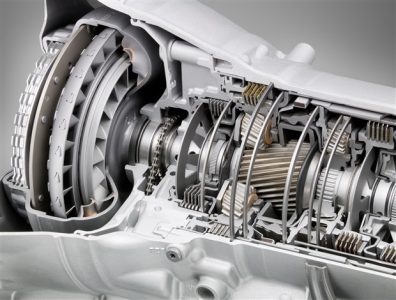
BMW 8 Speed Automatic Transmission

Cars are complicated.

Behind the hum of a running engine lies a carefully balanced dance between sheathed steel pistons, intermeshed gears, and spinning rods — a choreography that lasts for millions of revolutions. But millions is not enough, and as we all have experienced, these parts eventually wear, and fail. Oil caps leak. Belts fray. Transmissions seize.

None of these failures exist in an electric vehicle.

The point has been most often driven home by Tony Seba, a Stanford professor and guru of “disruption”, who revels in pointing out that an internal combustion engine drivetrain contains about 2,000 parts, while an electric vehicle drivetrain contains about 20. All other things being equal, a system with fewer moving parts will be more reliable than a system with more moving parts.

And that rule of thumb appears to hold for cars. In 2006, the National Highway Transportation Safety Administration estimated that the average vehicle, built solely on internal combustion engines, lasted 150,000 miles.

Current estimates for the lifetime today’s electric vehicles are over 500,000 miles.

Read more: NewCo Shift