Monthly Archives: June 2017

Renault Kangoo Z.E. 2017 review

The Kangoo Z.E. is the all-electric, zero emissions version of Renault’s smallest van

The Renault Kangoo ZE is the electric version of the Kangoo, Renault’s smallest van. Like the diesel version, it’s available in standard, Maxi and Maxi Crew body styles. In reality the only difference between the diesel and ZE (Zero Emissions) version is the fact there’s an electric motor under the bonnet instead of an engine, and a battery pack under the load area where the fuel tank would normally be.

Renault Kangoo ZE

The Kangoo ZE has a payload of 650kg, which is the same for the Maxi ZE, while the two versions have a load volume of 3.4 and 4 cubic metres respectively. This pair are two-seaters, while the Maxi Crew ZE has five seats.

Prices start from around £16,500, thanks to a Government Plug-In Car Grant of up to £8,000, while Renault offers two purchase options; you can either buy the Kangoo ZE outright, or buy the van and hire the batteries to help keep costs in check and eliminate any concerns about the batteries losing their longevity.

Power for the Kangoo ZE comes from a 44kW electric motor, which is the equivalent of 60bhp from a conventional engine. While that means the ZE has less power than any of the conventional Kangoo range (and 0-62mph takes a laborious 20.3 seconds), it doesn’t feel slow, thanks to a healthy 226Nm of torque (only the more powerful dCi 110 does better), and this torque is available as soon as you put your foot on the accelerator, so it really does nip away from the traffic lights.

Renault claims a range of 106 miles for the Kangoo ZE – it’s the same for the Kangoo Maxi, and is the same quoted for the Kangoo’s main rival, the Nissan e-NV200 – but in the real-world you can expect a range of around 75 miles on a full charge.

Read more: Auto Express
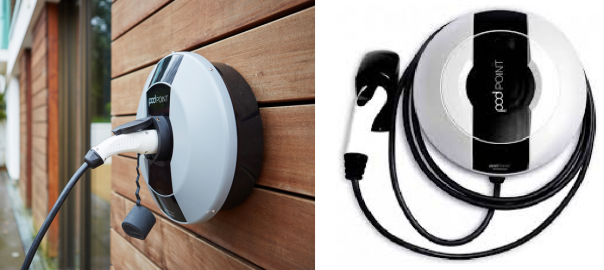
Untethered and Tethered Charge Points (Image: POD Point)

POD Point Installation Guide – Applying for the charge point

I Have my New Car Ordered – Now I Need a Charge Point

Untethered and Tethered Charge Points (Image: POD Point)

With my new Leaf, I get a new, FREE, POD Point charge point.
Thanks to a Nissan discount of £264 and the government OLEV scheme discount of £500, there is no charge for me at all for the entry level unit, although there are a couple of upgrade options you can choose.

Here is a quick guide to what to expect when you are ready to get your system installed. This blog covers the on-line application, with a separate blog that covers the installation.

Ordering my New Charge Point

The process starts with an email from POD Point to start the application. It was pretty straightforward and the pictures below step through the choices offered. The three choices I made of most significance to me were the following:
1) Upgrade to a 7kW charger. This cost £95. This seemed good value and future proofs me for longer range cars in the future.
2) Upgrade to a key so that I can lock the charger if necessary. This cost £30. I am not sure if electric thieving is likely.
3) I chose to have an un-tethered system with a type 2 socket so that it could work with any car. This was no charge. POD-Point tell me there is no difference in charge between a tethered and un-tethered system.

1 – The initial email from POD Point

2 – website starting point

3 – charge power choice

4 – tethered/untethered choice

5 – extras: key, cable, freestand

6 – Order summary showing total price less the nissan discount

7 – A statement that I have bought/leased a new car and have suitable off-street parking for a chargepoint to qualify for the OLEV grant

8 – 2nd Order summary including the OLEV grant

9 – payment for my extras

10 – payment summary

11 – address for installation
12 – installation specific questions

13 – statement of whether I do or don’t want the OLEV grant

14 – formal grant application. This needed a form downloaded, filled in and uploaded. Not particularly difficult and definitely worth it to save £500.

15 – MPAN number needed from my electricity bill.

16 – the thank you

Severe Flooding, Against a Background of Wind Turbines: November 2012, Tyringham, Bucks. (Image: T. Larkum)

Arctic stronghold of world’s seeds flooded after permafrost melts

No seeds were lost but the ability of the rock vault to provide failsafe protection against all disasters is now threatened by climate change

Severe Flooding, Against a Background of Wind Turbines: November 2012, Tyringham, Bucks. (Image: T. Larkum)

It was designed as an impregnable deep-freeze to protect the world’s most precious seeds from any global disaster and ensure humanity’s food supply forever. But the Global Seed Vault, buried in a mountain deep inside the Arctic circle, has been breached after global warming produced extraordinary temperatures over the winter, sending meltwater gushing into the entrance tunnel.

The vault is on the Norwegian island of Spitsbergen and contains almost a million packets of seeds, each a variety of an important food crop. When it was opened in 2008, the deep permafrost through which the vault was sunk was expected to provide

“failsafe” protection against “the challenge of natural or man-made disasters”.

But soaring temperatures in the Arctic at the end of the world’s hottest ever recorded year led to melting and heavy rain, when light snow should have been falling.

“It was not in our plans to think that the permafrost would not be there and that it would experience extreme weather like that,”

said Hege Njaa Aschim, from the Norwegian government, which owns the vault.

“A lot of water went into the start of the tunnel and then it froze to ice, so it was like a glacier when you went in,”

she told the Guardian. Fortunately, the meltwater did not reach the vault itself, the ice has been hacked out, and the precious seeds remain safe for now at the required storage temperature of -18C.

Read more: The Guardian

Electric Cars Are the Story Now, but Battery Power Is the Future for Tesla Inc.

You know Tesla (NASDAQ: TSLA) as a builder of electric cars. But that’s not necessarily what the company is about in the long run.

The electric car thing has become a temporary stop on a longer and much more ambitious journey, as Tesla’s mission has since expanded beyond just sustainable transportation. Tesla CEO Elon Musk wants to change the world, and that includes getting people used to replacing gas-powered vehicles with electric cars.

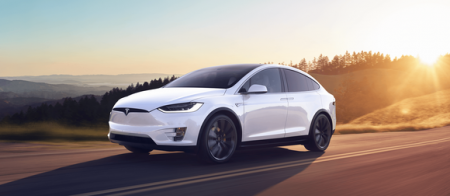
Tesla Model X

The Model X car is a good example of Tesla’s public image so far. .

Secrets and speculation?

This is not speculation on my part, or even a closely guarded secret. Musk laid out his master plan in some detail 11 years ago, and doubled down on the same theme last year.

In short, Tesla was always meant to develop and promote sustainable energy sources for everyone and everything. The expensive Tesla Roadster sports car only aimed at raining the capital to develop more affordable electric cars for a larger mass-market demographic — and even the Tesla Model S and Model X are just cash-generating stepping stones on the road to a clean-energy revolution.

Along the way, Musk is using Tesla’s capital platform and wide-ranging media reach to introduce and popularize other technologies for the good of humanity. Self-driving cars will make the road a safer place, while saving even more energy. Taking emotions and human error out of the driving experience can do both of those things.

Tesla’s early forays into electric vehicles and self-driving cars got the ball rolling. Now, Detroit and Japan are falling all over themselves to beat Tesla at its own game.

Read more: Madison.com

Consumer Reports Runs The Numbers On Tesla’s Solar Roof

Consumer Reports, which six months ago was skeptical about the viability of Tesla’s Solar Roof product, has once again “done the math” using newly announced pricing estimations.

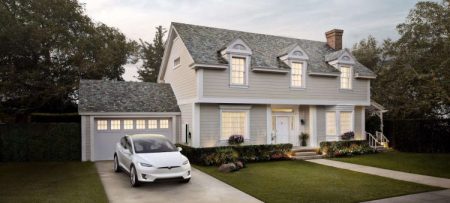
Tesla Solar Roof in Slate, Due for Release in 2018

According to CR, it’s not easy to weigh value of the offer, as company’s online calculator

“relies upon some important assumptions and predictions that delve deep into the economy of residential solar power in the U.S.”

In its first analysis, CR said that costs need to be below $24.50 per square foot to match costs of conventional roofs (including the cost of Powerwall batteries, but excluding solar incentives or rebates). A 3,000-square-foot Solar Roof would then cost $73,500.

Tesla announced an estimated cost at $21.85 per square foot, which would be $65,550 for the same example house.

After using Tesla calculator for example homes in New York, Texas and California and a 30 years period, CR found out that in some cases Tesla offers a good savings opportunity, although in other cases, it doesn’t look so good.

However, even if one’s first calculations seem tempting, CR advises to answer some questions before placing deposit.

Read more: Inside EV’s

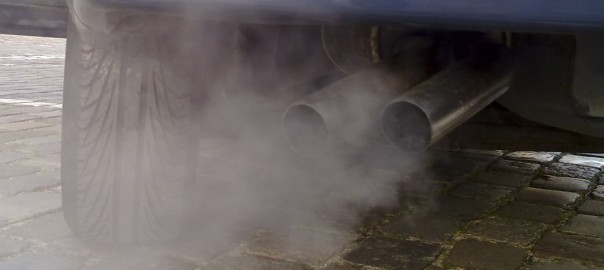
Car exhaust pollution (Image: Wikipedia)

Air pollution kills more people in the UK than in Sweden, US and Mexico

WHO figures show people in Britain are more likely to die from dirty air than those living in some other comparable countries

People in the UK are 64 times as likely to die of air pollution as those in Sweden and twice as likely as those in the US, figures from the World Health Organisation reveal.

Car exhaust pollution (Image: Wikipedia)

Britain, which has a mortality rate for air pollution of 25.7 for every 100,000 people, was also beaten by Brazil and Mexico – and it trailed far behind Sweden, the cleanest nation in the EU, with a rate of 0.4.

The US rate was 12.1 for every 100,000, Brazil’s was 15.8 and Mexico’s was 23.5, while Argentina was at 24.6.

The figures are revealed in the WHO World Health Statistics 2017 report, published on Wednesday, which says substantially reducing the number of deaths globally from air pollution is a key target.

The report reveals outdoor air pollution caused an estimated 3 million deaths worldwide, most of these in low- and middle-income countries.

Wealthy European nations had high levels of air pollution from fine particulate matter. The UK had an average of 12.4 micrograms of fine particulate pollutants (PM 2.5) for each cubic metre of air, which includes pollution from traffic, industry, oil and wood burning and power plants in urban areas. This is higher than the pollutant levels of 5.9 in Sweden, 9.9 in Spain and 12.6 in France. Germany had higher levels of particulate pollution than the UK at 14.4 and Poland’s was 25.4.

Dr Penny Woods, chief executive of the British Lung Foundation, said the report confirmed that deaths from air pollution were higher in the UK than many other comparable countries.

She said:

“It is deeply tragic that around 3 million lives are cut short worldwide because the air we breathe is dirty and polluted. In the UK, air pollution is a public health crisis hitting our most vulnerable the hardest – our children, people with a lung condition and the elderly.

“Yet, we are in the fortunate position of having the technology and resources to fix this problem. It’s time to use what we have to sort this problem out as a matter of urgency and clean up our filthy, poisonous air. The next government needs to bring in a new Clean Air Act to protect the nation’s lung health.”

Read more: The Guardian

Lasting legacy of VW diesel scandal: EU gets serious about testing

The Volkswagen diesel scandal left lasting imprints on the entire automotive industry, and may have changed the way regulators look at vehicles using the fuel forever.

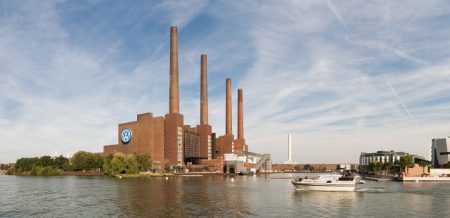
Volkswagen Plant, Wolfsburg Germany

That’s true not just in the United States, but elsewhere as well. The European Union is now increasing its efforts to make sure a scandal like Volkswagen’s can never happen again.

EU ministers have agreed to a new draft of rules and regulations for approving cars in the countries that make up the trade bloc; they give the European Commission more power in such circumstances.

Under the current system, national agencies such as Germany’s KBA have the authority to give new cars a pass for the entire European Union, according to Reuters.National bodies also have the power to revoke the rights to sell a vehicle should a controversy arise.

However, the newly drafted rules hand additional power to Brussels—a move Germany itself and its powerful car industry aren’t keen about.

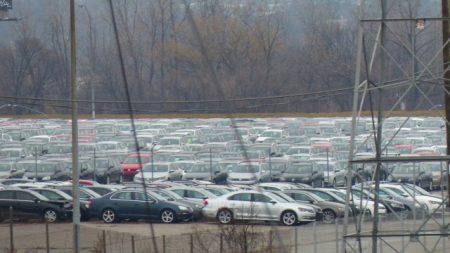
Volkswagen TDI Desiel Cars, Stored at Pontiac Silverdome

German junior economic minister Matthias Machnig told his national counterparts Germany is in favor of increased oversight. But, he said, the country remained wary over conflict of interest.

The changes to testing and approving new vehicles for sale in the EU come in response to Volkswagen’s deceit in the United States.

The German automaker used “defeat devices” in order to pass federal emission tests, and carried out a multi-year cover-up of that fact to continue selling its diesel-powered cars and SUVs.

The devices were programmed to comply with regulations for 23 minutes—exactly how long the EPA regulatory test takes. At minute 24, the NOx levels emitted by Volkswagen and Audi TDI vehicles rose considerably.

Read more: Green Car Reports

Daimler unveils its own new battery Gigafactory for electric vehicles

Daimler is among one of the few major automakers with aggressive all-electric vehicle plans.

The German automaker recently announced acceleration of electric car plans by 3 years and that they will spend $11 billion on 10 models by 2022.

They are backing this up with a new battery factory, which they officially unveiled today.

The German automaker produces its own battery packs through its ACCUmotive subsidiary and last year, they announced an important €500 million investment in a new battery factory in Kamenz, Germany.

The inauguration was a big deal attended by Federal Chancellor Dr. Angela Merkel and Stanislaw Tillich (Minister President of Saxony), who, together with Dieter Zetsche (Chairman of the Board of Daimler AG and Head of Mercedes-Benz Cars), Markus Schäfer (Member of the Divisional Board of Mercedes-Benz Cars, Production and Supply Chain), Frank Deiss (Head of Powertrain Production and Site Manager Mercedes-Benz Plant Untertürkheim) and Frank Blome (Managing Director Deutsche Accumotive GmbH & Co. KG), laid the casing of a vehicle battery as the foundation stone.

They didn’t confirm the capacity of the plant, but it is expected to be in the gigawatt-hour range and it will employ over 1,000 workers.

Daimler CEO Dieter Zetsche said about the new factory:

“The automotive industry is facing a fundamental transformation and we see ourselves as the driving force behind this change. The battery factory in Kamenz is an important component in the implementation of our electric offensive. By 2022, we will have more than ten purely electric passenger cars in series. We also continue to drive forward the hybridization of our fleet. Under the EQ brand, we are creating a holistic ecosystem for e-mobility.”

Read more: electrek

Financial Times declares a winner in the war for energy’s future, and Big Oil won’t be happy

‘Fossil fuels have lost. The rest of the world just doesn’t know it yet.’

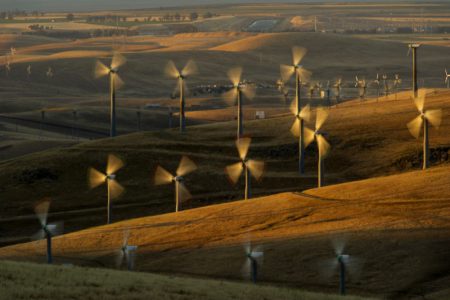
Wind turbines in California.

Traditional energy companies and mainstream financial publications are finally waking up to the new reality: The shift to renewable energy, electric cars, and a low-carbon economy is now unstoppable.
The details of this transition are spelled out in a new, must-read, 4000-word article in the Financial Times,

“The Big Green Bang: how renewable energy became unstoppable.”

What is most remarkable about the article is that it appears in the Financial Times. The free-market oriented paper is the “most important business read” for the world’s top financial decision makers and
“the most credible publication in reporting financial and economic issues”

for global professional investors, according to surveys.

We simply don’t see articles like this in Rupert Murdoch-run Wall Street Journal or even the New York Times, which continues to misreport the clean energy revolution and just hired a columnist who spreads misinformation on climate solutions.

The business community, though, is starting to see the writing on the wall, especially in Europe. The CEO of Royal Dutch Shell, Europe’s largest company, declared in a recent speech that the transition to a low-carbon economy is not just “unstoppable.” It is a necessity that “must be embraced” if an oil company like Shell is to survive and thrive. The low-carbon future, he explained, will be built around renewable electricity and electric cars.

The Financial Times article, in fact, begins with an anecdote of a company that developed a better turbocharger for gas-powered cars. After getting some interest from big car companies last year, in January,

“Suddenly, none wanted new products for cars running on fossil fuels.”

Instead, car companies were putting their limited R&D budgets into electric cars, a seismic shift at an unprecedented speed.

Read more: Think Progress

2017 Volkswagen e-Golf: first drive of updated 125-mile electric car

The 2017 Volkswagen e-Golf, the only battery-electric car sold by VW in the U.S., got a large range boost for its third year on the market.

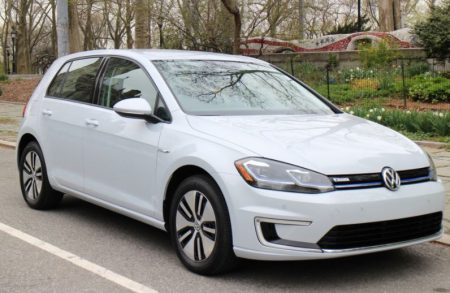
2017 Volkswagen e-Golf

While the current model year is winding to a close, 2017 e-Golfs are just now reaching dealers in the handful of states where the compact electric car is offered for sale.

But with an EPA-rated range of 125 miles combined, the 2017 VW e-Golf now offers more range than any all-electric car that’s not a Tesla or a Chevy Bolt EV.

That’s a 50-percent increase over the previous model’s 83 miles, and significantly increases the practicality of the e-Golf for drivers with longer commutes—or those who live in areas with winter weather.

Two weeks ago, we spent a brief time behind the wheel of a 2017 e-Golf, though New York City traffic prevented any meaningful test of the car’s expanded range.

For that we’ll wait to get the electric Golf for a longer test.

2017 Volkswagen e-golf

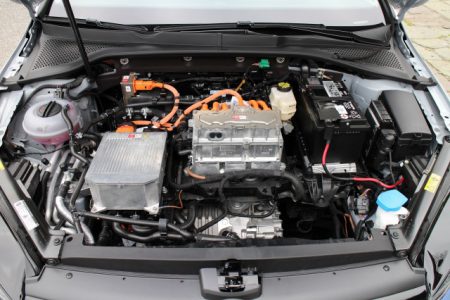
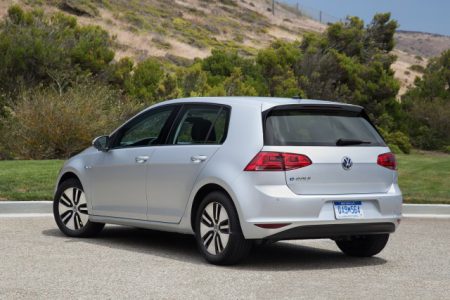
Meanwhile, what we can tell you is that the latest e-Golf is exactly what it was before: a Volkswagen Golf that happens to run on battery power.

What’s under the hood (and under the floor, rear seat, and cargo bay) may differ completely, but you’d never know it.

It’s so similar to conventional gasoline-powered Golfs that uninformed passengers might never catch on that it wasn’t simply the latest version of the 40-year-old hatchback classic.

As a result, our impressions of the longer-range VW e-Golf are essentially the same as those we had three years ago in testing its earlier iteration.

The 2017 e-Golf received a boost in its motor output, from 86 kilowatts (115 horsepower) to 100 kw (134 hp). Torque increased as well, from 199 to 214 lb-ft.

VW claims the acceleration from 0 to 60 mph is faster, at 9.6 seconds, which is a reduction of more than 1 second. To be honest, we couldn’t sense any difference, but it’s been three years.

2017 Volkswagen e-Golf

Reversing the car into parking spaces was as smooth as forward acceleration.

We noted no whine from either motor or power electronics under any circumstances, an impressive feat.

We smiled at the translation from German in the digital gauge clusters; in an e-Golf, it’s not “regeneration” but “recuperation.”

Otherwise, at the risk of disappointing those seeking decisive first-drive impressions … yep, it’s an electric Golf. Just as we expected, frankly.

Read more: Green Car Reports