Rowena’s BMW i3 has taken her city commute in a whole new direction
Daily Archives: June 22, 2017

Why Electric Cars Will Soon Be The Most Popular Vehicle
For what seems like a long time now, electric vehicles (EVs) have been on the cusp of going mainstream – in fact it was three decades ago that major automotive manufacturers first introduced working concepts of EVs.
Since then we’ve seen the hybrid vehicle make a significant impact on the car market, and now it looks like the fully-fledged EV is set to change motoring for good, making our cities less polluted and altering the very way we think of energy and how to use it.

The battery revolution
In the past, what’s held the EV back has been the high cost of batteries and their limited range. Consumers looking at the bottom line found they were paying more money for a car that travelled shorter distances. That has radically changed in recent years.
Battery costs have reduced enormously – 65% since 2010 – mainly for two reasons: firstly, as manufacturers figure out ways to make processes and materials more efficient, production becomes cheaper; secondly, economy of scale means that as EVs become more popular, the increasing demand pushes the cost of each individual battery down.
The other decisive factor with batteries is to do with improvements in their chemistry, which means they can now power a car over much longer distances.

Going station to station
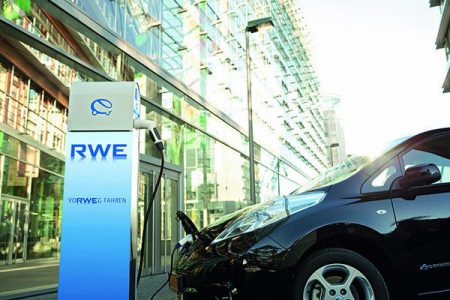
Another criticism of EVs in the past has been the lack of charging points. This meant that – especially for long journeys – you had to plan meticulously and incorporate various diversions to ensure you didn’t wind up in the middle of nowhere with a dead battery.
But in the UK for example, the EV charging network is expanding rapidly. There are now 4,100 public charging locations, which is remarkable when you think there were only a few hundred as recently as 2011. Compare that to the 8,472 traditional fuel stations (a drop of 75% in the last 40 years) and it’s clear a major shift is underway. In fact, based on these trends, electrical charge points will outnumber traditional fuel stations by 2020.

Driving energy
One significant bonus for EV drivers relates to the energy convergence we’re beginning to see in urban areas, and how these vehicles interact with a ‘smart city’ dynamic.
Recharge stations could be used to feed energy back to the national grid, a process we already see in places like Japan, which has one of the largest EV populations in the world. It operates ‘Vehicle to Grid’ (V2G) systems, which essentially turn EVs into generators, enabling their users to sell energy from their parked cars to the national grid at times when it is most needed. Such technology combines easily with an app on your smartphone or alternative device that, in turn, ensures none of said energy is wasted.
For years we’ve been told the Electric Vehicle is the future, but as that future begins to unfold, and people begin to understand both the economic and environmental benefits, their popularity will begin to snowball. Within a generation, there is every chance EVs will be the only vehicles we’ll see on the road.
Read more: Huffington Post
VIDEO REVIEW: 2017 BMW i3 94 Ah REx
[Test drive of] 2017 BMW i3 94 Ah REx. The last bit of that name seems like a jumbled mess of letters and numbers so, for those who aren’t well versed in EV-speak, it means that [this] particular i3 had the newer 94 Amp-Hour battery and a gasoline Range Extender.
Read more: BMW Blog

Is Big Oil planning its own funeral?
The end of the Oil Age is within sight. Everyone who follows the news should be able to see this by now, although people have vastly different ideas about the timeline.

Consultancies, investment analysts and think tanks around the world produce a constant stream of predictions about the future impact of new technologies on the auto and oil industries. Despite the pundits’ painstaking perusal of primary sources, including economic data and interviews with industry insiders, their conclusions do not agree, to say the least.
The oil industry itself, along with mainstream investment banks, tends to foresee a gradual, decades-long transition. BP’s 2017 Energy Outlook predicts that electric vehicle (EV) sales will grow to a mere 6% of the global auto market by 2035 (from around 1% today). A recent report by Goldman Sachs is a bit more adventurous, predicting that pure EVs will capture 5% of the market by 2025. The US Department of Energy’s Energy Information Administration (EIA) has doubled its forecast from last year, but still predicts that EVs will account for only 8% of the US market in 2025.

Organizations of a more greenish hue are more sanguine: Greentech Media Research expects EVs to score 12% of the US market in 2025, and Bloomberg New Energy Finance predicts 35% globally by 2040. A study from the Carbon Tracker Initiative argues that EVs could capture 33% of the global market by 2035, and that reductions in battery costs
“could halt growth in global demand for oil from 2020.”
To those who follow the EV industry, none of this is really news. Lately, however, there have been signs that at least some in the oil industry are reassessing the threat to their empire, and preparing for a “peak oil” scenario that may come much sooner than they have been predicting.
Read more: Evannex