Daily Archives: June 19, 2017

100 new PHEVs to be introduced by 2021, research finds

Research from Frost & Sullivan finds that the global PHEV market is estimated to reach about 3.7 million units by 2025 with 4.8 million light vehicles in an optimistic scenario and 2.9 million light vehicles in a conservative scenario.

Mitsubishi Outlander PHEV Concept-s

The reasons behind such growth include the imminent launch of 100 new models, favourable incentives, emission target compliance, and long battery ranges.

However, factors that may impede PHEV adoption include the phasing out of electric vehicle incentives, long-range battery electric vehicles, emergence of 48V mild hybrids, and the complexity of having two powertrains in a single vehicle.

“The stringent emission norms of 95 g CO2/km can only be met by PHEV technology, while EV battery technology evolves to overcome limitations. PHEVs have a better market than BEVs due to uncertainty in charging infrastructure,”

said Frost & Sullivan Intelligent Mobility Research Analyst Pooja Bethi.

“Owing to their ability to provide internal combustion engines and EV advantages, the PHEV market is set for high demand and growth.”

Dedicated EV platforms like the Volkswagen (VW) MQB, Mercedes-Benz EVA, and BMW FSAR are major drivers, pushing PHEV growth.

Read more: Green Fleet

After Record Surge In Q1, Renault ZOE Sales Slow In April Due To Brake Issue

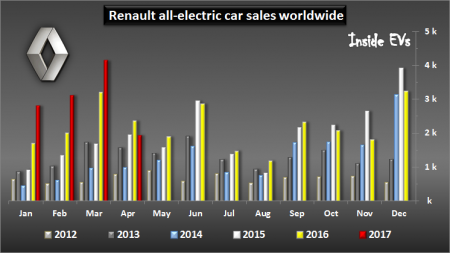
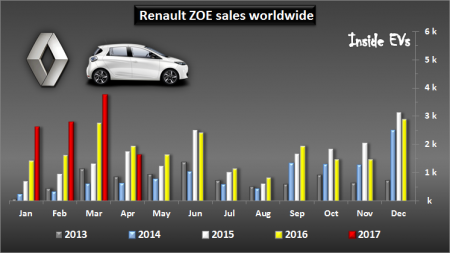
The introduction of a new longer-range Renault ZOE 40 Z.E. with 41 kWh battery and 300 km (186 miles) of real world range has translated into “higher highs” being set for sale…until this month.

April disappointed with just around 1,690 ZOE deliveries (a drop of 14.5% year-over-year).

In general, overall Renault electric car – mostly relied on ZOE – also decreased to 1,931 (down 18%).

Thankfully, sources indicate that April’s hiccup was not demand-related, but rather build-related.

And while we don’t ever wish for production flaws, or recalls, deliveries during the month where muted thanks to a defective part installed on cars produced before April 19th.

The repair (to do with locking the vehicle in parking mode using the handbrake) apparently isn’t the most simple fix, reportedly taking from 6-8 hours to rectify, and the company says it will likely take until the end of June to work all the issues out of the system.

New vehicles now coming of Renault’s Flins assembly line are not effected, but it may take another month to see sales rebound and return to previous trajectories.

With that said, and after four months, Renault has still sold nearly 12,000 electric cars (excluding Twizy), which is 29% more than year ago.

Source: Inside EVs

Half the Great Barrier Reef may have died in last two years

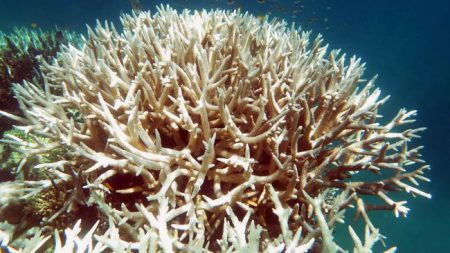
AS MUCH as half the Great Barrier Reef may have died in the back-to-back bleachings over the past two years.

Bleaching on a coral reef in Great Barrier Reef. Picture: ARC Centre of Excellence for Coral Reef Studies/AFP

But the head of the authority in charge of the reef says the actual extent of damage is tricky to calculate because some parts are growing well.

The Great Barrier Reef Marine Park Authority believes about 30 per cent of coral, in the reef’s northern part, died last year in bleaching caused by warmer ocean waters, chairman Russell Reichelt told a Senate committee on Monday.

Surveys after this year’s bleaching are still being done but initial observations suggest 20 per cent of coral — mainly in the central area of the 344,000 sq km reef — is dead.

“Don’t think of these figures as the net amount of coral on the Barrier Reef because there are quite big movements upwards as well as downward,”

Dr Reichelt told the senators at an estimates hearing in Canberra.

The southern part of the reef had grown by about 40 per cent in recent years because it hadn’t been hit by cyclones or bleaching — but it was likely it would suffer from those in the future.

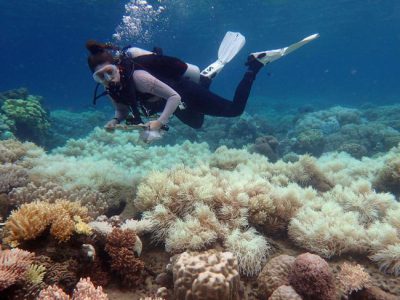
A diver examines bleaching on a coral reef on Orpheus Island. Picture: Greg Torda/AFPSource:AFP

Dr Reichelt said the bigger picture question was the coral’s resilience in the face of bleachings, tropical storms and other threats such as the crown of thorns invasions.

“It depends on the frequency of these major impacts and the concern is the frequency could well be increasing and the recovery time will be insufficient,”

he said.

“If the recovery time is very short, there won’t be a lot of coral.”

Read more: News.com.au