Daily Archives: June 9, 2017

Trump just passed on the best deal the planet has ever seen

His rationale for abandoning the Paris agreement is outdated and false. Now, America forges its own, lonely path in being shackled to coal and fossil fuels

Since day one as a contender for the Oval Office, current US President Donald Trump has pushed a dominant narrative: he’s a businessman. He gets economics. He knows the art of the deal. This week, with his decision to withdraw the US from the Paris agreement, the president has given the world strong reason to reject that narrative.

His rationale – that it’s a choice of economy over environment, and a fossil fuel economy is the top priority – is outdated and false. States and nations around the world have harvested the fruits of clean energy, and are redefining their economies and energy sources accordingly. Yet under false pretenses that “clean coal”, natural gas and other fossil fuel fixes are better than energy conservation and clean energy, the US forges its own, lonely path.

The idea that clean, renewable energy will generate power for our planet for generations to come is not rhetoric. The extent of human-caused climate change – and the rapidly improving economics driving the proliferation of renewable energy sources – make it fact.

If the US administration isn’t ready to move forward, hundreds of individual states and other countries will.
California is already a world leader on climate policy. Texas is rapidly expanding its wind energy capacity. In Germany, clean energy has become a movement itself, focused on thousands of small-scale projects under the Energiewende program. In Scotland, wind generation has increased by 81% over the past year, and in March this year, it produced enough energy to satisfy 136 % of the country’s household energy needs. These are just a few examples.

The US’s withdrawal doesn’t mean Americans and US investors will sit still, either. There is substantial economic opportunity in renewables. The US solar industry alone creates one in 50 new jobs. Worldwide, nearly 10 million people already work in renewable energy. Global clean technology exports doubled between 2008 and 2015, surpassing $1.15tn per year. Even America’s corporate giants – from Apple and Google to Walmart, and even oil giant Exxon Mobil – support the Paris agreement.

When news of the potential withdrawal reached the United Nations, the organization’s Twitter page read:

“Climate change is undeniable. Climate change is unstoppable. Climate solutions provide opportunities that are unmatchable.”

A Globe and Mail report showed that even fossil fuel companies – the likes of ExxonMobil, BP and Shell – think the US should stick with Paris.

This withdrawal is an ugly decision, made by a country that ought to be leading the transition to a cleaner future – not only because of its stature as an international economic powerhouse, but also because of its less-than-desirable environmental track record.

Read more: The Guardian

Five ways that autonomous electric cars will change your life

Here are five ways that autonomous cars will change our lives for ever – and much sooner than we think. Is this progress or decadence (or just sheer nonsense)? You decide:

image: comingtozero

Mobile homes. With real estate becoming ever more expensive, there is a case for owning a permanently-mobile home. With the low per-mile cost of electric driving, balanced against the sky-high price of real-estate, a fully autonomous electric home can take its owner to a quiet location at night, or even just drive at low speeds throughout the night, and still be a fraction of the cost of a land based home. Pre-set destinations and recharge automation will mean the vehicle can recharge as required, and arrive at the residents needed location at just the right time the following morning.

image: solar alley

Cash generating asset. If the budget runs low, then simply connect your vehicle to the grid at a fixed location for a few days and let the battery earn you some revenue as part of a grid-balancing aggregation program.

image: vetse news

Party heaven. For those of us that enjoy a drink, there is no longer a need for a designated driver. The car will always be sober and safe. However, what does this mean for public health? Is alcohol going to become a greater problem for more people without the ‘excuse’ of driving to have a night off?

The weekend starts here. After a Friday night-out with work friends, you can sleep it off as your car heads off overnight to your weekend destination.

The car is THE venue. Whether for business meetings or small social gatherings, the interior of an autonomous car no longer needs to be designed for the purpose of driving and so can become a location in its own right with more comfort and leg room and inward facing seats. With the expected safety improvements of autonomy, seat belts will no longer be a necessity. Imagine a lunch meeting with friends where the food is pre-ordered and picked up by the car before it collects your group. The car gives a tour of London’s most picturesque sites while you eat and relax.


For more information on autonomous driving,  visit our searchable news blog here or check out a couple of specific articles: MIT have ideas on technology for autonomy and people are talking about the effect on people.

GM commits to sustainable natural rubber for tires

General Motors buys a lot of tires. About 49 million a year, in fact. As part of its sustainability efforts, the automaker announced a goal of 100-percent sustainability for its natural rubber needs, and suppliers like Bridgestone, Continental, Goodyear, and Michelin – which were all represented at GM’s announcement this week in Detroit – ­are on board, too.

The partners also want to uphold labor rights for those in the rubber industry, conserve wildlife, and preserve carbon stocks, all while still producing quality products without raising costs.

Together, they aim to set the standard for sustainable and ethical rubber, holding every member of the supply chain accountable, and encouraging other suppliers and customers to follow suit. Traceability and transparency are keys, GM says, to making sure the rubber doesn’t lead to deforestation, and that it contributes to the economic and social development of the areas where it’s harvested.

Natural rubber will continue to be part of tire manufacturing for the foreseeable future. As Dr. Juan Botero, Continental VP of Sales of Passenger & Light Truck Tires for the Americas, points out,

“The properties that you get from that material, unfortunately, we have not been able to replicate in a laboratory. Mother nature does a fantastic job with this material.”

At this point, manufacturers simply can’t build as good of a tire without natural rubber. Over the years, advances have allowed them to use a smaller ratio of natural rubber, but it still makes up 10 to 15 percent of a passenger car’s tires, up to around 30 percent for a truck, and even higher for larger vehicles.

Proper management is critical to making natural rubber more sustainable. It’s better, of course, to make the most of existing trees than to clear land for new plantations, and all participating parties aim to dramatically increase their yield as demand continues to grow. It’s also important to protect rubber trees from disease, as their limited growing range makes them particularly susceptible. At the end of their lifecycle of about 20 years, the trees can harvested for their wood, and new ones are replanted in their place.

The natural rubber industry produces about 12 million tons per year, 75 percent of which is used in the tire industry. GM and the participating tire manufacturers hope this initiative will make a difference in their impact, as well as that of the other customers that share their supply chain.

The sustainable natural rubber plan is in its early stages, and we can expect more announcements about this initiative in the future.

Read more: Auto Blog

Ford replaces CEO with head of ‘mobility’ and appoints new exec for electric vehicles

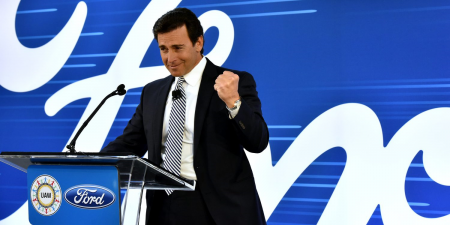
Ford had a massive leadership shakeup today that saw CEO and longtime executive Mark Field ousted and replaced by Jim Hackett, the head of the automaker’s ‘Smart Mobility’ division.

Mark Fields, Former Ford Motor Company president and CEO has been replaced.

The company also appointed a new executive in charge of “strategy and business model development for electrified vehicles and autonomous vehicles.”

In a press release, Ford gave some bullet points on the leadership changes:

  • Jim Hackett named as Ford Motor Company president and CEO, succeeding Mark Fields, who is retiring. Hackett, who will report to Executive Chairman Bill Ford, is recognized as a transformational business leader
  • Hackett led Steelcase Inc.’s turnaround to become the world’s No. 1 office furniture maker, served as interim Athletic Director at University of Michigan and has led Ford Smart Mobility LLC since March 2016. He served on Ford’s board from 2013 to 2016
  • Hackett, together with Bill Ford, will focus on three priorities: Sharpening operational execution, modernizing Ford’s present business and transforming the company to meet tomorrow’s challenges
  • Ford also named leaders to three new roles under Hackett. Jim Farley is appointed executive vice president and president, Global Markets, Joe Hinrichs is appointed executive vice president and president, Global Operations, and Marcy Klevorn is appointed executive vice president and president, Mobility
  • Mark Truby is appointed vice president, Communications, and elected a company officer.  He succeeds Ray Day, who plans to retire from the company next year and will provide consulting services until then
  • Paul Ballew is appointed vice president and Chief Data and Analytics Officer

In his new role as executive vice president and president of Global Markets, Jim Farley will be the executive in charge of Ford’s electric vehicle plans.

Read more: Electrek

cheapest electric car UK

Cheapest Electric Car UK

Cheapest Electric Car in the UK

A lot of people are searching for ‘cheapest electric car UK’ at the moment. We can help with that, though it can be difficult to say what’s the cheapest electric car in the UK because it depends on what you mean by ‘cheapest’. Let’s dig a bit deeper.

cheapest electric car UK

The most popular electric cars, are as follows:

Cheapest Electric Car UK (Image: Fuel Included)
Cheapest Electric Car in the UK (Image: Fuel Included)

Cheapest Electric Car UK: Monthly Cost

Of these the cheapest on a monthly basis are consistently the Nissan Leaf and the Renault ZOE. Typical starting prices are as follows (June 2017):

Those are great prices considering they include fuel (charging) plus with an electric car road tax is free, congestion charging is free, parking is often free, and servicing is cheap.

Clearly, though, this provides an answer to the original question. The Cheapest Electric Car UK (on monthly cost) is the Nissan Leaf.

Cheapest Electric Car UK: Cost Per Mile of Range

However, that’s not the end of the story. Electric cars are better than conventional cars in virtually every respect (performance, noise, smoothness, pollution, etc.). They do, however, typically have shorter ranges. Therefore it is usual to pay a premium for longer range electric cars (the Tesla being a well-known example, though it’s out of the reach of most people).

Let’s consider the question of range then. We’ll use the official NEDC (New European Driving Cycle) ranges, though we’d be the first to say these should be taken with a pinch of salt. In the real world you’ll only get about 75% of the NEDC range. However, they do give us a consistent metric for comparison purposes.

The NEDC ranges are as follows:

  • Nissan Leaf (30kWh battery): 155 miles
  • Renault ZOE (44kWh battery): 250 miles

If we take these into account we can work out the monthly cost per mile of range:

  • Nissan Leaf (30kWh battery): 155 miles for £255 = £1.65 per month per mile of range
  • Renault ZOE (44kWh battery): 250 miles for £309 = £1.24 per month mile of range

And so we have a new answer to the original question. The Cheapest Electric Car UK (cost per mile of range) is the Renault ZOE. And it’s that unprecedented range in a small, affordable and stylish electric car that explains why it’s so popular. See our Renault ZOE prices here.

Cheapest electric car uk

To see how much an electric car could save you, use our total cost of ownership calculator.

To find out which electric car would suit you best, just ask.