Tesla is now expanding its energy storage business from simply supplying the battery systems, to also remote control of installed storage systems to make the grid cleaner and more efficient.
Tesla calls it aggregation – the next step in energy storage.
Tesla Powerwall
The idea is to enable Powerwall owners to give utilities access to the battery – for use when energy demand is at its highest. Naturally, in turn owners would gain compensation for the extra capacity.
The first Tesla partner with the project is Green Mountain Power in Vermont.
Tesla and Green Mountain Power are excited to announce a program where you can get a Powerwall to back up your home with reliable energy for only $15/month.
In some ways, it’s similar to renting autonomous car, as Tesla would also build a platform joining those who have product, with those who are in need of using a product.
Too many U.S. states, and their electric utilities, think electric vehicles are linked to urgent action on climate change. They see EVs as an environmental solution to a problem that has yet to gain political consensus, at least in the U.S.
But they’re wrong: Electric vehicles, like the rest of the products emerging from what I and other economists call the green economic revolution, will win mass-market adoption because they cost less. And that day is fast arriving.
Electric vehicles anchor a critical mass of technologies poised to slash transportation costs through a new business model often called mobility as a service, or MaaS.
Google tests a self-driving car prototype in Palo Alto, California.
Some posit that MaaS will win price-competitive advantage by:
Displacing fossil fuels with lower-cost renewable electricity
Reducing vehicle maintenance costs by displacing mechanical systems with electronics
Reducing labor with autonomous vehicles
Lowering consumer costs with digitally-purchased, incremental mobility services compared to vehicle ownership
Recent estimates project that MaaS will be four to 10 times cheaper than owning a car in less than 15 years. The average American household is projected to save $5,600 annually. Such a massive cut could potentially drive our national economy to a 3 percent annual growth rate.
Vehicles designed as consumer devices
MaaS innovators are not focused on improving existing car design. Instead they seek to design vehicles as consumer electronics. These five technologies will drive the redesign of vehicles into consumer electronic devices:
5G: 5G is the next wave of mobile connectivity. It has gigabyte speeds and bandwidth compared to today’s 4G speeds. As early as 2018, MaaS will use 5G to create real-time convenience and efficiency between smart, autonomous vehicles and consumers.
Artificial Intelligence (AI): AI is the autonomous electric vehicle’s operating system and “steering wheel.” It will autonomously steer electric vehicles from customer to customer and curb to curb. It will optimize for safety, on-time performance and lowest cost.
Digital commerce: Car loans will be displaced by cheaper, easier and more convenient digital payment for incremental mobility service. Think of Uber-like services supplying whatever you need (drones, SUVs, pick-up trucks or non-emergency medical vehicles). through a digital payment system accessed through a smart phone or wearable device.
Renewable electricity: Renewable electricity will fuel vehicles designed as consumer devices. Electricity is the preferred energy for consumer electronic, and renewables will eventually take over as they become cheaper than fossil fuels or fossil-derived electricity.
Batteries: Batteries are on a downward cost curve driven by innovation and manufacturing economies of scale. Battery costs have already fallen by 75 percent and are projected to win another 75 percent cost decline by 2030. Battery range is being extended even as costs decline. And this month a company claimed its new-generation battery technology put up a 300-mile driving range with five-minute recharging times.
Earlier this month, wee flew out out to Germany to test the new 530e iPerformance in the German Alps and on the Autobahn to demonstrate its impressive capabilities.
The BMW 530e sets a best in class pure electric range at 50 km or about 30 miles, and Bavarian engineers say this longer pure electric range should allow most owners to commute to work without using any petrol.
As for its power source, trailblazing BMW eDrive technology teams up an eDrive electric motor with a 4-cylinder 2.0-liter TwinPower Turbo combustion engine to create an exceptionally efficient and powerful plug-in hybrid drive system.
OPINION: The 2006 documentary film “Who Killed the Electric Car?” presented a fairly depressing account of why electric vehicles are rarely seen on our roads.
The message was that we could have them, but big business didn’t want us to have them. General Motors had developed an electric vehicle, the EV-1, which customers drove on a lease agreement, and absolutely loved, until GM took them all back and unceremoniously crushed them.
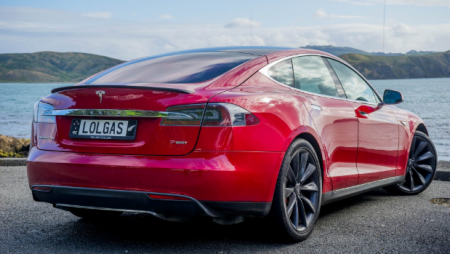
An electric Tesla 3 with a licence plate that cocks a snoot at the internal combustion engine.
Something has changed since that documentary was produced. Now it seems like big business does want us to have electric vehicles. GM would love to sell you one today, if you were in the United States, and there is no shortage of options for those of us in New Zealand. BMW have a very BMW-like electric car, with Nissan and others looking after more budget conscious drivers.
However, the reason for the change falls short of a fascinating tale of intrigue involving globalist powers living high on oil riches. There is money involved, but at the root of it all are, rather anticlimactically, science nerds developing battery chemistry, and engineering nerds building factories to produce what the scientists come up with.
The fact is that there has only ever been one problem with electric vehicles: the batteries. It turns out, thanks to nature, that storing lots of electrical energy in a small volume that doesn’t weigh a huge amount, is very difficult. On the flip side of this we have oil which, thanks to nature, it turns out is really very easy to do the same with. Early on we sensibly went all in for the oil option, because it was there, big companies could sell product and make money, and consumers were happy.
The rate of battery development was no doubt hurt by our love of oil, but it didn’t stop. In fact, there was an unexpected saviour of the electric car, which began its heroic march in the 1990s, in the form of an army of laptops and mobile phones.