Monthly Archives: June 2017

Milton Keynes EV Experience Centre

New Milton Keynes EV centre to feature multiple brands

The Electric Vehicle Experience Centre (EVEC) will open in Milton Keynes on Saturday 22nd July, featuring the UK’s first multi-brand electric vehicle showroom. Part of the city’s Go Ultra Low Cities bid, the EVEC will be located in the centre:mk shopping centre.

Milton Keynes EV Experience Centre
The EVEC will open with cars from a number of EV manufacturers

BMW i, Kia, Mitsubishi, Nissan, Renault, and VW have all signed up to be founding manufacturers for the EVEC, and will display a range of EVs spread across a range of costs and electric range.

Set to be run by Chargemaster, the EVEC will both showcase existing electric models and be an information point for EV ownership in general. Visitors will be able to talk with staff about all elements of owning and running an EV, with test drives available too.

Milton Keynes has a target for 23% of all new cars registered in the area to be electric by 2021. The centre is intended to help promote EV sales and use, and also to educate prospective buyers as to the benefits of going electric.

The EVEC is part of a suite of initiatives from Milton Keynes’ Go Ultra Low City bid, including investment in expanding the number of EV charge points available including creating a number of charging hubs, free parking for EVs, and additional grants for home and workplace charging.

Brian Matthews, Head of Transport Innovation at Milton Keynes Council, said:

“The EVEC is a centrepiece of our thrust to encourage the uptake of electric vehicles and is a good example of the innovation that Milton Keynes is using to lead the way in transport innovation. We are delighted to be working with Chargemaster and six founding car manufacturers to bring this about.”

David Martell, Chief Executive of Chargemaster, said:

“Opening the Electric Vehicle Experience Centre on 22 July will be a landmark day, not only for the electric vehicle sector, but also for Milton Keynes residents.

“Becoming the UK’s first multi-brand EV showroom, it will provide a destination for visitors to make an informed decision about owning an EV, without the pressure of having to make an immediate purchase decision. We are delighted to receive the support from six key electric vehicle manufacturers as founding partners of the EVEC.

“We hope that this platform will change the way that electric vehicles are sold in cities and we’re proud to be working with Milton Keynes and Go Ultra Low to deliver this to the public.”

Source: Next Green Car

f

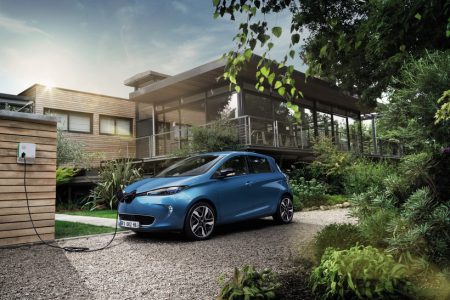
Why Americans Should Care About The Renault Zoe

If you’re looking for a true game-changing company in the automotive arena, it’s the Renault-Nissan Alliance, not Tesla, that has a firm grasp on the future.

Renault ZOE

With all the talk of climate change and the Paris Agreement, ask yourself if you’ve ever heard of the Renault Zoe. Probably not. It’s an electric vehicle (EV) sold by French automaker Renault. It’s also the most popular EV in Europe and is mechanically similar to the Nissan Leaf we have here in the U.S. So why should you care about this French EV? One simple reason: Automakers are serving a global market whether they like it or not and Renault-Nissan will soon be setting the agenda for EVs around the world. Partly thanks to partnerships between Nissan, Renault and now Mitsubishi, the Zoe is the perfect barometer for global EV success or failure.

According to CleanTechnica, an EV website, of the top-selling EVs and plug-in hybrid electric vehicles (PHEV) in Europe, Renault, Nissan and Mitsubishi have the top three spots for in 2016 and that trend continues into 2017. In total, Renault, Nissan and Mitsubishi vehicles make up 6 of the top 30 spots, including some oddballs like the Outlander PHEV, Renault Kangoo ZE and Nissan e-NV200. Only VW Group has more total vehicles in the top 30.

EVs Replace Diesel?

Eventually, EVs will replace diesel as the budget and eco-friendly option. Last year, I spoke to a Renault-Nissan executive, and he said that affordable diesel-powered small cars are likely the first to gradually disappear given the stricter emissions regulations coming to the E.U. The main reason is that the cost of compliance is getting to be a serious obstacle. In short, as emissions requirements become increasingly stringent, the cost of building compliant cars will go up. The U.S. pulling out of the Paris Agreement won’t change automakers’ global strategy, but China deferring compliance until 2030 may remove some of the urgency of the agreement.

The first area to feel this will be small, typically inexpensive cars where the buyers are very price-conscious. Renault-Nissan Alliance Chairman and CEO Carlos Ghosn echoed those sentiments at a press conference at the Paris Auto Show in 2016. And judging by his comments and how he essentially spun every emissions question into a talking point about EVs and the Zoe/Leaf, the next version of that car will likely put the Renault-Nissan Alliance in the catbird seat when it comes to global EV sales.

Maybe they’re already there: If budget friendly, diesel-sipping small cars go away, the next best option for budget-strapped motorists is an EV like the Zoe. According to Forbes, Renault-Nissan is on track to sell nearly 10.5 million vehicles in 2017, second only to Toyota. Therefore, Alliance decisions and innovations are bound to have a ripple effect on the global automotive marketplace.

Read more: Huffington Post

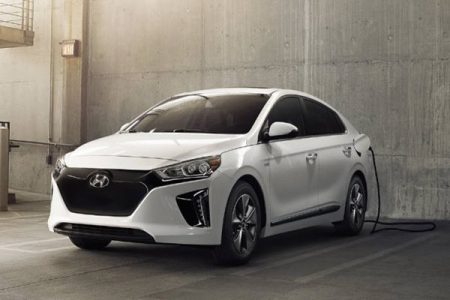
Hyundai Motor Company Increases Production Capacity of IONIQ Electric by 50%

Hyundai Motor Company is planning to increase production capacity of ‘IONIQ Electric’, which is its main electric vehicle, by 50% as number of potential buyers has greatly increased compared to its original prediction on demands in South Korean market. It is expected that this will resolve inconvenience of customers who have to wait 4 to 5 months to purchase IONIQ Electric.

Hyundai Motor Company’s IONIQ Electric

According to electric vehicle industries on the 6th, Hyundai Motor Company is planning to increase an output of IONIQ Electric, which is produced from its production plant in Ulsan, from 1,200 (based on per month) to 1,800. Half of this output is supply for South Korean market and the other half is for foreign markets such as the U.S., and Europe. Quota for South Korean market will also increase from 600 per month initially to 900 per month. It is expected that delivery of IONIQ Electric will be pushed forward when people have to wait between 4 to 5 months to purchase one. Increased output will first be applied to IONIQ Electrics that need to be delivered between July and August.

Hyundai Motor Company has increased production facilities when contractors including Ministry of Environment (ME), which is in charge of supply of electric vehicles, started complaining due to recent rapid increase in number of buyers of IONIQ Electric and it has also set its yearly sales goal high. It has increased yearly sales goal in South Korean market from 6,000 initially to 8,000.

But even this won’t help Hyundai Motor Company to make another upward revision as 5,581 IONIQ Electrics were already sold by end of April and the number of IONIQ Electric owners will rise to about 7,000 by end of May if people who already paid deposits are included.

Read more: etnews

Stylish Andersen A1 Home Charge Point Launched

Andersen has launched its first charge point – the A1 – offering EV drivers a premium option for home charging. The Andersen A1 is inspired by Scandinavian minimalist design, and hides away the cables within the unit.

Andersen A1 Charge Point

As part of a second wave of new charge points coming to the UK market, Andersen is aiming their product at those who want a sleeker, more stylish design. Although existing options perform well and offer a reliable home charge option, there are few on the market that look stylish.

Now though, charge point manufacturers are opening up the options available to buyers with a more expensive, but also more aesthetically pleasing product. There is a choice of five colours on offer too.

David Simpson, Technical Director at Andersen, said:

“The whole idea came from my own frustration with the home charge points that were available. I’d just bought an EV and I was looking for a charge point. I wanted one that didn’t have messy cables or flashing blue lights – just something that would sit happily on the side of my house.”

Jerome Faissat, Managing Director at Andersen, said: “A home charge point is something an electric car owner uses on daily basis and they’re often mounted in very visible places on the front of your house.

“The A1 is designed to complement the style of your home and work perfectly for you all the time. You can choose the colour you want and tidy the cables away if they bother you. It was important for us to create something that looked timeless and functional to last for many years.”

Andersen A1 Charge Point, Various Colours

Priced from £1,499 excluding OLEV grant and installation, Andersen has partnered with Just Energy Solutions as its OLEV accredited installer.

Source: ZapMap

Product: Andersen 

Honda looks to future with EV and autonomous strategy

Japanese manufacturer Honda has spelled out its plans for the future as it unveiled its mid-term Vision 2030 strategy plan. The company wants to develop level 4 autonomous cars for sale by 2025 and plans two new electric vehicles (EVs) by 2018.

Honda Garage

The company has been investing in its research and development of future mobility, spending 750 billion yen (€6.1 billion) for the year to March 2017.

Speaking at the launch of its new strategy, Honda CEO Takahiro Hachigo said:

‘We strive to electrify two-thirds of our global automobile unit sales in 2030. This development will put a central focus on hybrid-based models utilizing a high-efficiency plug-in hybrid system unique to Honda. As for zero-emission vehicles (ZEV), we will strengthen the development of electric vehicles as well as fuel cell vehicles (FCV), in addition to a China-exclusive model scheduled to go on sale in 2018, a dedicated EV model for other regions is also currently under development.’

Developing new driving technologies, robotics- and artificial intelligence-driven services and new energy solutions also would be key priorities for Honda in the years ahead, the company said.

In addition to the new low emission strategy, by 2025, Honda plans to come up with cars with level 4 standard automated driving functions, meaning they can drive themselves on highways and city roads under most situations. Achieving this will require artificial intelligence to detect traffic movements, along with a battery of cameras and sensors to help avoid accidents.

Hachigo adds:

‘By featuring smooth and natural driving characteristics, our automated driving vehicle will realise occupant comfort that gives the driver complete trust and provides a fun mobility that makes people naturally want to go driving. We are going to realise automated driving technologies for use on highways in 2020. Then, we will make them usable in a broader area including regular roads, by 2025.’

Read more: Autovista Group

Renault-Nissan to build energy storage plant from EV batteries to rival power stations

The Renault-Nissan Alliance is planning to build a 100MW energy storage plant big enough to power 120,000 homes, which can replace a gas or coal-fired power station, sources told Reuters. It is widely seen as a pilot project that could lead to a major new business opportunity for OEMs.

Following trialling using electric vehicle (EV) batteries for home energy storage, this is a further sign the Alliance is planning to establish an energy storage division. The energy storage plant intentions highlight the Alliance’s growing confidence in the powerful position OEMs will find themselves in following the upcoming electric vehicle revolution.

Energy storage plants – essentially gigantic batteries – help save costs and emissions by charging up in times of cheap excess electricity supply. This is when, for example, wind farms generate too much electricity than needed on a windy day. The storage plants then sell the electricity back to the grid at peak times, when the high demand means the electricity commands a higher price.

This helps solve two key problems holding back efficiency in the energy sector: the need to smooth out the variable energy generated from wind and solar, and the desire to remove the need for gas- or coal-fired power plants to be idling on standby for most of the day, and switched on ad hoc in order to meet times of peak electricity demand.

The Renault-Nissan project both aims to cultivate this demand for a second-hand battery market, as well as encouraging the development of energy infrastructure (which can have 10-year lead times) that will synergise with booming EV sales over the next decade. If successful, the expected high demand for these second hand EV batteries would help drive down the costs of electric vehicles (and raise residual values), and also provide an attractive mechanism for recycling the power cells which contain environment-harming heavy metals.

Read more: Autovista Group

Electric Car Sales Are Surging, IEA Reports

  • International Energy Agency says EV market grew 60% in 2016
  • Plug in automobiles may reach 30% market penetration by 2030

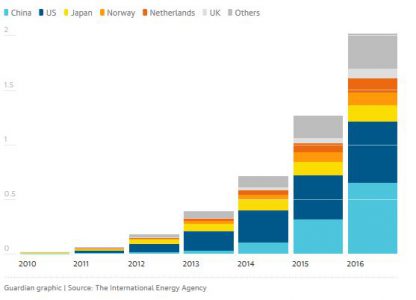
The number of electric vehicles on the road rocketed to 2 million in 2016 after being virtually non-existent just five years ago, according to the International Energy Agency.

Registered plug-in and battery-powered vehicles on roads worldwide rose 60 percent from the year before, according to the Global EV Outlook 2017 report from the Paris-based IEA. Despite the rapid growth, electric vehicles still represent just 0.2 percent of total light-duty vehicles.

“China was by far the largest electric car market, accounting for more than 40 percent of the electric cars sold in the world and more than double the amount sold in the United States,”

the IEA wrote in the report published Wednesday.

“It is undeniable that the current electric car market uptake is largely influenced by the policy environment.”

Read more: Bloomberg

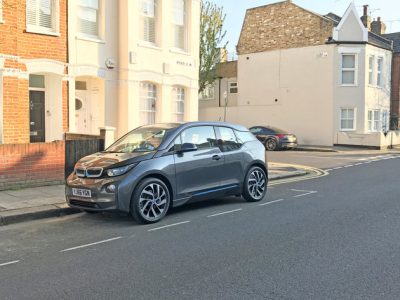
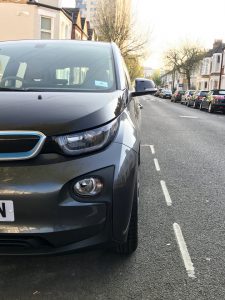
BMW i3 Diary: How Easy Is It To Own An Electric Car?

Range anxiety? What range anxiety…

BMW i3

Is owning an electric car a statement or simply good financial sense?

In the beginning it was most definitely the former. Electric cars were expensive, limited in range and thanks to a complete lack of infrastructure impossible to make long journeys in.

To find out if these cars are now living up to our expectations we spent two weeks with BMW’s i3. We drove to work, did the weekly shop and generally found every possible excuse to use it over our own two legs.

To begin with we’ll run though the model we tested. This was a BMW i3 94ah with range extender. That meant that if we drove it in BMW’s COMFORT mode we could, just about, squeeze out a top range of 205 miles.

BMW i3

The first few days…

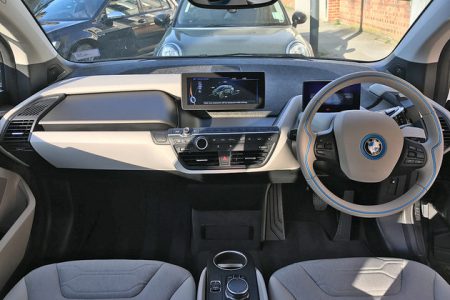
Getting into the car for the first time you’re struck at just how pleasant everything is. It’s BMW alright, but if BMW lived in California and went to yoga four times a week.

It’s all very minimalist and the cabin itself feels incredibly spacious, despite the small dimensions of the car.

Interior of BMW i3

Halfway there…

Electric cars are absolutely perfect for city driving, especially small ones like the i3.

Thanks to the i3 having plenty of punch in the acceleration department we found weaving through the central London chaos to be almost, and we do mean almost, enjoyable.

The silence is also something that becomes really hard to give up. The i3’s cabin has just the right amount of sound isolation to make sure that the only thing you’re going to hear is either the gentle whine of the electric motor or the radio. It’s a blissful oasis in a sea of livid cyclists.

The last stretch…

We’re on to the last week week now and despite having driven over what feels like every road hump in London our love for this plucky little car is growing.

The styling continues to be a real winner for us, especially this two-tone fabric against what looks like a black recycled composite. It looks futuristic and yet acutely homely at the same time, like a Bang & Olufsen speaker.

Bang & Olufsen speaker, BMW i3

Another thing that’s really starting to dawn on us is that not once have we worried about range anxiety. The car’s range readout is accurate enough that you never feel like it’s suddenly going to steal 5 miles from you.

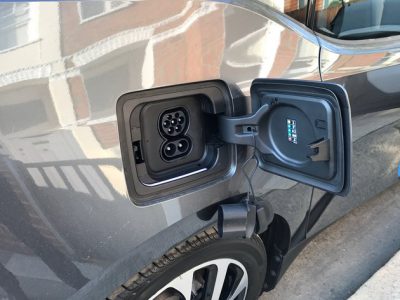
While an owner will have a charging point installed in their house we couldn’t and so had to rely on a plug socket. Naturally the plug socket was too far away and so for the last two weeks we’ve actually been solely charging the car using what’s available around the city.

BMW i3, Charging Port

Verdict….

The i3 is a superbly built car. It feels and behaves in every sense like a product that is at the top end of what BMW is capable of. The interior build-quality is second to none while the enormous windscreen at the front gives it perfect visibility for city driving.

Its electric motor is powerful and responsive and while the ride itself is a little hard the seats are incredibly comfortable.

The i3 doesn’t feel like an experiment any more, it is simply a BMW that’s electric. Most of this is down to the car while the rest is absolutely down to the fact that we finally have a substantial charging network here in the UK.

Read more: The Huffington Post


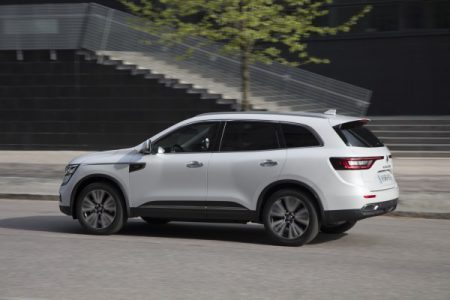
Renault: Plug-in Hybrid and electric versions of Koleos SUV could happen

The new five-seater SUV is currently offered with two diesel engines, but there is scope for this to change in future

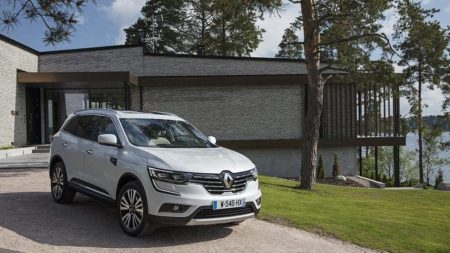
Renault Koleos SUV

A Renault director has not ruled out the possibility of a plug-in hybrid or pure electric version of its new Koleos SUV making its way into production.

The Koleos will go on sale in the UK in July, and will only be offered with a choice of two diesel engines – a 1.6-litre, 128bhp unit and a larger 2.0-litre 173bhp unit.

When quizzed on whether the recent bad press diesel has received in the UK could see an electric or PHEV version of the Koleos introduced to the market, Renault UK’s managing director Vincent Tourette said it was a possibility.

“It’s technically possible because we’re part of the alliance with Nissan and Mitsubishi now, so that’s something we have in the bank between us,”

he explained.

Renault Koleos SUV

“But at the moment, we are monitoring closely the way the market is going and if at some point we consider it’s a strong customer requirement, we will go for it. But today, it’s not in the plans.

“Today we have made the choice to offer our vehicles with petrol engines, with diesel engines and as pure EVs, which by the way, most manufacturers have decided to invest in too.

“So that’s our positioning and that’s the way our product plans have been formulated. But then we do have within the Renault-Nissan Alliance other possibilities, and if at some point we consider that [an electric/PHEV Koleos] something Renault also needs to bring to the market, we will have the possibility to do it.”

Source: Express and Star

Electric cars accelerate past 2m mark globally

China, US and Europe accounted for more than 90% of electric vehicle sales last year with decreasing costs driving demand

The number of electric cars in the world accelerated past the 2m barrier last year, as prices fell and manufacturers launched new models.

The number of battery-powered vehicles numbered just hundreds globally in 2005 and passed the 1m milestone in 2015, but sales jumped 60% in 2016.

China, the US and Europe accounted for more than 90% of electric vehicle sales last year, with China the single biggest market, according to research by the International Energy Agency.
In some European countries, growth has been so fast that electric cars are taking significant market share from petrol and diesel cars.

Nearly a third of new cars sold in Norway are electric, the highest proportion worldwide, followed by 6.4% in the Netherlands and 3.4% in Sweden.

While the UK lags behind on annual registrations, industry figures this week showed that a record 4.4% of new cars sold in May were hybrid or pure electric models. More than 100,000 electric cars have been sold in the UK under a grant scheme launched in 2011.

The growth globally indicated a “rapid market evolution” in electric cars, the IEA said, but it cautioned that they made up only 0.2% of all passenger cars.

Greg Archer, clean vehicles director at the Brussels-based Transport and Environment group, said:

“The rapid rise in electric vehicle sales is a consumer-driven phenomenon rather than being down to the efforts of suppliers.”

The number of electric cars on the road globally hit 2m in 2016

Decreasing costs, longer battery ranges and an increasing number of charging points were driving demand, he said.

Read more: The Guardian