Daily Archives: May 25, 2017

Newest, cleanest diesels in Europe can still be very dirty: analysis

It has become increasingly more evident that carmakers must take aggressive steps to ensure that diesel cars and light trucks meet current environmental regulations.

Tests done by Emissions Analytics found that the majority of new diesel-powered cars sold in Europe do not meet the Euro 6 emission standards for nitrogen oxides (NOx) in real-world use.

Worse, some of them emitted as much as 12 times the current levels when tested in real-world driving—and didn’t meet even the far lower Euro 3 standards from decades ago.

Diesel vehicles have been under more scrutiny since the world’s largest car manufacturer, Volkswagen Group, was caught using “defeat device” engine-management software to pass tests.

The deception was discovered by the University of West Virginia’s Center for Alternative Fuels Engines and Emissions (CAFEE) during independent research trying to prove that automakers could meet the NOx emissions standards.
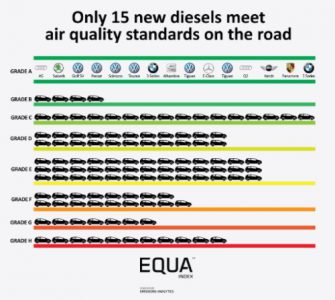
Emissions Analytics, like CAFEE, tested vehicles independently under real-world conditions to see if they met the new Euro 6 standards. Their disturbing results are published by the EQUA Index.

The Emissions Analytics real-world tests found that only 16 of 116 diesel vehicles tested meet the Euro 6 emission standards for NOx, as depicted in the EQUA Air Quality Index chart.

Ony 14 additional vehicles would have met the standards even if the less stringent Euro 5 standards were used, giving a total of just 30 vehicles meeting a now-obsolete regulation under real-world driving conditions.

But the most disturbing part of the results may be how many cars exceeded the limits by wide margins.

More than half the 67 vehicles tested met only the decades-old Euro 3 emission limits.

Against the newly imposed Euro 6 limits, 21 of the cars tested exceeded the maximums with emissions that were at least six times the allowable limits.

Ten of the 21 worst-performing cars had emission levels 12 times or more the limits set under the Euro 6 standards.

Read more: Green Car Reports
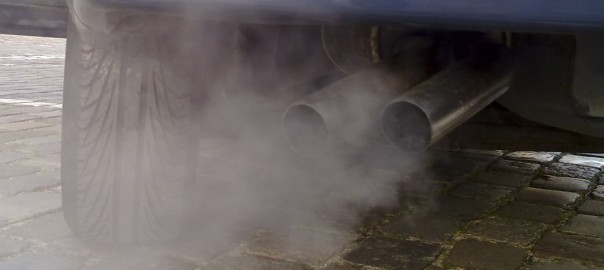
Car exhaust pollution (Image: Wikipedia)

When will we see ‘tailpipes’ on cars as morally wrong? An Earth Day question

Economists call them “externalities.” They’re the costs of people’s actions on other people or communities—though the people taking those actions don’t have to pay for those costs, even as they harm others.

Car exhaust pollution (Image: Wikipedia)

The emissions from combusting fossil fuels to propel vehicles are clearly a prime example.

While complaints about air quality in the Los Angeles Basin date back centuries, research established more than 50 years ago that vehicle emissions were the primary cause of photochemical smog.

That led the state of California to begin efforts to regulate tailpipe emissions—well before the U.S. Environmental Protection Agency even existed—which led in turn to the first catalytic converters in U.S. vehicles in 1975.

Catalysts spread throughout most of the automaking world over the next 20 years, hugely reducing emissions of carbon monoxide (CO), hydrocarbons (HC), and nitrogen oxides (NOx), all toxic in various ways.

It’s well established that electric cars have the lowest wells-to-wheels CO2 footprint of any near- or medium-term alternative, varying from the equivalent of about 35 miles per gallon on the dirtiest U.S. grids to more than 100 mpg on the cleanest grids.

And the carbon footprint per mile of driving an electric car declines every time the grid gets cleaner, whether from adding renewable energy sources or replacing a coal-fired generation plant with one using natural gas.

With increasing availability of zero-emission cars over the coming years, when will citizens at large start to question the idea that every vehicle has an “exhaust pipe” that just belches harmful substances into our shared air?

And when will driving a car that emits carbon dioxide every time it moves become morally unacceptable?

Read more: Green Car Reports

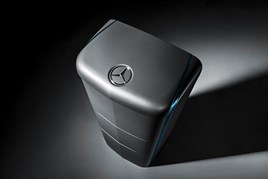
Mercedes-Benz ready to deliver home energy storage units

Mercedes-Benz Energy is ready for the delivery of the first energy storage units for residential use to homeowners in the UK.

The energy storage units are lithium-ion batteries based on the technology used by Daimler since 2012, in more than 80,000 hybrid and full electric vehicles.

By using the storage units, households with their own solar energy systems can store surplus power with virtually no losses. By combining renewable energy sources with a battery storage unit, households can increase their self-consumption of generated energy to as much as 65%.

Mercedes-Benz’s franchised dealer network will not be called upon to retail the systems, however.

Distribution is taken care of by a network of qualified partners such as Alternergy, Innasol and Wind & Sun, as well as with partners who offer a complete system installation, such as Solar Frontier.

“There is tremendous interest in our energy storage units in the UK. We’re very pleased to be able to offer Mercedes-Benz Energy Storage Home to customers here,” said Marc Thomas, managing director of Mercedes-Benz Energy.

Source: AM Online

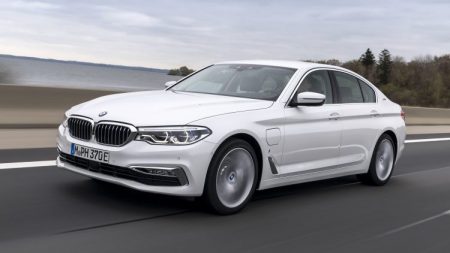
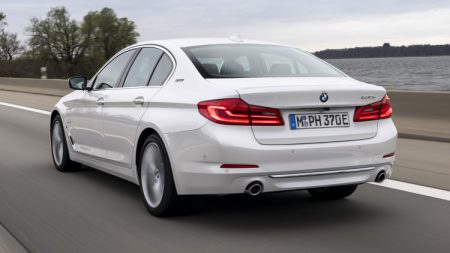
BMW 530e PHEV Test Drive Review

BMW’s new 5 Series now offers no-compromise plug-in power.

On a cold, foggy morning in the Alps southeast of Munich, right along the Austrian border, I don’t notice any of the BMW 530e’s hybrid wizardry working. It’s there, silently and effortlessly and unobtrusively switching between gasoline and electric power. But seeing as how I can barely see ten feet in front of me at this point, with unexpected patches of snow and ice tugging at my confidence during high-altitude cornering, it’s safe to say my mind’s focus is elsewhere.

BMW 530e iPerformance

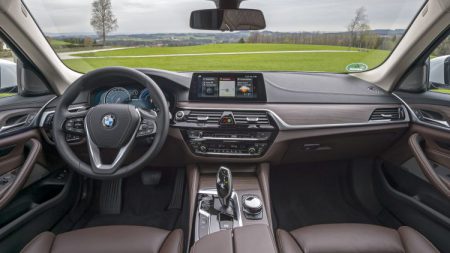
Down at sea level, on the flat, winding roads leading back toward Munich, I’m hustling along like I would in any other version of the fantastic new 5 Series. Like the 530i and 540i, this is an executive sedan that’s packed with luxury and an overwhelming amount of technology. And this 530e only enhances the experience with a bit more fuel economy, to boot. This is definitely the kind of hybrid driving that I could easily, um, plug in to.

Electric boost. The 530e mates a 2.0-liter turbocharged four-cylinder engine to an electric motor with a 9.2-kilowatt-hour battery. The gas engine itself is good for 180 horsepower and 255 pound-feet of torque, with the electic motor generating its own 111 hp and 184 lb-ft. BMW’s official combined system output ratings are 248 hp and 310 lb-ft, exactly like in the smaller 330e sedan. The 530e makes just as much horsepower as its gas-only sibling, but it has more torque – again, 310 lb-ft here, compared to 258 in the 530i. And because the electric oomph hits right from idle, the 530e and 530i run identical 0-60 times of six seconds flat with rear-wheel drive, despite the plug-in model carrying an extra 520 pounds of battery weight. The all-wheel-drive 530e xDrive shortens that sprint to 5.8 seconds – same as the 530i xDrive.

BMW 530e iPerformance

Increased range. When Jake Holmes earlier reviewed the 330e, he rightly pointed out that its 14 miles of electric range seems like enough for daily travels, but in reality – turn on the air conditioning or go heavy on the throttle a couple of times, and that alleged 14 miles is gone before you know it. Good thing, then, that the 530e uses a larger battery pack (9.2 kWh versus 7.6), which means it’ll do around 15% more EV driving, making it much more usable (on electricity) day to day.

Wireless charging. I’m still getting used to wireless charging for my iPhone, but BMW will soon allow drivers to wirelessly charge the entire car. Equip your home with one of BMW’s charging pads, drive the 530e over it, and juice up the battery without using the usual plug port. The details are still being finalized, but in the meantime, should you choose to use a conventional plug, the 530e will charge in less than three hours on a 240-volt (Level 2) outlet.

The only plug-in option in its class. Competitors like the Audi A6, Jaguar XF, and Mercedes-Benz E-Class don’t yet offer a hybrid alternative. What’s more, the base price of a 530e is only $200 more than a 530i, so it’s not out of reach for most would-be 5 Series buyers.

BMW 530e iPerformance

Read More: Inside EVs