Monthly Archives: December 2016

Electric cars can be a very effective way to save you money on motoring (Image: Go Ultra Low)

Diesel reliance reducing faster than expected

Contracthireacar.com customers are reducing their reliance on diesel models faster than expected, says the leasing company.

Electric cars can be a very effective way to save you money on motoring (Image: Go Ultra Low)

It carried out analysis of its own risk fleet following the research published by Arval for its 2016 Corporate Vehicle Observatory Barometer, which points to a 5% overall reduction in UK fleets’ use of diesel by 2021.

Arval’s study forecasts a 12% reduction in diesel use for larger fleets and a 1% reduction for smaller fleets of 40 or fewer vehicles, the latter accounting for the majority of Contracthireacar.com’s client base.

During the period January to July 2015, diesel made up 86% of car leasing deals written by the firm, with petrol on 12.57%. Alternative vehicle fuels such as hybrid and electric accounted for 1.42% of orders.

A year on, Contracthireacar.com data covering the period January to July 2016 stands at 79.29% diesel usage, with petrol having risen to 17.61% and alternative fuels having increased to 3.10%.

Craig Davy, business development manager for Contracthireacar.com, said: “With influencing factors ranging from the Volkswagen headlines, fuel price trends, advancements in turbocharged petrol engines and the EU leave result, to new London Mayor Sadiq Khan likely to introduce a T-Charge to deter older diesels and bring forward the city’s ULEZ, it’s no surprise that we’re seeing the switch to petrol and particularly hybrids and electrics accelerate.

“ULEV and EV orders doubling is to be expected but the 5% switch back to petrol within just a year is somewhat surprising.”

Read more: Fleet News

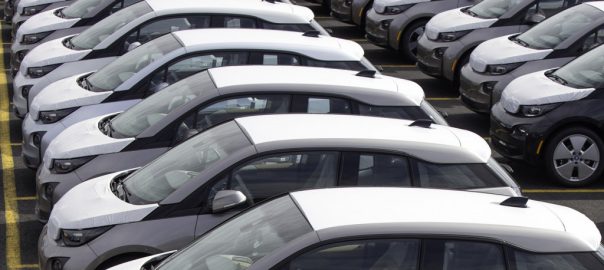
2016 BMW i3

1 in 6 cars sold in 2020 must be electric to meet fuel-economy rules

Several nations have enacted strict fuel economy standards but, for the most part, they have not required automakers to sell electric cars.

2016 BMW i3
2016 BMW i3

In the U.S., only the state of California has a zero-emission vehicle mandate that puts such a requirement on carmakers.

Yet even without mandates, automakers may soon be forced to sell large numbers of electric cars just to meet fuel-economy rules.

That’s the conclusion of a study published in June by the World Energy Council (WEC), which argues that automakers will need quite a lot of electric cars indeed.

Among the major the points in the full study (pdf) is a prediction that 16 percent of cars sold in 2020 will have to be electric in order to meet emissions standards.

The study compares emissions-reductions targets for the U.S., China, and the Europe Union—the world’s three largest car markets, with anticipated fuel-economy improvements that can be achieved with internal-combustion engines alone.

By the WEC’s estimation, larger volumes of electric-car sales will be needed to plug an “EV Gap” between fuel-economy targets and the improvements that can be realistically expected from internal-combustion engines.

Read more: Green Car Reports

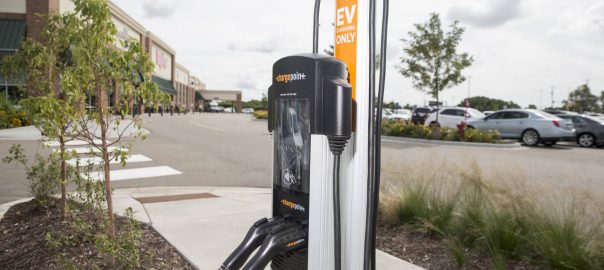
Hy-Vee, a Midwestern grocery chain, installs charging stations at all its new locations. The number of commercial charging stations is growing quickly. (Image: A+G/WSJ)

Why Electric Cars Will Be Here Sooner Than You Think

Adoption of electric vehicles will not be gradual, because the factors required to unlock demand for them are in place

Hy-Vee, a Midwestern grocery chain, installs charging stations at all its new locations. The number of commercial charging stations is growing quickly. (Image: A+G/WSJ)

In 2015, about one in every 150 cars sold in the U.S. had a plug and a battery. But mass adoption of electric vehicles is coming, and much sooner than most people realize.

In part, this is because electric cars are gadgets, and technological change in gadgets is rapid.

One big leap is in batteries. A typical electric vehicle today costs $30,000 and will go about 100 miles on a charge, if that. Within a year, you’ll be able to get double that range for just a little more money.

Tesla Motors Inc. is the standard-bearer, promising a Model 3 vehicle meant to appeal to the masses at $35,000 without incentives and more than 200 miles of range. By comparison, the average new car in the U.S. today sells for about $33,000.

But Tesla is hardly alone. Later this year, Chevrolet will roll out its $37,500 Bolt EV. It, too, boasts more than 200 miles of range, which appears to be the new goal for eliminating “range anxiety”—the fear that a vehicle will run out of juice—among potential electric-vehicle buyers.

And that is just the start. Pasquale Romano, chief executive of ChargePoint Inc., the world’s largest maker of electric-car charging stations, says he works with, and talks to, most major car companies.

“We have seen their internal plans to just electrify everything,” he said.

In the short run, many of these cars will be plug-in hybrids, with both electric motors and gasoline engines. It makes sense to lump them with electric vehicles because most new models have enough battery power to get the average U.S. commuter to work and back without using any gasoline.

Steve Majoros, a marketing director at General Motors Co.’s Chevrolet unit, says that 90% of trips and 65% of miles driven in its Volt plug-in hybrid are on electric-only mode. The Volt can go 53 miles on a charge.

Every plug-in hybrid is effectively an electric car that is carrying a “range extender,” just in case. They will help electrify a large share of the miles Americans drive. They’ll also help ease consumers into electric vehicles, overcoming any remaining fear about being stranded after running out of juice.

Competition among electric vehicles and plug-in hybrids will be intense, which will drive down prices. Volkswagen AG has pledged to make every model available as a plug-in hybrid by 2025. BMW AG has made the same promise. Hyundai Motor Co. promises eight plug-in hybrid models by 2020, plus two all-electric vehicles. Toyota Motor Corp.’s overhaul of the plug-in Prius, boasting twice the range, arrives before the year is out.

Read more: Wall Street Journal