Monthly Archives: April 2015

Kia Soul EV Car of the Year

Kia Soul EV, Car of the Year in Norway

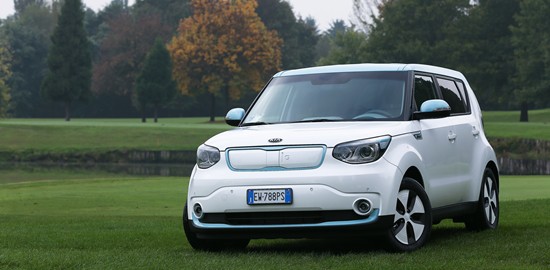
Kia Motors brought home another prestigious award, with the Kia Soul EV winning the Car of the Year title in Norway. The largest consumer information service providing organization in Norway, Dinside, has named the Kia Soul EV the best car for 2015 based on its price, space, handling, technology, and environmental friendliness.

Kia Soul EV Car of the Year

Soul EV gained the highest marks among 10 eligible candidates, thanks to its excellent design, spacious interior, and the best range (212km) on a single charge among the available electric vehicle (EV) models. Unlike some other eco-friendly cars with limited cargo space, Soul EV has been able to maximize the passenger and cargo room thanks to its boxy shape, adding practicality for all consumers.

Read more: Kia Buzz

Nissan ‘Ultimate Smart BBQ’ Electric Van

As electric cars become more common, it’s only a matter of time before more people start thinking of things to do with them besides drive to and from work.

Like, for example, turning one into a barbecue on wheels.

In this case, it’s an electric van, not a car–all the better to power your electric grill, right?

Nissan claims to have created the “Ultimate Smart BBQ Vehicle” using its e-NV200, an all-electric version of the NV200 small van.

As enthusiastically described (in Japanese) in the video (via Electric Cars Report), the modified e-NV200 has everything you’ll need for an outdoor party.

Read more: Green Car Reports

https://www.youtube.com/watch?v=wE1S4hXdA4s

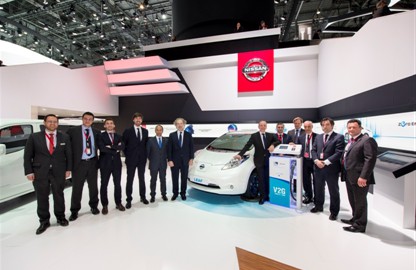
Power to spare - Nissan and Endesa sign pledge to promote Europe's first mass market vehicle-to-grid system (Image: Nissan)

Power to Spare – Nissan and Endesa Sign Vehicle to Grid Pledge

POWER TO SPARE – NISSAN AND ENDESA SIGN PLEDGE TO PROMOTE EUROPE’S FIRST MASS MARKET VEHICLE TO GRID SYSTEM

    • Nissan and Endesa, an Enel Group subsidiary, collaborate on bringing key technologies to market
    • Game-changing technology unlocks the potential of two-way charging and allows customers to reduce costs by selling power from electric vehicle batteries to the grid
    • First step towards integration of electric vehicles with the renewable energy sector
    • Madrid to host real-life demonstration of the system in March 2015

    Nissan and Endesa, an Enel Group subsidiary,  signed a ground-breaking agreement at the 85th Geneva International Motor Show that paves the way for a mass-market vehicle-to-grid (V2G) system.

    The two companies have pledged to work together to deliver a V2G system and an innovative business model designed to leverage this technology.

    Nissan- the world leader in EV sales with over 160,000 Nissan LEAF sold globally- is turning a page in zero emission mobility, and releasing the full potential of electric vehicle (EV) batteries with the Endesa two-way charging technology. It’s all part of Nissan’s commitment to support the entire EV ecosystem, not just the car..

    The two companies have agreed to collaborate on the following activities:

    • – Introduction of V2G services in the European market;
    • – Exploring the use of ‘second life’ EV batteries for stationary applications (including households, buildings, grid);
    • – Designing and evaluating potential affordable energy and mobility pack offers;

    Paul Willcox, Chairman of Nissan Europe, praised the innovative two-way charging system and the step-change towards a further acceleration of the EV market:

    We believe this innovation represents a significant development for Nissan Leaf and e-NV200 customers. Every Nissan electric vehicle battery contains a power storage capability that will prove useful in contributing towards smarter and responsible management of the power demand & supply of local power grids, thus reducing our EV total cost of ownership. Not only does this represent an opportunity for Nissan’s EV private and fleet owners, it could also support grid stability and fully demonstrate that each Nissan EV represents a tangible social asset.’

    Power to spare - Nissan and Endesa sign pledge to promote Europe's first mass market vehicle-to-grid system (Image: Nissan)
    Power to spare – Nissan and Endesa sign pledge to promote Europe’s first mass market vehicle-to-grid system (Image: Nissan)

    Indeed, one of the main challenges for electricity management systems is to assure grid stability. This situation is especially relevant in countries with a high level of renewable energy generation, and this will only increase in the future. The longer term zero-emission vision is for EVs to be at the center of a fully integrated system whereby owners can participate in wholesale energy markets using the power stored in the batteries of their electric vehicles, and thus significantly reduce their cost of operation. In a not-so-distant scenario, the EV user not only decides when and where they want to charge their EV, but how best they spend and re-sell the energy stored in their EV; receiving tangible financial benefits in terms of energy savings, while at the same time maximizing the use of green energy.

    The flexibility offered by V2G implementation in terms of storing and releasing green energy into the grid will further enhance the already significant and tangible benefits of electric mobility. This is why Endesa, together with its parent company Enel and partner Nissan, have decided to join efforts in promoting this technology.” said Javier Uriarte, Head of Market Iberia at Endesa.

    For Information

    This Vehicle to Grid (V2G) system consists of the Endesa two-way charger and an energy management system that can also integrate such off-grid, and renewable, power generation as solar panels and wind turbines. Using this equipment, a Nissan LEAF or e-NV200 owner can connect to charge at low-demand, and cheap tariff periods, with an option to then use the electricity stored in the vehicle’s battery at home when costs are higher, or even feed back to the grid with a net financial benefit. Electricity generated by solar panels or wind turbines can be used to charge a vehicle, to power the home or business, or to feed back to the grid.

    This unprecedented agreement between Nissan and Endesa means that European countries can now review their current energy management policies in order to respond to the technological innovation of the V2G system.

    Endesa has developed the ultimate low-cost V2G technology ready for the mass market after years of real-life testing. The company first showcased its V2G technology in 2008 in Smartcity Malaga, the Enel Group testing ground for smart cities. Later on, in 2012, Endesa presented the evolution of such technology at the ZEM2ALL demonstrator.

    On March 12, 2015, as the culmination of the V2G system development, together with Nissan as automotive partner, Endesa will host a full demonstration of the market-ready and low cost system in Madrid.

    ENDS

    About Nissan in Europe

    Nissan has one of the most comprehensive European presences of any overseas manufacturer, employing more than 17,600 staff across locally-based design, research & development, manufacturing, logistics and sales & marketing operations. Last financial year Nissan plants in the UK, Spain and Russia produced more than 675,000 vehicles including award-winning crossovers, small cars, SUVs, commercial vehicles and electric vehicles, including the Nissan LEAF, the world’s most popular electric vehicle with 96% of customers willing to recommend the car to friends. Nissan now offers a strong line-up of 23 diverse and innovative models in Europe under the Nissan and Datsun brands.

    About Nissan Motor Co.

    Nissan Motor Co., Ltd., Japan’s second-largest automotive company, is headquartered in Yokohama, Japan, and is part of the Renault-Nissan Alliance. Operating with approximately 236,000 employees globally, Nissan sold more than 4.9 million vehicles and generated revenue of 9.6 trillion yen (USD 116.16 b

    illion) in fiscal 2012. Nissan delivers a comprehensive range of over 60 models under the Nissan and Infiniti brands. In 2010, Nissan introduced the Nissan LEAF, and continues to lead in zero-emission mobility. The LEAF, the first mass-market, pure-electric vehicle launched globally, is now the best-selling EV in history.

    Source: Nissan Newsroom

    Figure 3: Composite image of patio door showing cold spot along bottom edge (Image: T. Larkum)

    Using an Infrared Camera to Look for Wasted Energy

    Fuel Included isn’t just about electric cars, but about the transition to a low carbon lifestyle. One of the easiest ways to reduce your carbon footprint is to use less energy, and that can be as simple as wasting less energy around the home. A beneficial side effect is that you save money too.

    A useful technique to investigate where heat is lost from your home is to use an infrared camera to show up areas that are cold and which typically indicate gaps around windows or doors, but which are not as obvious as draughts. The approach is known as Thermography but one of the most important early uses of infrared cameras was mounted on the nose of an aircraft for target location, so-called Forward Looking Infrared (FLIR) cameras. For this reason, and because the leading manufacturer of such cameras is known as FLIR Systems, the term FLIR is often used as a generic term for thermographic cameras.

    Figure 1: FLIR Camera as delivered (Image: T. Larkum)
    Figure 1: FLIR Camera as delivered (Image: T. Larkum)

    FLIR cameras have historically been very expensive to buy (though they are now coming down in price to typically about £1000) so there is a healthy rental market for them. Recently a group of colleagues at work clubbed together to hire one for a week and so I got a chance to try one out for a weekend for about £30.

    Figure 2: FLIR Camera close-up (Image: T. Larkum)
    Figure 2: FLIR Camera close-up (Image: T. Larkum)

    The camera arrives in a big industrial box (see Figure 1) but it is actually quite small, about the size and shape of a radar gun (see Figure 2). It works much like a modern digital camera, with images recorded on internal memory that can be downloaded via a USB lead to a PC. A neat feature is that every image is recorded twice, as a conventional colour image and as an IR image.

    Figure 3: Composite image of patio door showing cold spot along bottom edge (Image: T. Larkum)
    Figure 3: Composite image of patio door showing cold spot along bottom edge (Image: T. Larkum)

    I used the IR camera to do an ‘audit’ of the house, at night and in cold weather for maximum contrast. I imaged all the walls and doors, inside and out. I also checked each of the radiators to make sure they were working correctly. The IR images are coloured to show different relative temperature, from black (the coldest part of the image) through blue, green, yellow, orange, and red then to white (the hottest part of the image). So a gap around a door will show, say, dark blue while the rest of the door and frame are yellow and red. Similarly a cold spot in a radiator will show, say, green amongst mostly red.

    Figure 4: Composite image of back door showing cold spot at cat flap and along right edge (Image: T. Larkum)
    Figure 4: Composite image of back door showing cold spot at cat flap and along right edge (Image: T. Larkum)

    The images clearly showed up problems with our two back doors. The patio door had a very clear dark blue patch along the bottom (see Figure 3); we were already aware of a draught from this area. The main back door had a dark blue patch along the lock side, and another around the cat flap (see Figure 4). These are issues that I have noted to return to on another day to see if I can fix them with some draught proofing.

    The FLIR camera was easy to use and I recommend it to anyone who wants to know more about where their home is leaking energy.

    [Part 2 is here]

    Citi: Battery storage to hasten demise of fossil fuels

    Investment bank says wide deployment of battery storage will hasten the demise of fossil fuels and utilities that remain focused on centralised generation. It tips rapid fall in costs and a $400bn storage market by 2030.

    citi reportInvestment bank Citigroup predicts that the wide deployment of battery storage technologies will hasten the demise of fossil fuels across the globe in the coming decade, including oil, coal and gas.

    And it also warns that the battery phenomenom will be even more profound than the solar revolution currently sweeping the globe, and will sweep aside any traditional utilities that remain focused on centralised generation.

    The predictions of Citigroup analysts are a reprise of predictions it made in August last year, when it predicted that battery storage costs could fall to around $230/kWh by 2020, and eventually be as low as $150/kWh. The global market for battery storage could be worth more than $400 billion by 2030.

    The significance of its latest update is that these forecasts, and their potential impacts, are included as part of its analysis of the 10 major investment themes for 2015.

    The issue is therefor rapidly moving beyond those with a narrow focus on utilities and energy markets, it is now part of mainstream financial thinking, and because of that will have a profound influence on capital flows across the globe.

    Citi says improvements in battery storage both in terms of operational performance and economic terms should expand and accelerate the trend for corporates and households to become self-sufficient in terms of electricity generation.

    It cites six areas where fossil fuels and traditional utilities focused on centralised generation are at risk.

    These are

    1. Renewables: Storage would reduce both the cost of intermittency and the physical grid constraints that prevent deeper renewables penetration. The result would be a boost to the growth of renewables.
    2. Coal: If storage can be competitively used to “firm” intermittent resources, renewables can become a true substitute for baseload generation. In many markets, baseload is dominated by coal-fired power. And because of growing policy pressure to displace coal in markets ranging from the US to China, policy is likely to emphasize the substitution of firm renewables for coal-fired generation.
    3. Oil: Where oil is still used in the global power sector, it is often used in a peaking capacity. If storage is also deployed as a utility-scale peak shaving asset, storage might start to push out the stubborn oil-based generation still holding on as peaking capacity.
    4. Natural gas: In the near to medium term, natural gas’s complementarity with renewables makes gas a winner in any scenario with increased renewables, as gas continues to be the best option to balance intermittency in many places. But it too would pose challenges to the utility model in many countries, as any former base load fuel supply would bring lower returns to the utility based on lost peak/ high priced demand load.
    5. Gasoline: If storage were developed that promoted the growth of electric vehicles, this would significantly erode gasoline demand let alone demand growth, which, along with strong North American production of oil and gas, would put pressure on oil prices.
    6. The structure of power markets: Electricity is one of the few non-storable commodities. Large scale storage could change that, linking spot prices to forward prices in a transformation that would make electricity markets trade more like oil or gas markets. The implications for power forward curves and asset finance would be significant.

    Picking the winners in battery storage is a bit more complicated, because – like the solar industry – battery makers will be squeezed by severe pricing pressure from users on the demand side, and unavoidably high procurement costs on the supply side.

    That means that profits will come from new business models, away from the simple sales of hardware, towards a service model that includes after-market services, in the same way that the biggest profits are being made in the solar leasing business rather than manufacturing.

    Citi says the storage battery market is likely to develop as an infrastructure business that involves the supply of services and solutions, not just hardware and the winners will be those who come up with solutions that increase the convenience for users and make a long-term commitment to infrastructure.

    It says that the rise of distributed solar generation and battery storage does not necessarily mean the death of the utility model.

    It notes, for instance, that energy distributors could be well placed, as SA Power networks recently suggested. But those who rely on the dispatch of power generators in the grid are at risk. This is partly behind the thinking of European utility giant E.ON and NRG in the US in adapting their business models.

    “Our key takeaway is that US utilities will eventually adapt and join the party,” the Citi analysts write.

    “Why? Three main reasons include

    1) it makes economic sense to do so,

    2) it helps diversity the utilities fuel mix to help insulate them from volatility and

    3) it is a good hedge against upcoming EPA environmental legislation.”

    In its report last year, Citigroup suggested that many countries would be at “grid parity” for solar systems with battery storage by 2030, including Australia, parts of the US, Italy, Spain, Germany, and Portugal, while Japan, South Korea and the UK may not be far away.

    Its latest report underlines the main themes that are likely to influence battery storage.

    Chief among these is the potential of a global and binding agreement on greenhouse gas emissions being reach in December at the UN Climate Change Conference in Paris. That would require a bigger push for energy efficiency, demand response, renewables and e-mobility, making battery storage a crucial piece of the energy system puzzle.

    But even if that agreement was not reached, new environmental targets in the US, and battery storage mandates in the US (over and above the 1.3GW plan for California) will drive deployment.

    And on the technology front, the increased penetration of electric vehicles should continue to push down the cost of batteries for cars with parallel effects for energy systems battery costs.

    It cited projects such as Tesla’s Giga-factory in Nevada with plans for 2020 battery production (in GWh) from that plant alone to exceed today’s global production. Over and above this, a number of independent companies all have ambitious commercial plans.

    “The more they grow in customer numbers and partnerships, the more likely it is that battery storage costs will be declining,” the analysts write.

    Source: RenewEconomy.au
    A trial deployment of Moixa's residential storage systems have been supported by the UK government in a competitive demonstration scheme. (Image: Moixa)

    UK energy minister defends record on energy storage

    The UK’s minister for energy has said that her government is not planning any framework of incentives for energy storage, but said nonetheless that public funds can help “bridge the gap” between ideas and commercialisation.

    Amber Rudd, a minister at the Department for Energy and Climate Change (DECC), attended an event hosted in Westminster, London by the Electricity Storage Network, a UK trade association which has suggested the country needs a target of 2GW of energy storage deployed by 2020.

    The UK currently has a few programmes in place to examine the feasibility of energy storage as well as several pilot projects at residential and larger scales. In terms of programmes currently running, a small amount of funding, around £3 million, has been put into research and feasibility studies into early stage technologies. Meanwhile, four different energy storage technologies will compete in an £18 million trial funded by the department.

    However as Ray Noble of the Renewable Energy Association recently pointed out, there is no unifying national policy framework in place to support increased deployment in the UK as yet. This looks unlikely to change drastically in the short term with the country heading for a general election in May this year. Rudd’s chief scientific adviser at DECC, John Loughhead, also said at the event that setting a national a target for energy storage, or for any specific storage technology type could be a less useful mechanism than “targets for the services storage can provide”.

    ‘Under review’

    The minister was asked questions by attendees on topics including the possibility of feed-in tariffs (FiTs) for energy storage, the failure of recent capacity market auctions intended to shore up UK energy security to award a significant number of contracts to storage and the scope for developing a ‘national storage strategy’ in line with similar moves in solar and community energy.

    Referring directly to the 6MWh battery inaugurated late last year in Leighton Buzzard by companies including Younicos and S&C Electric, Rudd defended the government’s targeted funding of a handful of projects and research schemes rather than setting up overarching subsidies or mandates as have been introduced in Germany, California or Japan. Rudd said the Leighton Buzzard project was

    “a very good example where the public purse plays an important role, bridging that venture capital gap in terms of an idea and something commercial and the bit in between is just too expensive for the market to support”.

    On most topics Rudd remained resolutely non-committal, replying for the most part with assurances that the topic in question would be “under review”.

    Rudd discussed the four current trial schemes at the event. The selected project developers included Moixa Technology, a provider of battery storage and energy management systems mostly for the residential market and RedT, a flow battery system company which is trialling integration of renewables at remote communities on islands off the coast of Scotland.

    A trial deployment of Moixa's residential storage systems have been supported by the UK government in a competitive demonstration scheme. (Image: Moixa)
    A trial deployment of Moixa’s residential storage systems have been supported by the UK government in a competitive demonstration scheme. (Image: Moixa)

    Supporting framework

    Simon Daniel, chief executive of Moixa, behind one of the four competitive demonstration projects, asked Rudd what kind of support storage could see lent to it in the form of FiTs or similar schemes. Rudd replied that it was a question for the future, once trials have been underway for longer and said this topic too was “under review”.

    One attendee alluded to the recent failure of the capacity market auctions to foster significant levels of storage deployment before asking what specific incentives might be applied to storage as a flexibility resource for electricity networks. In the wake of the auction, one developer of pumped hydro storage had described the capacity auction as “evidence of a broken market”.

    Rudd said it had been decided by her department not to use the capacity market to finance and support storage, since the use of storage for supply-demand balancing is at an early stage. The minister’s reply appeared to contradict words her cabinet colleague, energy and climate change secretary of state Ed Davey, who, prior to the capacity market auction, had touted the potential for storage to benefit from that process.

    International picture

    Dr Jonathon Radcliffe, a senior research fellow in energy storage at the University of Birmingham, asked Rudd what could be done to ensure the UK did not fall behind competitively to other markets. Radcliffe said it was understandable the government did not want to back a specific technology at this early stage of the market, but said other territories had already gained a head start and could further extend their lead.

    Again Rudd said the topic would be “under review”.

    Later, Radcliffe told PV Tech Storage that he did have

    “…a bit of concern that the government targeted energy storage as one of the ‘eight great technologies’ a couple of years ago as an area to support because there’s good capability in the UK to develop the technologies and we can make some money out of it, as well as improve the energy system, essentially from deploying it in the UK”.

    Source: PVTech Storage

    Energy storage paves way for electricity independence

    Renewables have the power to transform not just the world’s energy markets, but global economics and geopolitics.

    But wind and solar alone cannot deliver a world of clean and free fuel. Both are, by their very nature, variable, so to realise their true potential other technologies need to be harnessed.

    Improving connectivity to other countries is one relatively simple solution, but in a world where governments are becoming increasingly preoccupied with energy security, its attractions are somewhat limited.

    Managing demand more effectively using smart grids and appliances is another.

    But the technology with the most revolutionary potential is energy storage.

    As Jimmy Aldridge at the UK’s Institute of Public Policy Research think tank says:

    “This is the most exciting area within the energy sphere and it’s totally transforming the way we interact with the grid.”

    ‘Huge disruption’

    There are some very obvious ways in which storage can help communities and companies across the world.

    Blackouts in developing economies can cause havoc.

    In South Africa in 2008, for example, power cuts caused some of the country’s biggest gold and platinum mines to close, leading to a rise in global commodity prices, not to mention huge disruption to the lives of millions. Such unreliable power grids also hamper foreign investment.

    Energy storage can not only provide back-up power in case of power cuts, but also help electricity grids run at average rather than peak load, therefore reducing the chances of cuts in the first place.

    To this end, Puerto Rico, for example, has set a 30% storage requirement for any new renewable capacity.

    But it’s not just developing countries that can benefit. The US government estimates that hundreds of power cuts between 2003 and 2012 cost the country up to $70bn (£45bn) a year. Tens of storage systems are already operating in many states, while California has set a target of 1.3GW to help meet its renewable objectives.

    The UK has already built its first grid-level storage battery while Italy, Hungary and Saudi Arabia among others are likely to follow suit.

    Storage is also proving invaluable for isolated communities that have no access to the national grid, with islanders in particular enjoying continuous power without the need for additional diesel generation.

    Read more: BBC

    Nissan launches seven seat e-NV200

    Thanks to growing requests from companies and fleets alike, Nissan has announced it is bringing forward the introduction of the latest iteration in its electric vehicle line-up – a seven seat version of the all-electric e-NV200.

    Since its inception, a seven seat version of the revolutionary van has always been part of Nissan’s plans, fulfilling an unmet need for an electric vehicle that can move a larger number of people. From taxi fleets to shuttle services and even to large families, the seven seat e-NV200 Evalia offers a zero-emission solution.

    Nissan Europe’s director of electric vehicles, Jean-Pierre Diernaz explains the introduction, commenting: “We have always planned to offer a higher-seating capacity version of the Nissan e-NV200. Marketplace demand has meant we have moved this introduction forward by several months to satisfy this need.

    “Nissan has had requests from taxi companies, VIP transfer services, hotels and private motorists who are interested in buying this uniquely flexible and capable vehicle.”

    The seven seat version of the e-NV200 is configured with two seats in the front, three in the middle and two in the rear. Both the second and third rows can be folded to allow for larger quantities of luggage to be carried, making the new variant a hugely flexible vehicle for commercial or private use.

    The second row rolls forward and the third row folds to the sides to open up an enormous 2.94 cubic metres of cargo capacity. With all three rows in place, the luggage capacity is 443 litres under the tonneau cover, and up to an impressive 870 litres when measured to the roof line, allowing the possibility to carry seven people and a large volume of luggage.

    To increase passenger comfort the seven seat passenger version comes equipped with additional rear air conditioning to ensure a more even temperature through the cabin, even for those in the third row of seating.

    The new model is available with the CHAdeMO quick charging system, which gives the access to the most widely installed rapid charging system in Europe today with over 1,500 accessible points. The quick charging option allows businesses or drivers to extend journeys or do multiple short journeys in a day with a quick top up.

    The Nissan e-NV200 7-seat Combi is available to order from April.

    Source: Next Green Car

    Go Long – $200 oil is coming sooner than you think

    In isolation, it could have seemed innocuous.

    Sonangal, the Angolan National Oil company announced cuts in capital expenditure. The industry paid little attention. Since the current crisis began, cuts in cap-ex have been all around us. But this move, from a National Oil Company, marks a significant shift that we should all recognize.

    Early in the current cycle, the international operators were first to take decisive action. This is business as usual as the price of oil goes down. The Operators pull back on planned expenditure, put a few projects on hold and trim some fat in their workforce. It’s rough if you find yourself out of a job, and I sympathize with anyone in that position, but it’s not a long term problem.

    Global exploration has slowed and this is markedly evident in the drilling market: Some offshore rigs which once were operating at full capacity are now standing idle as prices have fallen from $650k per day to $350k per day.

    The oil field services companies take a heavy hit early on, as do other businesses that swim in the slipstream of big oil. When the oil stops flowing, so does the money. But the results are mostly limited to a few poor quarters of financial performance before things return to normal.

    But in Angola, we see the start of something altogether more sinister. This is a National Oil Company making decisions that will drastically affect their ability to meet demand in the future.

    The issue is not restricted to Angola. The industry is heavily populated with countries that are structurally dependent on robust oil prices. There is a long list, which includes Venezuela, Iraq, Nigeria and to a lesser degree Russia.

    As oil prices have fallen and remained low these nation states are simply running out of cash reserves. In some cases the situation is already acute. Venezuela has reserves to cover a very limited period and Angola’s reserves will cover just six months on current spend. As an immediate consequence, these governments are being forced to make swinging cuts as they refocus increasingly scarce capital reserves on essentials such as food and medical supplies. One of the easiest ways to preserve capital is to stop investing in major capital projects. The biggest and most expensive of these capital projects are their investments in oil and gas exploration.

    These countries have enough issues without cheap oil muddying the waters. This month saw Venezuela deploy a new exchange rate system that aligns official rates more closely with the real black market rate for dollars. It is an indication of willingness to address real problems but in itself it will solve very little. Their woes will continue for as long as oil remains at these levels. When it recovers, they will only be left to handle the legacy issues caused by decades of fiscal mismanagement.

    In Mexico, oil prices have compounded the economic misery of recent years. Again, most of the cut backs resulting from the country’s recent $8.5bn budget slash will come at the expense of planned exploration projects. Geology works much the same way in Mexico as it does everywhere else: long term contracts for easy oil are fine, short term shale plays are out of the question.

    Every time capital expenditure is reduced, the gap in future supply and demand deepens.

    Back to Angola. Their national budget for 2015 was based on an oil price of $81; when that budget was resubmitted by the cabinet a few weeks ago, it lowered the benchmark to $40 and included a $14bn reduction in cap ex.

    Without this investment, capacity for future investment will continue to drop. In 12-24 months, both their supply and their production capacity will have been depleted by underinvestment, just as the opportunity arises to capitalize on soaring prices. This predicament will be common to every oil dependent nation currently running out of dollars.

    In the middle of all this carnage, Saudi Arabia is continuing to invest. The Middle East is the one area that remains buoyant even now. When prices rebound, and the remainder of the market finds itself hopelessly underinvested, the Saudis will be there with surplus capacity and the prices will be what you’d expect to see in a seller’s market.

    At that point, Angola will be forced to regret the cuts in investment that left them floundering.

    You and I will be the losers at the gas station back home, but bad news at the pump translates to good news for the wider economy and the oil and gas job market. When this dip ends, the rebound will be higher than the speculative prices of 2007.

    I’m not a betting man, but my advice to anybody willing to take a gamble is go long on oil. You are going to see a major return.

    Source: LinkedIn

    The Copelands’ home solar project (Photo: Creative Energies)

    Going Solar: The 21st Century Family Home Project

    300 pounds: That’s how much coal was not burned in a distant power plant in December as a result of the solar panels we installed on our house in Wyoming this fall.

    Being December, it was our lowest monthly generation period, with low sun angles and periodic snow covering our panels.

    An astonishing 1000 pounds of coal is burned to provide electricity for a typical US household per month.

    Research shows that people most often take action on the environment based on a direct experience (Kollmuss and Agyeman 2002). In the case of climate change, ocean water isn’t lapping at our front door, nor did a hurricane recently flood our house.

    Nor will we ever face these threats on the wind-swept plains of Wyoming.

    But the health of the environment and our love of wildlife and open spaces is something that we care deeply about and also what drew us to settle here many years ago.

    Home Solar Amidst an Energy Boom

    Living in one of the epicenters fueling America’s energy boom has been a wake-up call. For the past 15 years, we’ve watched the slow unraveling of the sagebrush ecosystem: natural gas and oil extraction causing declines in species like sage-grouse and mule deer that depend on these systems (Naugle et al. 2011, Sawyer et al. 2013).

    Even seemingly protected Yellowstone National Park, which sits nearly in our backyard, is warming at unprecedented rates. Recent temperatures have become as high as those experienced from 11,000 to 6,000 years ago (Shuman 2011) at a time when the concentration of carbon dioxide in Earth’s atmosphere has reached 400 parts per million (ppm), levels not seen since the Pleistocene (Pagani et al. 2010).

    Wanting to join others as a part of the solution in reducing dependence on fossil fuels led us to consider installing solar panels on our home.

    The Copelands’ home solar project (Photo: Creative Energies)
    The Copelands’ home solar project (Photo: Creative Energies)

    We studied the economics of the newest panels available and calculated that with the 30 percent federal tax incentive it would take 5 years to pay off the loan and 13 years to break even (Wyoming doesn’t have additional state tax incentives, but many states do). After that, all electricity we generated would be “free”.

    Initially, I was pretty hesitant. Did it really make sense to take out a loan for solar panels or to take any “extra” money that we have for family vacations or college and put it into investing in solar?

    The winning argument was to think of it like a bond fund, only we are the investors, and the project is solar on our house. When completed, our investment will result in nearly free electricity and the satisfaction of knowing that our electricity came from clean sources. Plus there’s the incalculable value of what it teaches our children. Even if we only break even financially, isn’t that still worth it?

    Read more: Nature Blog